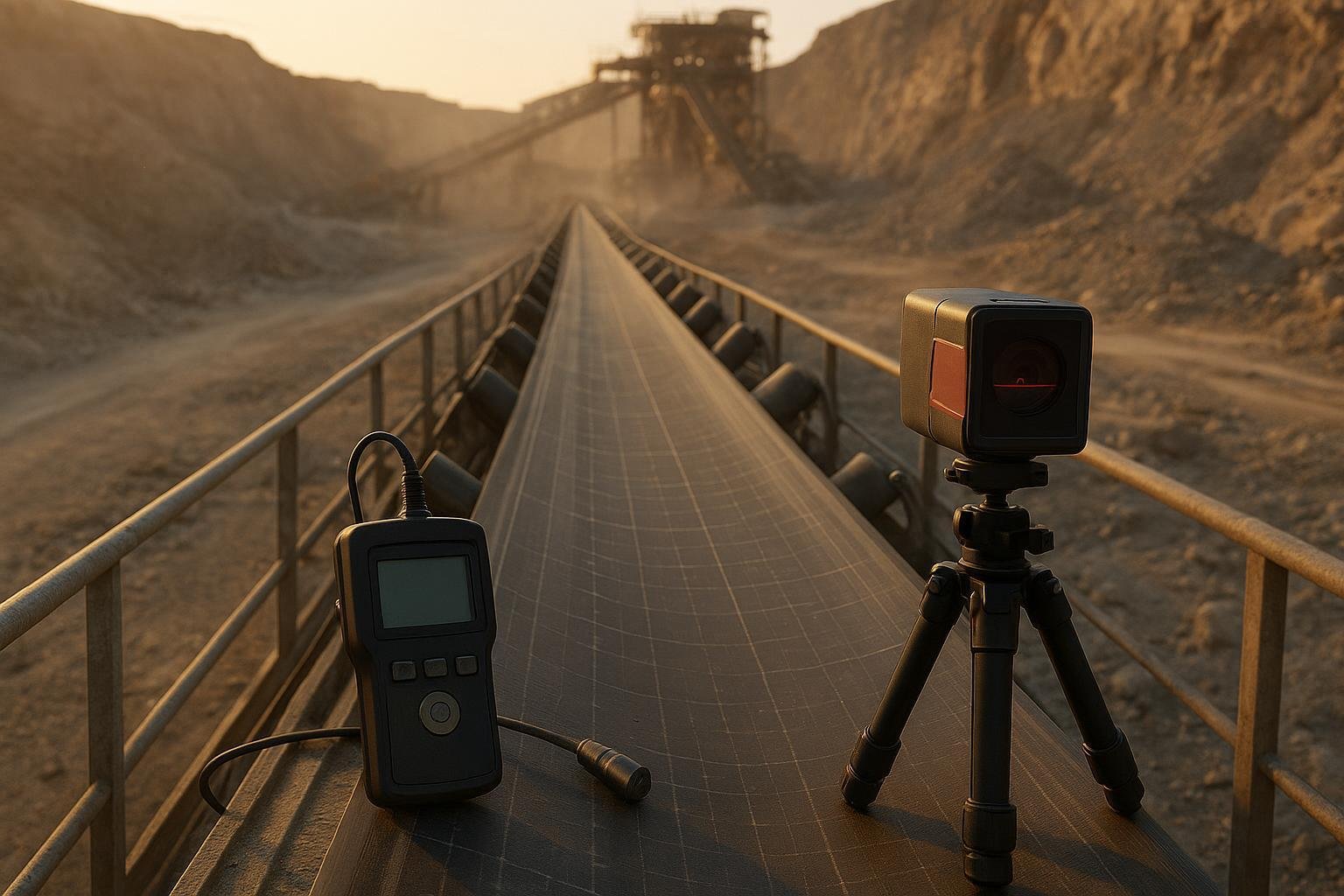
When belts fail without warning, plants lose hours, sometimes days. Belt wear mapping gives you hard numbers—where, how fast, and why the belt is thinning—so you can act before a splice opens or cords show. Start every program with safety: apply lockout/tagout and validate emergency stops per the guidance in CEMA’s safety bulletin. According to CEMA’s Safety Best Practices recommendation, teams should confirm LOTO and E‑Stop function before inspections to control hazards during conveyor work, as outlined in the 2022 document on common guidelines for all conveyors.
The belt wear mapping workflow
A consistent workflow turns scattered measurements into decisions. Here’s a practical sequence you can lift into your SOPs.
-
Baseline the belt
- Create a repeatable grid: along the length (e.g., every 10–25 m) and across the width (edge–center–edge). Mark stationing references (pulley-to-pulley distances, splice locations) and distinguish carry vs. return side. Photograph high-wear zones (loading points, transfer chutes, pulleys, return idlers).
- Measure cover thickness (ultrasonic) at each grid point; capture surface condition photos or scans at zones prone to grooving or cupping. Save files with consistent naming and belt-running direction noted.
-
Set your cadence
- Critical zones monthly; full belt quarterly; ad hoc after abnormal events (surge, chute modification, idler change). Align frequencies with your PM program; many operations escalate intervals in highly abrasive, hot, or dusty service based on practice-aligned summaries of CEMA-style maintenance guidance.
-
Quality-control the data
- Verify ultrasonic A‑scans, use the correct probe and couplant, clean the surface, and recheck any outliers. Keep a single technician/reviewer pair for consistency, and log ambient conditions that could affect readings.
-
Trend and alarm
- Calculate wear rate (e.g., mm per 1,000 hours). Start with a linear fit; flag step-changes after events. Define alarm bands for “monitor” vs. “action” based on remaining cover and risk at the zone.
-
Close the RCA loop
- Correlate patterns with mechanics: edge wear with mistracking or off‑center loading; cupping with material trajectory; scalloping near impact zones with inadequate support; hotspots with friction/slip. Validate on the line.
-
Decide: repair, reprofile, splice, or replace
- Consider remaining cover, splice integrity, delamination/cracking, exposure of plies/cords, and acceleration of wear-rate. Where numeric discard limits aren’t documented by your OEM/standard, set site-specific thresholds referencing the original belt datasheet and risk assessment.
-
Make it stick in the CMMS
- Standardize fields (asset, station, method, reading, units, photo/scan link, thresholds applied). Auto-create work orders when an action band is crossed; attach the map snapshot.
Choosing methods for mapping belt wear
Different methods answer different questions. Use more than one where it adds confidence.
-
Ultrasonic thickness (portable)
- Strengths: precise cover-loss trend quantification, depth accuracy in millimeters; ideal for baseline grids and periodic mapping. Field tips: select probes to match thickness and attenuation, verify echoes on the A‑scan, and keep a repeatable grid template.
- Evidence: Guidance from an industry application note on rubber conveyor belts covers probe selection for 2.5–25 mm rubber and recommends A‑scan verification for reliability.
-
Optical/laser surface profiling
- Strengths: fast capture of surface topology (cupping, grooving, local defects) while the belt is stationary or, with appropriate encoders and safety controls, at slow speed. Great for overlaying change maps between inspections.
- Considerations: calibration routine and positional referencing to belt stationing are critical; vendor specs vary.
-
Thermal imaging (infrared)
- Strengths: pinpoints friction-induced hotspots at edges, pulleys, or seized idlers that often correlate with rapid wear zones.
- Considerations: set emissivity correctly; interpret ΔT against recognized thermography guidance; always follow with mechanical verification.
-
Acoustic/vibration and distributed sensing
- Strengths: early detection of idler bearing failure and abnormal impacts; complements physical wear data and can trigger targeted mapping passes.
- Considerations: treat as an adjunct to, not a replacement for, thickness and surface measurements.
From numbers to decisions: sample wear‑rate and remaining‑life
Start simple. Fit a straight line to thickness over operating hours at each station/width point. Then ask: how fast are we losing cover, and how much safe cover remains at this zone?
Example dataset (simplified):
| Station (m) | Position (E/C/E) | Hours since baseline | Measured top cover (mm) |
|---|---|---|---|
| 120 | Edge | 0 | 9.5 |
| 120 | Edge | 1,000 | 9.0 |
| 120 | Edge | 2,000 | 8.5 |
| 120 | Edge | 3,000 | 8.0 |
Wear-rate calculation at 120 m, edge: (9.5 − 8.0) / 3,000 h = 0.5 mm per 1,000 h.
If your site rule (tied to the belt spec and risk at this zone) is to take action when remaining cover approaches a defined minimum, estimate remaining life by dividing current margin by the wear rate. Where an OEM or standard-backed numeric discard value isn’t available, document your engineering basis and review quarterly.
Measurement uncertainty matters. Repeatability depends on probe choice, surface prep, temperature, and operator technique. Re-run a small subset each round to estimate repeatability and put error bars on your trend lines.
Reading the map: patterns and likely root causes
Wear maps are pictures of mechanics. Here are common signatures and what they often mean—paired with resources you can consult for corrective actions.
-
Persistent edge wear or one-sided thinning
- Often linked to mistracking or off‑center loading. Tracking issues, material segregation, or loading on a transition zone can all contribute. See a practical overview of mistracking root causes and corrective hardware in a reliability blog and the Foundations material handling text’s transfer-chute chapter for mechanics of proper loading trajectory and support.
-
Grooving, scalloping, or cupping near the loading point
- Typically shows impact concentration or misaligned trajectory at the chute. Support cradles, proper skirting geometry, and centered loading reduce these patterns. Practical corrective options and critical inspection points are cataloged in the same set of transfer-point and inspection resources cited below.
-
Localized hotspots along the edge or at pulleys (from thermal scans)
- Friction due to rubbing, idler seizure, or slipping. Use thermography to localize and then inspect mechanical causes; address with idler replacement, cleaner adjustment, or tracker installs.
Neutral micro‑example: tying wear maps to component choices (BisonConvey)
At a quarry’s primary transfer, monthly mapping showed accelerated top-cover loss on the carry side within 3–5 m of the loading point—most pronounced at the wing positions. Ultrasonic readings trended at roughly 0.6 mm per 1,000 operating hours at the edges and 0.3 mm at center. After a joint review of the wear map, photos, and trajectory sketches, the team implemented two changes during a planned outage: 1) upgraded the first three impact idler sets to ceramic‑lagged rolls to better resist abrasion under the chute’s highest-energy zone, and 2) specified a more abrasion-resistant top cover compound on the replacement belt section. Over the next two quarters, the mapping cadence remained the same and the team compared like‑for‑like stations. The updated configuration showed a flatter wear gradient across the width and a reduction in edge-to-center differential—moving the edges closer to 0.35–0.4 mm per 1,000 hours. This is a representative example of how adjusting component selection and cover grade can help reduce mapped wear near transfers. Manufacturers such as BisonConvey provide idler options (including ceramic-lagged and UHMWPE variants) and belts with varied cover compounds that allow engineers to trial configurations matched to duty and verify outcomes through continued mapping.
CMMS fields that make mapping actionable
Get the data model right once; save guesswork later. Use a compact, consistent set of fields.
| Field | Purpose |
|---|---|
| Asset/Belt ID; Segment/station; Side; Width position | Fix the reading to a real location you can revisit. |
| Method & instrument | Tie readings to accuracy limits and calibration routines. |
| Reading value, units, timestamp | Enable trend math and comparisons. |
| Technician & reviewer | Accountability and QC. |
| Photos/scans attachment | Visual records for RCA and audits. |
| Thresholds applied; Status (OK/Monitor/Action) | Drives notifications and work orders. |
| Linked WO/PM ID | Closes the loop from data to action. |
SOP snippet: when any reading flips a status to Action, the CMMS automatically creates a corrective WO with the latest map image attached and notifies the area owner. After completion, a short verification mapping pass confirms the effect.
Implementation checklist and schedule hints
- Lock out, tag out, and validate E‑Stops before any mapping work. Revisit the site safety plan each quarter.
- Establish a baseline this month: full-length grid with ultrasonic spots and surface photos at high-wear zones.
- Set cadence: monthly for loading zones and transfers; quarterly for the full belt; ad hoc after events.
- Standardize your file naming and stationing references; train one lead technician and one reviewer for consistency.
- Define action bands by referencing the original belt datasheet and site risk; avoid publishing generic discard numbers without OEM/standard backing.
- Close the loop: each Action status creates a WO in the CMMS; attach map snapshots and re-verify after work.
When to consider continuous monitoring and analytics
If your constraint is access time or the penalty of failure is high, consider adding continuous or semi‑continuous monitoring. Examples include continuous ultrasonic belt thickness systems that trend cover loss and trigger alerts, or fusing thermal, acoustic, and thickness data for stronger signals. For operations exploring model-based planning, peer-reviewed work has described predictive belt-wear models and evaluation methods; these are best layered on top of a disciplined mapping routine rather than replacing it.
Sources and further reading
According to the CEMA Safety Best Practices recommendation, teams should confirm LOTO and E‑Stop function before inspections: CEMA Safety Best Practices Recommendation SBP‑002 (2022)
For ultrasonic rubber-belt thickness testing method and probe selection, see the industry application note: Evident/Olympus application guidance on rubber conveyor belt thickness testing
Representative gauge parameters (portable instrumentation): Olympus 45MG datasheet (PDF)
Example of continuous ultrasound-based cover trending: REMA TIP TOP MCube Belt Thickness Monitoring
CMMS data discipline for quantitative PM logging: SMRP Solutions article on quantitative PM logging (2017)
Root-cause context and corrective actions covering mistracking causes, transfer-chute mechanics, support/sealing options, and critical inspection points: Martin Engineering blog on mistracking causes, Foundations transfer-chute chapter PDF, Transfer point support and sealing overview (PDF), Critical points of conveyor inspection
Bulk-handling context reference: PracticalMaintenance compendium for belt conveyors (PDF)
Practice-aligned PM intervals summary: Cisco‑Eagle maintenance guide