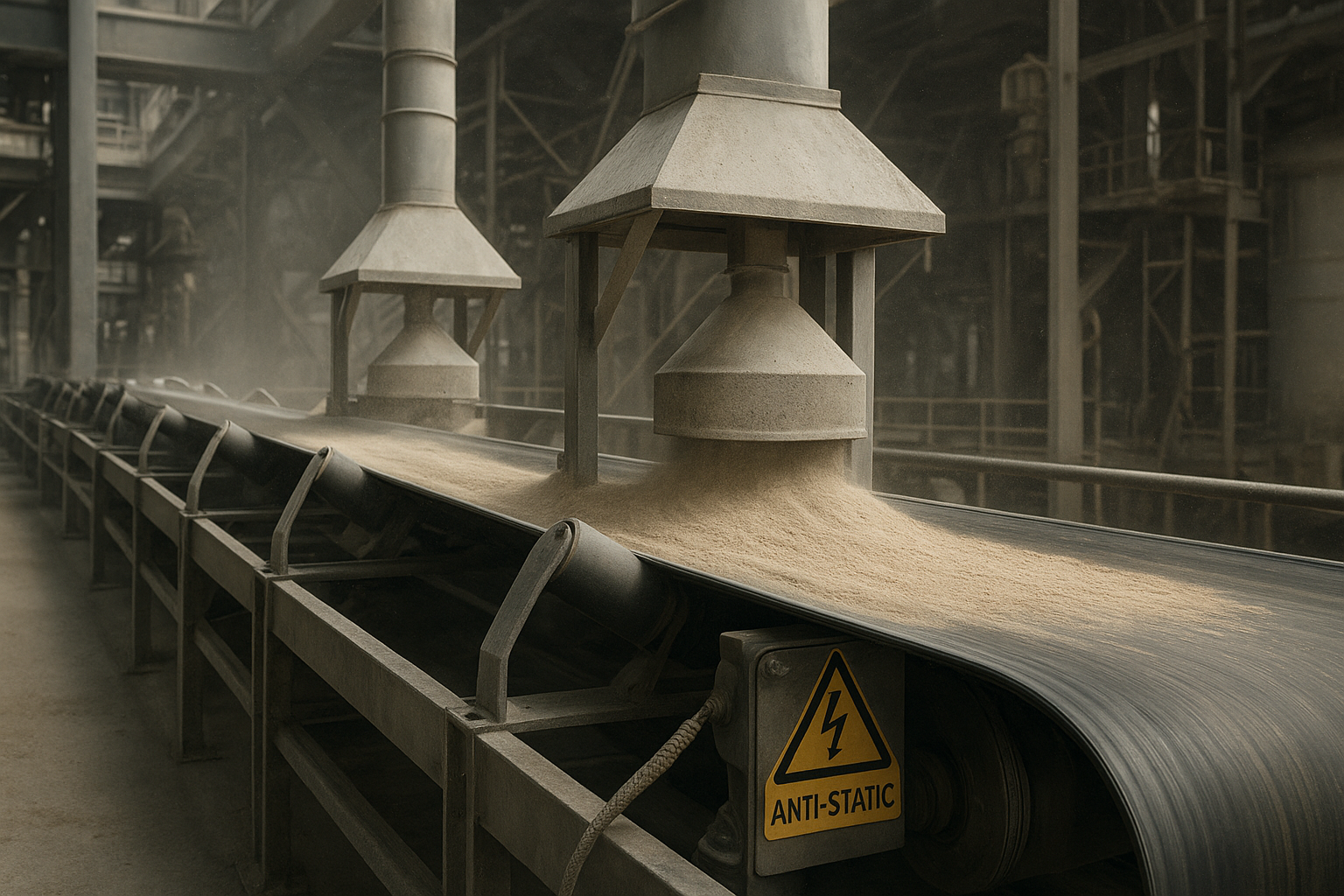
Ever brushed a conveyor guard and felt a sharp snap? In bulk-handling plants, that same static build-up does more than sting—it can pull dust onto belt surfaces, interfere with sensors, and, in the wrong mix of fines and air, contribute to an ignition source. Anti-static conveyor belt technology exists to give charge a safe way home to ground.
This article explains what “anti-static” means on a belt, how static is generated on conveyors, which standards apply, and how to design, verify, and maintain a reliable discharge path. The goal is practical: help engineers, maintenance leads, and procurement teams specify and operate belts that manage electrostatic risk without guesswork.
What “anti-static” really means (and how it differs from conductive and FRAS)
In the context of conveyor belts, anti-static means the belt has sufficiently low electrical resistance that any charge accumulated on its surface or in its structure will dissipate to ground under defined test conditions. That doesn’t make the belt a wire; it means the belt provides a controlled, safe leakage path so charge doesn’t build up to hazardous levels.
- Conductive usually refers to very low resistance materials (metals, certain carbon-loaded polymers) that readily equalize with ground.
- FRAS stands for Fire-Resistant, Anti-Static—a combined requirement common in underground mining and other high-risk environments where both flame spread and electrostatic ignition must be controlled. For context on where FRAS belts are expected and why, see the insurance and risk perspective in the Swiss Re overview, which outlines common regulatory expectations and use cases in mining and bulk handling: Swiss Re fire‑resistant anti‑static belts overview.
Below is a compact comparison to anchor terminology.
| Belt property | Anti-static (per ISO scope) | Conductive | FRAS (fire-resistant + anti-static) |
|---|---|---|---|
| Typical resistance level | Limited to ensure charge dissipation (tested) | Very low (metal or highly conductive compounds) | Meets anti-static criteria plus flame-resistance class |
| Primary purpose | Prevent hazardous charge build-up | Provide robust, immediate equalization to ground | Prevent ignition from flame and static in high-risk areas |
| Common materials | Rubber/PVC/PU with conductive fillers or yarns | Stainless/steel belts; heavily carbon-loaded polymers | Specialized rubber/PVC formulations meeting both requirements |
| Typical applications | Bulk solids handling, ports, cement, grain | ESD-sensitive manufacturing, cleanrooms | Underground mining, regulated hazardous areas |
How static builds up on conveyors (and why it matters)
Moving belts and bulk materials are a textbook case of the triboelectric effect: when two different materials contact and separate, electrons transfer. On a conveyor, contact occurs at chutes, idlers, scrapers, and between the belt cover and the product—especially dry powders and fine grains. Low humidity, high belt speed, and insulating contaminants all amplify charge.
Think of it this way: the belt is a moving capacitor. If there’s no reliable path to earth, its potential rises until it discharges. That discharge can create nuisance shocks, attract dust, and in explosive atmospheres, become an ignition source. A concise engineering discussion of charging and mitigation (including ionization in plastics handling) is available in the MTF Technik guide: MTF Technik static charging guide.
The standards you’ll see in specifications
- ISO 284: This is the international reference that defines the property and test method for a belt’s electrical conductivity. The current edition, ISO 284:2025, “specifies the maximum electrical resistance of a conveyor belt and the corresponding test method,” ensuring a belt can dissipate charge under defined conditions: ISO 284:2025 — Conveyor belts — Electrical conductivity.
- What about numbers? In procurement and safety programs, a widely cited criterion is a maximum of 300 megohms (300 MΩ) for belt resistance when qualifying belts as anti-static. For a publicly viewable mention in a safety context, see the 2019 committee responses associated with NFPA guidance, which reference “surface resistivity not greater than 300 megohms per square” for belts and lagging in combustible dust handling: NFPA committee responses (2019) referencing 300 MΩ. Always confirm the applicable standard and method in your jurisdiction and contract.
- ATEX/system context (EU): Belts used in explosive dust zones (20/21/22) are commonly specified to meet EN ISO 284 as part of a system-level ATEX conformity approach. As leading manufacturers note, anti-static belts support compliance, but ATEX conformity applies to the entire assembly and its earthing, not a single component: Fenner Dunlop ATEX compliance note.
Designing for dissipation: belt construction and the path to ground
A belt’s anti-static behavior depends on both its construction and the conveyor’s grounding scheme.
- Conductive compounds in covers: Rubber, PVC, or PU covers can be formulated with carbon/graphite fillers to lower resistivity so charge bleeds off instead of accumulating.
- Conductive yarns or grids: Some belts include conductive threads or a surface grid to provide a distributed, lower-resistance path across the belt width.
- Inherently conductive belts: Metal belts, such as stainless steel, offer a straightforward path to ground when the belt contacts grounded pulleys and idlers. For applications where ESD control is paramount (films, electronics), metal belts are often chosen. See a practical treatment of antistatic behavior in metal belts: DYMCO stainless steel belts — antistatic case.
The path to ground is the other half of the equation. Frames, pulleys, idler rolls, and scrapers must be bonded to a verified earth so the belt can actually discharge. The UK HSE provides a clear overview of earthing and bonding principles used across industry to prevent static accumulation and discharges: HSE guidance on earthing and bonding. In practice, plants also install conductive belt scrapers or grounding brushes, avoid insulating breaks (e.g., non-conductive lagging without a bypass bond), and periodically check continuity.
How to verify in the field (vs. laboratory)
Lab verification: Suppliers provide test reports showing compliance to ISO/EN 284, which uses a defined electrode setup, voltage, and environmental conditioning. Ask for the certificate of conformity and test method details associated with the delivered belt batch.
Field verification: You won’t reproduce ISO 284 on the catwalk, but you can confirm the system provides a viable discharge path.
- Check and document bonding continuity from frames to earth and across components that might isolate sections (e.g., across expansion joints, non-conductive lagging).
- Measure resistance between the belt (carefully via a safe contact brush/fixture when stationary) and ground; track readings over time and different humidity conditions. Expect readings to vary with contamination and moisture.
- Inspect and clean contact points—scrapers, brushes, and pulleys—so the designed discharge path remains effective.
Programs aligned with recognized safety practices typically include periodic continuity checks, housekeeping to minimize dust, and retention of certificates and measurements for audits. For open-access context on earthing principles used across industry, see the HSE overview: HSE earthing and bonding.
Selection guidance by environment
- Explosive dust zones (ATEX 20/21/22): Specify belts that meet EN ISO 284 (verify certificates), and design the conveyor with a robust earthing/bonding scheme. Select Ex-rated components where required, control dust layers, and document a full risk assessment. Remember: ATEX applies to the complete installation.
- General industry with dust but not classified: Anti-static belts reduce dust attraction and nuisance shocks, improving housekeeping and instrument reliability. Maintain grounding, monitor humidity, and keep the belt clean to sustain performance.
- ESD-sensitive manufacturing (electronics, precision films, certain ceramics): Consider inherently conductive belts (e.g., stainless steel) or specialized ESD-control belts with controlled resistance, and add ionization at transfer points. This combination reduces both the generation and the retention of charge on products and belts.
Practical workflow example: Upgrading a Zone 22 grain conveyor
Divulgación: BisonConvey es nuestro producto.
A grain terminal flagged nuisance shocks and occasional sensor faults on a 120 m transfer conveyor classified as Zone 22. Here’s a concise, standards-aware workflow the team used to upgrade the system.
- Define the requirement: Confirm Zone 22 classification and specify a belt verified to EN ISO 284, alongside a site earthing/bonding plan for the conveyor string. Request supplier certificates and test method references with the belt quotation.
- Choose construction: Select a rubber or PVC belt incorporating conductive cover compounds and, where available, conductive edge yarns to help establish a belt-to-structure discharge path. Involve the scraper OEM to specify a conductive blade and ensure its mounting is bonded to earth.
- Install and bond: During shutdown, bond the drive and return pulleys, stringers, take-up, and scraper frames to the plant earth grid. Add a grounded contact brush near the discharge to provide a consistent belt-to-ground contact in low-humidity months.
- Verify and document: Measure continuity from all bonded components to earth and record baseline belt-to-ground resistance after installation in dry and humid conditions. File the supplier’s ISO/EN 284 test report with the maintenance system.
- Monitor in service: Add checks to the preventive maintenance schedule—inspect brush/scraper contact, log seasonal resistance swings, and clean dust accumulations that can mask conditions or alter readings.
In this case, a premium anti-static belt from BisonConvey was used alongside the bonding upgrades. The value wasn’t just the belt’s tested resistance—it was the verified discharge path across pulleys, scrapers, and the frame that stabilized readings through seasonal humidity changes.
Common pitfalls and troubleshooting
- Assuming an anti-static belt alone solves ATEX compliance; system-level earthing and device selection are still required.
- Installing non-conductive lagging without a bonding bypass, breaking the discharge path across the drive pulley.
- Skipping seasonal checks—low humidity often reveals marginal discharge paths.
- Relying on topical anti-static sprays as a primary control; they’re supplementary and degrade.
- Forgetting that contamination changes behavior—oils, fines, and moisture can raise or lower readings unpredictably.
Bringing it all together
Anti-static conveyor belt technology is not a single material choice; it’s a system decision that pairs a verified belt construction with a dependable route to earth. If you’re handling powders or granules—especially where zones are classified—tie your specification to ISO/EN 284 test reports, install explicit bonding paths, and schedule routine checks. One final question to keep on your pre-start checklist: if the belt charges today, exactly where does that charge go?
For further reading, see the primary sources cited above: ISO’s current edition of the conductivity standard for belts, the NFPA-related committee responses that reference the 300 MΩ criterion, a manufacturer’s ATEX compliance note reminding that certification is system-level, an engineering guide to static charging and ionization, the HSE’s earthing overview, and a stainless-belt perspective on antistatic behavior. These will help you translate policy into a grounded, auditable practice on your own conveyors.