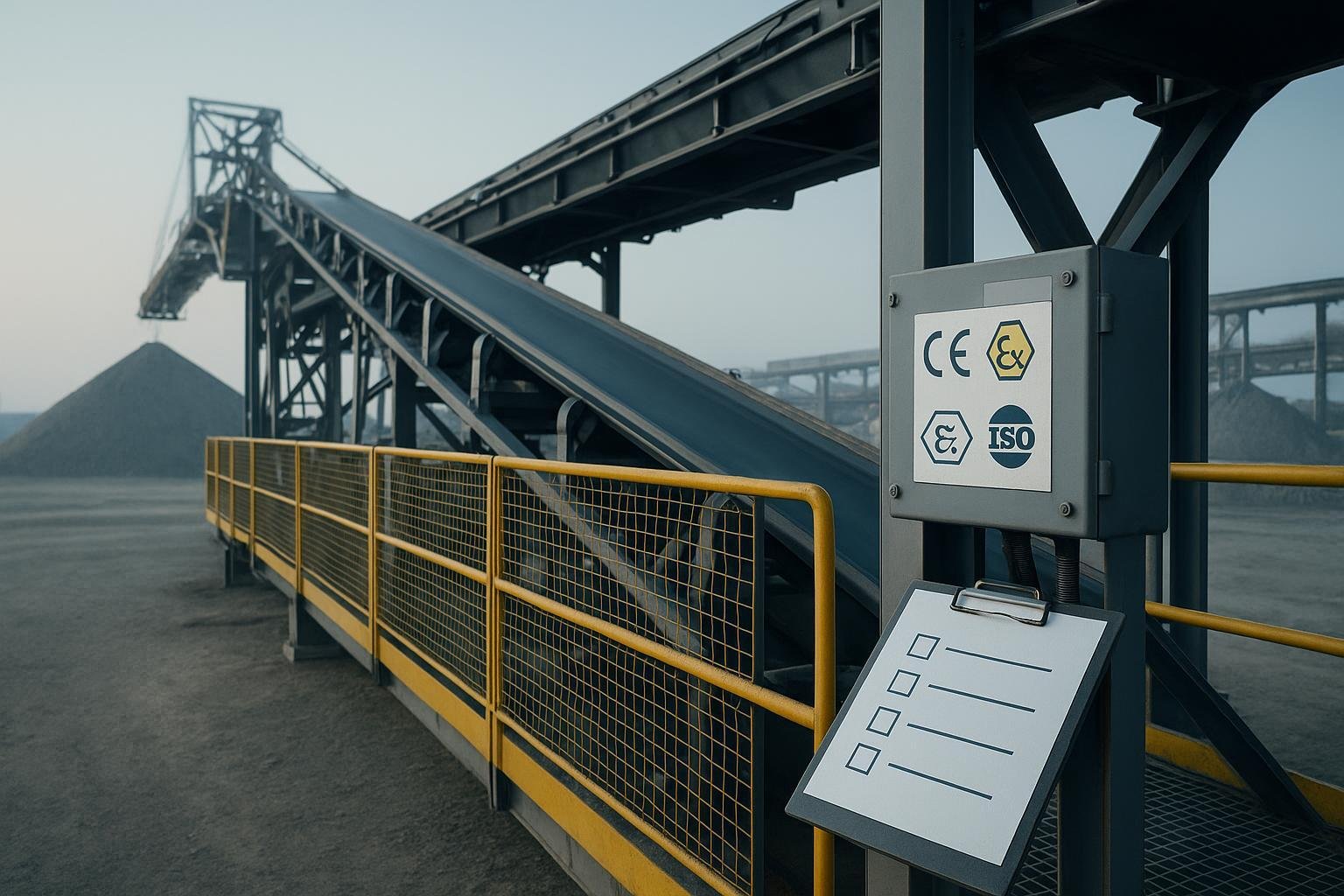
If you specify, buy, or maintain conveyors, a missed mark on compliance can halt a project at the dock, void insurance, or—worst—put people at risk. This 2026 guide ranks the certifications and standards that most often determine whether conveyor equipment is accepted, installed, and run without incident.
We focus on what procurement and engineering teams ask first: Is it mandatory? What does it apply to (belts, idlers, pulleys, drives, controls)? How do we verify it quickly? You’ll also find a single comparison table, common pitfalls, and short notes on pricing/effort to obtain approvals. A toolbox link appears mid-article if you want a ready-to-use supplier verification checklist.
What counts as a certification vs a standard
- Certification or approval: A conformity assessment outcome—often third‑party—that grants a certificate/mark or an approval number (e.g., ATEX Category 2 with a Notified Body, IECEx CoC, UL/CSA listing, MSHA Part 14 belt approvals). Evidence is a certificate/mark, test reports, and quality-audit records.
- Standard: A technical specification setting requirements/tests (e.g., ASME B20.1, ISO 15236, ISO 14890). Evidence is design calculations, test reports referencing clauses, and implementation checklists.
Think of standards as the rulebook and certifications/approvals as the referee’s stamp that you followed it.
Regional compliance overview (U.S., EU, International) — 2026
- United States: OSHA 29 CFR rules for guarding, power-transmission safety, and lockout/tagout are mandatory. Underground coal mines also require MSHA Part 14 flame‑resistant belts.
- European Union: CE marking under the Machinery Directive 2006/42/EC remains in force through 2026; the new Machinery Regulation (EU) 2023/1230 applies from January 20, 2027. ATEX 2014/34/EU is mandatory for equipment intended for potentially explosive atmospheres.
- International explosive atmospheres: IECEx is the widely recognized voluntary scheme based on IEC 60079, often accepted by specifiers outside the EU.
How we chose (methodology)
We ranked each framework against six weighted criteria that reflect real procurement and safety risk:
- Regulatory impact on procurement risk (22%)
- Safety risk reduction depth (20%)
- Relevance to heavy‑duty bulk handling (18%)
- Component‑level specificity (15%)
- Global recognition and portability (15%)
- Verification clarity and auditability (10%)
The top conveyor equipment certifications and standards for 2026 (ranked)
- ASME B20.1-2024 — Safety Standard for Conveyors and Related Equipment (ASME)
- Scope and where it applies: Design, installation, operation, inspection, and maintenance guidance for conveyors; widely referenced across U.S. industry.
- Regions/industries: U.S. baseline; also cited globally as good practice.
- Mandatory or de facto? Voluntary unless adopted by an authority or contract, but frequently used to evidence OSHA‑compliant guarding.
- Applies to: Conveyors, guarding, controls interfaces, maintenance practices.
- Key requirements affecting design: Identify nip/pinch points; guard power‑transmission parts; provide safe access and emergency stops; define inspection/maintenance practices.
- Verification path: Internal design reviews and site audits against clauses; purchase the standard for details. Reference: the official ASME B20.1 page describing scope is available via the publisher at the ASME site: ASME’s B20.1 standard overview.
- Why it matters: Reduces common injury modes (entanglement, crush, shear) and provides a shared language for OEMs, installers, and safety teams.
- Common pitfalls: Treating ASME B20.1 as optional even when contracts or insurers expect it; missing guards at transitions and return runs; no documented inspections.
- OSHA 29 CFR 1910.212/219/147; 1926.555 — Guarding, power‑transmission, LOTO, and conveyors (OSHA)
- Scope and where it applies: Mandatory U.S. federal requirements covering machine guarding, power‑transmission parts, and control of hazardous energy; construction has conveyor‑specific provisions.
- Regions/industries: U.S., all sectors using conveyors.
- Mandatory or de facto? Mandatory.
- Applies to: All machines including conveyors; drives and rotating parts; maintenance work.
- Key requirements affecting design: Guard belts/pulleys/shafts; design e‑stops and LOTO points; protect against nip/pinch points and in‑running nips.
- Verification path: Compliance audits and training records; reference OSHA standards, e.g., OSHA 1910.212 machine guarding y OSHA 1910.219 power-transmission.
- Why it matters: Noncompliance can trigger citations, fines, and stop‑work orders; it anchors your guarding strategy.
- Common pitfalls: Assuming OEM guards are sufficient without site‑specific assessments; weak LOTO procedures for belt tracking/cleanup work.
- CE Marking — EU Machinery Directive 2006/42/EC (transition to 2023/1230 in 2027)
- Scope and where it applies: EU legal framework requiring conveyors to meet essential health and safety requirements and bear CE marking via a manufacturer’s Declaration of Conformity (DoC).
- Regions/industries: EU/EEA (and often mirrored in customer specs elsewhere).
- Mandatory or de facto? Mandatory in EU/EEA.
- Applies to: Complete machinery, assemblies of machinery; some partly completed machinery.
- Key requirements affecting design: Risk assessment; application of harmonized EN/ISO standards; technical file; instructions in the user’s language.
- Verification path: Self‑declaration for most conveyors; Notified Body only for certain categories/modules. EU guidance with the 2026 context is summarized on the Commission’s machinery page: European Commission overview of the Machinery rules and 2027 transition.
- Why it matters: Without a correct DoC and technical documentation, importers/distributors can refuse equipment.
- Common pitfalls: Treating CE as a third‑party “certificate”; incomplete technical files; wrong or missing applied standards list.
Toolbox (mid‑list, after Item 3): Supplier Verification Checklist — Ask for a risk‑assessment summary, applied standards list, sample DoC, guarding/installation checklist, and recent test reports. Example supplier pack: BisonConvey offers documentation that supports ASME‑aligned safety practices and CE documentation expectations upon request.
- ATEX Directive 2014/34/EU — Equipment for potentially explosive atmospheres (EU)
- Scope and where it applies: Mandatory for equipment intended for use in explosive atmospheres (dust Zones 20/21/22 common at transfer points and bucket elevators).
- Regions/industries: EU/EEA; critical in grain, cement, chemicals, and any dusty bulk‑solids handling.
- Mandatory or de facto? Mandatory when Ex conditions apply.
- Applies to: Drives, sensors, controls, and sometimes mechanical parts that can be ignition sources in Ex zones.
- Key requirements affecting design: Equipment Group/Category selection; ignition source control; labeling with Ex code; quality assurance modules.
- Verification path: Notified Body involvement for Category 1/2 as per selected modules; DoC and CE/Ex marking. Official overview: European Commission ATEX page for equipment in explosive atmospheres.
- Why it matters: Wrong category‑to‑zone mapping can invalidate market access and increase ignition risk.
- Common pitfalls: Using Category 3 equipment in Zone 21; missing QA module surveillance; inconsistent markings across components.
- IECEx — International Explosive Atmospheres Certification System
- Scope and where it applies: Voluntary but widely recognized scheme for Ex equipment, services, and personnel based on IEC 60079.
- Regions/industries: Global acceptance outside the EU; often used in mining, oil & gas, ports, and grain.
- Mandatory or de facto? De facto in many specs; complements ATEX.
- Applies to: Motors, sensors, enclosures, repair facilities, and competence.
- Key requirements affecting design: Compliance with IEC 60079 series; documented quality systems; type testing.
- Verification path: Certification Body issues CoC; searchable database. Learn more via the official program summary: IECEx Certification System overview.
- Why it matters: Eases cross‑border acceptance where ATEX is not the legal baseline.
- Common pitfalls: Assuming IECEx replaces ATEX inside the EU; not aligning markings/documentation between the two.
- MSHA 30 CFR Part 14 — Flame‑Resistant Conveyor Belts (U.S. underground coal)
- Scope and where it applies: Regulatory approval for flame‑resistant belts used in underground coal mines.
- Regions/industries: U.S., underground coal mining.
- Mandatory or de facto? Mandatory within scope.
- Applies to: Conveyor belts specified for underground coal mines.
- Key requirements affecting design: Flame propagation tests; QA controls; approval number assignment.
- Verification path: Application and sample testing per eCFR. Reference text: U.S. eCFR for MSHA Part 14 flame‑resistant conveyor belts.
- Why it matters: Non‑approved belts cannot legally be used underground in coal mines.
- Common pitfalls: Assuming Part 14 applies to all mining belts; using “flame‑resistant” marketing language without an MSHA approval number where required.
- ISO 15236 series — Steel cord conveyor belts (ISO)
- Scope and where it applies: Design/dimensions/mechanical requirements; special safety requirements for underground use.
- Regions/industries: International; mining, steel, ports, long‑distance conveyors.
- Mandatory or de facto? De facto in specs; supports CE/DoC and global interoperability.
- Applies to: Steel‑cord belts and related tests.
- Key requirements affecting design: Tensile classes, elongation, splice tests, and belt construction parameters.
- Verification path: Accredited lab testing to ISO clauses; include reports in supplier file. ISO maintains category listings, e.g., the ICS page that indexes belt standards families: ISO’s ICS listing for conveyor belt standards.
- Why it matters: Aligns performance expectations and test methods across suppliers and borders.
- Common pitfalls: Mixing editions/parts; citing the series without specifying which part and year.
- ISO 14890 — Conveyor belts with textile carcass (ISO)
- Scope and where it applies: Requirements for rubber/plastics‑covered belts of textile construction for general surface use.
- Regions/industries: International; cement, aggregates, agriculture, and general industry.
- Mandatory or de facto? De facto in specs.
- Applies to: EP/NN belts (textile carcass).
- Key requirements affecting design: Tensile class nomenclature, cover grades, dimensional tolerances.
- Verification path: Accredited lab testing; include test method references on reports. See the official abstract page: ISO 14890 standard overview.
- Why it matters: Common baseline for textile belts; simplifies cross‑supplier comparisons.
- Common pitfalls: Confusing general‑use belts with special constructions (heat/flame‑resistant require additional standards).
- ISO 284 — Electrical conductivity (antistatic) of conveyor belts (ISO)
- Scope and where it applies: Maximum electrical resistance and test method to ensure antistatic properties.
- Regions/industries: International; especially relevant in dusty environments.
- Mandatory or de facto? De facto in specs.
- Applies to: Most rubber/plastics belts except light conveyor belts.
- Key requirements affecting design: Resistance thresholds; test setup specifics.
- Verification path: Single‑test lab report, often bundled with other ISO testing.
- Why it matters: Reduces static‑ignition risk around transfer points.
- Common pitfalls: Assuming light conveyor belts are within scope; not controlling humidity or contamination during testing.
- ISO 3684 — Determination of minimum pulley diameters (ISO)
- Scope and where it applies: Method for calculating minimum pulley diameters to protect belt integrity.
- Regions/industries: International; core to design engineering.
- Mandatory or de facto? De facto in specs.
- Applies to: Belt/system design.
- Key requirements affecting design: Diameter calculations tied to construction and splice parameters.
- Verification path: Engineering calculations retained in the technical file.
- Why it matters: Prevents premature flex‑fatigue and splice failures.
- Common pitfalls: Using generic diameter tables without checking the actual belt construction.
- FDA 21 CFR 177.2600 — Rubber articles intended for repeated use (U.S.)
- Scope and where it applies: U.S. food‑contact material requirements for rubber components, including some belt covers and scraper elements.
- Regions/industries: U.S. food processing.
- Mandatory or de facto? Mandatory for in‑scope rubber materials.
- Applies to: Rubber compounds in repeated food contact.
- Key requirements affecting design: Permitted substances and extraction limits; documentation and migration/extraction testing.
- Verification path: Supplier Declarations, test reports, and formulation controls. Official text: eCFR 21 CFR 177.2600 rubber articles for repeated use.
- Why it matters: Prevents non‑compliant materials from entering food streams.
- Common pitfalls: Assuming plastic‑layer rules apply to rubber; not matching test conditions to time/temperature of use.
- EU FCM — Framework Regulation (EC) 1935/2004 + Plastics Regulation (EU) 10/2011
- Scope and where it applies: EU legal framework for food‑contact materials; plastics require compliance with substance authorizations and migration limits; documentation and traceability are mandatory.
- Regions/industries: EU food and fertilizer lines with food‑contact belts.
- Mandatory or de facto? Mandatory in the EU for in‑scope materials.
- Applies to: Plastics layers and overall food‑contact systems; rubber is addressed nationally, with Good Manufacturing Practice under 2023/2006.
- Key requirements affecting design: Overall Migration Limit (OML), Specific Migration Limits (SML), Declaration of Compliance, and traceability.
- Verification path: DoC + migration testing at accredited labs. Commission overview: European Commission page on food‑contact materials legislation.
- Why it matters: A missing DoC can stall audits and shipments.
- Common pitfalls: Treating supplier marketing sheets as DoCs; ignoring NIAS risk assessment; not testing to end‑use conditions.
ATEX/IECEx dust zone quick visual
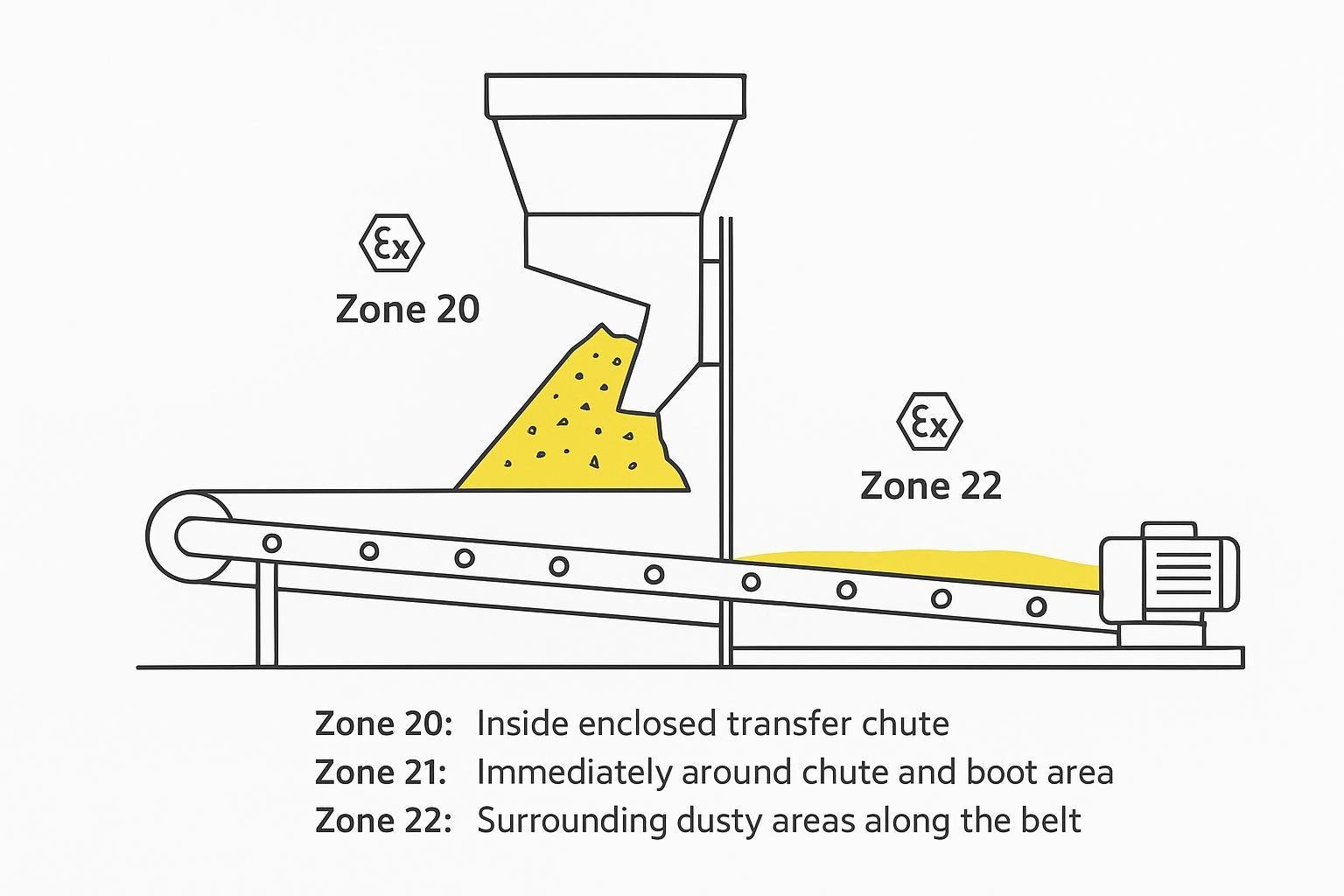
Zones 20, 21, and 22 cluster around transfer chutes and boot sections. Map categories to zones conservatively and keep records of your classification logic.
Consolidated comparison table
| Certification/Standard | Region | Mandatory? | Applies To | Key Focus | Verification Path | Notes |
|---|---|---|---|---|---|---|
| ASME B20.1 (ASME) | U.S./Global reference | No (benchmark) | Conveyors & related equipment | Safety design/installation/operation | Adopt standard; internal audits | Voluntary unless adopted by authority |
| OSHA 1910.212/219/147; 1926.555 | U.S. | Yes | Machines, power transmission, conveyors | Guarding, LOTO, conveyor safety | OSHA compliance; inspections | Construction conveyor rule in 1926.555 |
| CE (2006/42/EC → 2023/1230) | EU/EEA | Yes | Machinery (conveyors) | Essential safety reqs; documentation | Manufacturer DoC; NB if required | Regulation mandatory from 2027 |
| ATEX 2014/34/EU | EU/EEA | Yes (if Ex) | Equipment in Ex zones | Explosion protection | NB modules for Cat. 1/2; DoC | Marking: CE + Ex coding |
| IECEx | International | No (spec-driven) | Ex equipment/services/personnel | Explosion protection | CB certificate | Useful where ATEX not required |
| MSHA Part 14 | U.S. (mines) | Yes (underground coal) | Conveyor belts | Flame resistance | MSHA approval | Narrow scope (mining) |
| ISO 15236 series | International | No (spec) | Steel cord belts | Design/mechanical tests | Testing to ISO | Part 3 under revision |
| ISO 14890 | International | No (spec) | Textile belts | General requirements | Testing to ISO | General-use belts |
| ISO 284 | International | No (spec) | Belts (excl. light) | Antistatic resistance | Testing to ISO | Under revision |
| ISO 3684 | International | No (spec) | Belt/system design | Min pulley diameters | Design calc per ISO | Protects belt life |
| FDA 21 CFR 177.2600 | U.S. | Yes (food contact) | Rubber in food contact | Material safety | eCFR + testing | Rubber only; plastics elsewhere |
| EU FCM 1935/2004 + 10/2011 | EU | Yes (food contact) | Food-contact materials | Inertness; migration limits | DoC + lab tests | Rubber not harmonized EU-wide |
| UL 508A / CSA C22.2 (contextual) | U.S./Canada | Often required by AHJ/spec | Control panels/equipment | Electrical safety/SCCR | Listing or field eval | Contract/AHJ driven |
| UK PUWER | UK | Yes | Work equipment | Safe use/guarding | HSE compliance | Use‑phase duties |
| REACH/RoHS (scope‑dependent) | EU | Yes (within scope) | Articles; EEE | Substance restrictions | Declarations; CE (RoHS) | Monitor evolving lists |
Pricing and effort snapshots (typical ranges, non‑binding)
- CE (Machinery): Self‑declaration for most conveyors; 2–8 weeks to assemble a technical file and DoC if starting fresh; lab time depends on applied EN/ISO tests.
- ATEX: Category 1/2 with Notified Body testing and QA modules commonly takes 6–16+ weeks; effort depends on equipment complexity and chosen modules.
- IECEx: Similar to ATEX; combining ATEX/IECEx testing can reduce duplication.
- MSHA Part 14: Requires submission and testing; timelines vary with queue and sample iterations.
- UL/CSA (control panels): Weeks to months for Panel Shop listing or field evaluations; SCCR documentation per UL 508A Supplement SB can drive extra lab/config time.
Guarding schematic reference (ASME/OSHA cues)
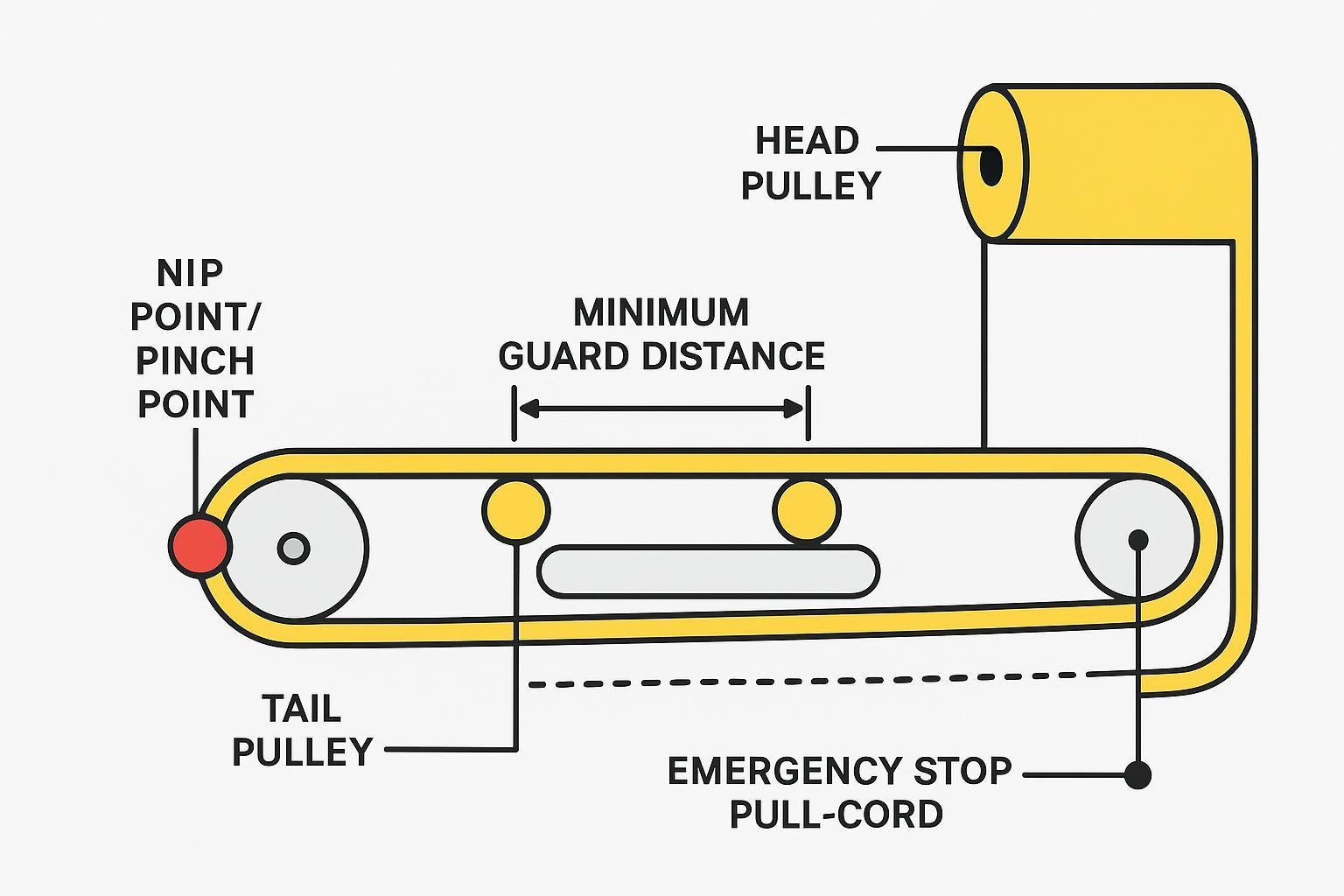
Verify nip/pinch points at head/tail pulleys and return rollers, add fixed guards, maintain e‑stop pull‑cord visibility, and document inspection intervals.
FAQ
-
Is CE a certification or a declaration? • CE is a manufacturer’s Declaration of Conformity under applicable EU law. Notified Bodies may issue certificates for specific modules, but CE itself is not a third‑party “certification.” See the European Commission’s summary for context in 2026 on the Machinery rules and 2027 transition noted above.
-
What’s the difference between ATEX and IECEx for conveyors? • ATEX is mandatory in the EU for equipment intended for explosive atmospheres, with CE/Ex marking and category‑based assessment. IECEx is a voluntary international scheme based on IEC 60079 that many markets accept in specs; it doesn’t replace ATEX inside the EU.
-
Do all conveyor belts in mining need MSHA approval? • No. MSHA Part 14 approvals apply to belts used in U.S. underground coal mines. Other mining segments may specify flame‑resistant performance, but that doesn’t equal a Part 14 approval.
-
Which ISO standards apply to conveyor belts? • Commonly cited: ISO 15236 (steel‑cord belts), ISO 14890 (textile‑carcass belts), ISO 284 (antistatic), and ISO 3684 (minimum pulley diameters). These support consistent testing and specification.
-
What marks are needed for food‑contact belts? • In the U.S., rubber in repeated food contact must comply with 21 CFR 177.2600 (with supplier declarations and testing). In the EU, a Declaration of Compliance under 1935/2004 plus plastics‑specific 10/2011 (if plastic layers are present) and GMP documentation are expected.
Closing next steps
If you’re shortlisting suppliers, request an “audit‑ready” evidence pack: risk assessment summary, applied standards list, test reports (ISO/MSHA where relevant), technical file index, and sample Declarations. If you’d like a real‑world example pack, you can ask BisonConvey—whose belts are designed and tested to align with widely used ISO performance benchmarks and who supports ASME‑aligned safety practices and CE documentation expectations—to share a sample documentation bundle. Start the conversation here: BisonConvey.
—
Note on terminology and dates: This guide reflects 2026 obligations. The EU Machinery Regulation (EU) 2023/1230 becomes mandatory on January 20, 2027; plan transition updates accordingly.
SEO note for readers comparing options: If you’re vetting “conveyor equipment certifications,” map your environment (region, Ex zones, food contact, mining) first, then align items from the ranked list above to avoid rework and delays.