Fire incidents on conveyors escalate fast, especially around transfer points and enclosed galleries. This step‑by‑step guide walks reliability, QA, and safety teams through fire resistant conveyor belt testing you can conduct or prepare for with confidence—centered on ISO 340 (small‑flame) and ISO 284 (antistatic), with clear context for EN 12882/EN 14973 and U.S. MSHA Part 14. It’s written to be operational and audit‑ready. Always purchase and consult the latest official standards for binding parameters; this tutorial does not replace them.
Standards at a glance
- ISO 340: Laboratory‑scale flammability characteristics and test method for conveyor belts; used globally and referenced by EN categories. See the ISO 340:2022 catalogue preview via ISO/iTeh for scope and apparatus cues in the official listing: ISO 340:2022 catalogue sample.
- ISO 284: Electrical conductivity (antistatic) specification and test method for belts. Industry sources reference a typical surface resistance limit of ≤ 300 MΩ; confirm from the current edition (ISO 284:2025). Context from industry technical pages: Dunlop ATEX compliance overview.
- EN 12882 (above‑ground): Category‑based safety requirements; references EN/ISO 340 and ISO 284, with higher categories adding severe fire and drum‑friction methods. See the EN 12882:2015 listing and industry explainer BulkInside guide to fire‑resistant belts.
- EN 14973 (underground): Electrical and flammability safety for underground belts; combines antistatic, flame behavior/propagation, and drum‑friction. See the EN 14973 preview/listing.
- MSHA 30 CFR Part 14 (U.S., underground): Regulatory approval scheme (BELT) involving full‑scale flame propagation. Use the eCFR for live sections and acceptance wording: eCFR Title 30, Part 14 index.
Equipment and lab setup checklist
Use this single checklist to prepare for fire resistant conveyor belt testing in a controlled lab setting.
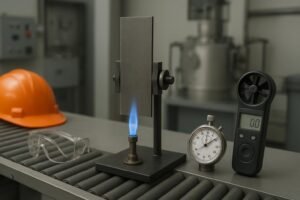
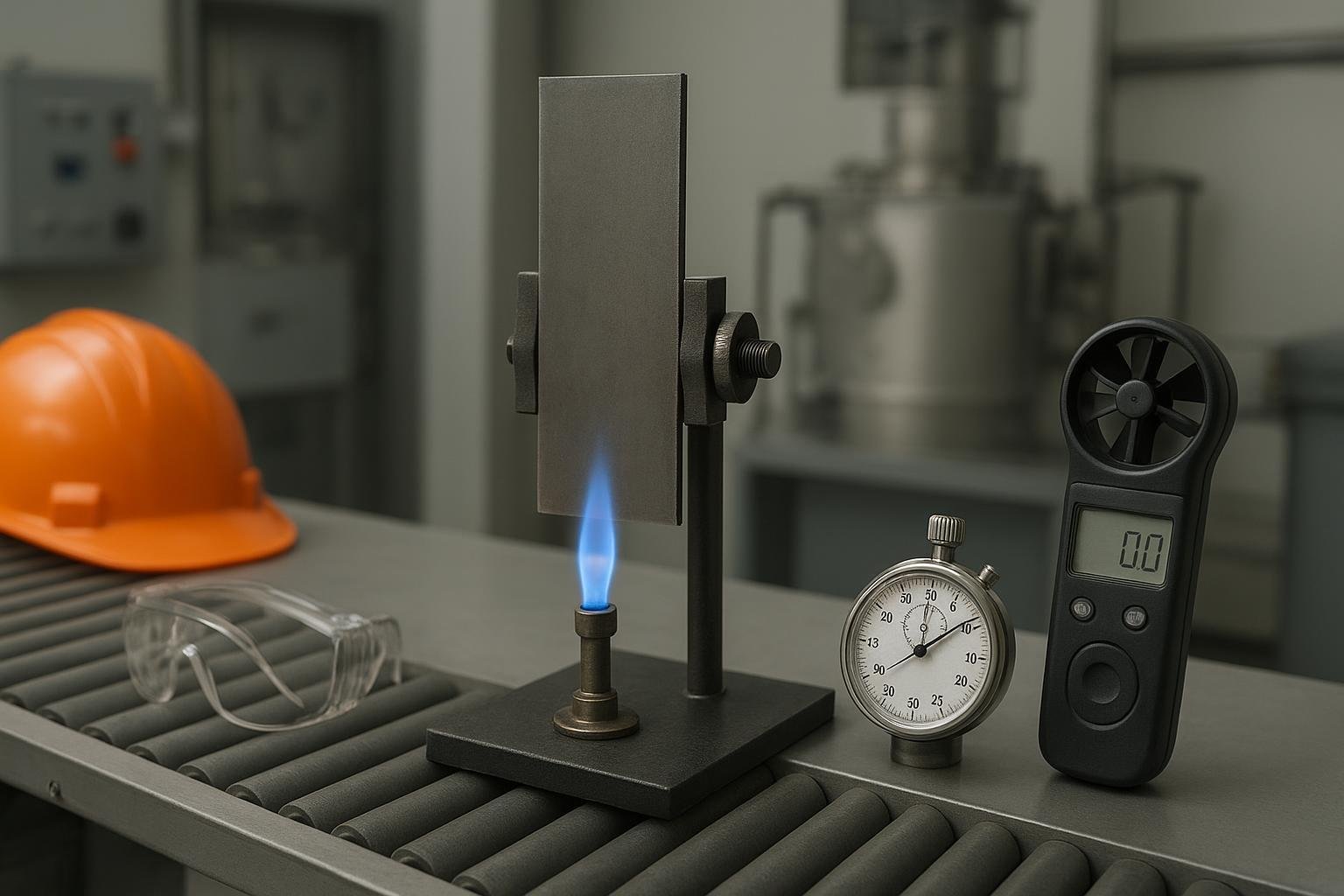
- Burner and mount: Gas burner with inside diameter of 10 ± 0.5 mm (as visible in the ISO 340:2022 preview); stable stand and clamp system.
- Specimen clamps/frames: For vertical mounting; heat‑resistant components.
- Conditioning chamber: To stabilize temperature/humidity as specified by the applicable standard.
- Airflow source and meter: For the post‑flame re‑ignition check (ISO 340) and for documenting draft conditions.
- Timing and recording: Laboratory timer or stopwatch; optional video camera with timestamp for verification.
- Antistatic instrumentation: Ohmmeter/megohmmeter per ISO 284; standardized surface electrodes; approved contact agent.
- Metrology and calibration: Thermo‑hygrometer, pressure/gas regulators, calibration certificates (timers, meters, instruments).
- PPE and safety: Eye/hand protection, lab coats, fume extraction, fire blanket/extinguisher.
- Documentation: Pre‑test checklist, specimen ID labels, results sheets, and equipment calibration log.
ISO 340 small‑flame test — step‑by‑step
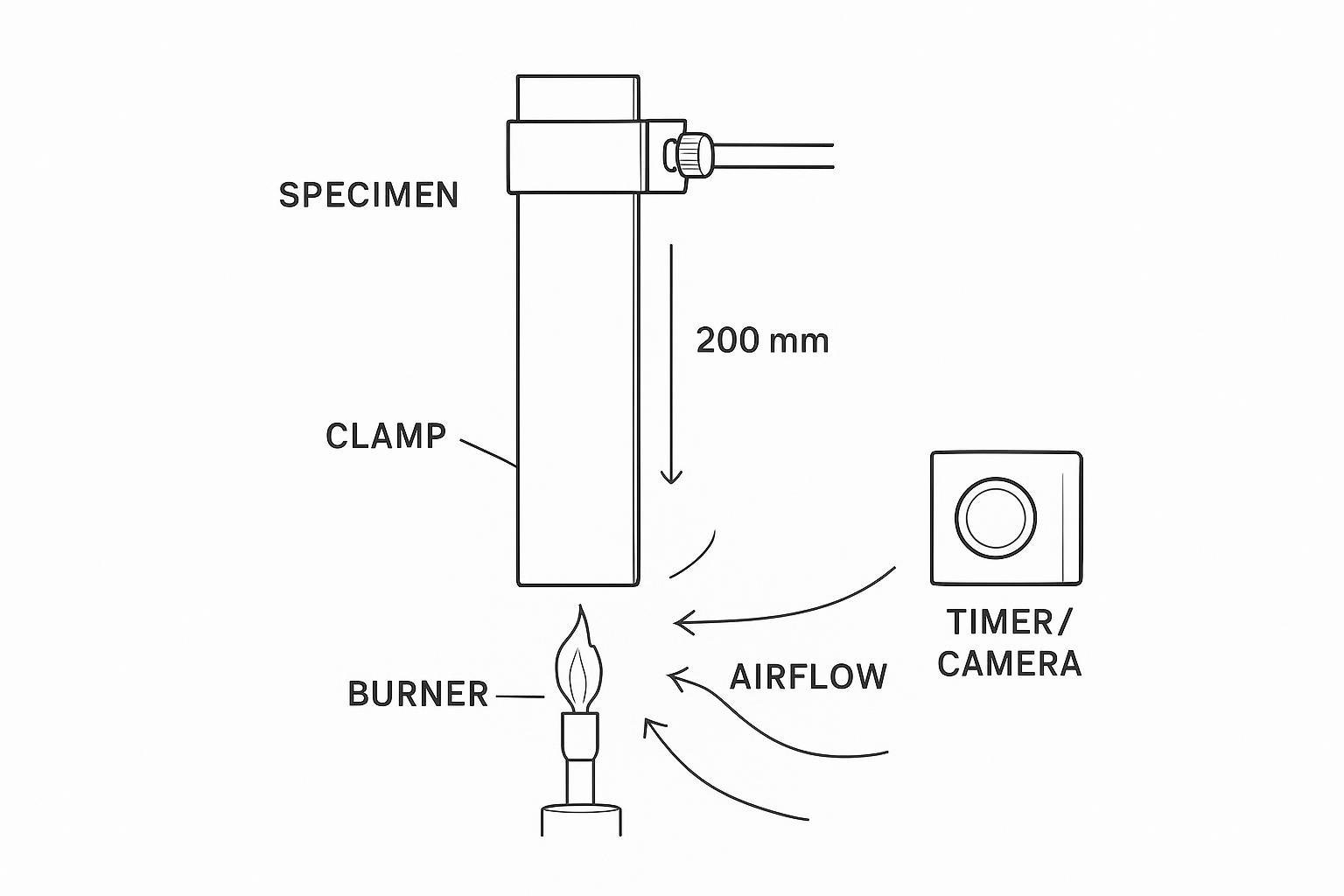
The ISO 340 procedure assesses a belt’s behavior when exposed to a small ignition source, and whether it self‑extinguishes without re‑igniting under a defined airflow. The ISO 340:2022 preview confirms typical test‑piece dimensions and a 10 mm burner tube ID; exact conditioning, flame/air settings, exposure duration, and acceptance math must be taken from the purchased standard.
-
Prepare and label specimens
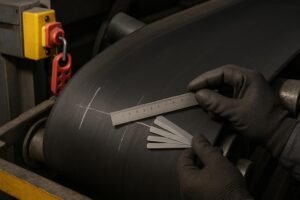
- Cut test‑pieces to (200 ± 5) mm × (25 ± 1) mm as visible in the ISO 340:2022 preview. For steel‑cord belts with covers removed, prepare at least 20 mm wide specimens containing at least two cords (per preview text cues). Produce longitudinal and transverse orientations as required. Assign traceable IDs and note belt type, cover grades, and lot/coil number.
-
Condition the specimens
- Stabilize all pieces in a controlled chamber at the temperature/humidity and for the duration specified by ISO 340. Record start/end times and chamber readings. Do not shortcut conditioning; out‑of‑spec RH commonly skews afterflame.
-
Set up the burner and alignment
- Fit a gas burner with 10 ± 0.5 mm inside diameter. Adjust the flame characteristics, angle, distance to the specimen, and exposure duration per ISO 340. Confirm gas type/pressure and verify there are no extraneous drafts (document ambient air speed).
-
Ignite, remove flame, and time afterflame
- Expose the lower portion of the vertically mounted specimen to the flame for the specified period, then remove the flame and start timing. Record afterflame time to the nearest 0.5 s or per the timing precision specified. Video capture with a visible timer is recommended for auditability.
-
Apply airflow and observe for re‑ignition
- Apply the prescribed airflow for the required time. Observe whether the specimen re‑ignites or continues glowing; document behavior exactly as the standard defines. Note any melt‑drip or scorching patterns.
-
Evaluate acceptance and document
- Compute per‑specimen afterflame and the group sum. Industry explainers often cite examples such as no single specimen afterflame exceeding 15 s and a maximum sum of 45 s across six specimens; treat these as examples only. Use the acceptance limits and formulas in the purchased ISO 340:2022 or referenced product standards (e.g., EN 12882 categories). Attach calibration records, environmental logs, photos/video, and the airflow/timing settings to the report. For official references, see the ISO 340:2022 preview and industry context from Dunlop’s fire‑resistant standards overview.
ISO 284 antistatic — step‑by‑step
ISO 284 verifies that belt covers can dissipate static electricity to minimize ignition risk in explosive or combustible atmospheres. Industry sources frequently reference a surface resistance limit of ≤ 300 MΩ for compliance; confirm the threshold and measurement rules in ISO 284:2025 before formal acceptance.
-
Prepare instruments and surfaces
- Use a compliant ohmmeter/megohmmeter and standardized electrodes per ISO 284. Clean several test areas on the top and bottom covers. Prepare the approved contact agent to ensure reproducible electrode contact.
-
Condition per the standard
- Stabilize the belt surfaces in a controlled environment (temperature/humidity and duration per ISO 284:2025). Record conditions meticulously; static behavior is humidity‑sensitive.
-
Place electrodes and measure
- Position electrodes at the specified spacing/geometry; apply the specified test voltage. Take multiple readings on each cover, rotating electrode positions to capture surface variability. Record values and environmental conditions for each measurement.
-
Evaluate acceptance and document
- Average per the standard’s rules and compare against the acceptance threshold (commonly cited as ≤ 300 MΩ by industry sources such as the Dunlop ATEX compliance page). Include instrument model, electrode details, calibration references, and raw readings in the report.
EN 12882 and EN 14973: choosing the right path
Above‑ground belts in Europe are generally assessed under EN 12882 categories that reference EN/ISO 340 and ISO 284 at minimum, with higher categories adding severe fire (EN 12881‑1) and drum‑friction (EN 1554). Underground belts fall under EN 14973 classes (A/B/C with subclasses) that combine antistatic, flame behavior/propagation, and drum‑friction criteria. Most plants won’t run severe fire or drum‑friction tests in‑house—these are typically performed by accredited labs. Helpful context is available in the EN 12882:2015 listing, the EN 14973 preview, and industry explainers such as the BulkInside guide.
| Region/Scope | Governing framework | Core lab‑scale tests | Additional tests | Where to verify |
|---|---|---|---|---|
| EU above‑ground | EN 12882:2015 | ISO 284 antistatic; EN/ISO 340 flammability (category‑dependent) | EN 12881‑1 severe fire; EN 1554 drum‑friction (higher categories) | EN 12882:2015 listing; industry explainers |
| EU underground | EN 14973 (consolidated 2016 common) | ISO 284; EN/ISO 340 small‑flame | EN 1554 drum‑friction; class‑dependent propagation | EN 14973 preview/listings; industry context |
| U.S. underground | MSHA 30 CFR Part 14 | N/A (MSHA BELT approval scheme) | Full‑scale flame propagation per regulation | eCFR Title 30, Part 14 index |
Verification, reporting, and audit readiness
- Calibration and traceability. Log calibration IDs, due dates, and uncertainty for timers, airflow meters, thermohygrometers, gas regulators, ohmmeters, and electrodes. Keep certificates attached to the test record.
- Environmental records. Document ambient temperature/humidity, drafts, and any airflow controls. Video key moments (flame application/removal) with a visible timestamp to corroborate afterflame timing.
- Specimen traceability. Record belt ID, construction (EP/NN or steel cord), cover grades, thicknesses, width, and lot/coil number. Label each specimen with orientation and cut location.
- Reporting fields that satisfy auditors. Include: standard edition and clause references; apparatus details (burner tube ID; flame parameters; electrode geometry/voltage); conditioning regime; individual and aggregate results; pass/fail rationale tied to the standard; photos/video links; and calibration references.
- Record retention. Align with your QA system (often five years or more) and any regulatory/supplier requirements; harmonize with ISO 9001/17025 practices where applicable.
Troubleshooting common failures
-
Excessive afterflame or re‑ignition in ISO 340. Often caused by out‑of‑spec conditioning, surface contamination, incorrect flame parameters, or a worn burner tip. Verify chamber logs, clean and recut specimens, replace the burner tip, and re‑check gas pressure and flame geometry.
-
Inconsistent antistatic readings in ISO 284. Typically due to poor electrode contact, very dry conditions, surface contamination, or instrument drift. Use the specified contact agent, stabilize humidity, clean the surface, replace instrument batteries, and repeat per the averaging rules.
-
Documentation gaps flagged by auditors. Missing timestamps, calibration IDs, or environmental logs create avoidable nonconformities. Use pre‑built forms and require sign‑offs at each stage of the test.
Practical example workflow (neutral)
Consider a maintenance team validating a replacement fire‑resistant belt for a clinker line. They cut and condition ISO 340 specimens, confirm the burner tube is 10 mm ID, run the exposure/timing sequence, and complete the airflow re‑ignition check. In parallel, they perform ISO 284 antistatic measurements on both covers using standardized electrodes and a compliant megohmmeter. With passing results, they review whether the installation falls under EN 12882 category requirements (above‑ground) or needs underground EN 14973 classification or, in the U.S., MSHA Part 14 approval checks via the eCFR index. If the belt supplier (for example, BisonConvey) provides test reports and certificates aligned to the cited standards, the team attaches those documents to the audit pack without treating brand literature as a substitute for official standards.
Further reading and official references
- ISO 340: test method scope and apparatus cues in the ISO 340:2022 catalogue sample
- ISO 284: confirm the current edition and antistatic criteria via ISO catalogues; industry context in the Dunlop ATEX compliance overview
- EN 12882 and EN 14973: category/class context in the EN 12882:2015 listing y el EN 14973 preview/listing
- U.S. MSHA: regulatory approval scheme at the eCFR Title 30, Part 14 index
Next steps: For procurement and audits, request edition‑specific test reports and approvals from your belt manufacturer or accredited lab. Where needed, purchase the applicable standards to ensure clause‑accurate compliance decisions.