If operators can’t hear each other near a conveyor, you’ve got more than a comfort problem—you may be edging into regulatory territory. OSHA’s program requirements kick in around the 85 dBA action level over an 8‑hour shift, and exposure control expectations rise as levels approach the 90 dBA PEL. According to OSHA’s program guidance, the most reliable path is engineering controls rather than just handing out hearing protection, which is why this guide zeros in on source and path fixes, not slogans. By the end, you’ll be able to map noise sources, measure them with an ISO‑style workflow, choose the highest‑ROI interventions, and maintain the gains.
Where the Noise Comes From (Quick Diagnostic)
Before investing in hardware, confirm what’s actually making the racket. On most belt conveyors, noise comes from a handful of mechanical interactions and a bit of structure‑borne amplification. Walk the line during steady throughput and listen for tones versus broadband “hiss”—that difference points you toward either rotating components or impacts.
- Bearing and idler shell noise: roller surface and bearing defects radiate a steady “whine,” often strongest 500–2,000 Hz.
- Belt–idler interaction: rough shells or misalignment cause micro‑slip and tonal components.
- Belt slap and resonance: under‑tensioned return runs slap the frames, creating intermittent bursts.
- Transfer/impact noise: material dropping or sliding at chutes and skirtboards.
- Drive/motor/gear tones: harmonics tied to belt speed and gear mesh.
- Structure‑borne amplification: guard panels or frames that behave like sounding boards.
How to Measure It (Fast, Replicable Workflow)
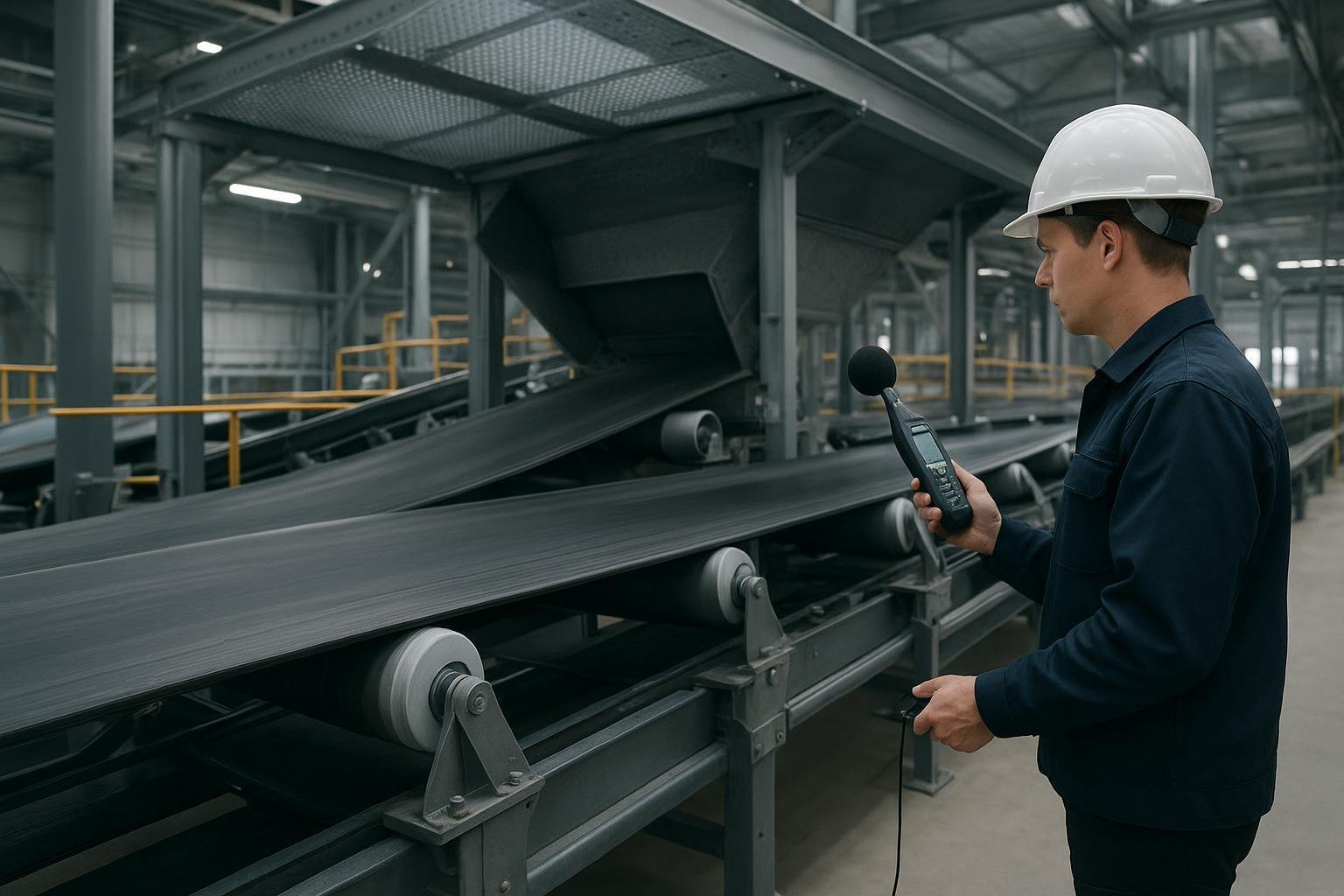
Here’s the deal: if you can’t reproduce your measurements, you can’t prove your improvements. Use a Class 1 or Class 2 integrating sound level meter (IEC 61672) with A‑weighting and 60–120‑second averages. For before/after comparisons at operator locations or at fixed distances from the conveyor, follow ISO 11201‑style “specified position” measurements: one microphone at 1 m and/or 3 m from the source, over a reflecting plane, with matched speed/load. Keep the background noise at least 7 dB below the source (a rule of thumb drawn from ISO 3744 free‑field practice) and note the ambient conditions.
Why this approach? OSHA’s program materials emphasize engineering controls and monitoring for exposure management, while ISO methods help you produce consistent, comparable data that procurement and safety teams trust. For a plain‑English primer on deriving sound power and setting up repeatable surveys, see Siemens’ “A Guide to Measuring Sound Power,” which summarizes the ISO logic in practical terms.
- Reference: OSHA’s program overview for occupational noise explains action levels and control expectations in clear terms in the agency’s noise pages: see the discussion of exposure management in the Occupational Noise Exposure topic at OSHA (2025 context) in the section linked here: OSHA’s occupational noise resources.
- Reference: For the ISO approach and instrument setup, a concise engineering explainer is provided in Siemens’ white paper “A Guide to Measuring Sound Power,” which outlines ISO 3744 engineering methods and practical setup considerations: Siemens guide to measuring sound power.
Source Controls for Conveyor Noise Reduction: Components and Materials That Move the Needle
If you’re looking for the largest single change with straightforward installation, start with idlers/rollers. Polymer shells (HDPE or UHMWPE) and carefully manufactured steel shells with rounded edges can substantially lower radiated noise compared with standard steel rolls, largely by reducing shell vibration and altering the belt–roller contact behavior.
One recent field study in the overland context measured A‑weighted levels at 1 m under matched speed/load and compared roll types. It found that rounded‑edge steel rolls reduced measured levels by roughly single‑digit decibels versus standard steel, while HDPE variants delivered deeper cuts—into the teens and beyond depending on the exact polymer and build. Methods, speed, spacing, and the microphone geometry were all disclosed, which makes the results a solid benchmark for pilots. See the Beltcon 2024 proceedings paper for details: Beltcon 2024 overland conveyor noise study.
Beyond shell material, quiet operation depends on:
- Precision bearings and sealing: smoother rotation, preserved over time by better exclusion of fines and moisture.
- Lagged pulleys and impact idlers at transfer zones: lower slip and cushion impacts.
- Idler spacing and alignment: tighter, consistent spacing can trim belt sag and slap; alignment prevents edge rub and tonal “singing.”
Remember, every site differs in frame stiffness, belt speed, and material. Treat the Beltcon numbers as a realistic range and validate on your geometry.
Path and Structure: Enclosures, Lining, and Isolation
Once you’ve tackled obvious sources, control what reaches the ear. Partial canopies and acoustic lining around transfer points help knock down airborne noise from impacts and turbulent flow. Micro‑perforated or porous absorbers inside chutes and under guards can absorb mid‑to‑high frequency energy that otherwise bounces around hard surfaces. Resilient mounts under guards and motor bases reduce structure‑borne amplification, while skirtboard design (proper overlap, wear liners, and airflow control) reduces both spill and the hiss of turbulent leakage.
Quantified performance for these elements is highly site‑specific and, in the public domain since 2021, remains sparse. That’s fine—design for clean airflow, avoid panel resonances, and verify with the ISO‑style measurements you set up above. If you don’t measure it, you’re guessing.
For a policy and program backdrop on engineering controls and hearing conservation, NIOSH consistently frames engineering solutions as first‑line measures and provides program resources you can draw on when building your internal plan: NIOSH engineering controls program overview.
Operations and Maintenance: Keep It Quiet Over Time
Quiet hardware won’t stay quiet without disciplined maintenance. Many “mystery” noise spikes trace back to a handful of operational drifts—tension changes after a splice, a few misaligned idlers, or bearings that lost grease after a washdown.
- Alignment: verify idler frames are square to belt travel; correct any edge rub immediately.
- Tensioning: confirm setpoints after load or splice changes; check return‑run sag that can trigger slap.
- Grease selection: use manufacturer‑approved grease that matches bearing seals and ambient temperature; avoid over‑greasing.
- Bearing inspection: look for temperature rise, roughness, or audible tones; flag any onset of tonal peaks during rounds.
- Vibration/condition monitoring: trend simple velocity spectra monthly; investigate new peaks aligned with roller RPM or gear mesh.
- Replacement triggers: define dB or vibration thresholds that prompt swap‑outs to prevent cascade failures.
Practical Example: A Polymer Roller Swap on a Packaging Line
A food‑grade packaging line running a 24‑in belt across a mezzanine had routine complaints from operators stationed 1–2 meters away. Baseline A‑weighted levels, averaged for two minutes with a Class 2 SLM at 1 m from the carry side, hovered in the high‑80s during peak throughput. The maintenance team needed a retrofit they could execute in one shift without touching the drive.
They piloted a 20‑meter section swap: existing painted steel return and troughing idlers were replaced with polymer‑shelled idlers of equivalent dimensions. The team kept spacing unchanged, checked frame alignment, and recorded belt speed and throughput. Measurements followed the same positions and averaging times as the baseline, with background confirmed more than 7 dB below source.
Results? The tonal whine dominant near 1 kHz dropped substantially and the overall A‑weighted level fell into the lower‑80s at the 1 m position—consistent with what the Beltcon overland study suggests is achievable when moving from standard steel shells to well‑designed polymer rolls on comparable geometries. Operators reported easier voice communication and less fatigue at shift end. Importantly, the plant documented the full method—instrument class, geometry, load, and atmospheric notes—so the gains were defensible in internal reviews.
Where do components come in? In scenarios like this, a manufacturer such as BisonConvey can supply HDPE or UHMWPE idlers and compatible troughing frames to match legacy dimensions, which supports a low‑risk pilot without drive changes. The engineering lift was modest, and the pilot gave procurement the confidence to evaluate a broader rollout using the same measurement protocol.
Two Short Case Notes (With Methods)
Case 1 — Polymer idlers on a long overland run: The Beltcon 2024 paper reported ISO‑style field measurements at 1 m under constant speed and matched load while testing multiple roll types. Compared with standard steel rolls, rounded steel rolls reduced A‑weighted levels by roughly single‑digit decibels, while HDPE designs showed larger drops that, in some cases, extended well into the teens and beyond at the microphone. The paper discloses spacing, speed, and setup, providing a rare apples‑to‑apples benchmark for your pilots. Source: Beltcon 2024 overland conveyor noise study.
Case 2 — Transfer‑point canopy and lining on a quarry conveyor: A maintenance team enclosed a problematic chute with a partial steel canopy and added porous acoustic lining on internal walls. They used the same ISO 11201‑style geometry (1 m and 3 m positions) and averaged for 120 seconds before and after, documenting belt speed, drop height, and moisture content. While results are highly site‑specific and not generalized here with a number, the team’s method shows how to validate path controls: fix the geometry, control the load, and report the delta with uncertainty and any observed frequency‑band shifts.
Cost vs Impact, Plus an RFQ Snippet
Below is a compact view of common interventions. Treat the ranges as planning inputs—confirm with a pilot on your line.
| Intervention | Typical cost band | Expected dB(A) change (site‑specific) | Difficulty | Maintenance impact |
|---|---|---|---|---|
| Swap standard steel idlers to HDPE/UHMWPE | Medium | Single‑digits to teens at 1 m (per Beltcon‑style tests) | Low–Medium | Similar or lower cleaning; inspect seals |
| Rounded‑edge steel idlers (quality steel) | Medium | Small‑to‑moderate at 1 m | Low | Comparable to existing |
| Partial canopy at transfer + acoustic lining | Medium–High | Variable; verify with pilot | Medium | Inspect liners; manage dust hygiene |
| Resilient mounts for guards/motor bases | Low–Medium | Small; reduces resonance and tones | Low | Periodic torque checks |
| Skirtboard redesign and wear liners | Low–Medium | Small–moderate broadband hiss reduction | Medium | Routine wear inspection |
RFQ snippet for low‑noise idlers (paste into a vendor request):
- Shell material and hardness (HDPE/UHMWPE or rounded steel; specify Shore D if polymer)
- Bearing class/tolerance and sealing system (dust and moisture rating)
- Total indicated runout (TIR) max, shell roundness, and dynamic balance class
- Idler diameter/length, trough angle, and spacing to match legacy frames
- Load rating and speed rating at site conditions
- Documentation request: factory test data and recommended lubrication intervals
Next Steps
Start with a short baseline survey, map hotspots, and pilot one change—often a polymer idler section swap is the fastest win for conveyor noise reduction. Re‑measure with the same geometry, then scale what works. If you want a second set of eyes, engage an equipment specialist to review measurements and shortlist pilot components.
Notes on sources and measurement approach in this guide draw on program guidance from OSHA’s noise resources (OSHA’s occupational noise resources), NIOSH’s engineering controls overview (NIOSH engineering controls program overview), an ISO‑methods primer (Siemens guide to measuring sound power), and the Beltcon 2024 field study on idler roll type and measured noise (Beltcon 2024 overland conveyor noise study).