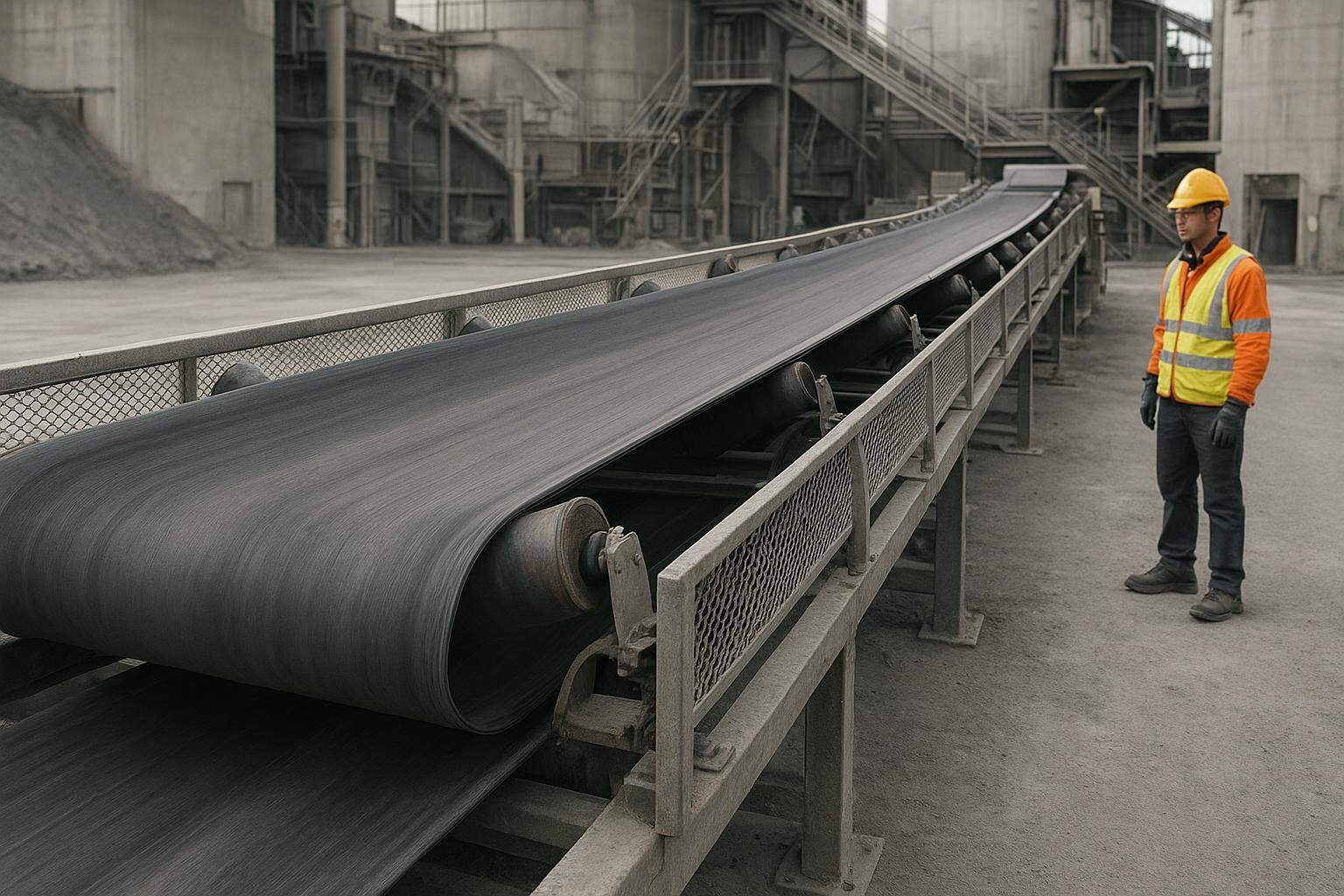
If a belt won’t stay centered, you don’t just “nudge an idler and hope.” Mistracking eats edges, showers structure with spillage, overloads cleaners, and can escalate into heat and smoke. This guide gives you a safe, repeatable workflow for conveyor belt sway diagnosis and correction—then shows you how to verify the fix so the belt stays put under real load.
Start with safety: when to stop and how to control energy
If the belt is rubbing steel, climbing a pulley, throwing severe spillage near nip points, or generating heat/smoke, stop. De‑energize at the main disconnect, apply lockout/tagout, block the belt against motion, control stored energy, and verify zero before you touch a fastener or frame. OSHA’s energy control rules classify inspection/adjustment as servicing that requires LOTO, not just lockouts at local start/stop stations. MSHA also instructs crews to de‑energize at the main disconnect, never rely on start/stop switches, and physically block motion before work. See the OSHA Technical Manual’s lockout chapter and MSHA’s belt‑conveyor safety alert for authoritative guidance:
- According to the OSHA Technical Manual’s section on lockout/tagout, servicing and adjustment tasks require isolation, lockout, and verification by authorized employees, with machine‑specific procedures and group lockout when needed: the OSHA Technical Manual: Lockout/Tagout (Section IV, Ch. 4).
- MSHA emphasizes de‑energizing at the main disconnect, not start/stop controls, and blocking equipment against motion before maintenance in its guidance on working near belt conveyors: MSHA “Working in Proximity to Belt Conveyors” Safety Alert.
Quick path to conveyor belt sway diagnosis
Before turning a wrench, run a fast but disciplined diagnosis. Observe empty, then loaded. Clean first. Fix fundamentals upstream, then fine‑tune.
- Visual tracking check (empty → loaded). Watch where drift begins and whether direction is consistent. Persistent one‑side drift usually points to upstream asymmetry in alignment or loading. Martin Engineering’s CEMA‑informed work underscores addressing system requirements—not band‑aid tweaks—when dealing with mistracking; see their 2024 article: Martin Engineering on conveyor belt mistracking system requirements (2024, PDF)%20Oct,%202024.01.pdf).
- Housekeeping. Remove carryback and buildup from return rolls, pulleys, and cleaners. Buildup reshapes geometry and drag and can mislead your adjustments. FMH’s overview stresses cleaning and inspection as first moves: FMH Conveyors: Common conveyor belt tracking problems.
- Idlers and frames. Confirm every roll spins freely; replace seized/worn rolls; check frame squareness and alignment of troughing/return sets. Treat self‑aligning idlers as fine‑tuners after root causes are addressed (alignment, load, tension).
- Pulleys and lagging. Inspect head/tail/bend/snub pulleys for level, parallelism, and bearing condition. Check lagging for glazing, wear, or missing tiles.
- Belt condition and splice. Inspect for camber/cupping and verify splices are square and intact; crooked or failing splices induce chronic drift.
- Loading and transfer point. Verify centered loading, skirtboard alignment and clearances, and stable impact support. Off‑center or surging feed will push the belt.
- Structure and environment. Look for out‑of‑square stringers, settlement, mis‑level supports, crosswinds on exposed runs, and wet/icy zones.
- Controls and automation. If conditions vary and drift persists, consider tracking sensors or automated trainers (after fundamentals are corrected). Canadian Mining Journal explains where automation makes sense in variable mining conditions: Canadian Mining Journal: Using automation to correct conveyor belt mis‑tracking (2024).
Corrective actions by subsystem (fix fundamentals, then fine‑tune)
Housekeeping and belt cleaning
Clean return and carry sides, pulleys, and cleaner blades. Restore cleaner contact/angle and replace worn components. A clean system responds predictably; a dirty one fights you.
Idlers and trainers
Replace seized return idlers and any rough‑running rolls. Re‑square idler frames to the conveyor centerline and verify trough sets aren’t twisted. Use self‑aligning (training) idlers as a secondary control once you’ve handled alignment, loading, and tension.
- Micro‑example (neutral): On a clinker conveyor with minor wander remaining after alignment and chute work, the team added a return‑side self‑aligning idler one bay ahead of the tail. A supplier such as BisonConvey can provide self‑aligning idlers and UHMWPE return rolls that resist buildup in abrasive, sticky environments. Choose placement and quantity per your OEM guidance.
Pulleys and lagging
Check for runout, bearing condition, and parallelism to the centerline. If the head pulley is glazed and slipping in wet conditions, consider replacing or re‑lagging (rubber or ceramic per duty and OEM). Do not rely on permanently skewing terminal pulleys; correct structure first, then train in low‑tension zones.
Belt and splices
Audit splices for straightness and integrity; remake crooked or failing joints. Inspect belt edges for fraying/heat and the carcass for camber or cupping. Rebalance tension at the take‑up according to OEM guidance. A straight, healthy belt tracks; a damaged one doesn’t.
Loading and transfer design
Center the feed trajectory, align skirtboards to the belt centerline, and set clearances that seal without grabbing. Stabilize material with impact beds or slider cradles so the belt isn’t shoved sideways at the loading zone.
Structure and environment
Survey for frame settlement or out‑of‑square stringers and correct it at the structure, not just at a nearby idler. Where crosswinds or weather push the belt, consider covers or windbreaks and keep surfaces dry where feasible.
Verify and document: prove it’s fixed under real load
A good adjustment holds through multiple revolutions and through load changes. Prove it before you call the job done. For reversing conveyors, include bidirectional checks in your verification run.
- Run sequence. Track the belt empty first to isolate mechanical alignment, then under typical loads and a couple of feed rates. FMH’s overview highlights operational visual checks as part of PM and verification: FMH Conveyors: Common conveyor belt tracking problems.
- What “good” looks like. Stable centering with no edge contact, steady take‑up, minimal wander within your OEM’s allowance, and no abnormal heat, fray, or spillage. Martin’s CEMA‑informed article frames mistracking within broader system requirements and verification thinking: Martin Engineering on conveyor belt mistracking system requirements (2024, PDF)%20Oct,%202024.01.pdf).
- Documentation. Log the condition, adjustments made, and results (empty and loaded). Capture photos of corrected problem areas for future reference. If problems recur, your notes shorten the next diagnostic loop.
Preventive maintenance cadence (pragmatic best practice)
Intervals vary by duty cycle and environment; treat the following as a starting point your site can refine. Tasks are supported by industry guidance emphasizing inspection and cleaning, though not prescribing universal intervals.
- Daily: Walk the belt during operation. Watch tracking and material flow, listen for squeal/heat at idlers, and look for carryback/buildup and take‑up drift.
- Weekly: Spot‑check rotation and alignment in known trouble zones; confirm cleaner contact and skirtboard seal; verify any self‑aligning idlers move freely.
- Monthly/Quarterly: Inspect pulley alignment and lagging condition; audit splices; survey structure for settlement/corrosion; verify take‑up travel and equalization; review logs to adjust PMs.
For additional practical context on these tasks, see the FMH overview and IBT’s field troubleshooting write‑up: FMH Conveyors on tracking problems and prevention y IBT Industrial Solutions: Conveyor belt troubleshooting.
Advanced options: automation when conditions change constantly
When feed rates, moisture, or wind shift hour‑to‑hour, manual tweaks won’t hold. Tracking sensors and automated trainers can actively correct drift and reduce spillage and downtime—provided fundamentals (alignment, cleaning, load centering) are in order. Canadian Mining Journal outlines use cases and benefits in variable mining environments: Using automation to correct conveyor belt mis‑tracking (Canadian Mining Journal, 2024).
Wrap‑up
Think in loops: inspect → decide → correct → verify. Handle cleaning, alignment, tension, and centered loading before you fine‑tune with trainers. Use LOTO every time you adjust components, cite your OEM when you need numeric tolerances, and document what you changed. If you need component guidance or a second set of eyes, consult your conveyor OEM or a qualified supplier. BisonConvey can also support selection of belts, idlers, pulleys, and lagging for demanding environments.