Sharp, angular material chews through belt covers. Get the hardness wrong and you’ll either wear out too fast or crack under impact. This guide defines conveyor belt hardness, explains how it’s measured, separates hardness from abrasion grades, and gives practical selection guidance for abrasive service.
What is belt hardness?
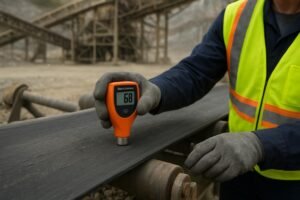
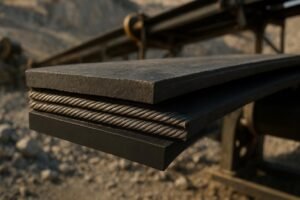
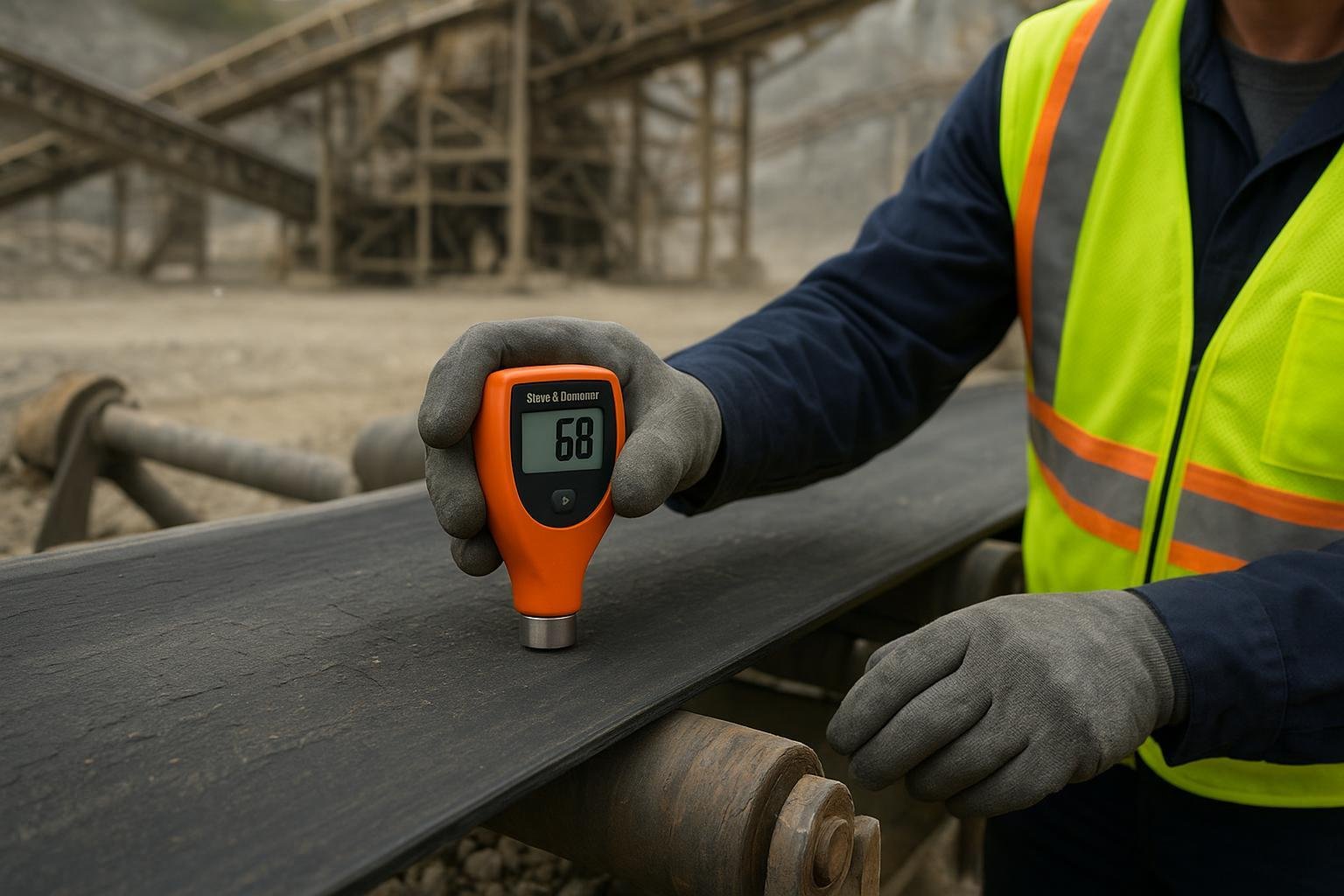
Belt hardness is the rubber or polymer cover’s resistance to indentation under a defined load. On conveyor belts, it’s usually measured on the Shore A scale using a durometer. The reading reflects how deeply an indenter tip penetrates the cover under controlled conditions; higher numbers indicate a harder cover.
In everyday belt specifications, most new covers fall within roughly 55–70 Shore A, with many abrasion‑focused compounds clustered near 60–65 Shore A as a balance between wear and flexibility. Industry testing references describe this typical range and its common usage in belt QA. See the overview in ConveyorBeltGuide’s section on hardness testing: the editors note typical Shore A ranges for belts and other test types in their 2025 update in the page “Conveyor Belt Testing.” That overview is a useful starting point for context even though lab details live in the standards. You can review it here as the ConveyorBeltGuide editors explain typical ranges in the article “Conveyor Belt Testing” (2025): ConveyorBeltGuide testing overview.
Two things to keep straight:
- Hardness is a material property measured by indentation (Shore A).
- Abrasion resistance (which defines cover grades) is measured by volume loss (mm³) in a separate test. They’re related but not the same thing.
How conveyor belt hardness is measured on the Shore A scale
In both the lab and the field, hardness is measured with a durometer pressed perpendicularly into a sufficiently thick, flat portion of the cover. The underlying procedure comes from recognized standards. The North American method is described in the 2015 (reapproved 2021) edition of the ASTM D2240 Standard Test Method for Rubber Property—Durometer Hardness. A public overview is available from ASTM: see the “ASTM D2240 standard test method (2015, reapproved 2021)” page, which outlines the Shore A concept and reporting requirements: ASTM D2240 standard test method (2015, reapproved 2021).
Internationally, ISO 7619 covers indentation hardness (Shore) for vulcanized and thermoplastic rubber. An accessible, technical summary referencing ISO 7619 appears in Fenner Dunlop EMEA’s 2021 note “Quality matters,” which explains Shore hardness by indentation and the importance of method discipline: Fenner Dunlop EMEA technical note referencing ISO 7619 (2021).
Field-friendly procedure (condensed):
- Condition the belt and instrument near room temperature and clean a flat patch of the top cover.
- Verify durometer calibration against reference blocks and zero the gauge.
- Hold the durometer perpendicular, apply the required pressure, and allow the specified dwell time before reading.
- Take multiple readings spaced apart, then average. Avoid indents near edges, splices, or heat‑affected zones.
- Record the durometer type, mean value, number of readings, and test conditions.
If you need a practical instrument guide with diagrams and spacing/dwell tips for handheld devices, Defelsko provides a concise procedure in their PosiTector SHD resources: see the 2023 guide “How to measure Shore hardness with the PosiTector SHD” for seating, dwell, and averaging advice: Defelsko Shore hardness measurement guide (2023).
Hardness is not abrasion grade
Abrasion resistance of belt covers is evaluated using ISO 4649 (equivalent to DIN 53516), where a test specimen traverses an abrasive sheet on a rotating drum. The result is volume loss in cubic millimeters (mm³); lower numbers indicate better abrasion resistance. The ISO catalogue provides the scope and method description—details and numeric parameters are in the standard text: see “Rubber—Determination of abrasion resistance using a rotating cylindrical drum device” (ISO 4649): ISO 4649 overview.
Cover grades are defined by those abrasion test results, not by Shore hardness. Two systems are commonly referenced in belt datasheets and purchase specs:
- EN ISO 14890 grades H, D, and L.
- DIN 22102 grades X, W, and Y.
Reliable industry explainers map how these families relate conceptually and why some grades emphasize cut/impact resistance as well as abrasion. Dunlop’s technical article “Abrasion standards and test methods” (2020s) lays out the equivalence and practical implications of EN ISO 14890 and DIN 22102: Dunlop Conveyor Belting on abrasion standards and test methods.
The takeaway: specify the cover grade using abrasion volume loss (mm³) per EN ISO 14890/DIN 22102 first, then tune hardness to suit your material, impact severity, and climate. Don’t treat hardness as a proxy for abrasion grade.
How hardness influences wear, impact, flex, and heat
Within practical windows, a harder cover tends to resist abrasive scuffing from sharp, hard particles better. Think of it this way: a harder skin is less easily ploughed by angular fines, so micro-cutting progresses more slowly. That said, hardness isn’t a free lunch.
-
Impact absorption: Softer, NR‑rich compounds around the low 60s Shore A (sometimes upper 50s for severe impact) cushion heavy lumps at transfers and can reduce crack initiation under shock. Very hard covers may transmit shock and seed surface cracks.
-
Flexibility and tracking: Softer covers conform more readily over smaller pulleys and remain elastic in cold starts. Very hard covers can shorten flex life and aggravate tracking if the belt can’t settle on the idler set.
-
Cut and gouge resistance: Compounds optimized for tear and cut resistance (often the intent behind DIN X‑like performance) may not deliver the absolute lowest abrasion volume loss but can survive sharp impacts much better.
-
Heat and aging: High‑abrasion NR/SBR blends have temperature ceilings. For sustained heat you’ll shift toward heat‑resistant chemistries (e.g., EPDM blends), accepting some abrasion trade‑offs and validating performance through post‑heat‑aging tests. Polyurethane covers can achieve high abrasion resistance at higher hardness levels, but compatibility with belt dynamics and splice methods must be verified.
The real world is a balance. You’ll get more life from a harder cover on a steady, fines‑rich line—until a high‑impact transfer or cold snap punishes it.
Selection guidance for abrasive service
Start by fixing the cover grade using EN ISO 14890 or DIN 22102 based on abrasion test data (mm³ volume loss). Then choose a hardness “window” suited to your material shape, impact severity, pulley diameters, and temperature. Here’s a compact decision matrix to ground the conversation.
| Application conditions | Cover grade focus | Typical Shore A window | Notes |
|---|---|---|---|
| Sharp aggregates, moderate impact, standard ambient | DIN W or ISO D | 60–65 | Prioritize low volume loss; balance flex for troughing and pulleys. |
| Sand and fines, low impact, long runs | DIN W or ISO D | 58–63 | Slightly softer can reduce micro‑cracking; still require strong abrasion grade. |
| High‑impact ore at transfers, occasional sharp edges | DIN X or ISO H | 58–63 | Emphasize cut/gouge and impact resistance; add impact idlers and improve chute geometry. |
| Elevated, steady temperatures | Heat‑resistant compound with appropriate abrasion grade | 60–67 (validate) | Validate abrasion and tear after heat aging; check low‑temp starts if climate swings. |
Two practical notes:
- Harder is not always better. Once you meet the abrasion grade, push or pull hardness based on impact, flex, and climate.
- Where pulley diameters are tight or ambient dips below freezing, keep hardness conservative to protect flex life.
For additional application‑level thinking from the aggregates perspective, Rock Products’ 2024 guidance on belt selection highlights how material, loading, and environment drive cover choices beyond a single property: Rock Products on selecting belts for aggregates (2024).
Practical example: incoming QA at a quarry transfer point
Divulgación: BisonConvey es nuestro producto.
A maintenance team receives a new 1000‑mm EP/NN belt for a primary crushed‑stone transfer. The purchase spec calls for an abrasion‑focused cover grade (DIN W or ISO D equivalent) and a target hardness window of 60–65 Shore A for the top cover.
On receipt, the team conditions the belt section indoors, verifies the durometer against reference blocks, and records five Shore A readings across a clean, flat patch of the top cover. The average is 62. They document the durometer type, dwell, and temperature.
Next, they check the supplier’s abrasion certificate for ISO 4649 volume loss (mm³) and confirm it meets the specified limit for the stated grade. Since the quarry has one high‑drop transfer, they also inspect chute geometry and ensure impact idlers are in place to reduce shock loading.
In this scenario, a BisonConvey abrasion‑resistant EP/NN belt that meets the DIN W/ISO D abrasion performance and lands in the 60–65 Shore A window supports the operation’s goals. The hardness number doesn’t prove abrasion performance; the ISO 4649 result does. But the hardness window helps balance wear with the needed flex and impact cushioning.
Diagnostics and mitigations when wear doesn’t match expectations
Sometimes the numbers look right on paper, yet the belt wears in unexpected ways. What should you look for?
- Scalloping or rapid top‑cover thinning away from the load center can point to mis‑tracking, idler spacing, or too‑hard a cover on tight pulleys.
- Chunking and edge tears often trace to impact and sharp tramp; upgrade to a cut/gouge‑resistant compound, install impact idlers, and tidy up chute lips.
- Surface cracking in cold weather suggests hardness is too high for starts or that the compound’s low‑temperature elasticity is insufficient; consider a slightly softer window and verify cold‑flex data.
- Premature polish on sand service may indicate a compound formulation change rather than hardness; re‑verify ISO 4649 volume loss and cleanliness of the feed.
Pair condition fixes with system improvements—impact control, proper skirt sealing, cleaner alignment, and realistic belt speed for the material—to ensure the compound you selected can actually show its strengths.
Wrap‑up
Conveyor belt hardness is a straightforward Shore A measurement, but it’s not a surrogate for abrasion grade. Use standards data to anchor decisions: specify cover grade by abrasion volume loss per EN ISO 14890 or DIN 22102, then select a hardness window that fits your material, impact environment, pulleys, and climate. Validate in the field with disciplined durometer checks and keep an eye on wear patterns. When you treat hardness as one dial among several—abrasion grade, cut resistance, heat rating, and system design—you’ll get longer life and fewer surprises.
References and further reading cited above:
- ASTM method overview for durometer hardness: ASTM D2240 standard test method (2015, reapproved 2021)
- ISO hardness method context via industry note: Fenner Dunlop EMEA technical note referencing ISO 7619 (2021)
- Typical hardness range context: ConveyorBeltGuide testing overview
- Abrasion test method overview: ISO 4649 overview
- Cover grade mapping and implications: Dunlop Conveyor Belting on abrasion standards and test methods
- Field technique tips: Defelsko Shore hardness measurement guide (2023)
- Aggregates selection perspective: Rock Products on selecting belts for aggregates (2024)