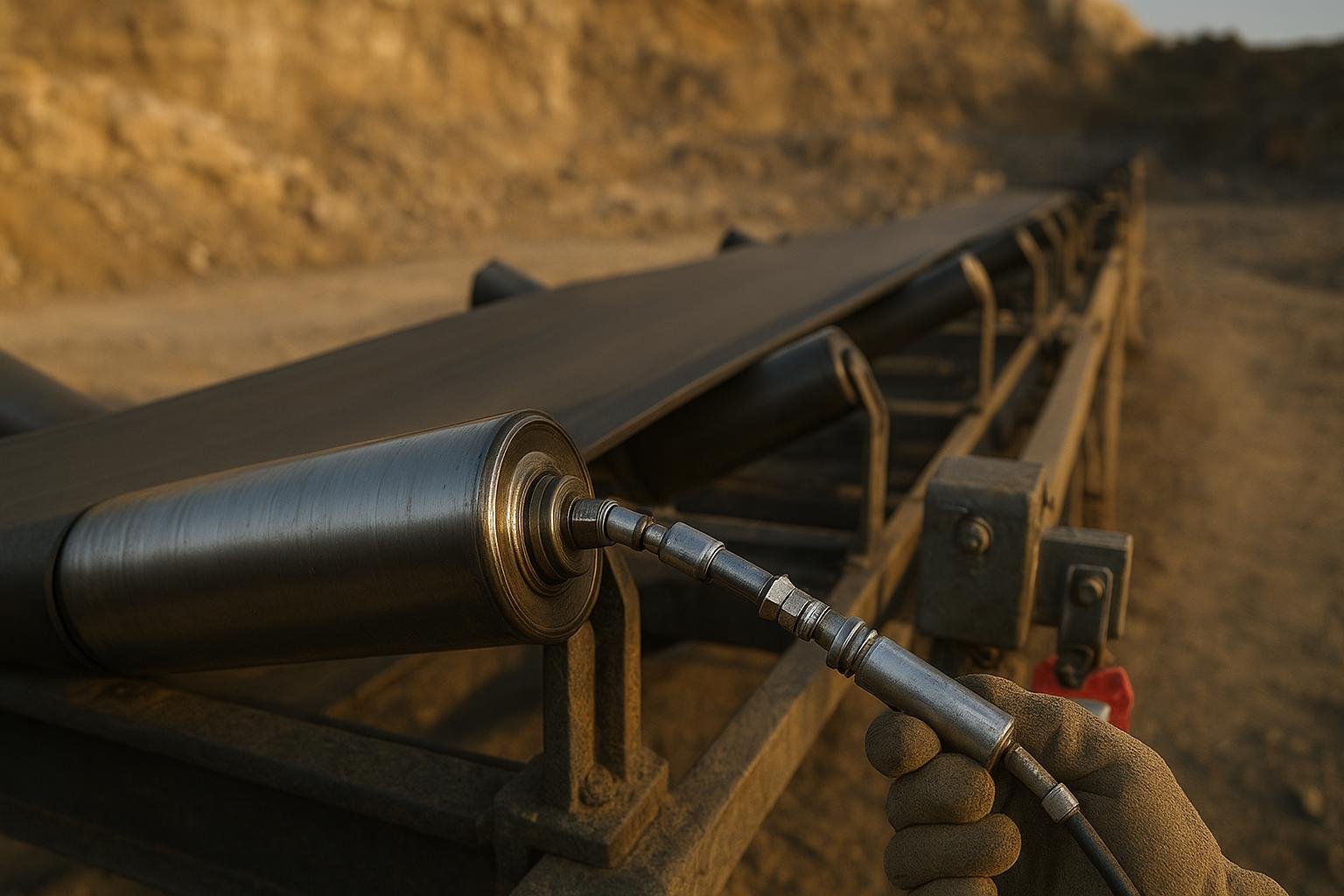
If you’re responsible for keeping bulk-material conveyors moving, you already know most bearing failures aren’t mysteries—they’re usually about contamination, wrong grease, or inconsistent intervals. This guide distills roller lubrication best methods into procedures you can drop into PMs, with specs, sealing choices, dosing math, inspection cues, and the HSE essentials.
Grease, oil, or sealed-for-life? Make the right call
Most conveyor idlers use grease-lubricated deep-groove ball bearings because grease is simple, resists contamination, and doesn’t require complex housings. Oil is reserved for higher speeds/temperatures or special housings where controlled oil flow makes sense. Sealed-for-life units remove routine greasing but tie service life to the internal grease’s longevity. The engineering frame for these decisions is outlined in SKF’s selection guidance on grease vs. oil and its explanation that grease life and relubrication interval are related as L10 ≈ 2.7 × L1 in SKF’s grease life and relubrication page.
Grease selection that works in the field
Choose grease on four axes: NLGI consistency, base oil viscosity (ISO VG), additive chemistry, and the real operating temperature/speed. The aim is adequate film at temperature without starving or over-purging.
- NLGI grade: Most bearing greases sit in NLGI 1–3. Lower grades (0–1) pump better in cold climates and some automatic systems; NLGI 2 is the all-round plant standard; NLGI 3 can help retention in slow, heavily loaded rollers. Grade behavior and examples are summarized in SKF’s grease technical data overview.
- Base oil viscosity: For slower/heavier service or hotter running, you’ll lean toward higher ISO VG (e.g., ≥220 cSt @ 40°C). For higher speed or cold starts, lower VG (e.g., 32–100 cSt) reduces churning and torque. SKF emphasizes selecting viscosity at the actual operating temperature via viscosity-ratio methods (κ) within its selection materials.
- Additives and thickener: EP/antiwear packages are common in heavy industry; rust inhibitors matter where washdowns or humidity are present. Lithium complex, calcium sulfonate, and polyurea thickeners are typical; always confirm compatibility before mixing.
Grease quick-reference (confirm with OEM tools like SKF LubeSelect):
| Operating cue | Typical NLGI indication | Base oil viscosity cue |
|---|---|---|
| Slow/heavy load, dusty | 2–3 | Higher VG (e.g., ≥220 cSt @ 40°C) |
| Moderate speed/load | 2 | Medium VG (~100–220 cSt) |
| High speed/colder climate | 1–2 (or 1 in auto-lube) | Lower VG (32–100 cSt) |
Sealing and contamination control: keep the dirt out, keep the grease in
In bulk-handling, seals decide whether your grease does its job. Multi-stage labyrinth designs are the industry workhorse for dust and fines because they’re non-contact and create tortuous paths for contaminants. In persistently wet or corrosive zones, contact lip seals or multi-lip combinations may be specified, accepting slightly higher torque in exchange for ingress resistance. Where regreasing is practiced, purgeable paths let you push contaminants out—watch for clean grease at the relief point and stop there. Complement seals with shielding (boots, flingers) and correct mounting/alignment to avoid seal wear. Keep zerks capped and clean.
Lubrication methods in practice: manual and automatic
Manual greasing remains common and effective when done right. Clean the fitting, use a coupler that seals, apply measured doses, and observe purge. Stop as soon as fresh, clean grease appears—over-pressurizing can blow past seals.
Automatic lubrication adds consistency and reduces human variation. Single-line systems meter programmable doses to many points; multi-point lubricators handle small groups with cartridge reservoirs. Selection hinges on: grease pumpability (NLGI range), operating temperature, dosing programmability, reservoir size, allowable backpressure/line length, environmental sealing (IP rating), power options, and alarms. For a concise overview of architectures and capabilities, see SKF’s single-line systems introduction.
Auto-lube buyer’s checklist (use this to scope vendors):
- Confirm grease compatibility (e.g., NLGI 1–2 typical) and operating temperature range.
- Verify dosing programmability (interval and volume per point) and number of points supported.
- Check reservoir size, refill method, and low-level alarms.
- Ensure backpressure tolerance, line length limits, and IP rating fit your layout.
- Confirm power options (24 VDC, battery, solar) and monitoring/alarms.
Dosing and interval guidance — roller lubrication best methods you can copy into PMs
Two things matter: how much grease per shot and how often. Use proven formulas and then correct for your environment and temperature.
- Replenishment quantity (SKF): Gp = 0.005 × D × B, where D = bearing bore (mm) and B = bearing width (mm). See the formula in SKF’s determining grease quantities.
- Interval relationships (SKF): grease life L10 ≈ 2.7 × L1 (relubrication interval). Background in SKF’s grease life and relubrication.
- Temperature correction (NSK heuristic): halve the interval for every +15°C above reference. See NSK’s bearing maintenance guide.
- Contamination correction (SKF examples): reduce interval by a factor of 0.5 (moderate), 0.3 (severe), or 0.1 (very severe). See examples in SKF’s mounted bearing lubrication guidance.
Worked example (illustrative, confirm with OEM calculators):
- Bearing: 6205 (D = 25 mm, B = 15 mm)
- Speed: 300 rpm; Ambient: 35°C; Environment: dusty (severe)
- Quantity per event: Gp = 0.005 × 25 × 15 = 1.875 g ≈ 1.9 g
- Baseline interval L1, from OEM tool for this bearing and speed (example workflow): say 1,000 hours
- Temperature adjustment: +15°C above 20°C reference → halve once → 1,000 → 500 h
- Contamination factor (severe ≈ 0.3): 500 × 0.3 = 150 h adjusted interval
Calculator snippet you can adapt:
Given: D (mm), B (mm), L1_base (h at reference temp)
Steps:
1) Gp (g) = 0.005 * D * B
2) L1_temp = L1_base / 2^( (T_oper - T_ref) / 15 )
3) L1_final = L1_temp * ContamFactor   # e.g., 0.5, 0.3, or 0.1
Use this math to set PMs, then validate in the first month by checking temperature, noise, and purge evidence and tuning intervals ±20% as needed. Avoid stacking corrections without OEM confirmation; when in doubt, rely on OEM calculators for final values.
Inspection checklist and troubleshooting cues
Standardize quick checks so problems don’t hide in plain sight. If a roller runs hot or sounds rough, suspect starvation or contamination first. Over-greasing shows as excessive sling and hot running after service. Seal damage leaves streaks or rapid recontamination. Correct the cause, not just the symptom.
- Daily: Walk-by listen/feel; look for grease sling, dirt-laden purge, or water streaking; confirm guards and caps are in place.
- Weekly: Spot-check temperature (IR) and noise on a sample of rollers; verify zerk integrity and cleanliness.
- Monthly: Check axial/radial play, mounting hardware torque, alignment that could abrade seals; review auto-lube status, alarms, and cartridge levels.
Safety and environmental notes you should never skip
Lockout/Tagout (LOTO): Before greasing or servicing, de-energize, lock, and verify. OSHA’s 29 CFR 1910.147 program requires documented procedures, training, annual audits, and that only the applier removes their lock. For practical guidance, review OSHA’s LOTO toolbox reference.
Used oil/grease handling: Store and dispose in line with U.S. EPA used oil management standards (40 CFR Part 279). Keep containers sound and labeled, repair leaks, record movements, and clean spills promptly. See the EPA’s business guidance on managing used oil.
Practical example — greasing a heavy-duty idler on a dusty conveyor
On a clinker transfer conveyor with persistent dust, a maintenance tech services a regreasable, heavy-duty steel idler with multi-stage labyrinth seals. After LOTO and a clean-down of the area, the tech wipes the zerk and seats a gauge-equipped coupler. Based on the bearing and speed, the PM calls for ~2 g per side and a 150-hour interval (calculated using the method above and validated during commissioning). The tech pumps slowly, watching for the first appearance of clean grease at the relief path, then stops to avoid blowing past the seals.
Because dust is relentless here, the site switched to a programmable single-line automatic lubricator set to dose small amounts more frequently—keeping a protective grease collar at the seal without big purges. The unit’s cartridge is checked monthly alongside other PMs. This approach stabilized temperatures and eliminated the yo-yo effect of manual over/under-greasing. For comparable idler hardware and maintenance guidance, see BisonConvey’s product and support resources at BisonConvey. The same workflow applies regardless of brand: match grease to conditions, protect the seals, meter the dose, and verify with inspections.
Closing next steps
- Validate your grease choice with OEM tools and confirm dosing/intervals using the formulas and factors above.
- Pilot adjusted intervals on one conveyor, measure temperature/noise, and tune. Roll out the settings fleetwide.
- For product datasheets and maintenance diagrams that map zerk locations and seal designs, start from your supplier’s technical resources; if you use BisonConvey hardware, begin at the company homepage linked above.