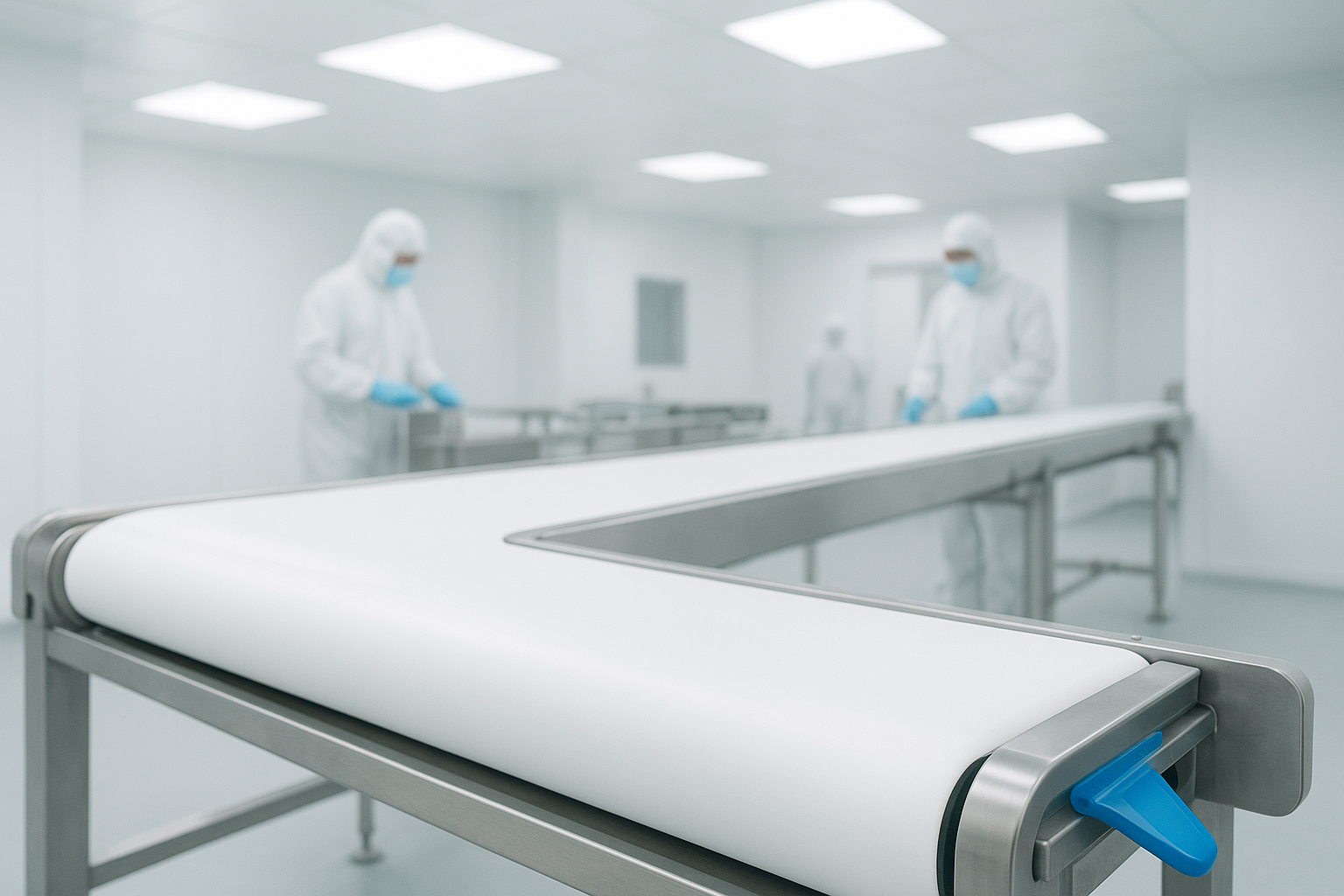
Clean-room production punishes anything that sheds particles or hides residue. That’s why many engineers specify homogeneous (monolithic) thermoplastic belts with closed surfaces and positive-drive options instead of fabric-reinforced or open modular designs. One caveat up front: vendors rarely publish ISO 14644 particle-generation ratings for belts. Most facilities validate cleanliness at the system level. This guide focuses on five widely used hygienic families and the practical factors that drive a good choice in 2025: cleanliness expectations, sanitation efficiency, regulatory fit, mechanical limits, environmental resistance, and ESD options.
Before we compare brands, think of the belt as one link in a hygienic system. Materials, surface finish, sprockets/pulleys, scrapers, and frame geometry all matter. If you’re new to monolithic TPU and why it helps with low shedding and easy washdown, see an overview of TPU in food‑grade belts on your spec side for context: the brief material primer at TPU belts.
How to choose, fast
- Define the environment: ISO class target, airflow, humidity, and whether ESD control is required; specify any need for closed, ultra-smooth surfaces.
- Map sanitation: CIP vs. manual, cleaning frequency/duration, chemistries, and maximum water temperature; note scraper use and access for lift-and-clean.
- Check mechanics: drive type (positive vs. friction), minimum sprocket/pulley diameters, profiles/flights/sidewalls, and transfer gaps; confirm compliance stack (FDA/EU) and run a facility‑level validation plan.
Scenario picks (what tends to work)
- ISO 5–6 electronics/medical assembly: Favor fully closed, smooth surfaces and request belt-specific ESD data (surface resistivity and test method). Positive drive reduces tension and micro-abrasion. You’ll likely need facility validation for particles regardless of brand.
- ISO 7–8 food packaging/post‑process: Prioritize rapid sanitation and scraper-friendly surfaces. Positive-drive, monolithic TPU belts with documented cleaning outcomes can shorten downtime. Who doesn’t want fewer hours on the hose?
- High humidity/aggressive sanitation: Choose hydrolysis‑resistant TPU compounds and confirm chemical/temperature limits. Min diameters increase as belts stiffen in the cold.
- Tight transfers/small pulleys: Friction‑drive monolithic options can accommodate smaller pulleys at the cost of some sanitation/drive advantages; verify minimums per datasheet.
Quick head‑to‑head
| Product family | Construction / drive | Strengths | Constraints | Notes (temp/compliance/ESD) |
|---|---|---|---|---|
| Intralox ThermoDrive | Homogeneous thermoplastic; tensionless positive drive | Closed surfaces; broad material set; strong, quantified sanitation case studies | Series-specific sprockets; confirm SKU‑level compliance; ESD values provided on request | Material options span PU to A23/HTL/Cold Use; temperatures by series; see the ThermoDrive materials overview in Intralox’s documentation |
| Habasit Cleandrive | Monolithic TPU; positive‑drive and friction‑drive | Scraper‑friendly; small pulleys feasible in friction‑drive; aramid reinforcement options | Positive‑drive has minimum pitch diameters; limited public quantified sanitation data | Engineering guide and PDS list minima and compliance; see Habasit’s monolithic belts engineering guide (2024) |
| Ammeraal Beltech Soliflex (PRO/CB/FB) | Homogeneous TPU/TPEE; positive‑drive variants | Hygienic design focus; FDA/EU/USDA references | Many specs gated via reps (ask for exact temp/pitch/approvals); ESD data not public | See Soliflex context on Ammeraal Beltech’s Food Safety page |
| Volta SuperDrive / Mini | Extruded monolithic TPU with integrated teeth | Robust positive drive; hydrolysis‑resistant DR compounds; thorough technical manual | Larger minimum pulley diameters vs. some friction‑drive belts; ESD metrics not public | Tooth pitch 39.7 mm; detailed MPDs in Volta’s SuperDrive Technical Manual (Feb 2024) |
| Forbo Siegling Fullsan (and hygienic Prolink) | Homogeneous TPU family; positive/friction variants | Smooth, scraper‑friendly surfaces; profiles/sidewalls; engineering guidance | Temp limits vary; request product datasheets; ESD metrics not public | Design ranges and approvals in Forbo’s Fullsan Engineering Manual |
Product capsules (alphabetical order)
Ammeraal Beltech Soliflex (PRO/CB/FB)
Soliflex belts are single‑piece homogeneous designs in TPU/TPEE with positive‑drive variants. The line’s message centers on cleanability and food safety, with FDA/EU/USDA references for applicable SKUs. Many critical parameters—temperature ranges, sprocket pitch and diameters, and exact approvals—are provided on product datasheets via local representatives, not typically on public pages. That’s workable in regulated environments where you’ll request code‑specific documents anyway. Constraint: lack of public ESD metrics and readily downloadable PDS pages means more vendor interaction up front. See the hygienic program context on the Food Safety page.
Forbo Siegling Fullsan / Prolink (hygienic)
Fullsan is Forbo’s homogeneous TPU family with positive‑ and friction‑drive offerings and accessories like profiles and sidewalls. The engineering manual provides useful integration guidance and indicative temperature ranges by sub‑family; final limits live on product datasheets. For compliance, Forbo documents FDA/EU/MHLW applicability by code on certification pages. Constraint: public ESD values aren’t listed, and some temperature specifics require code‑level datasheets. For integration context, consult Forbo’s Fullsan Engineering Manual.
Habasit Cleandrive
Cleandrive spans two architectures: positive‑drive monolithic TPU and friction‑drive monolithic TPU. Friction‑drive models allow notably small pulleys (e.g., 25–30 mm minima on some codes), useful for tight transfers; positive‑drive variants specify minimal pitch diameters by series and command better tracking and sanitation characteristics in many applications. Compliance is addressed at the PDS level (EU 1935/2004, EU 10/2011, and FDA suitability where applicable). Constraint: quantified sanitation time/water data isn’t commonly published; plan to validate on your line. For technical baselines and code‑level minima, see Habasit’s monolithic belts engineering guide (2024).
Intralox ThermoDrive
ThermoDrive is a homogeneous, tensionless positive‑drive platform with several material families that target different environments: general polyurethane, hydrolysis‑resistant A23 for warm/damp zones (higher heat capability), HTL for high‑temperature heavy load, Dura for impact, and Cold Use for low ambient conditions. A distinct advantage here is the volume of published, quantified sanitation outcomes—case studies report 50–75% reductions in cleaning time and measurable water/chemical savings in food post‑process lines. Constraint: exact food‑contact compliance is SKU‑specific; confirm via Material Compliance documentation, and request ESD values if needed. See the materials overview in Intralox’s ThermoDrive documentation and an example outcome such as a 75% cleaning time reduction noted in the 2023 poultry case study summarized on Intralox’s Senpilic case page.
Volta SuperDrive / Mini SuperDrive
Volta’s extruded monolithic TPU belts integrate drive teeth (positive drive) and are documented in a detailed technical manual. The geometry is explicit (tooth pitch 39.7 mm, tooth height/width, and minimum pulley diameters by belt thickness and flex direction). Volta also emphasizes DR hydrolysis‑resistant compounds for harsh sanitation and humid conditions, useful for high‑moisture lines. Constraint: minimum pulley diameters are generally larger than some friction‑drive monolithic options, and public ESD values are not listed—ask for code‑specific data. For integration numbers and selection tables, consult Volta’s SuperDrive Technical Manual (Feb 2024).
System hygiene matters as much as the belt
A smooth, closed belt surface isn’t enough if the conveyor structure harbors residue. Pair belts with sanitary frames, properly shielded return runs, scraper designs that won’t gouge or abrade, and corrosion‑resistant components. If you’re mapping a hygienic retrofit or new build, review complementary components such as sanitary idlers and—when drives are external—sanitary pulley assemblies. For material context across monolithic TPU families, the brief material primer at TPU belts can help align specifications before you request vendor datasheets.
Validation checklist you can run this quarter
- Particle and ESD: Request belt‑code certificates for food contact, plus ESD surface resistivity with test method (e.g., IEC 61340-5-1 or ASTM D257) where static control is required; perform facility particle checks in situ.
- CIP trials: Time a full cleaning cycle on your line before/after changeover; measure water and chemical use; inspect for residual soils under UV or ATP where allowed.
- Mechanical fit: Verify minimum sprocket/pulley diameters at the coldest operating point; confirm tooth pitch compatibility and scraper clearances; check transfer gaps and profile heights.
Also consider (related alternative)
Disclosure: BisonConvey is our product.
If you need application‑driven guidance across homogeneous TPU belts and matching hygienic components, you can also consult BisonConvey’s engineering team and product range. A neutral starting point is the materials and monolithic options summarized here: BisonConvey conveyor belts. The company also supplies sanitary idlers and pulleys for system‑level hygiene.
Bottom line
There isn’t a single “best” belt for every clean‑room. Instead, match the belt’s construction and drive to your ISO class, sanitation method, and mechanical footprint, then insist on code‑specific documents and run a validation in your own facility. When in doubt, ask vendors for ESD numbers, temperature/chemical limits, and cleaning outcome references—and verify those claims on your line before you scale.