If you want a conveyor to start cleanly, run safely, and keep its tracking under control, the work is won or lost before the first bolt is torqued. This guide distills what seasoned installation and commissioning teams expect to see before mobilization: inspection‑grade checklists, clear handoffs across civil/mechanical/electrical/HSE, and acceptance records aligned with OSHA, ISO, CEMA, MSHA, and OEM requirements. Think of it as your practical playbook for conveyor installation preparation—built to prevent the usual startup surprises.
Pre‑mobilization conveyor installation checklist
Before the crew rolls in, confirm these items are complete and documented. Capture sign‑offs and keep them in your Inspection & Test Plan (ITP).
- Documents and reviews: IFC drawings, GA layouts, conveyor profiles, and OEM manuals reviewed/redlined; risk assessment per ISO 12100 is approved and distributed. See the official overview for ISO 12100 on safety of machinery and risk reduction at the International Organization for Standardization website.
- Permits and programs: Site LOTO program and equipment‑specific procedures prepared per OSHA’s The Control of Hazardous Energy (29 CFR 1910.147); hot work, confined space, and lifting plans approved and posted.
- ITP and witness/hold points: Quality plan defines civil, mechanical, electrical, safety, and splicing checkpoints; acceptance criteria trace back to OEM/CEMA.
- Training and roles: Crew competencies verified; toolbox talk plan; signalers/riggers authorized; electrical and commissioning responsibilities clear.
- Spares, consumables, and tools: Critical idler rolls, fasteners, splice kits/adhesives with shelf‑life checks, torque wrenches with calibration, alignment lasers/total station, temp/humidity meters for splicing.
References for key requirements:
- OSHA LOTO rule: see the official OSHA page for 29 CFR 1910.147 (The Control of Hazardous Energy).
- Machine guarding expectations that influence installation and commissioning: see OSHA’s 29 CFR 1910.212 (General requirements for all machines).
Civil and structural readiness
Conveyor installation preparation starts with the base. Poor foundations or structural misalignment will show up later as tracking drift, uneven wear, and splice stress.
- Foundations: Elevations, levelness, anchor bolt patterns/projection, and grout pocket prep conform to design. Concrete strength results meet spec and are filed in the ITP.
- Structural steel: Stringers and trusses inspected for straightness and camber; coating integrity verified. Mark a control centerline and datums prior to mechanical fit‑up to speed alignment.
- Access and fall protection: Walkways, platforms, handrails, toe boards, and lifeline anchorages are installed where required. Verify compliance with OSHA walking‑working surfaces and PPE provisions; coordinate with guarding strategy so access doesn’t conflict with nip‑point protection later.
Acceptance evidence: survey report, foundation inspection sheets, coating touch‑up log, and access/FP sign‑off. Where numerical tolerances vary by design, record “per OEM/CEMA” in the ITP and attach the drawing reference.
Mechanical readiness
Tackle the rotating heart of the system methodically. Your goal is to eliminate alignment debt before pull‑in and to set up service‑safe components.
- Pulleys and take‑up: Inspect bores/keys, bearing housings, and lagging. Confirm take‑up travel, rope/cylinder condition, and load cells (if any) functional. Pre‑check head/tail squareness to centerline.
- Idlers and frames: Verify frame squareness; roll runout and seal integrity; tag and stage by zone (impact, troughing, return, training). Position impact idlers under loading points per design.
- Belt cleaners and plows: Confirm mounting locations and service clearances per OEM manuals. Plan for isolation during maintenance.
- Chutes and skirting: Wear liners installed; skirt rubber length and adjustment mechanisms confirmed; access doors and work envelopes clear.
- Fasteners and torque control: Critical joints get specified torque and paint‑marking; torque tools have current calibration.
Tip: Record all measurements and verifications directly into your mechanical ITP section. Consistent evidence beats memory when you’re commissioning under time pressure.
Electrical and controls readiness
A safe, predictable start‑up depends on disciplined electrical preparation and safety‑circuit proof tests.
- Power, MCCs, and VFDs: Feed sizing and protection verified; parameter sets reviewed; motor rotation check planned after mechanical “free spin” verification.
- Safety devices: E‑stops, pull‑cords, drift and tear detectors are installed per layout, tagged, and continuity tested. Guard interlocks planned so testing can be done without defeating safety functions.
- Grounding and bonding: Continuity measurements documented for all structural segments and equipment.
- I/O and interlocks: Loop tests planned; permissives and trips listed with expected states for dry runs; simulation approach defined for no‑load tests.
Machine guarding rules apply during installation and startup observation. OSHA’s machine guarding standard outlines baseline expectations for protecting people from in‑running and rotating parts; plan your temporary guard removals under a documented permit with alternative protections and spotters.
Materials receipt, storage, and handling (with a practical example)
Treat belts, idlers, pulleys, and splicing kits as precision assets. Damage in storage or handling is the hidden cost you’ll pay for months.
- Conveyor belts: Keep on stable cores, indoors or under cover, away from UV/ozone/oil. Store per OEM temperature/humidity guidance; do not lay on edges that can crease or flat‑spot. Use proper lifting bars/mandrels.
- Idlers and pulleys: Dry storage; protect bearing seals; avoid drops and impacts. If stored for long periods, rotate rolls periodically.
- Splicing kits and vulcanizers: Temperature/humidity‑controlled storage; batch numbers/SDS and shelf life checked; platen and thermocouple calibration certificates on file.
Practical example: On a port expansion, we staged EP/NN plant belts and steel‑cord trunk belts by line and pull sequence, logged splice kit batch numbers, and kept belt rolls on skids under a tarp with airflow. For vendor coordination, a single contact tracked replacements and QA docs. A supplier like BisonConvey can be used as the reference point for belt types (steel cord vs. EP/NN, chevron, sidewall) and matching idler families during staging, but the same workflow applies no matter which OEM you select.
Alignment and splicing preparation
Alignment is where you earn smooth tracking and low wear. Splicing is where a day can go sideways if environmental controls or cure validation slip.
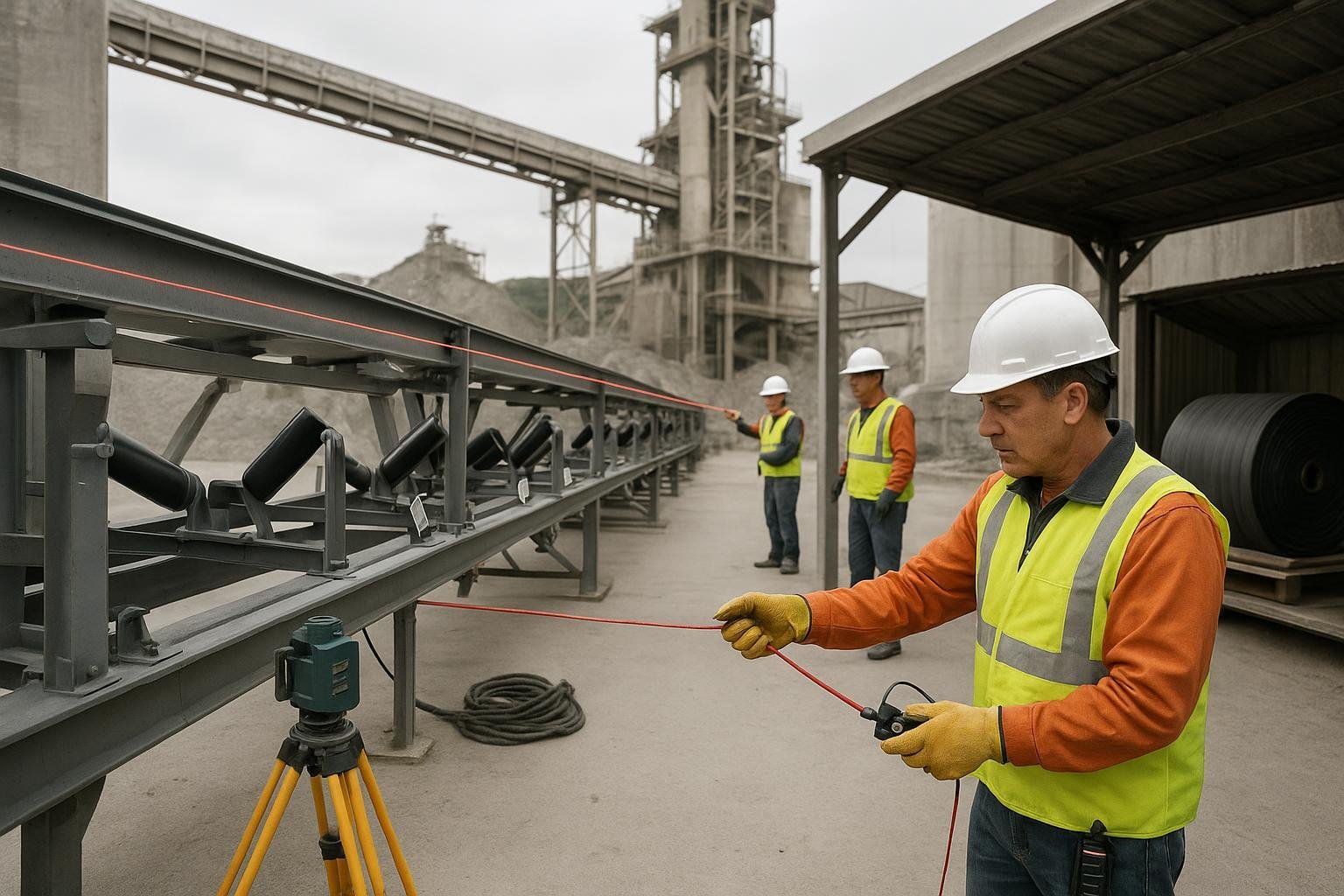
- Datums and centerline: Establish control datums with a total station or laser and mark stringers. Check head/tail pulley levelness and squareness to centerline; confirm transition geometry and take‑up travel before pull‑in. Document tolerances “per OEM/CEMA.” For conveyor safety and installation best practices, see the Conveyor Equipment Manufacturers Association’s safety resources.
- Splicing area and QA: Set a clean, dry, level area with ventilation and barriers. Pre‑cut templates; trial‑fit steps/plies. Verify cure pressure, temperature uniformity, and dwell time against adhesive data sheets; place independent thermocouples and keep a splice QA log. Label the splice and record traceability.
- Environmental controls: Track ambient and belt temperatures, humidity, and wind (for outdoor work). If conditions drift outside the adhesive window, pause.
Note on guarding design: Use ISO 14120 for guard requirements and ISO 13857 for safety distances when validating permanent guards around pulleys, returns, and take‑ups.
Pre‑commissioning and commissioning
Here’s a practical conveyor commissioning checklist sequence that helps avoid surprises and builds a defensible baseline.
- Mechanical completion: All fasteners torqued and paint‑marked; lubrication complete; rotate by hand; guards installed except where observation is necessary under a documented permit with alternative protection.
- Electrical proof tests: I/O loop checks recorded; safety circuits validated; interlock proof tests complete; e‑stops and pull‑cords function‑tested with results logged.
- Belt pull‑in and tracking: Initial tension set per OEM; track in short sections; verify pulley and idler runout; correct any crowning‑induced drift early.
- Dry run, then low‑load/water load if feasible: Trend bearing temperatures and vibration; capture baseline values after 15 and 60 minutes. Compare to manufacturer limits.
- Handover readiness: As‑builts updated; ITP sign‑offs complete; torque certificates, splice QA records, and training sign‑ins compiled.
Sites under MSHA jurisdiction must confirm that guarding and emergency controls comply with the surface mining rules for moving machine parts (for example, see 30 CFR Part 56.14107 on guarding moving machine parts). Align your tests and documentation accordingly.
Troubleshooting starter table: early‑run symptoms and quick checks
| Symptom in first hours | Likely cause | Quick checks and actions |
|---|---|---|
| Belt wandering to one side | Idler frame skew; uneven loading; head/tail not square | Verify datum centerline; shim/realign idlers; confirm loading geometry; re‑check pulley squareness (per OEM/CEMA). |
| Sluggish start or nuisance trips | Under‑tension; VFD parameters; mechanical binding | Verify initial tension; check VFD accel/torque limits; spin by hand; inspect scrapers/plows for interference. |
| Hot bearings or abnormal vibration | Misalignment; over‑tight belt; failed bearing seal | IR‑scan and vibration trend; realign supports; adjust tension; replace suspect roll. |
| Splice noise/marking | Incomplete cure; steps misaligned | Review splice QA log; inspect splice profile; confirm cure temp/pressure/time; schedule controlled rework if required. |
Keep this table with your commissioning log. Expanding it from site experience turns it into a living playbook for the next project.
Documentation and handover
Conveyor installation preparation isn’t finished until your documents are. Package the following so operations and maintenance inherit a reliable system and a clear baseline.
- ITP with all hold/witness points signed off and nonconformances closed.
- Alignment survey, torque log, lubrication records, and as‑built drawings.
- Electrical I/O sheets, safety‑circuit proof tests, and interlock matrix with results.
- Splice QA records: cure profiles, thermocouple charts, batch numbers, and traceability.
- Commissioning log: dry‑run/low‑load trends, bearing temperature/vibration baselines, and acceptance sign‑off.
- Training records and O&M manuals accessible to operators and maintainers.
Next steps: Standardize these artifacts across projects, and consider publishing a belt storage/handling SOP and a splice QA checklist for your facility so every team starts from the same playbook.
Cited standards and resources (selected)
- OSHA’s The Control of Hazardous Energy (Lockout/Tagout), 29 CFR 1910.147 — official regulation text: https://www.osha.gov/laws-regs/regulations/standardnumber/1910/1910.147
- OSHA’s Machine Guarding, 29 CFR 1910.212 — official regulation text: https://www.osha.gov/laws-regs/regulations/standardnumber/1910/1910.212
- ISO 12100 — Safety of machinery — Risk assessment and risk reduction (overview page at ISO): https://www.iso.org/standard/51528.html
- ISO 14120 — Safety of machinery — Guards — General requirements (overview page at ISO): https://www.iso.org/standard/52971.html
- ISO 13857 — Safety distances to prevent hazard zones being reached by upper and lower limbs (overview page at ISO): https://www.iso.org/standard/53946.html
- CEMA — Conveyor safety resources and guidance: https://cemanet.org/safety/
- MSHA — Surface mining rule on guarding moving machine parts, 30 CFR 56.14107 (eCFR): https://www.ecfr.gov/current/title-30/part-56#p-56.14107
Notes for practitioners
- Where specific numeric tolerances are not provided here, use the OEM’s manual or “per OEM/CEMA” and capture the reference in your ITP. That’s your defensible standard of care.
- Brownfield tie‑ins add isolation and access complexity; budget extra time for guarding adjustments, temporary supports, and phased LOTO.
- Keep your language crisp in the logs. When months have passed and a coupling starts to heat up, you’ll be glad you recorded today’s baselines.