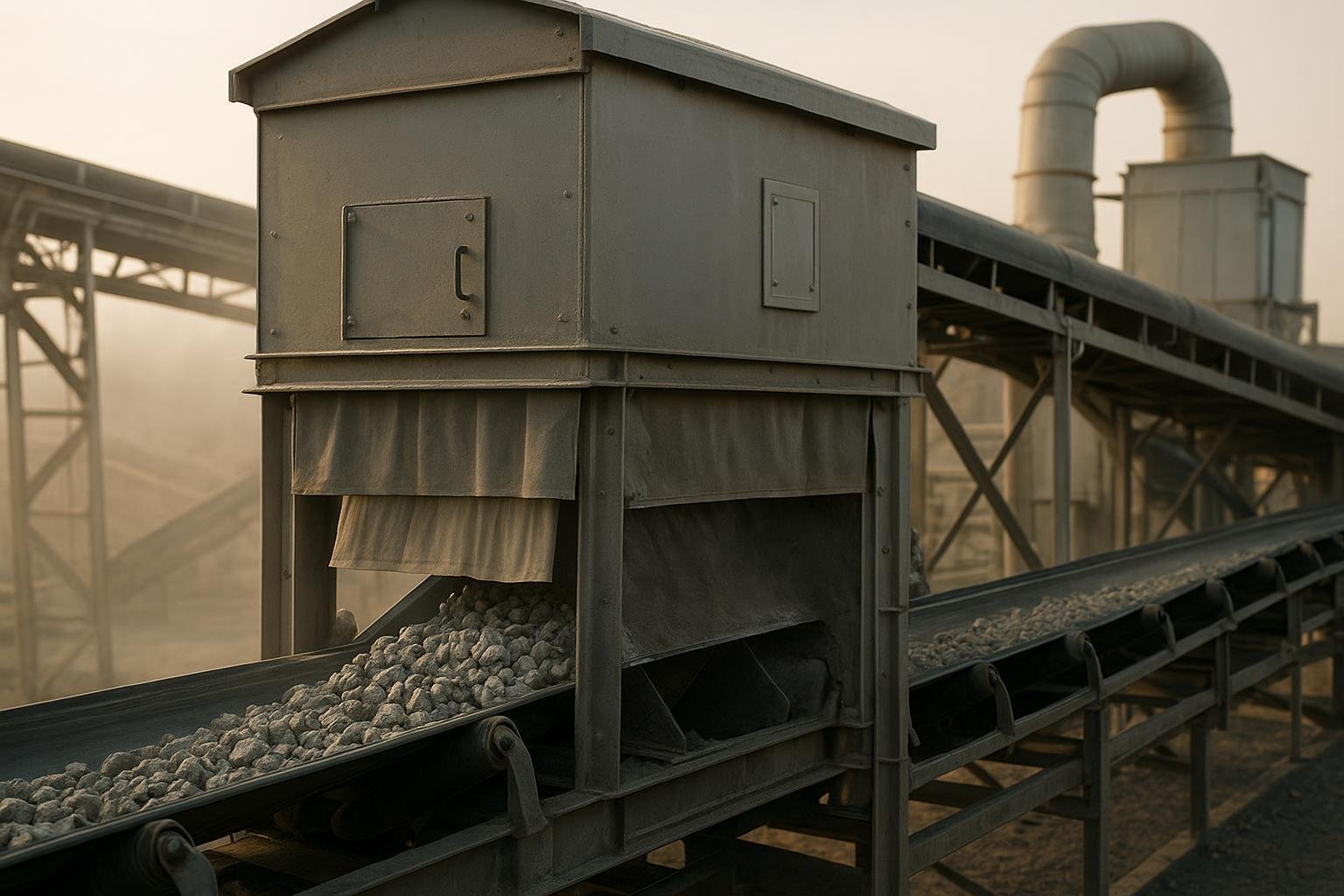
Fine dust from belts and transfer points doesn’t just coat guardrails. It finds lungs, fouls bearings, blinds sensors, and steals uptime. The good news: most plants already have 70–80% of the puzzle pieces—skirting, covers, sprays, and a collector—but they’re often under‑sized, mis‑placed, or poorly maintained. This guide distills practical, standards‑aligned methods to get results you can measure and defend during audits. In short, dust control for conveyor systems is achievable with layered controls and disciplined maintenance.
Why dust control matters
Uncontrolled dust increases wear, cleanup costs, and exposure risk. In mining, the Mine Safety and Health Administration (MSHA) finalized a respirable crystalline silica rule that sets a permissible exposure limit (PEL) of 50 µg/m³ and an action level of 25 µg/m³ with compliance dates into 2025–2026. For details and applicability, see the MSHA silica final rule overview (2024 slides) and the Federal Register rule summary (2024).
General industry employers face the same numeric thresholds under OSHA’s silica standards. OSHA reinforces monitoring, engineering controls, and training; see the agency’s explanatory materials in the OSHA respirable crystalline silica publications page.
From an environmental perspective, EPA fugitive dust programs and many state implementation plans (SIPs) expect controls at transfer points and may specify opacity thresholds. For control menus and audit methods, EPA’s own guide on fugitive dust control best practices (2022) is a practical reference.
How to combine dust control for conveyor systems
Think in layers. You’ll get the biggest step‑change by combining:
- Containment at transfer points (skirting, curtains, covers, tight chutes)
- Suppression (water or mist where appropriate)
- Local capture and filtration (LEV to a fabric filter)
- Mechanical controls that cut dust at the source (belt cleaning, support)
Each layer reduces the load on the others. Miss one, and the rest work harder.
Transfer‑point containment that actually seals
Most airborne dust starts at the loading zone. Aim to keep air calm, gaps tight, and the material stream stable.
- Belt support at impact: Use impact beds or closely spaced impact idlers under the loading zone so the belt profile stays steady. A steady belt lets skirting maintain a consistent, small seal gap.
- Dual skirting and skirtboards: Self‑adjusting seals reduce leakage even as the belt or liners wear. Set contact pressure for the conveyed material so you avoid burning the seal or leaving daylight.
- Dust curtains and drop management: Curtains or baffles reduce entrained air and turbulence. If possible, reduce drop height to cut kinetic energy and air induction.
- Covers and partial enclosures: Low‑profile covers over approach/departure and tight chute doors limit leakage paths. Plan inspection doors and sight windows so crews keep them closed during operation.
Enclosures and ventilation: design, don’t guess
If you enclose a transfer point, extract the leakage you’ve contained. Treat the enclosure like a small hood: size airflow using the opening area and a reasonable capture or face velocity, then keep duct transport velocity high enough to avoid settling. A practical starting framework comes from the mining community’s reference text, the NIOSH Dust Control Handbook (2019-124), which lays out principles and examples (e.g., Q = V × A) along with layout and leakage‑management practices.
Pragmatic tips:
- Keep openings as small as operations allow; fit overlapping doors and compressible seals.
- Place extraction near expected plume paths; avoid pulling coarse material.
- Provide differential pressure or airflow indication so operators see when the system drifts.
Suppression: match droplets to the problem
Water works when the goal is to knock down airborne fines and keep surfaces damp—without flooding chutes or creating carryback. The principle is simple: aim for droplet sizes that interact with the target dust fraction, and place nozzles where dust forms (free‑fall stream, impact zone, discharge). Vendor literature commonly cites atomized ranges in the tens to a few hundred microns for airborne capture; treat those numbers as a starting hypothesis and validate on site using observation and sampling. NIOSH summarizes placement and wetting concepts in its mining guidance; see the NIOSH Dust Control Handbook for context.
Cold weather and water management matter:
- Freeze season: Heat‑trace/insulate lines and pump skids; throttle or suspend sprays when temperatures and wind create icing risks. Consider foams or alternative suppressants when deep‑freeze persists. Cost/operations context appears in EPA control manuals for wet systems; see the EPA Control Cost Manual – wet/dry scrubbers notes.
- Wastewater: Provide settling and filtration, monitor pH/TDS, and route blowdown per permit.
Local capture and fabric filters (baghouses)
When suppression alone won’t cut it—or when you must avoid adding water—use local exhaust ventilation (LEV) from the enclosure to a collector. The EPA fabric filter operations chapter explains air‑to‑cloth, pressure drop, hopper discharge, and transport velocity in accessible terms.
Effectiveness varies by design and material. Enclosure‑style hoppers and transfer controls have shown large respirable dust reductions in field reports; one frequently cited enclosure system (analogous in function) reported reductions spanning roughly 40–90% depending on product size and setup in a NIOSH‑hosted study; see the NIOSH/Stacks case report on enclosure‑style loading. Use such figures as planning context, and confirm with your own baseline and follow‑up sampling.
Mechanical controls that cut dust at the source
Carryback and spillage become tomorrow’s airborne dust. Keep belts clean and material contained.
- Belt cleaners: A proper primary cleaner at the head pulley, backed by a secondary on the return run, reduces carryback. Inspection points, blade wear checks, and tensioning are routine tasks documented in neutral technical primers like the Martin Engineering belt cleaning basics.
- Skirting/seals and liners: Check contact, fasteners, and wear. Re‑set before gaps appear.
- Idlers and support: Impact idlers in the loading zone and well‑aligned return idlers limit bounce and micro‑gapping that ejects fines.
Monitoring and KPIs: prove it worked
What gets measured gets funded. Pair qualitative audits with quantitative sampling. How will you demonstrate that last month’s retrofit isn’t just “less dusty,” but compliant and repeatable?
- Visual methods: EPA’s fugitive dust guide summarizes practical use of Method 22 (presence/absence) and Method 9 (opacity) for field checks at transfer points and along conveyors. See the EPA fugitive dust best practices (2022) for procedures and examples.
- Exposure and area sampling: For worker protection, task‑based personal sampling and area monitors around transfer stations give hard numbers in mg/m³. NIOSH methods and mining handbooks cover filters, pumps, and interpretation within industrial hygiene programs; foundational concepts appear in the NIOSH Dust Control Handbook.
Useful KPIs include: pre/post respirable dust concentrations, visible emissions audit scores, carryback residue mass per area at fixed stations, housekeeping hours per week, nozzle uptime and flow checks, and baghouse differential pressure trends with bag life. Ask yourself: if a regulator or plant manager reviewed last quarter’s logs, would the data show sustained control—not just a one‑week improvement?
Maintenance keeps controls working
Controls drift. Plan light, frequent touches rather than heroic quarterly overhauls.
- Inspection cadence: Many plants succeed with weekly quick looks (doors shut, seals intact, spray pattern acceptable, DP in range) and bi‑monthly deeper checks (cleaner blade wear, tension, skirting pressure, impact bed hardware, duct buildup, enclosure leakage).
- Housekeeping: Vacuum settled fines at transfer points and under returns; prefer HEPA vacuums to dry sweeping to avoid re‑entrainment (consistent with EPA/NIOSH guidance).
- Spares and change‑out rules: Keep cleaner blades, seal segments, nozzles, and door seals on hand. Define runtime‑based or condition‑based triggers (e.g., replace blades when carryback at a reference station exceeds your site threshold for a defined period).
Quick specification checklist
| Item | What good looks like | Why it matters |
|---|---|---|
| Loading‑zone belt support | Impact bed or close‑spaced impact idlers matching belt width and drop energy | Stabilizes belt for tight skirting seal |
| Dual skirting & skirtboards | Self‑adjusting seals, correct contact pressure, easy adjustment access | Limits leakage; keeps seal gap consistent as wear occurs |
| Enclosure & access | Small, sealed openings; overlapped doors; sight windows | Reduces leakage paths; encourages doors to stay closed |
| LEV sizing & ducting | Airflow sized from opening area (Q = V × A); maintain transport velocity; DP indication | Captures leakage and keeps dust in suspension to the collector |
| Suppression | Nozzle type/placement to match dust source; heat‑trace in freeze zones; water quality filtration | Knocks down airborne fines without flooding |
| Belt cleaning | Primary + secondary cleaners with easy tension checks; documented inspection cadence | Cuts carryback—the root of much spillage and dust |
| Monitoring | Visual (Method 22/9 context) + personal/area sampling; KPI dashboard | Proves effectiveness and supports compliance |
Example retrofit: sealing a troublesome transfer point
A quarry’s secondary crusher discharge was loading a 1,000‑mm belt and coating everything down the line. Here’s a practical, vendor‑neutral workflow that mirrors what many plants implement:
- Stabilize the loading zone with an impact bed sized to the belt width and drop energy. Verify that the belt trough matches the bed profile.
- Install dual skirting with self‑adjusting seals and set contact pressure based on abrasiveness. Add a rubber dust curtain above the impact area to calm air.
- Fit low‑profile covers on the approach and departure, and convert the chute into a compact enclosure with overlapped access doors and compressible seals.
- Add an extraction takeoff duct near the natural plume path inside the enclosure and route it to an existing fabric filter. Size airflow using opening area and target capture/face velocity; verify transport velocity in the duct. Add a simple DP gauge.
- Apply targeted sprays at the impact zone to reduce airborne fines when temperatures allow. In freezing months, rely on enclosure + LEV and switch spraying schedules accordingly.
- Tighten belt cleaning at the head pulley with a primary and a secondary cleaner; document a weekly visual and a bi‑monthly detailed check.
Where it’s helpful to identify off‑the‑shelf components, a supplier like BisonConvey can provide impact beds, dual skirting, low‑profile covers, idlers, pulleys, and belt cleaners that fit common belt widths and troughing angles. Keep expectations neutral and performance‑based: specify by function (seal gap tolerance, bed geometry, cleaner compatibility with splices) and verify on site.
Cost and total cost of ownership (TCO)
Budget conservatively for capital and operating costs, then track savings so the next project is easier to approve. Dust control for conveyor systems delivers ROI when you target your dominant loss mechanisms.
- Capital: Enclosures, doors, skirting, impact beds, covers, extraction takeoffs, ductwork, and collector capacity. Sprays usually cost less upfront but may need heat tracing and water treatment.
- Operating: Water/energy, bag changes and DP‑driven maintenance, cleaner blades and seals, and modest housekeeping. Expect electricity for fans and pumps.
- Savings: Reduced housekeeping hours, fewer idler/bearing failures, less spillage cleanup, fewer nuisance stops, and lower PPE exposure time near transfers. Many plants see short paybacks when carryback and cleanup dominate current costs. The question to ask is simple: what does an hour of unplanned cleanup or lost production really cost here?
Putting it together
Start with one transfer point. Baseline dust and cleanup time, then implement containment, add or tune sprays, and—if needed—extract to a baghouse. Verify with visual audits and mg/m³ sampling, adjust, and lock in maintenance. When the data shows a win, copy the recipe down the line. If you want component drawings or a neutral bill of materials reviewed for your next retrofit, a quick note to BisonConvey can get you application‑driven options without the sales fluff.
References for deeper design work and audit prep include the MSHA silica final rule overview (2024 slides), the Federal Register rule summary (2024), OSHA’s silica publications, the EPA fugitive dust best practices (2022), the NIOSH Dust Control Handbook (2019-124), and the EPA fabric filter operations chapter.