When people ask “How much does a conveyor belt cost?” they’re usually staring at a stack of quotes that don’t match. The truth is simple: belt price moves with construction, width, rating, covers, patterns, and splice strategy—and those choices also change how long the belt lasts and what you’ll spend to run it. Think of sticker price as one line in a five‑year spreadsheet, not the whole story.
Quick answer with real ranges for conveyor belt cost
Below are indicative belt‑only ranges from recent trade sources. Use these as planning bands; actual quotes depend on width, tensile class, cover compound and thickness, patterning, and region.
- Fabric rubber belts (general industry): roughly $10–$50 per foot for lighter builds; wider, higher‑ply, and premium compounds can land higher within or above this band, per supplier explainers such as Bi‑State Rubber’s cost considerations (2024).
- Modular/plastic belts: often around $30–$100 per foot in typical light‑ to medium‑duty service per Bi‑State Rubber’s guide (2024).
- Wider, high‑tension steel cord or specialized profiles: quotes vary widely; public examples in GramConveyor’s pricing overview (updated 2026) show certain wide, steel‑cord configurations implying several hundreds of dollars per foot.
Two quick notes:
- Per‑meter discussions from Vitrans’ 2025 pricing posts can be used for conversions; always normalize by width, rating, and covers.
- Installed conveyor systems (frames, drives, controls, install) are a different budget category. For planning context, industry articles like JHFoster’s overview of installed conveyor system costs discuss full‑system budgeting; don’t confuse those numbers with belt‑only pricing.
| Belt family | Typical duty | Indicative belt-only price band (USD/ft) | Notes |
|---|---|---|---|
| Fabric rubber (EP/NN) | General plant, quarries | $10–$50 | Higher ply ratings, thicker abrasion or heat covers, and wider widths push higher |
| Modular/plastic | Food, packaging | $30–$100 | Material type and module design drive variance |
| Steel cord (ST ratings) | Long, high-tension runs | $150–$500+ | Wide widths and special compounds/profile belts can climb higher (per examples in public sources) |
All price ranges are indicative examples from public industry articles cited above. Always RFQ to spec for current pricing.
What drives conveyor belt cost
Construction and rating
Belt construction is the biggest lever. Fabric belts (EP/NN) suit a wide swath of plant applications at lower upfront cost. Steel cord belts (ISO 15236 ST classes) carry high tensions over long distances with low stretch but cost more per foot. Understanding designations—such as EP400/3 for a fabric belt or ST1400 for steel cord—is essential; overviews like the Conveyor Belt Guide’s designation page explain how ratings are expressed and what they mean for selection and price.
Width, length, and strength class
More width and higher strength mean more material and manufacturing complexity. It’s common to see step‑changes at certain width breakpoints where both belt mass and splicing/handling needs jump. Long belts can improve price per foot due to scale, but overall spend still scales with length.
Cover compound and thickness
Cover choice is a classic trade‑off. Abrasion‑resistant, heat‑resistant, oil‑resistant, or flame‑resistant compounds, plus thicker top covers (e.g., 6 mm vs. 4 mm), raise initial cost yet often extend service life. To compare apples to apples, note standards references—EN ISO 14890 abrasion classes (H, D, L) and DIN 22102 grades (X, W, Y, Z). Dunlop Conveyor Belting provides a clear summary of abrasion standards and test methods in its technical bulletin on abrasion standards.
Patterns and profiles
Chevron patterns, sidewalls, and cleats add manufacturing steps and materials, increasing price. They’re often essential for inclines or steep‑angle transport; budget accordingly.
Splicing choices
Mechanical fasteners are quick and lower‑cost to install but may have shorter service life in heavy‑duty service. Hot vulcanized splices cost more and require qualified labor and time, yet they generally deliver higher retained strength and longer life. Trade sources such as ASGCO’s splice overview and Flexco’s guidance on when to choose mechanical fasteners outline where each method fits.
From sticker price to TCO
Conveyor belts live inside systems. Your choice of belt changes energy draw, component wear, changeout frequency, and downtime risk. That’s why “conveyor belt cost” should be weighed against multi‑year operating economics.
Energy and rolling resistance
Indentation rolling resistance (IRR) in the belt‑idler contact zone can account for a large share of power consumption. Peer‑reviewed work reports IRR commonly representing about half or more of total conveyor energy, and shows how low‑rolling‑resistance cover compounds and idler geometry reduce kWh over time. For context, see a 2019 modeling paper discussing IRR’s ~60% share of power and active levers such as idler radius and belt viscoelastic properties in Wiley’s open‑access study on belt conveyor power models.
Idlers, pulleys, and alignment
If rollers are underspecified or spaced too widely, the belt deflects more, increasing IRR, wear, and tracking problems. Correct pulley lagging and alignment protect the belt and stabilize energy draw. Small upgrades here can extend belt life and lower operating cost.
Planned installation and changeouts
Budget for removal, vulcanizing, curing time, and re‑alignment. Planned changeouts cost less than emergency swaps because you control labor, lifting, and downtime windows.
Maintenance and downtime risks
Industry explainers emphasize that unplanned outages and chronic mis-tracking quickly dwarf the sticker price of a belt. Maintenance overviews—such as West River Conveyors’ discussion of hidden costs in outdated systems and Sparks Belting’s TCO perspective—advise focusing on proactive inspections, timely cover repairs, and component health to avoid costly interruptions.
Get comparable quotes every time
To reduce variance between quotes, send the same, complete specification to every vendor. Use this single checklist:
- Belt type: EP/NN fabric, steel cord, modular/plastic, or specialty (chevron/sidewall)
- Width and total length; edge type (molded or cut)
- Strength class: EP/NN ply rating (e.g., EP400/3) or ST rating (e.g., ST1400)
- Cover compound and thickness: top/bottom in mm; abrasion, heat, oil, flame grade with standards class
- Material handled: size, abrasiveness, temperature, oil/chemical exposure, moisture
- Conveyor geometry: incline angle, pulley diameters, minimum pulley wrap
- Splice preference: mechanical fasteners or hot vulcanized; onsite or shop splice
- Certifications: antistatic, flame‑resistant, food‑grade, MSHA as required
- Quantity and delivery: roll lengths, MOQs, lead time, shipment terms
A worked micro‑example buyers can adapt
Here’s a normalized example to show how two variables shift both upfront conveyor belt cost and five‑year economics. Assumptions: 36 in width; EP400/3; 6+2 mm abrasion‑resistant covers; ambient temperature; hot vulcanized splice; 500 ft length; continuous duty. Ranges are indicative and meant for comparison logic.
- Scenario A: Standard abrasion‑resistant compound, 6+2 mm covers. Based on public bands above, a 36 in fabric belt with these specs usually prices within the mid to upper end of the $10–$50/ft fabric range when normalized for width and cover thickness. Replacement cadence depends on duty severity and maintenance quality.
- Scenario B: Heat‑resistant compound with thicker top cover, same width and rating. Expect a higher initial $/ft due to compound and thickness premium. In hot service, the upgrade typically extends cover life and reduces crack/checking risk, improving TCO despite the higher sticker price.
Note: For long, high‑tension runs or steep/incline duties, moving to steel cord (e.g., ST1400) changes both $/ft and splice strategy. Public examples in GramConveyor’s pricing article show certain wide steel‑cord belts implying several‑hundreds‑per‑foot pricing. Vendors such as BisonConvey support both EP/NN and steel cord selections; in practice, you’d compare life‑of‑belt hours, splice life, and energy impacts alongside sticker price.
Sector pointers at a glance
Mining and quarrying
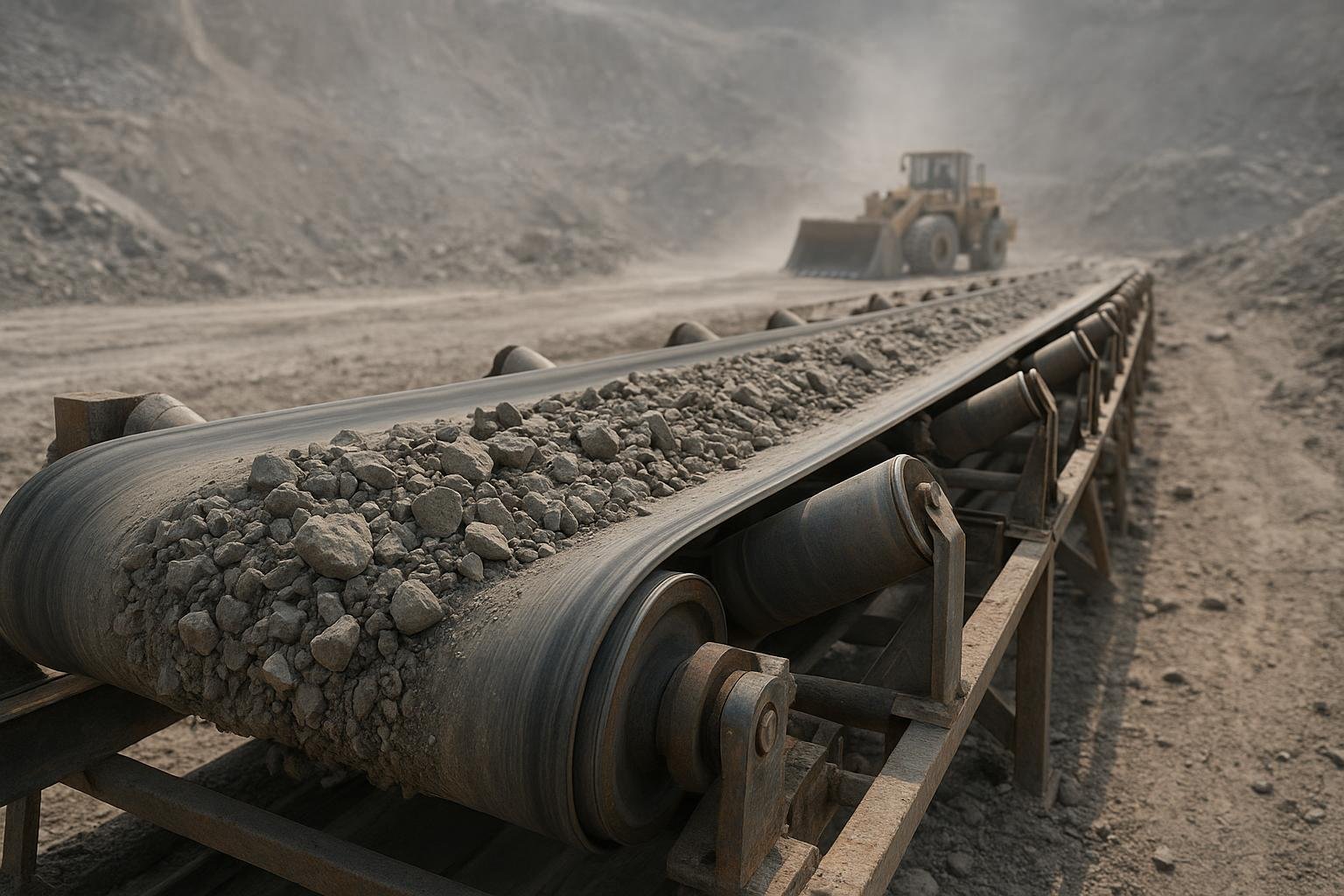
Highly abrasive ores and aggregates favor thick abrasion‑resistant covers; long overland conveyors often justify steel cord for tension control and low stretch. IRR‑focused belt and idler choices can shed meaningful kWh over years on energy‑intensive routes.
Ports and bulk terminals
Wide belts and high throughput push buyers toward durable covers and corrosion‑tolerant components. Small improvements in rolling resistance and pulley lagging repay quickly under continuous operations.
Cement, steel, and power
Heat‑resistant or flame‑resistant compounds are common. Dust control and safety certifications influence cover selection. Stable tracking reduces spill cleanup and premature edge wear.
Food and agriculture
Modular/plastic and food‑grade constructions dominate. Cleaning and sanitation drive material and design choices. Per‑foot costs are typically in the modular/plastic bands noted earlier, but hygiene standards and accessories add variance.
FAQs
What is the typical conveyor belt price per foot?
For fabric belts in general plant service, public 2024–2026 sources cite roughly $10–$50/ft as a planning band, while modular/plastic belts often run $30–$100/ft. Wide, high‑tension steel cord or specialized profile belts can be several hundreds per foot. Always RFQ to spec. See examples in Bi‑State Rubber’s guide and GramConveyor’s overview.
Why do quotes for the same width vary so much?
Because “same width” rarely means “same belt.” Ply count or ST rating, cover compound and thickness, edge type, profile patterning, and splice method all shift price. Ask vendors to state these parameters explicitly to compare like for like.
How do splicing choices affect cost and uptime?
Mechanical fasteners reduce upfront cost and install time but may shorten service life in heavy‑duty use. Hot vulcanized splices have higher labor/material cost yet typically retain more belt strength and run longer with fewer tracking issues, per ASGCO’s splice overview.
Is there a simple way to estimate total cost of ownership?
Start with the belt‑only quote, then add installation and changeout labor, planned downtime windows, splice life, energy draw (kWh affected by rolling resistance and idler condition), and routine maintenance. Studies summarized in Wiley’s belt conveyor power models paper show why material selection and idler choices influence energy over years.
How do per‑meter prices translate to per‑foot?
Divide per‑meter values by 3.281 to convert to per‑foot. Still, conversions are only half the story—normalize by width, rating, covers, and profiles. For public per‑meter context, see Vitrans’ 2025 pricing posts.
This guide used public, dated industry sources to frame indicative ranges and selection trade‑offs. When you request quotes, supply a complete spec and ask vendors to confirm standards, cover grades, and splice methods so you can compare true like for like.