A national e‑commerce distribution center faced a familiar bind: rapid SKU growth, peak‑season surges, and rising labor churn. The manual system—totes on carts, frequent fork‑truck touches, and ad‑hoc staging—capped throughput and created error‑prone handoffs. The project team set clear objectives: raise sustained carton rate at pack by 35–50% during peaks, cut touches between pick and ship, and enforce machine‑safety standards while keeping downtime risk low during cutover. The path chosen combined zoned accumulation conveyors, targeted sortation, and tight WMS→WES→PLC orchestration—balanced by disciplined safety and testing.
Where warehouse automation conveyors fit in this profile
For a high‑mix, small‑parcel e‑commerce DC, conveyors act as the spine. They stabilize flow from goods‑to‑person pick to pack, merge waves without collisions, and buffer during label or exception delays. Carts and forklifts are flexible, but they create variable cycle times and congestion at merges. By contrast, zero‑pressure accumulation (ZPA) keeps cartons separated in zones so product doesn’t bump, improving label readability and reducing damage. Public guidance describes ZPA as zone‑based control that releases product only when the downstream zone is free—a concept widely used for unit handling and tote/carton flow, as outlined in Bastian’s overview of accumulation systems in their conveyor content hub: see the ZPA concept in the Bastian Solutions conveyor page described in the Bastian ZPA overview. In robot‑enabled warehouses, trade press has also documented how compact accumulation loops feed workstations to enable “one‑touch” processing; Material Handling & Logistics reported a Lane Automotive example showing accumulation used to pace workcells, providing a useful motif for buffer design near pack and put areas, per the MMH Lane Automotive article.
Solution overview — conveyor types, controls, and sensing
The deployed line combined several elements:
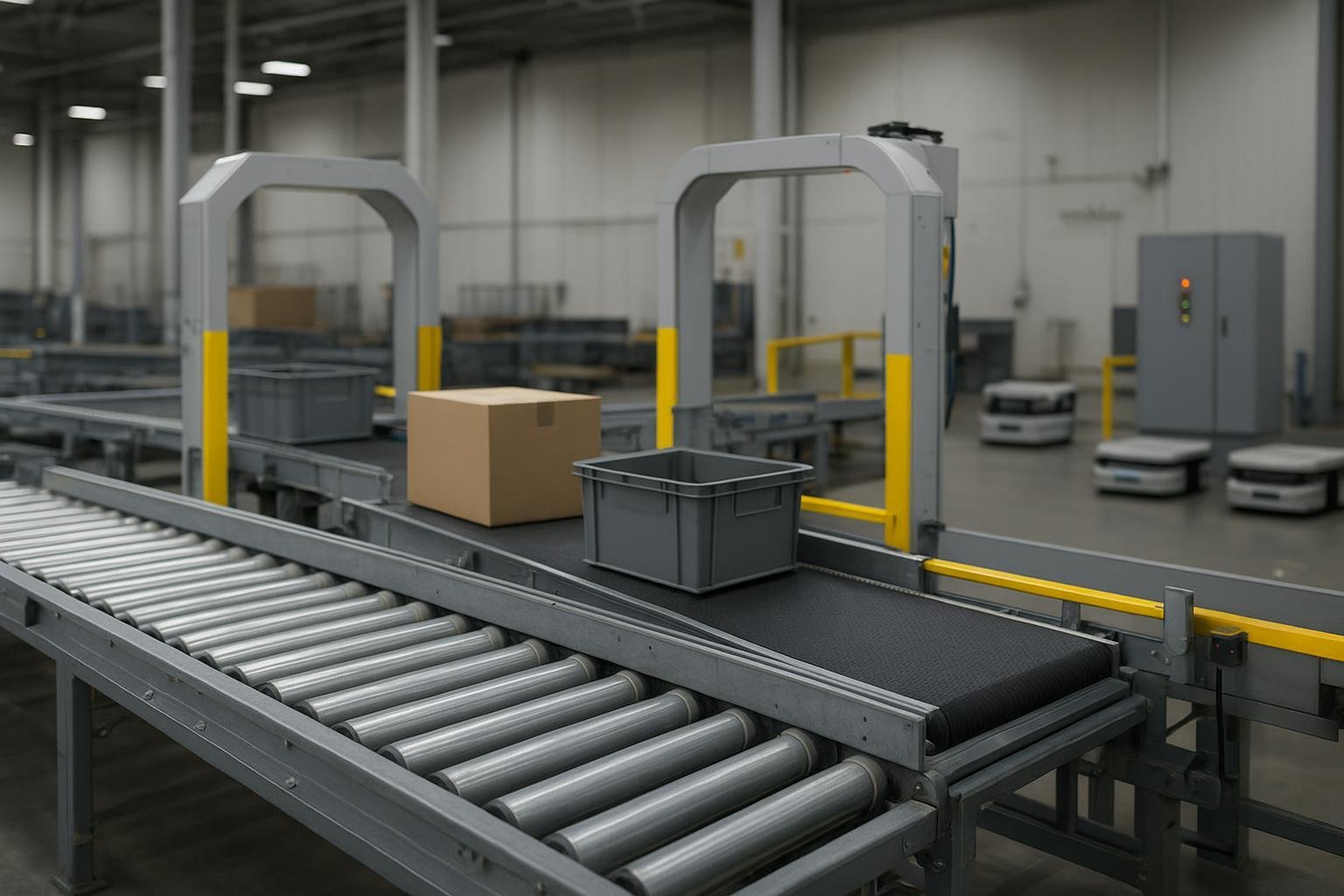
- Belt conveyors to bridge longer, straight runs and gentle inclines where uniform support reduces skew.
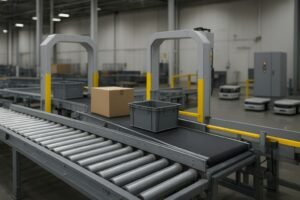
- Roller conveyors with ZPA for merges, induction to print‑and‑apply, and pre‑sort buffers, controlled by zone photoeyes.
- A compact sorter (pop‑up wheel/divert) to send cartons to carrier lanes, with barcode scanning upstream.
Controls and sensors knit this together. Discrete photoeyes provide zone presence; encoder counts inform speed matching; barcode readers and weight checks validate identity and route logic. ZPA often relies on distributed drives and intelligent controllers to modulate zone releases; Interroll’s controller family describes how local zone logic coordinates with higher‑level PLC/WES routing, clarifying the partition of responsibilities between zone control and plant PLCs, as described on the Interroll intelligent controls page. For context on ZPA fundamentals and platform capabilities (including AMR top‑module conveyor platforms), Interroll’s product documentation provides additional design cues; see the Interroll LCP catalog.
Integration architecture and handshake
Conveyor projects live or die on orchestration. A common pattern separates planning (WMS), real‑time orchestration (WES/WCS), and deterministic device control (PLC). Public vendor documentation explains this layering: a WCS/WES orchestrates material movement, while PLCs handle I/O and interlocks at the conveyor level, as summarized on the FORTNA WCS overview.
Think of the message flow like a relay race:
- WMS releases a wave or discrete tasks with carton IDs and destinations.
- WES/WCS assigns routes and time windows based on lane availability and SLA priorities.
- PLC executes zone moves, merge rules, speed, and divert actuations; local ZPA controllers handle gentle starts/stops.
- Events bubble back up: scans, weights, jams, e‑stops, completed diverts.
Illustrative pseudo‑handshake for a tote transfer (labels are examples, not vendor‑specific):
# WMS → WES
ALLOCATE(carton_id=12345, ship_lane=12, service_level=PRIORITY)

# WES → PLC/WCS
ROUTE_ASSIGN(carton_id=12345, path=INDUCT_2→MERGE_A→SORTER_B→LANE_12)

# PLC events upstream
SCAN_OK(carton_id=12345, read_point=INDUCT_2)
ZONE_RELEASE(zone=MERGE_A_Z3)
DIVERT_CMD(carton_id=12345, sorter=SORTER_B, lane=12)
DIVERT_OK(carton_id=12345, lane=12)

# Exception example
JAM_DETECTED(zone=MERGE_A_Z2)
JAM_CLEARED(zone=MERGE_A_Z2, by=OP_47, time=14:09)
This sequencing supports predictable merges and fast exception handling while keeping responsibilities clear.
Measurable outcomes and ROI framing
What can you expect without over‑promising? Industry coverage shows accumulation loops pacing workcells and reducing touches; the Lane Automotive example above provides qualitative validation for buffered flow near stations. In our archetype DC, success indicators included: steadier pack rates during peak, fewer recirculations at the sorter, cleaner label reads, and fewer manual re‑handles between pick and ship.
Rather than invent numbers, use a transparent ROI framing you can populate with your own data. Here’s a simple structure:
- Benefits: labor hours avoided (pick to pack), higher sustained cartons/hour (peak), lower mis‑sort/rework, reduced unplanned downtime minutes, and safer operations (fewer close calls at merges).
- Costs: CAPEX (conveyors, sortation, controls), installation and cutover, WES/WCS licensing/integration, maintenance spares, energy.
Sample ROI calculation (replace variables with your audited figures):
| Component | How to measure |
|---|---|
| Throughput delta | (Peak sustained cartons/hr with conveyors) − (baseline) |
| Labor savings | (Baseline labor hrs − post‑go‑live hrs) × fully loaded $/hr |
| Rework avoidance | (Baseline mis‑sorts − post‑go‑live) × cost per rework |
| Downtime reduction | (Baseline unplanned min − post‑go‑live) × cost/min |
| Energy delta | kWh with conveyors − kWh baseline (same volume) |
| Annualized benefit | Sum of above deltas (use conservative, documented inputs) |
| Payback period | CAPEX ÷ Annualized benefit |
Methodology note: if you attribute gains to multiple changes (e.g., WES + conveyors + pack‑layout), apportion benefits conservatively and document the window of measurement.
Pre‑deployment checklist and testing vectors
Use this one‑page preflight before placing orders or cutting steel:
- Site and mechanical: confirm live load on mezzanines; check floor flatness for long roller runs; validate turn radii and clearances at curves; plan for accumulation zone lengths matching carton sizes and expected gaps.
- Electrical and controls: verify available power and panel space; specify VFDs and safety‑rated relays where required; finalize PLC platform and network (Ethernet/IP, Modbus TCP, or OPC UA) and IP addressing early.
- IT and data: align WMS item master, label formats, and scan points; define WES/WCS routing rules, exception codes, and retry logic; prepare a test harness for simulated scans and jam events.
- Safety: design guarding for nip and pinch points and rotating elements per OSHA 1910.212 machine guarding and OSHA 1910.219 power‑transmission; document lockout/tagout steps per OSHA 1910.147 LOTO; align terminology and scope with the ASME B20.1 conveyor safety overview.
Testing vectors to run during FAT/SAT: simulate merges at 110–120% of planned peak with mixed SKUs, force barcode no‑reads and verify recirculation, trigger jam states at each zone and confirm safe stop and guided recovery, and test e‑stop zoning so upstream buffers park without back‑pressure.
Safety and lessons learned from the floor
Three patterns consistently protect uptime and people:
- Guard the obvious and the subtle. Nip points at pulleys and pop‑up transfers draw attention, but long, straight belt returns and drive shafts must also be guarded; these requirements flow from machine‑guarding and power‑transmission rules in the federal standards cited above. Align maintenance procedures to lockout/tagout to control hazardous energy during service per OSHA’s LOTO rule; skipping LOTO during a “quick clear” is how injuries happen.
- Design for graceful failure. ZPA can hide issues until buffers saturate. Instrument for early warnings—zone blocked timers, diverter retries, and photoeye health. Provide physical jam‑clear space and tool storage at merges.
- Don’t starve the data layer. A WES with clear state models and exception codes turns mystery stoppages into actionable trends. Keep the PLC handling deterministic motion and interlocks while the WES/WCS owns routing decisions and priorities; vendor documentation such as the FORTNA WCS page provides a good orientation on this split of concerns.
Practical product micro‑example (neutral)
On high‑throughput merges, small friction and alignment losses compound. Two component choices often help: a low‑rolling‑resistance belt on incline/merge infeeds and ceramic‑lagged idlers or pulleys where traction must be consistent despite dust or carton debris. In practice, these selections reduce slippage, keep speed consistent under load, and cut the frequency of re‑tensioning—small gains that add up across shifts. For readers sourcing components, manufacturers like BisonConvey supply steel‑cord and EP fabric belts along with idlers and pulleys engineered for abrasion and impact; selection should be based on belt type, width, strength class, and environment. Figures vary by site; document your baseline tensioning intervals and belt wear so you can quantify improvements post‑change.
What’s next
If you’re scoping a conveyor project, gather baseline KPIs, map the WMS→WES→PLC split, and pressure‑test safety and testing plans—then speak with your preferred integrator or component supplier to validate assumptions.