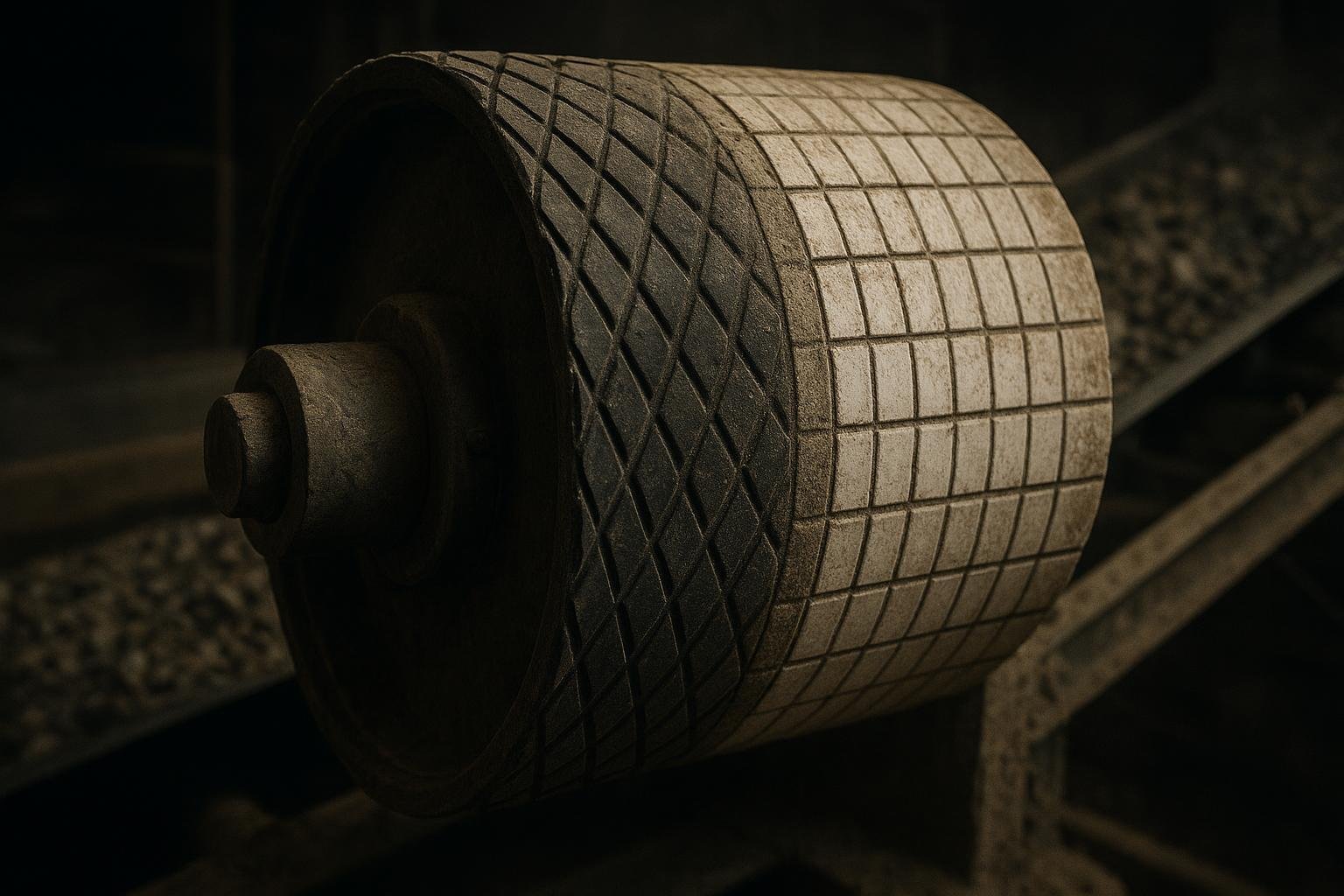
If you’ve chased slip alarms after a rainstorm, cleaned up after a thrown belt, or found a drive pulley crown worn flat, you already know lagging isn’t cosmetic—it’s traction, tracking, and uptime. This field guide gives you a straightforward pulley lagging selection process you can run with: gather the right data, map duty to candidates, choose materials and patterns, pick an installation method, then verify and maintain. By the end, you’ll have a vendor-ready pre-spec you can send out for quotes.
Step 1 — Gather the right data (safely)
Before anything else, plan the work under lockout/tagout. OSHA’s energy control standard spells out the essentials—identify energy sources, isolate, dissipate stored tension, lock and tag, and verify isolation—see the official overview in OSHA’s LOTO tutorial.
Capture these inputs for each pulley:
- Pulley role and ID (drive, tail, snub, bend); diameter and face width; wrap angle
- Belt type and bottom cover compound; speed; design/operating tension
- Environment: dry/clean, wet/muddy/slurry, high abrasion (e.g., quartz, clinker), temperature extremes, oils/chemicals/food contact
- Maintenance constraints: access, allowable downtime, preferred bonding method, local surface prep capability
Quick tools: tape or laser diameter gauge, straightedge for crown check, tach or PLC speed readout, IR thermometer for hotspots, camera for wear documentation. A short site walk with these in hand saves weeks later.
Step 2 — Map pulley role and environment to candidates for better pulley lagging selection
Not every pulley needs the same grip or wear resistance. Drive pulleys see the highest shear and benefit most from traction upgrades; tails handle incoming debris and water; snub/bend pulleys are usually about belt guidance and wrap.
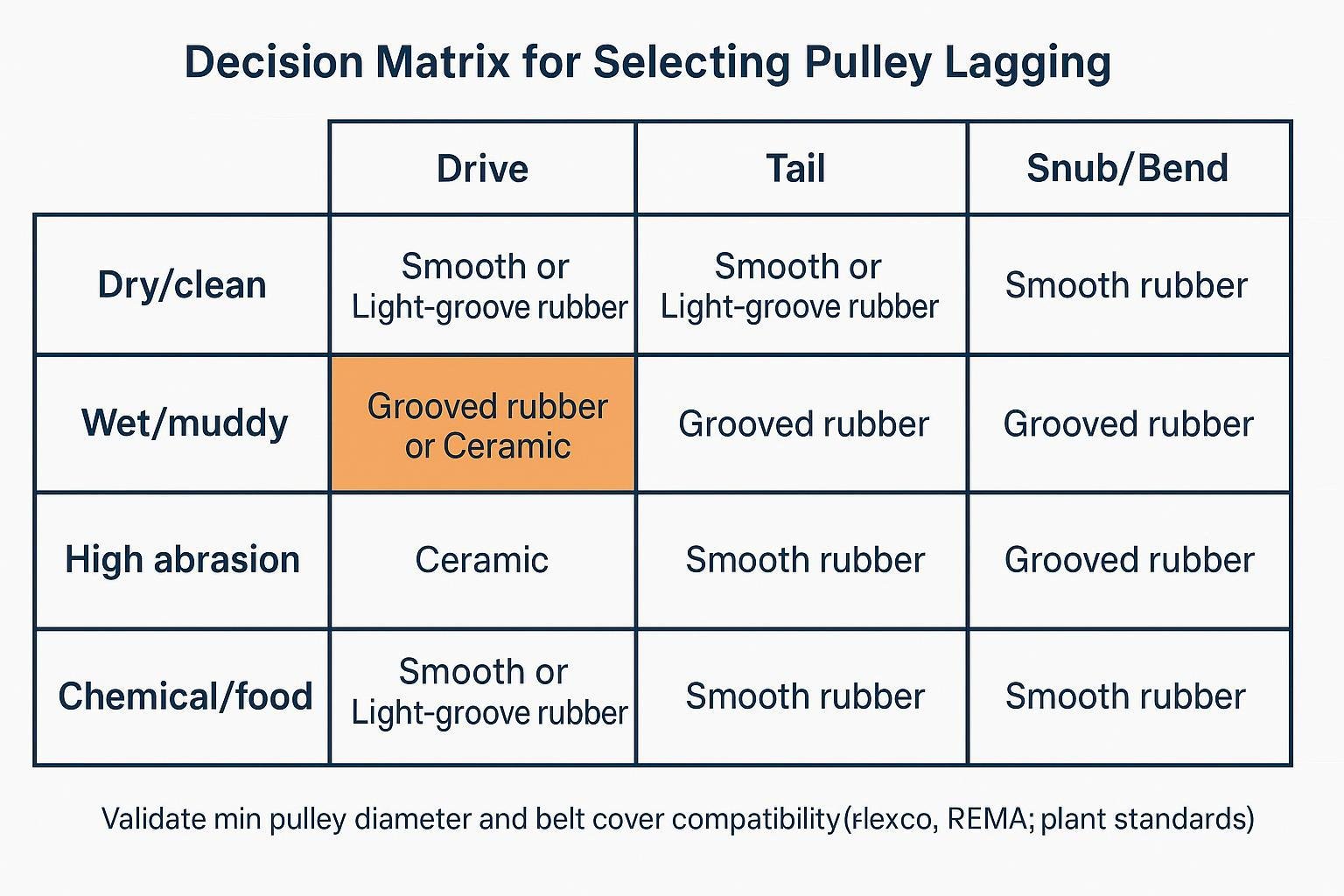
How to read the matrix in practice:
- Dry/clean service with moderate tension: Smooth or light-groove rubber is typically sufficient, especially on tail and snub/bend pulleys.
- Wet or muddy conditions: Grooved rubber (diamond or herringbone) helps channel water and fines off the interface; escalate to ceramic on drive pulleys if slip persists.
- High abrasion (e.g., hard rock, clinker): Consider ceramic on drive pulleys for wear and traction; quality rubber compounds can be adequate for tails and bends depending on wear rate.
- Chemical/food: Evaluate polyurethane or specialty rubber compounds for compatibility; confirm hygiene and chemical resistance.
Vendor literature consistently positions grooved rubber for drainage and ceramic for high-traction, high-wear scenarios on drives—see the pattern and product overviews in REMA TIP TOP’s pulley lagging materials guide and Flexco’s Flex-Lag technical guide.
Step 3 — Choose materials and patterns for precise pulley lagging selection
Think of this as matching traction, wear, and maintainability to the duty. The ranges below are typical examples from vendor sources; always confirm with datasheets and plant standards before you lock a spec.
Rubber lagging (smooth, diamond, herringbone)
- Where it shines: General duty; dry to moderately wet service; drive and tail pulleys when grooving manages moisture/fines. This is the baseline in many plants when starting pulley lagging selection for routine service.
- Typical spec cues: 10–12 mm thickness and roughly 60–70 Shore A hardness appear frequently in vendor catalogs for grooved drive lagging; verify the exact compound (standard SBR vs. heat/oil/chemical resistant). Examples and data formats are shown in REMA TIP TOP product pages and related family sheets.
- Pattern logic: Smooth for dry/clean and to protect pulley surfaces; diamond/herringbone to shed water/fines and increase effective traction under moisture. Keep crown geometry in mind—overly aggressive patterns on a small crowned pulley can alter tracking behavior.
Ceramic pulley lagging
- Where it shines: High abrasion and persistent slip on drive pulleys. Vendors detail tile size and coverage because these affect traction and wear. For example, a published spec lists tile size around 0.30″ × 1″ × 1″ with about 44% ceramic surface exposure; use these as reference points and confirm with your chosen product’s datasheet (see Richwood’s Combi‑Lagg spec sheet).
- Watchouts: Higher upfront cost and installation quality matter; misapplied ceramic can mark or wear belt covers, especially on small diameters or incompatible compounds. For clarity, this guide references ceramic pulley lagging where the evidence supports improved traction and wear in demanding drive applications.
Polyurethane and replaceable systems
- Where they help: Chemical resistance and hygiene-sensitive applications (polyurethane); fast change-outs in access-limited areas (replaceable slide/weld‑on systems). Traction is product-dependent; review vendor test data and min-diameter notes.
Quick spec table (typical examples — validate on site)
| Lagging type | Common patterns | Typical thickness | Typical hardness | Primary use-cases |
|---|---|---|---|---|
| Rubber (SBR or specialty) | Smooth, diamond, herringbone | ~10–12 mm (varies by product) | ~60–70 Shore A (by compound) | General duty; moisture managed with grooves; drive/tail |
| Ceramic on rubber backing | Mosaic/full-tile, dimpled | Tiles ~3–6 mm on rubber 3–6 mm | Backing hardness varies; tile is rigid | High abrasion and chronic slip; primarily drive pulleys |
| Polyurethane | Smooth or grooved | Product-specific | Product-specific | Chemical/hygiene or specialty environments |
| Replaceable/weld‑on modules | Grooved or ceramic modules | Module-specific | Module-specific | Rapid maintenance; often non-drive |
Citations for examples: rubber thickness/hardness ranges in REMA TIP TOP’s overview; ceramic tile dimensions/coverage in Richwood’s Combi‑Lagg PDF.
Step 4 — Pick an installation method that fits duty and downtime
Installation quality is the make-or-break factor for lagging life. Choose the method to match loads and your maintenance window.
- Hot vulcanized lagging: Delivers the strongest, most durable bond for heavy duty and high-tension drives; requires heat/pressure and longer downtime. For process and suitability, see the Flexco hot‑vulcanized IOM.
- Cold‑bond (adhesive) lagging: Field-friendly, moderate adhesion; surface prep and cure windows are critical for success. Use when loads are moderate and time is tight.
- Replaceable/weld‑on systems: Fastest change-out; traction and wear depend on module design; popular on non-drive pulleys or where access is limited.
Minimum pulley diameter matters. Flexco notes that many minimum-diameter recommendations assume 10–12 mm total lagging thickness and provide typical minima by product style (e.g., larger diameters for ceramic versus plain/diamond rubber). See the selection tables in Flexco’s Flex‑Lag technical guide and product pages like Weld‑On Rubber Lagging for examples.
Two practical tips:
- Thicker lagging increases effective pulley diameter; re-check belt manufacturer minimum pulley diameter tables for your carcass and cover combination before you upsize thickness.
- Match compound to exposure (heat, oils, chemicals) to avoid softening, glazing, or premature debonding.
Step 5 — Verify, maintain, and know end‑of‑life
Post‑install, run‑in checks and steady inspections catch issues early and protect the pulley shell and belt cover.
- Post‑install verification: After cure/return to service, monitor for slip events, temperature hotspots (IR), abnormal dusting, or noise. Confirm tracking and crown effectiveness.
- Inspection cadence: Start at 3–6 months, then adjust based on wear rate and environment. Trade and vendor resources suggest daily/weekly visual walkdowns and periodic detailed checks; adapt to severity. See the periodic maintenance prompts summarized in West River Conveyors’ maintenance checklist and wear context in Pit & Quarry’s article on pulley lagging importance.
- End‑of‑life indicators: Crown loss or flat spots, glazing, chunking/uneven wear, debonding/delamination, persistent slip alarms, heat hotspots.
Troubleshooting mini‑matrix (symptom → likely cause → quick action):
- Repeat slip events after rain → Groove pattern too mild or worn; consider re-grooved rubber or ceramic on drive; verify tension and wrap.
- Premature rubber wear at tail → Abrasive fines blasting the interface; evaluate harder compound, thicker sheet, or ceramic if traction loss accompanies wear.
- Debonding at edges → Inadequate surface prep or thermal/chemical mismatch; review bonding method, compound, and site temperature swings.
- Belt bottom cover marking → Ceramic/on-edge tile profile too aggressive for belt and diameter; confirm compatibility and diameter rules; consider grooved rubber.
Build a vendor‑ready pre‑spec
Copy this framework and fill it per pulley. It saves back‑and‑forth and accelerates quoting.
- Pulley: [Drive/Tail/Snub/Bend], ID [____], Diameter [____ mm/in], Face [____ mm/in], Wrap [____°]
- Belt: Type [EP/NN/Steel cord], Bottom cover compound [____], Speed [____ m/s or fpm], Tension [____ kN or lbf]
- Environment: [Dry/clean | Wet/muddy | High abrasion | Chemical/food], Temperature [____ °C/°F]
- Candidate lagging: Material [Rubber/Ceramic/Polyurethane], Pattern [Smooth/Diamond/Herringbone], Thickness [____ mm], Hardness [____ Shore A]
- Installation method: [Hot vulcanized | Cold‑bond | Replaceable/weld‑on]
- Constraints & notes: Min pulley diameter check completed [Y/N], Belt cover compatibility check [Y/N], Plant standard reference [CEMA/ISO/DIN section or site doc]
References and standards (for validation)
Use these documents to validate selections against your site standards and vendor data:
- Materials and patterns overview with example specs: REMA TIP TOP pulley lagging guide
- Tile dimensions/coverage example: Richwood Combi‑Lagg spec sheet
- Selection and minimum diameter notes by product style: Flexco Flex‑Lag technical guide
- Safety program basis for lockout/tagout: OSHA’s LOTO tutorial
CEMA (Belt Conveyors for Bulk Materials) and relevant ISO/DIN pulley and design standards provide the design basis; consult current revisions and your plant engineering standards.
Next steps: Use the pre‑spec to request quotations, and validate minimum pulley diameters and belt cover compatibility with your chosen products and plant standards. For integrated pulley and lagging solutions, suppliers such as BisonConvey can provide matched components and datasheets—always confirm compatibility with your belt cover and site rules before purchase.