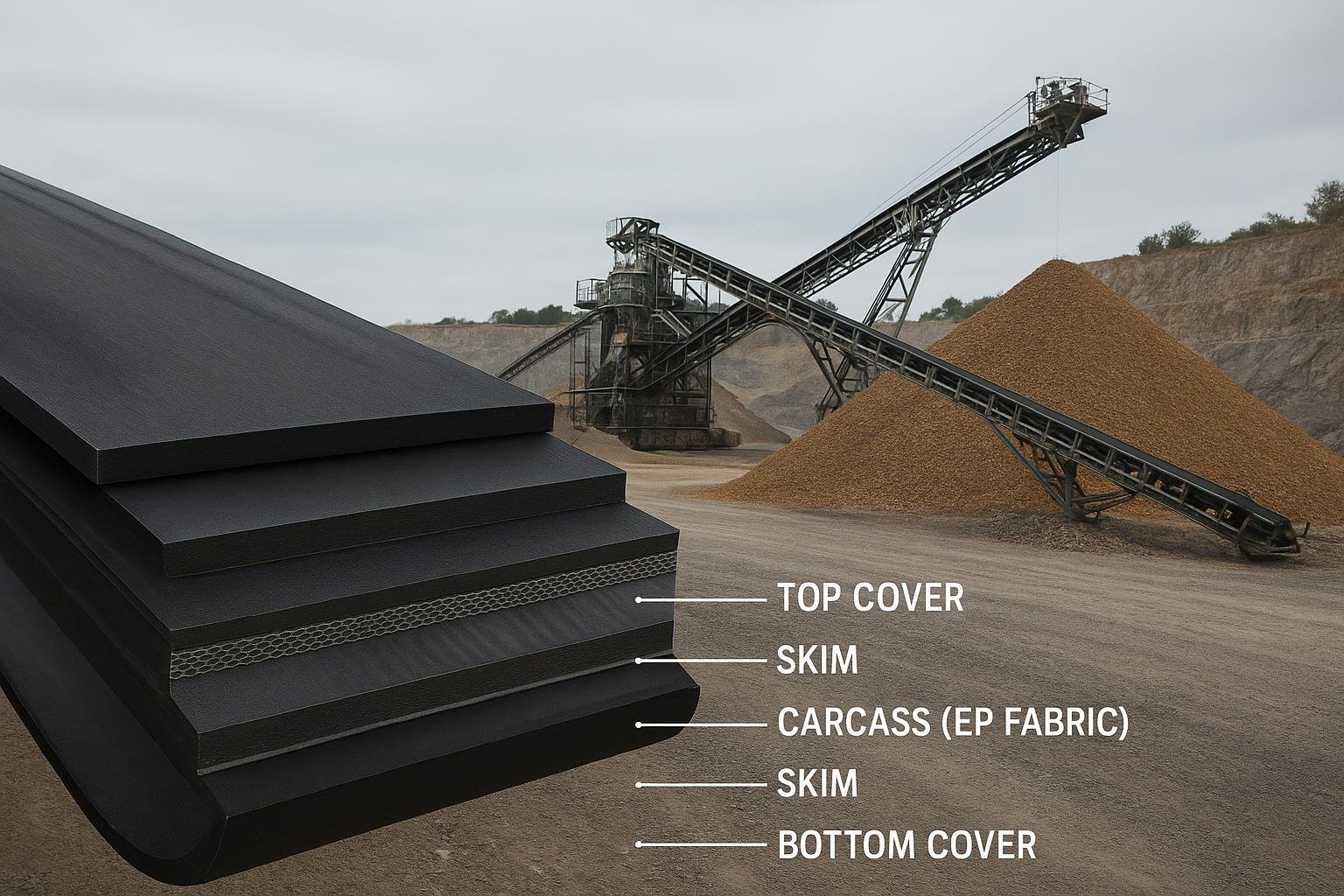
Choosing the wrong belt thickness can drain energy, chew through covers, and punish splices long before their time. The right thickness, on the other hand, balances wear life with flexing losses, fits your pulleys, and survives real‑world abuse at load zones and cleaners.
What “thickness” really means
Total belt thickness isn’t just one number you pick off a table. It’s the sum of the top cover, skim/adhesion rubber, the carcass (EP/NN textile plies or steel cords), more skim, and the bottom cover. The top cover shields against material abrasion and impact. The bottom cover endures idlers, pulleys, and cleaners on the return. Textile carcasses use EP (polyester/nylon) or NN (nylon/nylon) plies; steel‑cord carcasses embed cords in rubber. Manufacturers treat cover “gauge” as application‑specific rather than fixed, which Continental makes clear in its steel‑cord overview and heavy‑duty catalog references to variable rubber types and gauges (see Continental’s heavy‑duty and steel‑cord documents linked below).
Covers: picking gauges by duty and environment
Most belts in plant service fall into two cover‑gauge bands.
- Textile (EP/NN) belts: General purpose often runs top 3–5 mm and bottom 2–3 mm; for heavy abrasion, top 6–10+ mm and bottom 3–5 mm are common. You’ll find representative ranges in the ASGCO Heavy Duty belting brochure and Continental heavy‑duty catalog tables, where cover gauges feed thickness/weight calculations. See the 2018 Continental catalog in particular for how gauges enter sizing. Sources: the ASGCO brochure and Continental catalog linked below.
- Steel‑cord belts: General service typically uses top 4–6 mm and bottom 3–5 mm; severe wear pushes top covers to 8–12+ mm with 4–6 mm bottoms. Sempertrans and ASGCO product literature illustrate these bands in their product families.
How do abrasion classes fit in? Textile belt cover qualities are described in ISO 14890 and DIN 22102 using abrasion loss tests (ISO 4649/DIN 53516). In practice, many engineers treat ISO H ≈ DIN X (high abrasion and cut/impact), ISO D ≈ DIN W (very high abrasion resistance), and ISO L ≈ DIN Y (general). That equivalence is a field convention described by industry explainers rather than an official cross‑map between standards. What matters here: harder, abrasion‑resistant compounds can extend life at a given thickness, but in severe chute wear you still often need more top cover to maintain time‑to‑carcass exposure.
Environmental modifiers can nudge gauges upward. Heat‑, oil‑, and flame‑resistant compounds sometimes trade abrasion for thermal/chemical performance, so a 6–8 mm top cover is common in hot clinker or MOR/OR service where a 4–6 mm top might suffice in cool, clean duty. Fire test compliance (e.g., ISO 340:2022) is about safety performance, not thickness; you choose thickness for durability while ensuring the compound meets the fire test standard.
References in this section: Continental heavy‑duty catalog; ASGCO Heavy Duty brochure; Sempertrans product catalogue; ISO standards and industry explainers linked below.
Carcass: how ply count and cords affect thickness and flexibility
Carcass choice quietly dictates both thickness and bendability. A textile belt specified as EP 400/3 (three plies with a 400 N/mm rating) will be thinner and more flexible than an EP 800/4, even if you keep the same covers. More plies and higher fabric ratings add thickness and stiffness. That matters at small pulleys and tight transitions.
In steel‑cord belts, cord diameter and pitch plus the cover gauges determine the total thickness. As strength classes rise, cord diameters typically increase and minimum pulley diameters follow suit. Manufacturer catalogues, such as the Sempertrans Product Catalogue, lay out how construction parameters tie into pulley selection and splicing dimensions.
System compatibility checks you can’t skip
Thicker isn’t automatically better. Here’s why you should verify compatibility before you finalize gauges.
- Minimum pulley diameters rise with total thickness and carcass stiffness. Using covers that are too thick for a given construction and pulley set risks cover cracking, ply separation, or core fatigue. Manufacturers publish minimum pulley tables by belt strength and construction; verify against those, not a rule of thumb. Sempertrans provides representative guidance, and other makers publish similar tables.
- Splice design stretches with thickness. Multiply step splices require longer steps as ply count and gauge rise. Steel‑cord splices build up thickness as you add rubber between cords. Dunlop’s multiply splice instructions show how step geometry scales; Sempertrans steel‑cord splicing instructions do the same for cord belts. Your splice must pass the smallest pulley without overstress.
- Troughing, idlers, transitions, and cleaners all react to thickness. As belts get stiffer, they resist troughing and need proper transition distances; unequal cover gauges can demand extra distance to avoid edge stress. Cleaner blade pressure and skirt seals act like constant wear tests—under heavy pressure, thin top covers disappear quickly. CEMA Standard #502 defines idler classes/geometry; use those definitions as you check troughability and spacing in your layout.
A simple, defensible selection workflow
Use this workflow to get to a first‑pass thickness, then validate with supplier tables.
- Define duty severity and material conditions. Note lump size, drop height, abrasion index (fine sand vs. sharp rock), temperature, oil/chemicals, throughput, and speed.
- Choose compound class first. Select abrasion/heat/oil/flame compounds that meet your environment (e.g., DIN X/ISO H for high abrasion; heat‑resistant for clinker; MOR/OR for fertilizers).
- Pick a cover gauge range that matches duty. As a starting point: textile general purpose 4+2 or 5+2 mm; abrasive quarry 6–8 mm top with 3–5 mm bottom. Steel‑cord general 4–6 mm top and 3–5 mm bottom; severe wear 8–12 mm top and 4–6 mm bottom. Adjust upward for heat/oil.
- Select carcass/strength for tensions and impact. Ensure adequate safety factor. For textile, pick ply count/fabric rating (e.g., EP 500/3); for long, high‑tension runs consider steel‑cord.
- Check minimum pulley diameters and splice geometry in manufacturer tables. If your chosen thickness conflicts with your pulley set, either reduce gauge, increase pulley sizes, or change carcass type.
- Verify troughability, transition distances, and cleaner/skirt settings. Increase transition distances if needed; tune blade pressure and skirt gaps to avoid accelerated top‑cover wear.
- Lock the spec with your supplier. Provide belt width, strength class, top/bottom cover gauges, compound grade, and quantity—and get a written verification that the belt will suit your pulleys and splices.
Quick reference: typical cover ranges by application
| Application | Textile (EP/NN) typical top/bottom | Steel‑cord typical top/bottom | Notes |
|---|---|---|---|
| Quarry primary crusher / shot rock | 6–8+ mm / 3–5 mm | 8–12+ mm / 4–6 mm | Abrasion‑resistant compounds (DIN X/ISO H or DIN W/ISO D); prefer larger pulleys as thickness rises |
| Cement/clinker (hot) | 6–8 mm / 3–5 mm | 8–10 mm / 4–6 mm | Heat‑resistant compounds; validate temperature rating and idler sealing |
| Fertilizers/chemicals (MOR/OR) | 4–6 mm / 2–4 mm | 6–8 mm / 3–5 mm | Oil‑resistant compounds may trade abrasion; consider slightly thicker top |
| Grain/agriculture | 3–4 mm / 2–3 mm | — | Low abrasion; prioritize flexibility and small pulleys |
Ranges are first‑pass guides. Always confirm against the belt maker’s pulley and splice tables for your exact construction.
Practical example (neutral and replicable)
Let’s say a quarry transfer drops 100 mm minus stone onto a 1,000 mm‑wide EP belt at moderate speed with good skirt sealing. The plant wants to reduce change‑outs but can’t change pulley sizes. A general‑purpose EP 500/3 with 4+2 mm covers wore to carcass in 8 months under the skirts.
- First pass: Move to a DIN X/ISO H abrasion‑resistant compound and increase only the top cover to 6 mm (keeping 2–3 mm bottom). EP 500/3 stays for flexibility and pulley fit. Check the minimum pulley table; if the current pulleys already suit 4+2, they usually also suit 6+2 for the same carcass class, but verification is still required.
- Verification: Confirm splice step length increases for the thicker top cover and ensure the splice passes the smallest pulley without over‑strain; adjust transition distances if needed.
If we were specifying a new belt from a supplier like BisonConvey, we would request EP 500/3, DIN X compound, 6+2 mm covers, and written confirmation of pulley and splice compatibility. Disclosure: BisonConvey is our product. No superlatives—just the data the supplier needs to validate the build.
Troubleshooting and common pitfalls
- Top cover cracking near pulleys: Often excessive bending strain from too‑thick covers or too‑stiff carcass on small pulleys. Confirm minimum pulley diameter; consider reducing cover gauge or increasing pulleys.
- Rapid wear under skirts/cleaners: Usually pressure or mis‑alignment, not just thin covers. Fix sealing and blade pressure first, then increase top cover if the duty truly warrants it.
- Splice bumps and heat generation: Splice geometry not matched to thickness/ply count. Rework step lengths and ensure proper buffing/buildup per the manufacturer’s splice instructions.
- Poor troughability and edge fraying: Stiff belt with short transitions. Lengthen transitions, check idler angles (CEMA classes), and balance top/bottom gauges.
Sources to validate your choices
- Continental’s 2018 heavy‑duty catalog shows how cover gauges feed thickness and weight, and discusses gauge considerations in selection: see the 2018 Continental Heavy Duty Conveyor Belt Catalog (PDF) under Goodyear Rubber Products’ library. Link: ContiTech Heavy Duty Conveyor Belt Catalog (2018).
- For cover options by duty across multiply and straight‑warp belts, ASGCO’s spec pages provide representative top/bottom gauge options: ASGCO Heavy Duty Conveyor Belting brochure (2024).
- Steel‑cord construction notes, pulley diameter trends, and splice considerations are summarized in the Sempertrans Product Catalogue (2019).
- Multiply splice step geometry guidance is detailed in Dunlop’s Multiply Splice Instructions; use this to scale steps with thickness.
- Idler classes/definitions for checking troughing interfaces are documented on the CEMA store page: CEMA Standard No. 502 description page.
- For fire testing context when flame resistance is required, see ISO 340:2022 – Conveyor belts — Laboratory-scale flammability characteristics.
- For the field‑used mapping between ISO 14890 and DIN 22102 cover classes, see the industry discussion in Agg‑Net’s ‘Conveyor belting – who sets the standards?’.
Next steps
Document your duty conditions, pick compound and gauges from the ranges above, then verify pulleys, splices, and transitions against the manufacturer’s latest tables. If you want a second set of eyes, share your draft spec and pulley set—happy to review for fit and risk before you place the order.