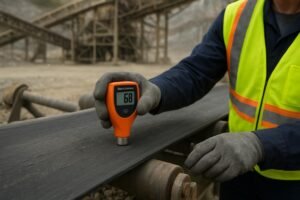
If your plant keeps fighting stretch, splice fatigue, and unplanned stoppages on long, fast, or high‑tension lines, you’re already in the upgrade zone. This guide helps maintenance, reliability, procurement, and operations leaders decide when a move from EP/NN fabric belts to steel cord belts makes technical and economic sense—and how to plan it with fewer surprises.
Steel cord conveyor belts upgrade triggers and thresholds
Upgrading is usually justified by a cluster of signals rather than one event. Here are the indicators I look for on site, with references to standards and OEM practice:
-
Repeat splice failures under cyclic load: Fabric belts commonly achieve dynamic splice efficiencies in the 30–35% range; modern steel cord joints routinely reach 50–60%+ on properly executed vulcanized splices, improving fatigue life. See the DIN 22110 Part 3 dynamic splice test framework summarized in the independent overview on the ConveyorBeltGuide splice testing page and efficiency analysis discussed in the bulk‑online white paper on belt safety factors.
-
Excessive elongation and tracking issues: Steel cord belts typically exhibit permanent elongation around 0.10–0.35% and total elongation ~0.3% in service, while fabric belts can show 1.0–2.5% permanent and 1.5–2.0% total elongation. On long centers with limited take‑up, fabric stretch drives slack and mis‑tracking. Elongation ranges are compiled in testing notes and OEM catalogs, including the ConveyorBeltGuide testing overview and OEM documentation such as Oriental Rubber’s steel cord overview (2021).
-
System scale and speed heuristics: Lines longer than ~500–700 m or running faster than ~3 m/s put a premium on low stretch and high tensile modulus—conditions where steel cord often pays off. These thresholds are planning heuristics from project experience; verify against your pulley diameters and tension utilization.
-
High emergency repair frequency and downtime cost: If belt‑related events are consuming meaningful hours each month and your downtime cost per hour is high, the ROI case strengthens quickly. Independent industry studies place unscheduled downtime around a median of ~$125,000–$240,000 per hour in heavy industry; see the ABB survey synopsis.
-
Material characteristics: Large, abrasive, high‑impact lumps (iron ore, coal, clinker) accelerate cover wear and carcass fatigue. Steel cord’s higher modulus and fatigue behavior suit long‑distance, high‑capacity lines.
Lifecycle cost and ROI—how to compare EP vs. steel cord
A good upgrade decision balances upfront price with maintenance, splice reliability, and downtime. Use a simple total cost of ownership (TCO) frame:
TCO over N years ≈ Initial belt cost + Maintenance/repair + Downtime cost due to belt events + Replacement/installation costs − Salvage (if any).
Below is a 7‑year worked example. Adjust to your site realities; the numbers are illustrative and should be validated during procurement.
Assumptions (illustrative):
- Conveyor: 1,200 mm width, 1,000 m length, abrasive ore
- EP belt price: $120/m; steel cord price: $220/m
- EP service life: 3 years; steel cord life: 7 years
- Downtime cost: $130,000/hour (mining benchmark)
- Annual belt‑related downtime: EP 10 h/year; steel cord 4 h/year
- Installation/splicing per replacement: $80,000 (crew, vulcanization, consumables)
| Scenario (7 years) | EP/NN fabric belt | Steel cord belt |
|---|---|---|
| Initial belt cost | $120/m × 1,000 m = $120,000 | $220/m × 1,000 m = $220,000 |
| Replacements | Years 3 and 6 → 2 × $120,000 = $240,000 | None |
| Installation/splicing | 2 × $80,000 = $160,000 | $80,000 |
| Maintenance/repairs | $25,000/year × 7 = $175,000 | $15,000/year × 7 = $105,000 |
| Downtime (belt events) | 10 h/year × 7 × $130,000 = $9,100,000 | 4 h/year × 7 × $130,000 = $3,640,000 |
| Total 7‑year TCO | $9,795,000 | $4,045,000 |
Sensitivity notes:
- If your downtime cost is lower (e.g., $50,000/h), the gap narrows but remains significant when repair hours drop materially.
- If steel cord pricing is higher than assumed, payback still tends to be fast on long, high‑throughput lines because downtime dominates the economics.
- Always test scenarios with your actual repair logs, splice performance, and inspection data.
Benchmarks for downtime costs vary by sector. Heavy industry medians often fall in the ~$125,000–$240,000/h range, summarized in the ABB survey overview.
Inspection and NDT criteria before you decide
Diagnostics build confidence in the upgrade case and reduce risk. A practical cadence:
-
Weekly visual: Damage, cracks, cuts, exposed cords, mis‑tracking, buildup.
-
Monthly/quarterly targeted NDT: Use magnetic flux leakage (MFL) to locate broken or corroded cords and phased array ultrasonic testing (PAUT) to image internal conditions and thickness loss. For PAUT application guidance, see Sonatest’s steel‑reinforced belt inspection note.
-
Annual comprehensive inspection: Full‑length NDT with splice audits and documentation; escalate to X‑ray for ambiguous defects or critical joints where internal anomalies are suspected.
Record splice efficiency and elongation at the take‑up. If dynamic splice efficiency trends below expected values for your belt class, or elongation exceeds take‑up capacity, you have hard data supporting an upgrade. For context on dynamic splice testing, consult the ConveyorBeltGuide splice testing overview.
Installation and sizing checks you can’t skip
Feasibility often hinges on pulley diameters, splice logistics, and tensioning:
-
Minimum pulley diameters: Steel cord belts specify diameter thresholds that scale with ST rating and cord size. Representative OEM tables aligned to DIN/ISO practice show, for example, ST1600 belts with typical cord diameters around ~4.7 mm needing ~1,600 mm drive pulleys and ~1,250 mm tail/tension pulleys. See an OEM summary aligned with DIN 22131 in Forech’s steel cord overview.
-
Splice method and environment: Plan hot vulcanized splices with controlled temperature, pressure, and clean surfaces. ISO 15236‑4 outlines principles for vulcanized joint design; refer to the ISO 15236 series overview for scope.
-
Tensioning and take‑up travel: Steel cord’s low stretch reduces required travel, but set‑up errors can still cause mis‑tracking and shock loads. Verify take‑up capacity and start‑up tensioning procedures.
-
Handling and storage: Avoid tight bends that exceed minimum diameters during transport and storage; protect from moisture and contamination before vulcanization.
For projects with mixed component ages, confirm idler alignment, lagging condition, and snub/bend pulley diameters; high deflection angles on undersized pulleys drive cord fatigue.
Practical decision workflow
- Assess operating context: length, speed, lift, material abrasiveness/impact, tension utilization, take‑up travel, pulley diameters, splice history, tracking/spillage.
- Quantify current performance and costs: elongation measurements, splice audits (dynamic efficiency), NDT scan results, annual downtime hours due to belt events, repair frequency and cost.
- Feasibility check: verify minimum pulley diameters versus the candidate ST rating; confirm tensioning method and splice feasibility (hot vulcanization logistics).
- Model TCO: compare EP vs. steel cord using your price quotes, expected life, repair hours, and downtime cost; run sensitivity tests.
- Pilot or phased upgrade: validate assumptions on a critical line or section; baseline NDT before and after.
- Procure and install: finalize ST rating, cord construction, cover compound, splice design and consumables; set QA/QC controls and acceptance testing.
- Monitor and optimize: weekly visual checks; monthly/quarterly NDT on critical zones; annual full scans; track splice performance and update TCO with actuals.
Procurement questions for suppliers
- What minimum pulley diameters apply to your proposed ST rating across drive, tail/tension, bend, and snub?
- What cord construction (diameter, pitch, zinc coating) and adhesion test results per ISO 15236‑3 can you provide?
- Which cover compounds are available (abrasion, heat, oil, fire, anti‑rip), and what DIN/ISO grade performance do they meet?
- What dynamic splice efficiency should we expect with your recommended method and consumables? What is the required splice environment?
- What NDT compatibility and recommended inspection intervals do you support (MFL magnetization, X‑ray visibility, PAUT notes)?
- What delivery lead times, installation support, and QA documentation (traceability) are included?
Practical micro‑example (with disclosure)
Disclosure: BisonConvey is our product.
A bulk terminal operates a 1,200‑mm overland conveyor (~900 m, 3.5 m/s) moving iron ore to a ship loader. The EP belt shows 2.0% total elongation at load, two splice fatigue failures in 12 months, and recurring mis‑tracking on the backstretch. Downtime averages 6 h/month during repairs and cleanup.
The team runs PAUT on the current belt to establish a baseline and audits splice efficiency on the worst joint. Feasibility checks confirm existing pulleys: drive 1,600 mm, tail 1,250 mm, bend 1,000 mm—adequate for an ST1600 steel cord belt per OEM tables aligned with DIN practice. Procurement requests specs for ST1600 with abrasion‑resistant covers (e.g., 8+3 mm), cord construction and adhesion data per ISO 15236, and a hot vulcanized splice design with consumables list.
During installation planning, the team schedules QA for environmental control (temperature/pressure), verifies take‑up travel, and sets acceptance tests: elongation measurement after commissioning and a 3‑month NDT scan to confirm joint integrity. In a neutral supplier comparison, BisonConvey’s steel cord option matches the ST rating and pulley diameters, provides documented dynamic splice efficiency targets in the 50–60% range, and offers inspection guidance compatible with periodic NDT. The upgrade proceeds on this line first; post‑upgrade metrics show reduced elongation and fewer belt‑related stoppages, which supports rolling the spec to additional conveyors.
Resources and next steps
- Standards and testing: Overview of steel cord belt requirements in the ISO 15236 series and dynamic splice testing summarized on the ConveyorBeltGuide splice testing page.
- NDT methods: Application notes from Sonatest on PAUT.
Ready to compare specs? Request a data‑driven quote or a steel cord belt spec sheet to run your own TCO model.
Author: A reliability engineer and conveyor specialist with 10+ years of heavy industry projects, focused on diagnostics, splice QA, and lifecycle economics. Reach out for technical questions or a sanity check on your upgrade plan.