If you run bulk material lines in mining, ports, cement, or steel, you don’t need another catalog—you need a shortlist you can trust and a way to compare it. This 2026 roundup ranks global conveyor belt manufacturers for heavy-duty service, based on what matters most: reliability, service life, materials (steel cord vs. aramid vs. textile), cover chemistry (heat/flame/abrasion), and proven fit in harsh environments.
How we ranked (transparent, evidence-first)
We scored brands using documented capability and support, then tempered claims with public evidence. Weights:
-
Capability match to heavy-duty use cases (mining/ports/cement/steel): 25%
-
Evidence quality & recency (spec sheets, standards, third-party reports): 20%
-
Lifecycle value (durable covers, splice reliability, TCO cues): 20%
-
Ecosystem & support (global service, splicing know-how, lead times): 15%
-
Learning curve & compatibility (integration with existing systems): 10%
-
Price/value transparency (range disclosures, limits): 10%
Key sources include manufacturer product pages and recognized industry outlets or standards. Example: Continental’s ST10000 capability expansion covered by industry media in late 2024—see IM Mining’s report (2024). Standards context for fire/heat is summarized by manufacturers referencing EN 14973, ISO 340/4195, and MSHA Part 14 (use official texts for procurement).
2026 snapshot: what’s changing
-
High-tension overland remains king: steel-cord belts (ST classes) anchor long-distance mining lines; documented ultra-high ratings (e.g., ST10000) continue to be industrial benchmarks.
-
Lightweight alternatives mature: aramid carcasses (e.g., Fenner Dunlop’s Staramid) help with very long runs where lower belt weight and elongation are valuable. Think of it as trading raw tensile mass for smart stiffness and handling.
-
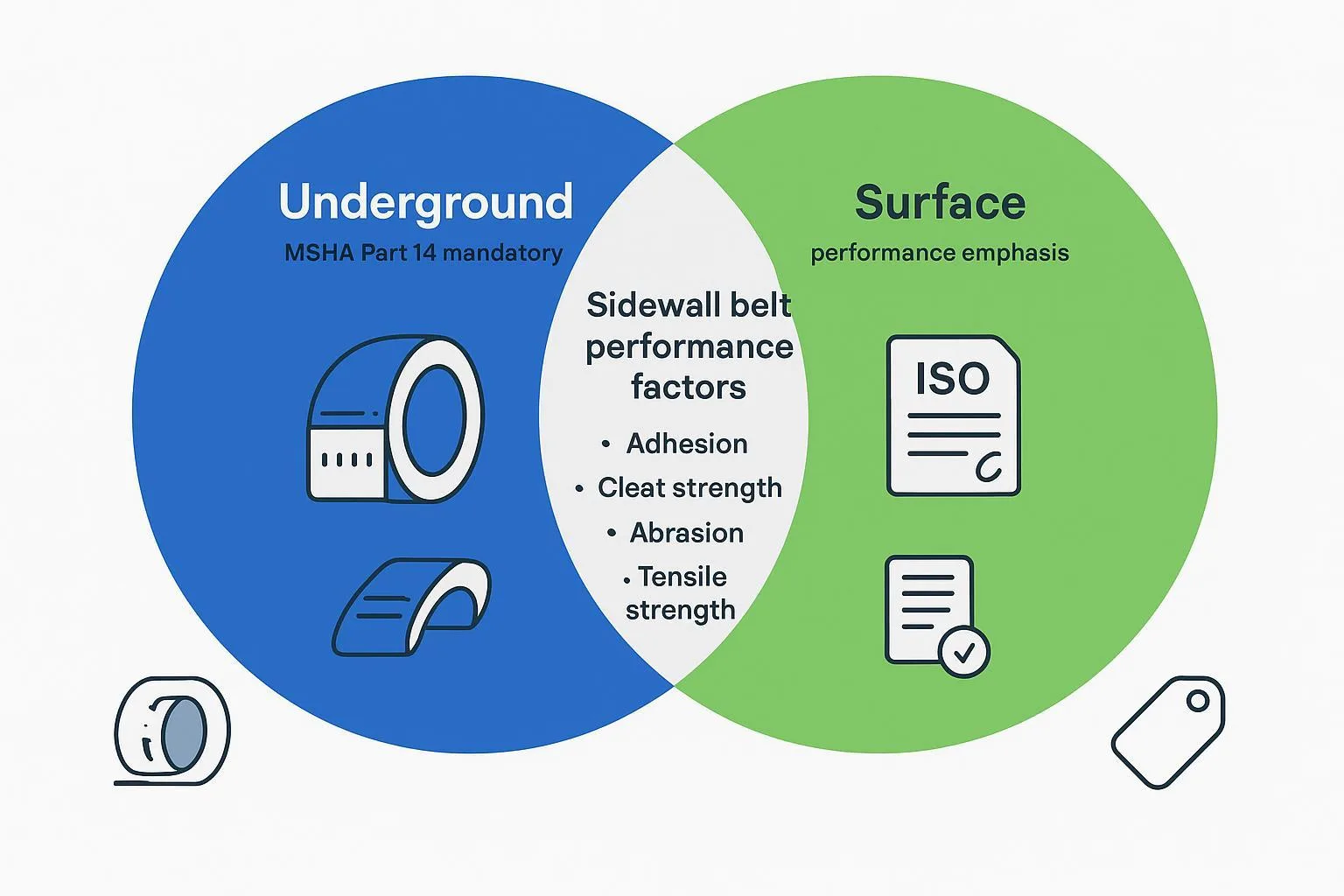
Heat and flame compliance stays front-and-center: cement and steel plants require covers aligned to ISO 4195 (heat) and ISO 340/EN 14973/MSHA for flame—always verify the exact grade on the product datasheet.
-
Energy attention, claims caution: “Low rolling resistance” compounds are sought after, but numeric LRR values are not consistently public; treat vendor energy-savings as project-specific until primary test data is provided.
-
Service ecosystem matters: splice designs, field support, and supply-chain reliability often outpace raw datasheet numbers in determining uptime.
The ranked shortlist (global heavy-duty focus)
- Continental (ContiTech/Phoenix)
-
Positioning: A powerhouse in ultra-high-strength steel-cord belts for mining and long overland.
-
Evidence: Industry coverage of ST10000 capability expansion in Brazil (2024).
-
Best for: Ultra-high-tension mining conveyors where long runs and high tonnage dictate steel cord.
-
Watch-outs: Treat energy-saving claims conservatively unless Continental publishes proprietary LRR data.
-
Reference: Continental Industry overview: Conveying Solutions.
- Fenner Dunlop (EMEA/Netherlands site; including Steelcord & Staramid)
-
Positioning: Comprehensive heavy-duty range with unusually transparent public documentation.
-
Evidence: Official product page for Steelcord.
-
Best for: Long-distance mining (steel cord) and very long/lightweight-sensitive runs (aramid).
-
Watch-outs: Confirm widths/strengths and splice geometry per project; performance depends on precise splicing.
- Sempertrans (Semperit)
-
Positioning: Steel-cord families (Sempercord, Metaltrans) with specialized covers including energy-saving and flame/heat options.
-
Evidence: Metaltrans product sheet (2024) and official splicing instructions.
-
Best for: Overland mining with structured splicing practices; plants with flame/heat requirements.
-
Watch-outs: Public numeric LRR values are limited; treat TransEvo as an energy-saving option without quoting figures unless you have test data.
- ASGCO
-
Positioning: North America–focused heavy-duty belting, including Steel-Flex steel-cord belts for long-distance, high-tension service.
-
Evidence: 2024 brochure detailing compounds, carcass constructions, and sectors: Heavy-Duty Belting Brochure.
-
Best for: Mining and ports in North America needing accessible service and distribution.
-
Watch-outs: Confirm MSHA/EN/ISO class declarations on the specific compound datasheet.
- Oriental Rubber Industries
-
Positioning: Broad heavy-duty portfolio spanning steel cord, fabric, chevron, and flame-resistant lines (MAXX AGNI).
-
Evidence: Flame-resistant line brochure showing application ranges and cover options: MAXX AGNI (2025 PDF).
-
Best for: Plants needing a wide selection with regional manufacturing in India and exports to heavy industry.
-
Watch-outs: Validate exact ST rating and temperature limits per order; ranges differ by construction.
- Dunlop Conveyor Belting (NL/EMEA; includes Ultra X, Superfort, steel cord)
-
Positioning: Heavy-duty belts with strong documentation, including standards context and sector guidance.
-
Evidence: Ultra X datasheet for abrasion-resistant single-ply designs.
-
Best for: Ports/terminals and quarries seeking high-impact/abrasion resistance and service support.
-
Watch-outs: Match compound to material class and impact zone design to protect splices.
- SIG (Società Italiana Gomma)
-
Positioning: European specialist with steel-cord (SIG SC/ST) and multi-ply EP/TEXTER, plus sidewall systems.
-
Evidence: General conveyor-belt catalogue (Texter).
-
Best for: Steep-incline/sidewall projects and mixed portfolios across cement, ports, and aggregates.
-
Watch-outs: Ensure compatibility of sidewall and splicing with your pulley and transition geometry.
- Kauman (Spain)
-
Positioning: Families across steel cord (KAUSTEEL), aramid (KAUFORT), and textile (KAUFLEX/KAUSTRONG), with mining guidance.
-
Evidence: Conveyor belts overview.
-
Best for: European projects seeking tailored portfolios including aramid for very long conveyors.
-
Watch-outs: Confirm reinforcement choice and splice design against route profile.
- Zhejiang Double Arrow (China)
-
Positioning: Large manufacturer with reported projects at very high ST classes and pipe conveyors; exports to mining/ports/power.
-
Evidence: Official news noting ST10000 testing pass: Double Arrow news (ST10000).
-
Best for: High-tension projects where cost and scale are balanced with documented capability.
-
Watch-outs: Standards declarations can be project-specific; require order-level certificates.
- Bridgestone
-
Positioning: MASTERCORE steel-cord belts with in-house steel cord manufacturing; global industrial footprint.
-
Evidence: Corporate report referencing MASTERCORE and internal cord capability: Bridgestone Integrated Report (2025).
-
Best for: Custom steel-cord solutions where integration with broader Bridgestone industrial support is helpful.
-
Watch-outs: Public product-level pages are sparse in English; verify specs via regional technical teams before RFPs.
Also great / Regional specialists
-
Yokohama Rubber — global industrial rubber supplier; public English conveyor-belt details are limited this cycle. See corporate profile noting heat-resistant and power-saving belts: Company Profile (PDF).
-
Sempertrans Australia — regional support notes and product pages consolidate many mining use-cases: Sempertrans Australia.
Quick construction/cover comparison (at a glance)
Procurement tips (keep uptime front-and-center)
-
Ask for order-level certificates: flame and heat grades, anti-static compliance, and tensile class declarations should match the exact belt you intend to buy.
-
Demand splicing geometry and QA guidance: the splice is often the weakest link—get step lengths, curing cycles, and inspection checklists from the vendor.
-
Match cover to material and temperature: abrasion vs. heat vs. flame can’t be “one size fits all.” Cement clinker, sinter, and coal each punish belts differently.
-
Consider energy holistically: rolling resistance compounds may help, but pulley alignment, idler quality, and loading conditions can dwarf compound gains.
-
Plan impact zones: chute design, impact beds, and breaker plies reduce gouging and splice stress.
What to do next (single action)
Submit your inquiry with project details—belt strength class, width, route profile, material type, temperature, and standards required—so you can get comparable quotations and technical proposals.
Disclosure: BisonConvey is our product. We manufacture heavy-duty conveyor belts and bulk handling components for harsh environments. If you need an engineering-led review or a quotation, share your specs and uptime targets, and we’ll respond with configuration options and lead times.