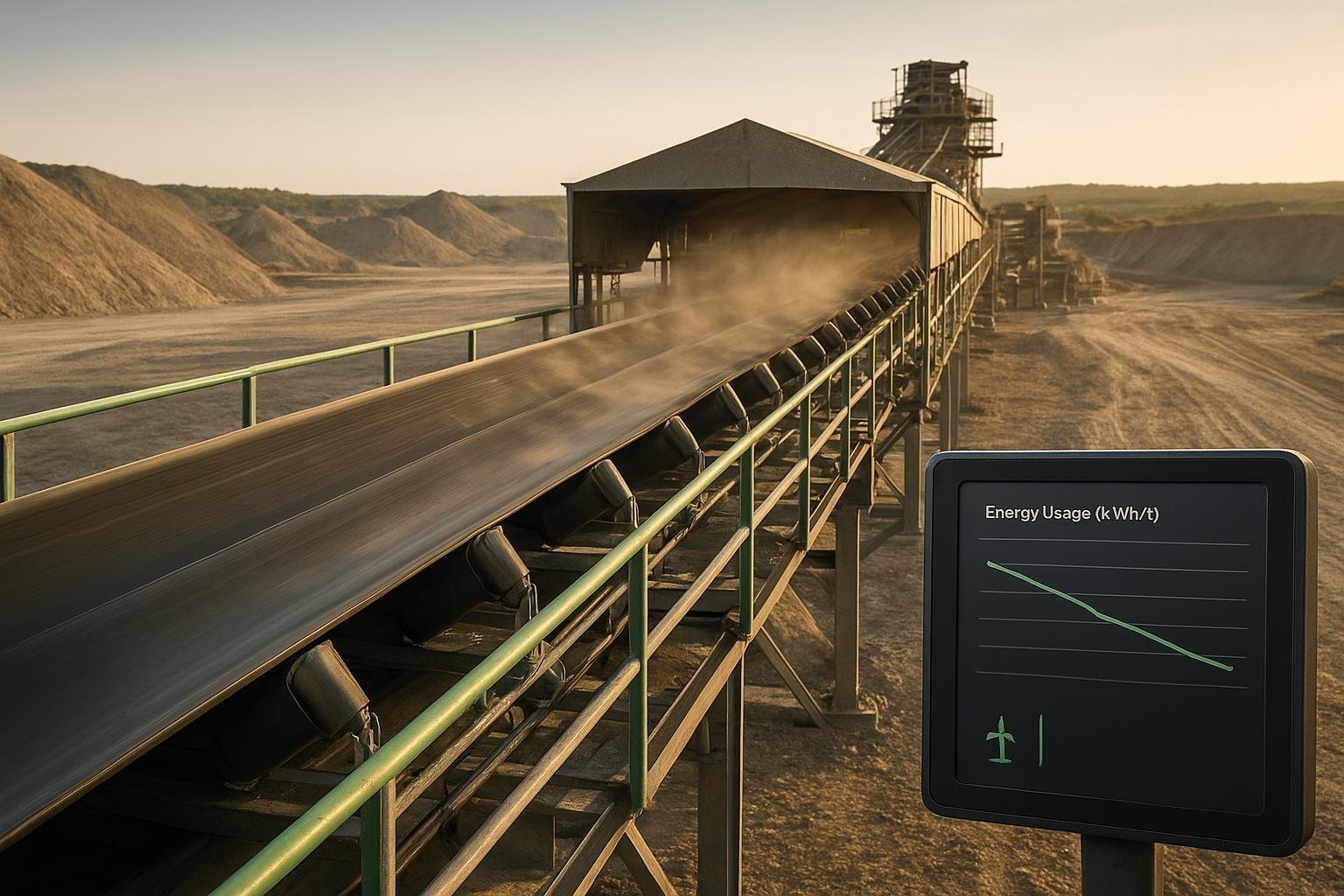
If you run bulk material handling, sustainability isn’t just about optics—it’s about fewer stoppages, lower kWh per ton, cleaner air around the plant, and safer crews. The good news: most gains come from disciplined design choices and maintenance routines you can verify on the shop floor. This guide lays out practical levers, the evidence behind them, and how to implement changes without gambling with uptime.
Design for energy efficiency
Speed control and right-sized power draw are the fastest path to lower energy intensity. When conveyors operate under varying loads, variable frequency drives (VFDs) let you match belt speed to demand and reduce waste during partial-load operation. Department of Energy methodology for motor-driven systems shows material savings when variable-speed operation and high-efficiency motors are applied under suitable duty cycles; the principles extend to conveyors in plants with fluctuating throughput (see DOE frameworks referenced in 2024 motor efficiency analyses).
Downhill or mixed-profile conveyors are another major opportunity. In regenerative mode, drives feed energy back to the grid, significantly reducing net consumption. A cement application documented by BEUMER shows belt conveyors at about 1.44 kWh per ton compared to diesel trucks at roughly 11.4 kWh per ton—about a 90% reduction in primary energy—with the added benefit that downhill segments can regenerate power; the study quantified savings on the order of tens of millions of kWh per year at scale, according to the IM Mining summary of the case in 2020. See the discussion in the BEUMER profile in International Mining: the economic and energy case for ore transport by conveyor.
What about mechanical drag? Alignment and rolling resistance matter. Seized or rough-running idlers, poor troughing alignment, overloaded skirtboards, and carryback all push power demand up. Low-friction design principles—including stable belt support in load zones, proper sealing to avoid material grinding at the edges, and tight tracking—cut hidden losses. While many manufacturers describe energy benefits for low rolling resistance (LRR) belts and UHMWPE idlers, public, third-party kWh-per-ton comparisons are still sparse; treat those component-level claims cautiously unless you can validate them onsite with power logging.
Here’s the practical sequence I recommend:
- Baseline each conveyor’s power draw versus tonnage for a representative week. Capture speed, load, and stop/start patterns.
- Identify conveyors with variable throughput and evaluate VFD integration, including controls strategy to avoid hunting.
- Inspect mechanical loss drivers—idler condition, take-up tension, belt cleaners, carryback, and loading geometry—and fix the obvious friction sources before assuming a drive upgrade will carry the day.
Control dust and local air emissions
Transfer points are typically the dominant source of fugitive emissions on belt systems. The U.S. EPA’s AP-42 factors for crushed stone processing list an uncontrolled PM-10 emission factor of 0.00243 lb per ton at conveyor transfer points, dropping to about 0.00054 lb per ton with control—roughly a 77–78% reduction depending on application specifics. That’s a solid basis to estimate benefits and justify projects in permitting or internal capital reviews, as detailed in the EPA AP-42 Chapter 11.19.2 tables.
Design-wise, think in terms of controlling airflow and stabilizing the material stream:
- Use properly proportioned chutes and settling zones so the material stream decelerates and changes direction without atomizing fines.
- Seal the load zone with maintained skirtboards; belt support under the loading area reduces bouncing, stabilizes the profile, and keeps entrained air from escaping with dust.
- Decide on suppression versus collection. Wet systems typically achieve 70–95% reductions when engineered and maintained; fabric filters (baghouses) routinely exceed 99% capture for PM-10 and around 99.6–99.9% for PM-2.5 for ducted sources.
Two cautions. First, water has trade‑offs: it can increase moisture in the process and create housekeeping or freeze-up issues, so use the minimum effective rate and consider surfactants where appropriate. Second, if you duct to a baghouse, size for realistic grain loading and ensure capture velocities at hoods actually match the material trajectory, or you’ll pay fan energy without getting the dust.
Safety and compliance as sustainability enablers
Safety standards don’t just prevent injuries—they stabilize operations and reduce waste. The 2024 edition of ASME B20.1 sets expectations for the design, installation, inspection, and operation of conveyors, including guarding concepts and emergency stop identification. A public summary from ANSI outlines scope and notable changes for 2024.
On the regulatory side, OSHA’s general machine guarding rule (29 CFR 1910.212) requires safeguarding against hazards like ingoing nip points and rotating parts, a principle that applies directly to conveyors across industries. For construction settings, OSHA 1926.555 addresses conveyor requirements such as emergency stopping means at operator stations and prohibitions on riding unless the system is designed for personnel.
If you operate in mining, MSHA adds specific guarding and start-up warning requirements. Guidance documents explain that drive, head, tail, take-up pulleys, and rollers must be guarded to prevent reaching pinch points, and start-up warnings are required where you can’t see the full conveyor length. Adhering to these rules reduces the odds of unplanned downtime, avoids cleanup from incidents, and keeps your energy intensity steadier because you’re not stopping and restarting to address avoidable hazards.
Materials and circularity choices
The most sustainable component is the one you don’t have to replace often. That means matching the belt carcass and cover compounds to your material, temperature, and abrasion profile. Steel cord belts excel on long, high‑tension runs due to their strength and fewer splices. EP/NN fabric belts are versatile for plant conveyors with moderate lengths and variable loading. Chevron belts help with moderate inclines; sidewall belts enable steep-angle conveying where footprint is constrained, reducing transfer points (and their dust and energy penalties).
For components, ceramic-lagged pulleys improve traction and cut slippage, which protects belt covers, stabilizes speed control, and reduces heat. Stainless or UHMWPE idlers resist corrosion and buildup in wet or caustic environments, extending service life. These choices often pay back through fewer change-outs and steadier power demand.
On recycled content and bio-based materials, the market is moving, but plant-ready data remains uneven. If claims matter to your ESG reporting, ask for documented recycled content, LCA summaries, and warranty terms under your actual duty conditions. In the meantime, evaluate circularity in practical steps: specify longer-life components, standardize widths to simplify reuse, and plan end-of-life handling with vendors who can support recycling where available.
Digital maintenance and predictive reliability
Seized idlers and mis-tracking waste energy and chew through belts long before their rated life. Sensorized rollers, temperature and vibration monitoring on critical idlers, drive telemetry, and simple current logging on motors give you early warning. Pair that with digital inspection logs aligned to your OSHA/MSHA/ASME regimes so nothing falls through the cracks.
You don’t need a full-blown digital twin to start. Begin with a criticality map: longest conveyors, highest tonnage, hottest or most abrasive service, and those with the most transfer points. Instrument just enough to catch the 20% of events that cause 80% of unplanned stops—overheating idlers, rising drive amps at constant throughput, accelerating belt wander. Close the loop by scheduling just-in-time replacements and verifying the effect with power and downtime data.
Workflow example: a pragmatic upgrade path
Imagine a limestone quarry feeding a cement plant with a 1.2 km overland conveyor and three plant conveyors with intermittent loading. Here’s a realistic, non-disruptive upgrade path:
- Baseline. Install temporary power loggers and integrate tonnage signals to compute kWh per ton for two weeks. Log start/stop events and belt speeds.
- Fix friction first. Replace seized or rough idlers in top-loaded zones; reset take-up tensions; re-track belts; service cleaners to reduce carryback; verify skirtboard gaps under load.
- Dust at transfer points. Add enclosure panels and consistent belt support to calm airflow. Choose between low-flow wet suppression or a small baghouse where capture is feasible, based on AP-42 factors and your permit context.
- Speed control. Add VFDs to the three intermittent plant conveyors with a simple throughput-based speed setpoint and soft-start logic to avoid surges.
- Consider regeneration. Model the overland profile; if there’s a net downhill section, evaluate regenerative drives and grid interconnection.
- Verify. Re-log kWh per ton, dust complaints/inspections, and unplanned stops. Keep what worked; adjust what didn’t.
Vendors can support different pieces of this puzzle. For instance, a supplier like BisonConvey provides belt types suited to each run (steel cord for the overland; EP/NN for plant conveyors), along with UHMWPE idlers in corrosive areas and ceramic-lagged pulleys to maintain traction. The value isn’t the label; it’s specifying components and settings that extend service life and keep power steady, then proving it with data.
Decision support: what to do, why it matters, and how to verify
| Design lever | Why it matters | What to verify | Evidence snippet |
|---|---|---|---|
| VFDs on variable-load conveyors | Matches speed to demand; cuts energy during partial loads | Load profile actually varies; controls avoid hunting; motor/gearbox suitability | DOE motor-driven system analyses show savings for variable-speed operation under variable duty (2024 context) |
| Regenerative drives on downhill segments | Feeds power back; large net kWh/t reduction | Sufficient elevation drop; grid interconnection; braking strategy | BEUMER case shows ≈1.44 kWh/t for conveyors vs 11.4 kWh/t for trucks; downhill can regenerate |
| Transfer point enclosure and support | Reduces entrained air, spillage, and dust | Chute geometry; skirtboard condition; belt support continuity | AP-42 shows PM-10 factors drop from 0.00243 to ~0.00054 lb/ton with controls |
| Wet suppression or baghouse (fit-for-duty) | Controls visible and fine particulates | Water rate and coverage; or hood capture velocity and filter loading | EPA notes 70–95% reductions for wet suppression; fabric filters >99% PM-10 |
| Guarding and e-stops per standards | Prevents injuries and unplanned downtime | Guard reach distances; e-stop access and testing logs | ASME B20.1-2024 scope; OSHA 1910.212 guarding principles; MSHA guarding/warnings |
| Condition monitoring on critical idlers and drives | Catches drag and failures early | Alarm thresholds; work order closures; trend of drive amps | Reduced seize-ups and steadier power at constant throughput |
References and further reading (selected)
- According to the ANSI summary, the 2024 edition of ASME B20.1 clarifies conveyor guarding and emergency stop identification; see the overview in the ANSI blog: ASME B20.1-2024 safety standard for conveyors.
- OSHA’s general machine guarding requirements in 29 CFR 1910.212 apply to conveyors and define safeguarding principles for nip points and rotating parts; see OSHA’s machine guarding standards page.
- For mining operations, see MSHA’s equipment guarding guidance summarizing requirements around pulleys, rollers, and start-up warnings (30 CFR Parts 56/57/75) in MSHA’s Equipment Guarding for Conveyor Belts document.
- EPA’s AP-42 Chapter 11.19.2 provides emission factors for crushed stone processing, including transfer point PM-10 factors used to estimate reductions with controls.
- For control device performance, see EPA’s engineering information on fabric filters (baghouses), which documents >99% PM-10 and ≈99.6–99.9% PM-2.5 capture for ducted sources.
- For the energy intensity comparison between belt conveyors and trucks and the role of regenerative operation, see BEUMER’s case discussion reported by International Mining.
ASME B20.1-2024 summary — ANSI blog
OSHA machine guarding standards (29 CFR 1910.212) — OSHA
MSHA Equipment Guarding for Conveyor Belts — MSHA
EPA AP-42 11.19.2 crushed stone processing — EPA
EPA fabric filters (baghouses) control device chapter — EPA
Conveyors vs trucks energy intensity and regeneration — International Mining (BEUMER)
What’s the simplest way to start? Baseline kWh per ton and dust at transfer points, fix friction and sealing, add speed control where duty varies, and pilot regeneration if your profile allows. Then let the data tell you what to scale. If it doesn’t show up in the trend lines, it’s not a sustainability improvement—it’s a guess.