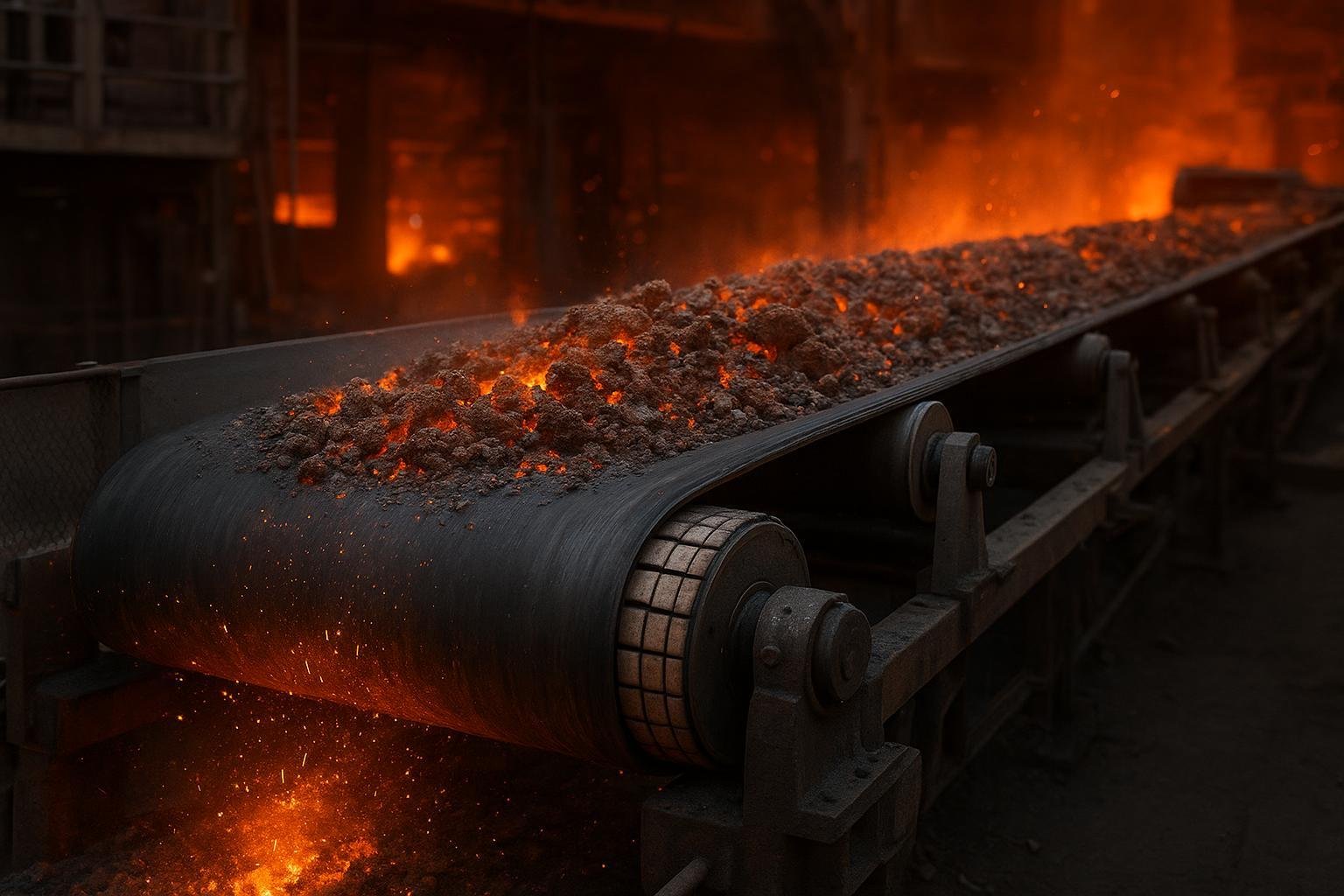
Steel works push conveyors to their limits: hot sinter and slag at the transfer, abrasive scale and coke, rolling oils and acids in finishing lines, and continuous impact, dust, and moisture. The wrong belt choice means hardening covers, splice failures, mistracking, carryback, and unplanned stoppages that ripple through the melt shop and rolling mill.
This 2026 buyer’s guide distills steel mill conveyor belts into practical “Best for” picks with a normalized spec view and evidence-minded methodology. You’ll see where steel cord vs EP/NN fits, how heat‑resistant grades map to continuous and short‑peak temperatures, when to step up to UHR covers, and which compatible idlers and pulleys keep energy use and slippage in check. If you already know your duty, jump to the comparison table or the quick decision guide below.
Note: Where public, we reference OEM pages for independent verification. Prices and lead times are quote‑based and subject to change.
How we chose (methodology and weights)
We scored each solution type against plant-floor factors that matter in steel environments and aligned them with ISO/DIN language where applicable.
- Heat/abrasion/chemical resistance performance (22%): Temperature bands (continuous and short‑peak), abrasion loss per DIN/ISO (mm³), and chemical compatibility for pickling/galvanizing lines.
- Tensile strength and splice reliability (16%): Carcass class (kN/mm), elongation, adhesion values, and approved splicing practices.
- System-level compatibility (15%): Availability of matched idlers (impact, UHMWPE, stainless) and pulleys (ceramic‑lagged, motorized) with sizing and wrap guidance.
- Energy efficiency (10%): Low rolling resistance covers and low‑runout, low‑drag idlers to reduce kW draw.
- Lifecycle cost and maintenance interval (18%): Wear rate, MTBF, changeout time, spares availability, and cleaning effectiveness (carryback control).
- Compliance and QA traceability (12%): Alignment with common standards nomenclature (e.g., ISO 15236 for steel cord, ISO 14890 for textile belts; DIN references for abrasion and heat‑aging) and documented test results.
- Delivery lead time and global support (7%): Stock widths/strengths, build slots, export readiness, and on‑site support.
Scoring transparency: We used OEM datasheets where available, standards terminology, and practical field constraints (pulley diameters, wrap angles, incline needs). Always verify final selection with site measurements and the belt maker’s latest datasheet.
2026 comparison at a glance
The table below summarizes how common steel‑mill belt and component solutions compare. Values vary by grade and supplier; use it as a screening tool, then confirm against current datasheets.
| Solution | Temperature rating | Abrasion index (DIN/ISO) | Tensile rating (kN/mm) | Max width | Best for | Not for | Typical cover compound | Compatible idlers/pulleys | From price | Notes |
|---|---|---|---|---|---|---|---|---|---|---|
| Steel cord belts | Continuous per cover; short‑peaks per grade | Datasheet‑dependent (mm³) | Very high; datasheet‑dependent | Very wide; datasheet‑dependent | Long‑distance, high‑lift raw materials | Very small pulleys; short retrofits with tight transitions | Abrasion‑resistant, HR/UHR as needed | Impact + standard/UHMWPE idlers; ceramic‑lagged drives | Quote‑based | See steel cord overview at Continental for classes and uses: Continental steelcord belts |
| EP/NN textile belts | By cover grade | Datasheet‑dependent (mm³) | Moderate (by ply/EP rating) | Broad; datasheet‑dependent | Plant transfers, shorter centers | Extreme lifts/long centers with high tension | Abrasion‑resistant; HR/NBR options | Standard/UHMWPE idlers; ceramic‑lagged drives | Quote‑based | See Metso portfolio for use cases: Metso conveyor belts |
| UHR heat‑resistant belts | Short peaks ~200–400°C (grade‑specific) | Often trades abrasion for heat | As per carcass | As per carcass | Hot sinter/slag discharge | Cold, oily lines where NBR is needed | UHR/EPDM‑family | Impact/steel or stainless idlers; ceramic‑lagged drives | Quote‑based | Example grade overview: HILFLEX UHR |
| HR heat‑resistant belts | Typical continuous ~140–180°C (grade‑specific) | Abrasion per grade (mm³) | As per carcass | As per carcass | Hot clinker/sinter below UHR peaks | Very high short‑peaks >200°C | HR cover compounds | Standard/UHMWPE idlers; ceramic‑lagged drives | Quote‑based | Verify with OEM datasheet for exact temp band |
| Oil/chemical‑resistant belts | Per compound and thickness | Often higher abrasion loss vs AR grades | As per carcass | As per carcass | Pickling lines, rolling oils | Dry, highly abrasive ore if AR is priority | NBR/CR or specialized compounds | Stainless/UHMWPE idlers; rubber/ceramic‑lagged drives | Quote‑based | Check chemical compatibility against SDS |
| Corrugated sidewall belts | By cover and carcass | As per grade | As per carcass | Engineered‑to‑order | Steep elevation in tight footprints | Very high speeds that damage cleats | AR/HR depending on zone | Dedicated sidewall pulley/idler layout | Quote‑based | Consider FLEXOWELL‑style systems; verify pulley plan |
| Stainless/steel belts | Very high temperature capability | Not rubber‑based | Not applicable (belt is metal) | Engineered | Cooling beds, extreme heat lanes | Sharp troughing with rubber idlers | Stainless/steel | Flat beds; dedicated supports | Quote‑based | See steel belts overview: IPCO steel belts |
| UHMWPE/stainless idlers | Affects energy, not belt temp | Low drag surfaces | N/A | Width‑matched | Lower rolling resistance and corrosion zones | Very high impact > rated load | N/A | UHMWPE shells; stainless housings | Quote‑based | Specify runout/tolerances; pair with low‑RR covers |
| Ceramic‑lagged pulleys | Enables traction under wet/dirty load | N/A | N/A | Size‑matched | High‑load drives; contamination | Misaligned systems that chew covers | N/A | Ceramic tiles on drive pulleys | Quote‑based | Also available via ASGCO: ASGCO conveyor belting category |
| BisonConvey integrated portfolio | UHR/HR/NBR grades per zone | DIN/ISO abrasion options | Steel cord and EP/NN ranges | Common mill widths | Steel‑mill duty across hot/abrasive/corrosive zones | Ultra‑specialized metal mesh niche lines | HR, UHR, AR, NBR covers | Ceramic‑lagged pulleys; UHMWPE/stainless idlers | Quote‑based | Neutral note: Supports selection and global export via application‑driven guidance (verify with supplier) |
Quick decision guide
Use these checkpoints to narrow your shortlist. Then confirm pulley diameters, wraps, and take‑up travel with the supplier before ordering.

- Temperature: If continuous temperature is below roughly 160°C, HR cover may suffice; for short peaks above ~200°C at discharge, shortlist UHR covers and confirm exact tolerance from the datasheet.
- Tension and distance: Long centers or steep lifts usually favor steel cord (lower elongation, high kN/mm). Short runs with tighter pulleys often suit EP/NN textile carcasses.
- Chemicals and oils: In pickling or oil‑rich lines, prioritize NBR/CR or specialized chemical‑resistant covers, even if abrasion resistance is slightly lower than AR grades.
- Incline: For compact, steep elevation, look at corrugated sidewall systems; for moderate inclines, a chevron profile can work with simpler hardware.
- Traction and energy: Pair belts with ceramic‑lagged drive pulleys to curb slippage under wet/dirty load; use UHMWPE or stainless idlers to lower rolling resistance and resist corrosion in wet zones.
The 10 Best‑For solutions in 2026 for steel mill conveyor belts
1) Steel cord conveyor belts — Best for long‑distance, high‑tension raw material handling
Positioning: High‑tensile, low‑elongation carcass for ore, coke, and aggregate runs into the plant with stable tracking and splice performance when designed correctly.
Best for / Not for: Best for long centers, high lifts, and high‑throughput trunk lines; not for very small pulleys or tight retrofit transitions without re‑engineering.
Key specs to request: Tensile class in kN/mm, allowable pulley diameters, elongation at nominal load, cover grade (abrasion, HR/UHR/NBR), continuous vs short‑peak temperature.
Compatible components: Impact idlers in loading, standard or UHMWPE idlers along the run, ceramic‑lagged drive pulleys.
Pros: Very high tensile capacity and low stretch reduce mistracking; good lifecycle economics on long runs.
Limitations: Higher upfront cost and specialized splicing; transition and pulley sizing must be respected.
Price/lead time: Quote‑based; varies with width, kN/mm class, cover thickness/grade, and length.
Standards & evidence links: See the steel cord overview and product classes at Continental’s official page: Continental steelcord belts.
Alternatives: High‑strength textile belts for shorter centers; metal belts only for extreme heat flats.
2) EP/NN textile conveyor belts — Best for general plant transfers and shorter runs
Positioning: Versatile textile carcass that flexes over smaller pulleys and supports multiple cover chemistries.
Best for / Not for: Best for inter‑process transfers, shorter centers, and moderate lifts; not for very long hauls or the highest tensions.
Key specs to request: EP/NN rating and ply count, minimum pulley diameters, abrasion index (DIN/ISO mm³), selected cover grade and thickness.
Compatible components: Standard or UHMWPE idlers; ceramic‑lagged drives in dirty/wet areas.
Pros: Typically faster lead times and lower cost; flexible and easy to splice with approved methods.
Limitations: Higher elongation than steel cord; ultimate tensile capacity is lower.
Price/lead time: Quote‑based; influenced by width, ply/EP rating, and cover.
Standards & evidence links: Portfolio and use‑case overview from Metso: Metso conveyor belts.
Alternatives: Steel cord for long centers/high lifts; modular chevron or sidewall solutions for incline.
3) Ultra heat‑resistant (UHR) rubber belts — Best for hot sinter/slag with short peaks
Positioning: Cover compounds engineered to tolerate high short‑peak temperatures at transfer and discharge.
Best for / Not for: Best for hot sinter and slag handling with transient thermal shocks; not for oil‑rich pickling lines unless paired with chemical‑resistant chemistry.
Key specs to request: Continuous and short‑peak temperature ratings, abrasion index, carcass type and kN/mm class, recommended cleaning solutions.
Compatible components: Ceramic‑lagged drives; steel or stainless idlers with adequate heat considerations.
Pros: Reduces heat‑induced cracking/hardening versus standard covers; supports uptime in hot zones.
Limitations: Some UHR grades trade abrasion resistance for heat tolerance; cleaning and scraper selection matter.
Price/lead time: Premium over HR; quote‑based by grade and thickness.
Standards & evidence links: Example overview of UHR grades from HILFLEX: HILFLEX UHR.
Alternatives: HR belts where continuous temps are modest; metal belts where rubber limits are exceeded.
Want a neutral, spec‑checked shortlist that maps your transfer temperatures to feasible cover grades? A technical team like BisonConvey can provide application‑driven options without obligation.
4) BisonConvey integrated heavy‑duty portfolio — Best for system‑level fit across hot, abrasive, and corrosive mill zones
Positioning: A consolidated belt-and-components lineup covering steel cord and EP/NN belts with HR/UHR and oil/chemical‑resistant covers, plus matched idlers (UHMWPE/stainless) and ceramic‑lagged pulleys.
Best for / Not for: Best for mills seeking a single supplier that aligns belt selection with idler/pulley choices and publishes QA aligned with ISO/DIN terminology; not for ultra‑niche metal mesh or sanitary specialty applications.
Key specs to request: Belt carcass class (kN/mm), cover grade and thickness (abrasion/heat/chemical), approved splice procedures, idler runout specs, and pulley lagging options.
Compatible components: Ceramic‑lagged drive pulleys, UHMWPE or stainless idlers, impact idlers in loading, motorized pulleys where appropriate.
Pros: Helps reduce slippage and rolling resistance through matched components; documented QA and application‑driven selection support global projects.
Limitations: Specific compounds/widths depend on build slots; always verify datasheet details and lead times.
Price/lead time: Quote‑based; depends on belt type, width, tensile class, cover grade, and quantity.
Standards & evidence references: Aligns selection with ISO/DIN nomenclature used for steel cord and textile belts; request current certificates and test summaries from the supplier.
Alternatives: Mix‑and‑match OEM ecosystems if you have in‑house engineering bandwidth for integration.
5) Heat‑resistant (HR) rubber belts — Best for hot clinker/sinter below UHR thresholds
Positioning: Balanced heat‑aging resistance for continuous elevated temperatures without the premium of UHR.
Best for / Not for: Best for sustained hot service where short‑peaks are modest; not for thermal shock zones above UHR thresholds.
Key specs to request: Continuous temperature rating, abrasion loss (DIN/ISO mm³), cover thickness, and scraper compatibility.
Compatible components: Standard or UHMWPE idlers, ceramic‑lagged drives.
Pros: Solid performance envelope for many mill hot zones; broad availability.
Limitations: Will harden sooner than UHR at higher peaks; confirm cleaning approach to limit carryback.
Price/lead time: Quote‑based; depends on cover thickness/grade and carcass.
Evidence link: General belting overviews from established OEMs like ASGCO provide context: ASGCO conveyor belting category.
Alternatives: UHR for higher peaks; abrasion‑first AR covers for cold, very abrasive duty.
6) Oil/chemical‑resistant (NBR/CR) belts — Best for pickling lines and rolling oils
Positioning: Compounds that withstand hydrocarbons, acids, or alkalis common in finishing and treatment lines.
Best for / Not for: Best for wet, oily, or chemically active areas; not for dry, highly abrasive ore where AR cover is the priority.
Key specs to request: Chemical compatibility per SDS, swelling/volume change data, abrasion index, and anti‑static/flame‑retardant options if required.
Compatible components: Stainless or UHMWPE idlers; appropriate cleaners that won’t damage the compound.
Pros: Preserves cover integrity where oils/chemicals would rapidly degrade standard rubbers.
Limitations: May trade abrasion or heat resistance versus AR/HR; chemistry must match the media.
Price/lead time: Quote‑based; chemistry and thickness are main drivers.
Evidence link: See general OEM product families (textile/cover options) at Metso: Metso conveyor belts.
Alternatives: HR/UHR covers where heat dominates; stainless belts for extreme heat and hygiene.
7) Corrugated sidewall belts — Best for steep‑angle elevation in compact footprints
Positioning: Cleated sidewall systems move charge at steep angles with controlled spillage.
Best for / Not for: Best for vertical or near‑vertical lifts where space is limited; not for very high belt speeds that accelerate cleat wear.
Key specs to request: Wall height, cleat profile and pitch, belt width, cover grade per material, pulley layout.
Compatible components: Sidewall‑compatible pulleys and support idlers; engineered transitions.
Pros: High lift in minimal space; customizable for layout.
Limitations: Specialized maintenance; spares management for cleats and walls.
Price/lead time: Engineered and quote‑based; depends on geometry and grade.
Evidence link: Many OEMs offer technical overviews of sidewall systems akin to FLEXOWELL‑style designs; verify with supplier datasheets.
Alternatives: Chevron belts for moderate inclines; bucket elevators for discrete lifts.
8) Stainless/steel belts — Best for cooling beds and extreme heat lanes
Positioning: Solid or perforated stainless/steel belts where rubber limits are exceeded or hygiene/cleanability is vital.
Best for / Not for: Best for cooling beds, quench zones, and very high radiant heat; not for troughing idler systems requiring rubber flex and grip.
Key specs to request: Alloy and thickness, perforation pattern (if any), support/tracking hardware, allowable tension and speed.
Compatible components: Flat beds, dedicated supports, and drive elements; cleaning systems designed for metal.
Pros: Withstands temperatures beyond rubber; dimensional stability on flat beds.
Limitations: Heavier and noisier; different tracking and power requirements.
Price/lead time: Engineered‑to‑order; quote‑based with alloy and geometry driving cost.
Evidence link: High‑temperature overview from IPCO: IPCO steel belts.
Alternatives: UHR rubber belts where temperatures and layouts allow.
9) UHMWPE/stainless idlers — Best for lowering rolling resistance and resisting corrosion
Positioning: Idlers that cut power draw and survive wet or chemically aggressive zones.
Best for / Not for: Best for wet or corrosive lines and energy‑sensitive conveyors; not for ultra‑high impact loading above the idler’s rating.
Key specs to request: Runout, sealing class, shell material (UHMWPE vs stainless), bearing type, allowed load and speed.
Compatible components: Energy‑saving cover compounds, well‑aligned frames, appropriate belt cleaners.
Pros: Lower indentation rolling resistance versus conventional steel in some applications; corrosion resistance; can reduce kW.
Limitations: Load and temperature limits for UHMWPE; thermal expansion must be considered.
Price/lead time: Quote‑based; diameter, length, and sealing drive cost.
Evidence link: Cross‑reference with established conveyor component OEMs and request runout/power‑draw data.
Alternatives: Standard steel idlers for heavy impact; impact idlers in loading zones.
10) Ceramic‑lagged pulleys — Best for traction under contamination and high load
Positioning: Drive pulleys faced with ceramic tiles to boost friction and cut slippage, especially when moisture, scale, or fines reach the drive.
Best for / Not for: Best for high‑tension drive stations and wet/dirty conditions; not for misaligned systems that will prematurely abrade covers.
Key specs to request: Tile type and pattern, thickness, friction coefficient ranges (dry/wet), and recommended wrap angles.
Compatible components: Steel cord or textile belts; combine with effective cleaners and water management.
Pros: Higher effective friction than rubber lagging under contamination; improved drive reliability; extended lagging life.
Limitations: If tracking is poor, cover wear may increase; proper installation and cleaning are essential.
Price/lead time: Premium over rubber lagging; quote‑based by pulley size and tile spec.
Evidence link: Many OEMs and integrators document ceramic lagging performance; verify with current technical bulletins and site trials.
Pricing and lead‑time notes (2026)
- Model: Predominantly quote‑based across steel mill conveyor belts and matched components. Published list prices are rare due to customization.
- Main drivers: Belt width, tensile class (kN/mm), cover compound and thickness, overall length and splice plan, cleaning hardware, and quantity. For components: idler diameter/length/sealing, pulley size and lagging type.
- Lead time drivers: Stock widths/strengths, production slots, integrated component orders, export documentation, and shipping lanes. Peak maintenance seasons can extend schedules.
- Disclaimer: All ranges and notes are indicative and subject to change in 2026. Lock specs and timelines with a written quote.
Splicing and installation checklist (practical)
- Verify carcass and splice method: Steel cord usually requires approved hot‑vulcanized splices; textile belts may allow a broader range but still follow OEM procedures. Ask for target splice efficiency and adhesion values.
- Confirm pulley diameters and transition geometry: Check minimum diameters for the chosen carcass and cover; validate trough angles, transition distances, and take‑up travel.
- Prepare the belt path: Align structures, square pulleys, set training idlers, and verify scraper compatibility with HR/UHR or NBR compounds.
- Commissioning and audits: Conduct a controlled run‑in; schedule daily visual checks for the first week, monthly alignment/roller audits, and 6–12 month splice inspections.
- Documentation: Keep batch/serial records, splice reports, and any QA certificates for traceability.
FAQ
Q: What heat‑resistant grades are suitable for hot sinter or slag? A: If continuous temperatures are roughly 140–180°C with modest peaks, HR covers are common. Where short peaks exceed ~200°C at discharge, shortlist UHR compounds and confirm exact ratings on the datasheet. Pair with ceramic‑lagged drives to manage traction under hot, dusty conditions.
Q: When should steel cord be chosen over EP/NN fabric in steel plants? A: Use steel cord on long centers or high lifts where low elongation and high kN/mm classes stabilize tracking and splices. Choose EP/NN on shorter runs with smaller pulleys, complex transitions, or tighter retrofits where flexibility is valuable.
Q: How do ceramic‑lagged pulleys reduce slippage? A: Ceramic tiles offer a higher effective friction coefficient than rubber lagging under wet or dirty conditions, improving traction at the drive. This cuts slip‑related heat and wear, but still requires proper wrap angles, alignment, and cleaning to protect the belt cover.
Q: What maintenance intervals extend belt life in mills? A: Start with daily visual checks for spillage, mistracking, and hot spots; perform monthly alignment and roller audits; and schedule splice inspections and tension checks every 6–12 months. Cleaners and skirting should be inspected frequently in abrasive or hot zones.
Standards and evidence references (selection language)
- Steel cord belts referenced with the terminology used in ISO 15236 and DIN 22131.
- Textile belts referenced with terminology used in ISO 14890 and DIN 22102; abrasion concepts align with ISO 4649 (DIN method) for mm³ loss and heat‑aging concepts align with ISO 4195.
- Representative OEM resources used in this guide for cross‑checking positioning and applications:
- Continental — Steel cord belts overview: Continental steelcord belts
- Metso — Conveyor belts portfolio and applications: Metso conveyor belts
- IPCO — Steel/stainless belts overview: IPCO steel belts
- HILFLEX — Ultra Heat Resistant grade example: HILFLEX UHR
- ASGCO — General heavy‑duty belting category: ASGCO conveyor belting category
Next steps (soft CTA)
If you want a neutral, spec‑checked shortlist mapped to your temperatures, materials, pulleys, and incline targets, request an application‑driven recommendation and quote. A supplier like BisonConvey can align carcass class, cover chemistry, idler runout, and drive lagging to your exact mill duty — and provide the datasheets and QA documentation you’ll need for sign‑off.