When a conveyor project is on the line, choosing between steel cord and fabric (EP/NN) belts determines far more than the belt invoice. It sets the trajectory for uptime, take-up travel, pulley sizing, splice strategy, and lifecycle cost. The question isn’t “Which belt is best?” but “Which belt fits the mechanical, operational, and environmental realities of your system?”
This guide compares construction and behavior, shows a quick side-by-side, then maps real scenarios—long-distance overland, small pulleys and curves, high-impact transfers, wet/heat/corrosive conditions, and rapid repair requirements—to help you pick with confidence.
What really differs: construction, behavior, and why it matters
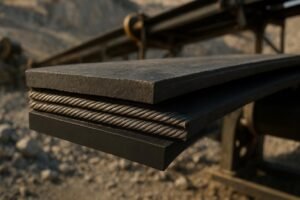
Steel cord belts embed longitudinal steel cords (usually brass- or galvanized-coated) in the carcass with rubber covers and skim layers engineered for adhesion and fatigue resistance. The result is very high tensile ratings (ST classes) and minimal service elongation—ideal for long, high-tension flights. Larger minimum pulley diameters come with the territory, scaling with strength class; representative ranges are provided by manufacturers and standards-based datasheets, such as the technical overviews in the Standard‑A steel cord belt guide (2024) and the NRC steel cord brochure.
Fabric belts use textile plies: EP (polyester warp/nylon weft) for low-to-moderate elongation and better dimensional stability in moist/thermal conditions, and NN (nylon warp/nylon weft) for higher elasticity and superior shock absorption. Fabric belts bend over smaller pulleys and handle tighter transitions; minimum pulley diameters are published by OEMs—for EP, see the Fenner Dunlop Superfort datasheet. Abrasion and heat performance is determined primarily by cover compound and grade, not carcass type; DIN and ISO frameworks are summarized in the Dunlop abrasion standards explainer (2024).
Quick comparison table (2026 snapshot)
| Dimension | Steel Cord Belts | EP Fabric Belts | NN Fabric Belts |
|---|---|---|---|
| Tensile class & behavior | ST1000–ST5400+ commonly used; minimal service elongation; high splice integrity under hot vulcanization | Low-to-moderate elongation; moisture/heat dimensional stability; wide rating range (kN/m) | Highest elasticity; excellent shock absorption; ratings in kN/m |
| Minimum pulley diameters | Large and strength-class dependent (e.g., ST5400 often ~1,800 mm drive) | Moderate; OEM charts define diameters by load fraction and ply rating | Smallest among the three for a given rating; good for tight transitions |
| Geometry fit | Long, straight, high-tension flights; overland/high lift | Mixed plant geometry; moderate curves and transitions | Tight curves, small pulleys, frequent transitions |
| Splice and repair | Hot vulcanized splices preferred; mechanical/cold generally avoided for primary joints | Hot vulcanization best; mechanical/cold possible for rapid or temporary repairs | Mechanical/cold repairs commonly used as temporary/emergency measures |
| Maintenance focus | Splice integrity, corrosion control of cords, alignment/cleaning | Tracking/tension management; idler alignment; quicker field interventions | Tracking under higher elasticity; frequent starts/stops |
| Cover compounds & compliance | Full range (abrasion, heat, oil, FRAS/MSHA) available; select per duty and standard | Same cover options and compliance frameworks | Same cover options and compliance frameworks |
Representative references: Standard‑A steel cord belt guide, NRC steel cord brochure, Fenner Dunlop Superfort datasheet, Dunlop abrasion standards explainer (2024).
Scenario 1 — Long distance and high lift overland
If you’re designing a multi‑kilometer overland line or pushing steep vertical lift with high tonnage, steel cord is the default baseline. Minimal service elongation reduces take‑up travel and maintains tension stability across seasonal swings, while ST ratings cover the tensile headroom. Global OEMs document single‑flight capabilities into the tens of kilometers and thousands of tons per hour; for scale context (not a prescription), see BEUMER’s overland conveyor capabilities.
Trade‑offs worth noting:
- Larger pulley diameters and heavier belts can increase capex and structure load.
- Splice quality is critical; plan for expert hot vulcanization and QA.
- Corrosion control matters: choose cord coatings and cover compounds suited to moisture and chemistry.
When might fabric still appear? Shorter overland tie‑ins or bypasses with moderate tension, or plant-to-pit links where geometry constraints and lead time favor EP.
Scenario 2 — Small pulleys, curves, and frequent transitions
Tight transfer geometry, short center distances, smaller drive/tail drums, and multiple snubs point to fabric. EP balances flexibility with lower elongation than NN, while NN excels when shock absorption and very small pulleys are mandatory.
Why it works:
- Lower bending stiffness lets fabric belts run on smaller diameters with less flex fatigue.
- Published OEM charts align pulley diameters to belt rating and load fraction; see the Superfort EP pulley guidance for an example of how to read these tables.
Got frequent starts/stops or screen decks creating oscillations? Fabric’s dynamic behavior helps avoid jarring transitions and reduces risk of cover cracking at sharp bends.
Scenario 3 — High-impact loading and transfer points
A thick‑covered steel cord belt can be exceptionally resistant to tearing and longitudinal gouging under high drop heights. However, if the limiting factor is instantaneous impact energy and shock absorption at a small transfer, NN’s elasticity can be a better fit—provided tension requirements stay moderate and pulley diameters remain small.
Practical notes:
- Consider impact idlers, ceramic‑lagged pulleys, and proper skirt sealing regardless of carcass type.
- For steel cord in impact areas, review the cord pitch, rubber penetration, and cover thickness alongside chute design.
- For fabric belts, specify the right ply count and abrasion grade (DIN/ISO) to extend life; Dunlop’s abrasion standards explainer is a useful framing.
Scenario 4 — Wet, hot, or corrosive operating environments
Both carcass families rely on cover compounds and design details to survive harsh environments. EP fabric’s polyester warp offers dimensional stability in moist settings and is often selected for wet process lines. Heat, oil, and flame resistance derive from compound choice and certification, not from carcass alone. Use the relevant DIN/ISO grade and regional approvals (e.g., MSHA/FRAS) that apply to your site standards and insurance requirements.
Key implications:
- For steel cord belts in corrosive or persistently wet environments, cord coating (brass/galvanized) and adhesion systems are pivotal; see steel cord construction notes in Standard‑A’s guide.
- For EP/NN, ensure cover grade and ply layout match abrasion/temperature profiles; the Dunlop abrasion standards overview explains grade selection logic.
Scenario 5 — Rapid repair vs. maximum splice strength
Downtime realities often drive splicing decisions. Hot vulcanized splices provide the highest strength recovery for both steel cord and fabric designs when executed per OEM manuals. But some operations need the line back in hours, not days.
- Mechanical fasteners and cold splices can get fabric belts running quickly, typically with lower strength recovery and reduced longevity—appropriate as temporary fixes or for lower‑tension service. For practical pros/cons and method overviews, see MIR’s conveyor belt repair methods guide.
- Steel cord lines under high tension should avoid mechanical joints for primary splices; plan outages for hot vulcanization and non‑destructive testing if used.
Think of it this way: if your operating window punishes downtime and your tensions are moderate, fabric plus a well‑planned mechanical or cold repair strategy can protect throughput. If your line is mission‑critical and high‑tension, prioritize hot vulcanized splices and preventive maintenance.
Splicing and maintenance: where the work really happens
Steel cord systems reward precision. Splice geometry and execution quality dominate reliability, and corrosion control of cords (via coating selection and sealing) matters over the belt’s life. Routine alignment checks, effective belt cleaning, and periodic inspections (including NDT where implemented) support uptime; construction and maintenance themes are summarized in the NRC steel cord brochure.
Fabric systems prioritize tracking and tension management. Because EP and especially NN elongate more under load than steel cord, plan for greater take‑up travel and periodic adjustments. The upside is agility: field repairs and replacements are typically faster, and spare inventory can cover a wider set of conveyors when widths and ratings align.
Standards and compliance you’ll likely touch
Selecting the right belt almost always intersects with international or regional standards—either directly in specs or indirectly via insurer and regulator expectations. A few you’ll encounter:
- ISO/DIN design and product families. Steel cord belts align to ISO 15236 lineage and DIN 22131 heritage; textile belts align to DIN 22102 and EN ISO frameworks for abrasion and related properties. For a directory view of ISO conveyor standards and committees, review the ISO catalogue for belt conveyor standards.
- Pulley diameter methodologies in ISO 3684 (and OEM tables derived from it) guide minimum sizes by carcass and loading—use OEM datasheets to apply them to your specific belt.
- Site‑specific safety approvals (e.g., FRAS/MSHA Part 14 for underground coal) and compound standards (e.g., ISO 4195 for heat) must be specified explicitly in the inquiry.
Lifecycle and TCO: take‑up, downtime, and lead time
No two projects carry the same risk profile, but recurring economic patterns show up:
- Take‑up and creep: Minimal elongation on steel cord reduces take‑up stroke and stabilizes tension, which helps very long flights maintain tracking and splice health. Fabric requires more take‑up travel and more frequent adjustments—an OPEX consideration that is often acceptable on short plant runs.
- Energy and structure: Steel cord belts and larger pulleys may raise initial capital and structural loads, but the trade can be favorable over multi‑kilometer lines due to uptime and splice stability. Fabric’s lighter constructions suit shorter distances and complex geometries.
- Repairs and spares: Fabric’s compatibility with mechanical/cold interventions can shorten unplanned downtime. Stocking a few EP widths and ratings may cover a wide set of conveyors; steel cord spares are more specialized.
- Lead time and availability: Market and regional supply chains shift. If your schedule is tight, availability may tilt the decision toward fabric unless steel cord performance is genuinely required.
How to choose: a fast decision framework
- If your conveyor is long, straight, high‑tension, or high‑lift, start with steel cord and size pulleys accordingly; validate with OEM pulley charts and hot‑splice planning.
- If your conveyor geometry is tight—small pulleys, curves, frequent transitions—or you expect frequent starts/stops, start with EP (or NN if shock absorption and very small diameters dominate).
- If you operate in wet, hot, oily, or flame‑risk areas, specify cover compounds and compliance first; then choose carcass type based on tension and geometry.
- If rapid repair is a top priority and tensions are moderate, consider fabric with a defined mechanical/cold repair playbook; reserve hot vulcanization for planned outages.
Also consider
Disclosure: BisonConvey is our product.
For projects that benefit from system‑level compatibility (belts, idlers, pulleys, lagging) and application‑driven selection support across both steel cord and fabric families, you may also evaluate BisonConvey’s portfolio. See the company overview at BisonConvey’s official site. This is a neutral reference; choose based on your technical and commercial criteria.
Closing
There isn’t a single “best” belt—there’s a belt that matches your tension envelope, pulley geometry, environment, repair philosophy, and uptime targets. Use OEM pulley charts and applicable standards to validate diameters, specify cover compounds to match your duty and compliance needs, and decide early whether maximum splice strength or fastest repair times matter more. Ready to make the call? Gather your design loads, geometry limits, and compliance requirements, then shortlist one steel cord option and one fabric option to compare against your project’s most unforgiving constraint. Let’s get the right belt on the rollers.