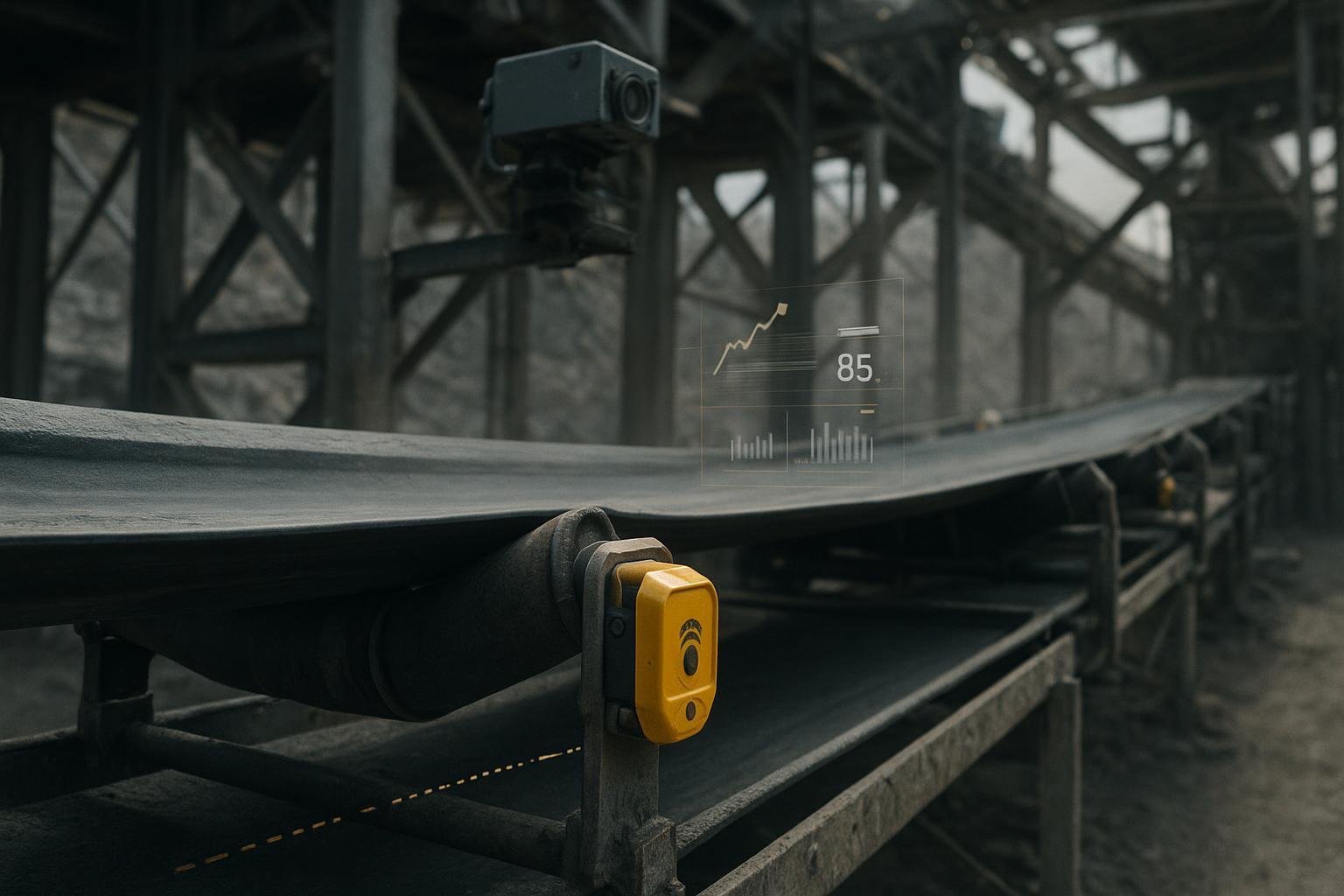
Conveyors are the heartbeat of bulk‑material operations. When one goes down, production, safety, and budgets take a hit. Smart sensors—vibration, temperature, alignment, speed, and machine vision—give reliability teams the early warnings they need to stop small issues from becoming belt damage, fires, or extended outages. The trick isn’t buying more gadgets; it’s designing a program that fits your environment, integrates cleanly with SCADA/MES/CMMS, and follows safety and cybersecurity standards.
What to measure, where to mount
The following table summarizes common conveyor failure modes, the sensor types that help you catch them, and practical placement notes.
| Sensor type | Primary failure mode | Placement guidance | Practical notes |
|---|---|---|---|
| Vibration (accelerometers/IO‑Link nodes) | Idler/pulley bearing defects, looseness | On bearing housings (idler frames, pulley bearings), rigidly mounted | Trend RMS velocity per ISO 20816; use high‑frequency/envelope per ISO 13373 for bearing faults |
| Infrared temperature (surface or IR spot) | Overheating bearings/pulleys | Aim at bearing housings or pulley shells; shield optics from dust | Set alarms as baseline + delta; verify emissivity and spot size |
| Belt alignment/misalignment sensors | Tracking drift, rub risk | Near load zone, snub/take‑up, return side transitions | Configure early thresholds; use IO‑Link for adjustable switching points |
| Speed/zero‑speed/underspeed | Slip, drive issues, jam | Drive or tail pulley, encoder wheels, magnetic pickups | Set underspeed as % of nominal; publish RPM for trending |
| Rip/splice detection (ultrasonic arrays) | Belt tears, splice anomalies | Arrays over/under belt in straight runs | Synchronize sensors to avoid crosstalk; tune to belt characteristics |
| Load cells/weigh idlers | Overload/underload, mass flow | Weigh frames before/after transfer points | Use stable, clean runs; calibrate with test weights |
| Machine vision/line‑scan/radar/LiDAR | Surface defects, debris, carryback; profile | Overhead camera mounts; radar/LiDAR where dust is heavy | Choose IP/NEMA ratings; validate lighting and dust tolerance |
For safety context, align guarding and servicing practices to OSHA’s machine guarding and lockout/tagout rules (29 CFR 1910.212 and 1910.147). See OSHA’s official texts for details in the machine guarding (1910.212) and lockout/tagout (1910.147) sections.
If your conveyors operate in explosive atmospheres (coal dust, grain handling, chemicals), select sensors and enclosures with ATEX/IECEx approvals (IEC 60079‑0/‑11) or Class/Division equivalents. Vendor guidance and standards explain markings and intrinsic safety principles; a clear overview is provided in Getac’s ATEX vs. IECEx explainer.
Build the reliability program right (ISO 17359/20816/13373)
You don’t need universal magic numbers—you need a program. ISO frameworks help you design it:
- ISO 17359 describes how to establish a condition monitoring program: asset criticality, technique selection, measurement routes, frequency, alarm logic, and escalation. A good primer appears in industry proceedings that outline the workflow referenced by reliability teams (e.g., PHME 2024).
- ISO 20816 (formerly 10816) defines measurement bandwidths and severity zones for classes of rotating machines. Use overall RMS velocity in the 2 Hz–1 kHz band for trending; classify severity zones (A/B/C/D) by machine class.
- ISO 13373 guides diagnostic techniques such as envelope detection and crest factor to identify bearing defects versus imbalance or misalignment.
Pair these with site baselines. Collect at least 2–4 weeks of data under normal loads to establish “normal.” Then tune alarm thresholds around that baseline to avoid nuisance alerts.
Edge computing and integration: make data useful, not noisy
A modern conveyor monitoring stack typically looks like this:
- Sensors output via IO‑Link or Modbus (and sometimes 4–20 mA for simple trips). Edge gateways aggregate, filter, and run light ML inference locally to reduce latency and chatter.
- Publish structured telemetry to a Unified Namespace using MQTT Sparkplug B. Sparkplug’s birth/death certificates and standardized payloads improve reliability across plants. See HiveMQ’s Sparkplug essentials (2024) for a concise introduction.
- Use OPC UA where you need rich data modeling and secure client‑server interactions, often alongside Sparkplug in UNS architectures. A practical viewpoint appears in Capgemini’s UNS implementation using OPC UA & MQTT (2025).
Cybersecurity by design (ISA/IEC 62443)
Smart sensors are part of your control system. Treat them accordingly.
- Component requirements: Align devices/gateways to IEC/ISA 62443‑4‑2 (authentication, secure update, logging, crypto) and require supplier secure development lifecycle statements (62443‑4‑1). See Keyfactor’s 62443‑4‑2 guide for an overview.
- System architecture: Segment networks and apply foundational requirements per 62443‑3‑3 (zones/conduits, identification, use control, integrity). A readable summary is UpGuard’s 62443‑3‑3 explainer.
- Patch management: Maintain a firmware update policy aligned to 62443‑2‑3—identify, test in a sandbox, deploy, verify.
Step‑by‑step deployment workflow (from pilot to scale)
-
Map critical assets and failure modes
- Rank belts by consequence of failure (throughput, safety, environmental spill risk). Identify idler and pulley bearings with known history, hot load zones, and areas prone to drift.
-
Select sensors and ratings
- Choose vibration nodes for bearings; IR for thermal; alignment sensors at edge/return; speed pickups on drive/tail; vision or radar/LiDAR where dust obscures optics. Specify IP65–IP69K and, if needed, NEMA 4X/6; validate ambient temperature and cable glands.
-
Validate safety and Ex requirements
- Confirm guarding and LOTO procedures per OSHA 1910.212/1910.147. For hazardous areas, ensure ATEX/IECEx markings (IEC 60079‑0/‑11) or NEC Class/Div equivalents. Document zones and protection methods.
-
Design data architecture
- Define your UNS topics/tags. Decide which metrics stay at the edge (filtered, aggregated) and which go upstream to SCADA/MES/CMMS. Plan event severity and routing to work orders.
-
Install and commission
- Mount sensors per OEM guidance: rigid mounting for vibration; correct IR distance/emissivity; alignment sensors positioned for early detection; speed sensors aligned to encoder wheels/pulleys. Verify IP/NEMA integrity and strain relief.
-
Baseline and tune
- Run for 2–4 weeks under typical loads. Capture RMS velocity, envelope, crest factor, surface temperature, and RPM. Tune alarms: e.g., vibration rising into ISO Zone C plus increasing envelope amplitude triggers a targeted inspection.
-
Integrate alerts to workflows
- Connect alarms to CMMS with failure codes and recommended corrective actions. Use compound rules to reduce false positives (multi‑sensor corroboration).
-
Scale to more conveyors
- Expand to similar assets after the pilot meets KPI targets. Standardize tag models, alarm logic, and maintenance routes.
Procurement and commissioning checklist
Use this checklist during vendor selection and install. It’s intentionally concise so crews can carry it into the field.
-
Compliance and environment
- OSHA machine guarding and LOTO documented; ASME B20.1 e‑stops and guarding verified. See overview of ASME B20.1‑2024 in ANSI’s safety standard summary.
- If applicable, MSHA silica monitoring and dust mitigation plans align with the 2024 final rule timelines; see the official Federal Register silica rule (2024).
- IP/NEMA ratings, ambient temperature, vibration survivability, and cable/conduit hardware validated.
- Hazardous locations: ATEX/IECEx/NEC markings confirmed; documentation filed.
-
Cybersecurity and firmware
- Supplier statements for 62443‑4‑1/‑4‑2 compliance; unique credentials and MFA where feasible.
- Signed firmware, patch cadence, and sandbox test procedure (62443‑2‑3) defined.
-
Protocols and integration
- IO‑Link/Modbus support; gateway bridging to MQTT Sparkplug B and/or OPC UA confirmed.
- UNS tag model and topic hierarchy documented; retention and alarm routing defined.
-
Commissioning and calibration
- Vibration sensors: rigid mount, orientation noted, sample rate configured; baseline route created.
- IR sensors: spot size covers target; emissivity set; optics cleaned and shielded.
- Alignment sensors: thresholds set conservatively for early drift; test trip procedures verified.
- Speed sensors: RPM verified against handheld tach; underspeed trip set to 80–90% nominal.
- Vision/radar/LiDAR: lighting tested; dust mitigation validated; image/radar profiles benchmarked.
Troubleshooting and false‑alarm reduction
False alarms waste time and erode trust. You can fight them without blinding yourself. Combine indicators—e.g., vibration Zone C plus rising envelope and +20°F surface temperature—before issuing a high‑priority alert. Establish site baselines: a belt in a hot ambient tunnel runs warmer, and a fully loaded conveyor vibrates more; set deltas around your baseline, not external one‑size‑fits‑all numbers. Keep sensor health checks in your PMs: tachometer verification for speed sensors, emissivity tests for IR, and mounting integrity for vibration. Maintain environmental shielding: dust on optics or loose mounts produce junk data, so clean and re‑torque routinely. Finally, practice network hygiene: if telemetry goes missing, Sparkplug birth/death certificates will tell you—investigate gateway connectivity and credentials before assuming mechanical faults.
KPIs and ROI: measure what matters
What’s the payoff, and how fast? Track these metrics from day one.
- Unplanned downtime hours on instrumented conveyors (target reduction 20–40% over 6–12 months depending on baseline).
- Mean time to repair (MTTR) for bearing and alignment issues.
- False alarm rate (% of alerts without confirmed issues) and time to triage.
- Work order conversion rate (alerts → corrective work orders) and completion lead time.
- Payback calculation: sum avoided downtime cost (production + labor + material), subtract sensor/gateway/installation + maintenance costs. Keep assumptions transparent.
Real‑world evidence exists but is often proprietary. One named, large‑scale deployment is Schaeffler’s OPTIME wireless condition monitoring at Tarmac’s Tunstead limestone plant, where ~150 sensors across conveyors and other rotating assets improved early warning and planning in harsh quarry conditions; see Bearing‑News’ report on the case (2024). Quantified conveyor‑specific KPIs were not published; treat generalized industry estimates cautiously until your pilot proves local numbers.
Your first 90 days: a simple action plan
- Days 1–15: Define scope and safety—pick one critical conveyor, document guarding/LOTO, Ex zoning, and failure modes. Select sensors and ratings, draft your UNS tag map, and plan CMMS integration.
- Days 16–45: Install and commission. Capture baselines, tune alarms, and test alert routing end‑to‑end. Train crews on verification routines.
- Days 46–90: Operate and iterate. Apply compound rules, track KPIs weekly, and document corrective actions. Prepare the scale‑up plan with standard tag models and maintenance routes.
One last question: are you measuring, or just collecting data? With the right sensors, standards‑aligned program, and secure integration, you’ll spot problems early, protect people and equipment, and make the numbers that matter move in the right direction.