What a Sidewall Conveyor Belt Is—And Why It Exists
If you need to lift bulk material steeply without the footprint of a long trough conveyor—or the complexity of a bucket elevator—sidewall belts are often the answer. A sidewall conveyor belt is a base belt fitted with corrugated rubber sidewalls along both edges and transverse cleats (flights) across the belt. Those elements create “pockets” that hold material on steep or even vertical sections and stop it from rolling back.
Think of the cleats and sidewalls like a series of flexible cups on a moving escalator: as the belt rises, each pocket carries a measured volume of material upward. The corrugations let the sidewalls bend around pulleys and through transitions without collapsing. Because the belt has to resist folding sideways under the load, manufacturers specify cross‑rigid (cross‑stabilized) carcasses so the belt stays flat and tracks correctly in horizontal sections and through changes in direction. For high‑angle capability and the one‑piece design approach, see Cambelt’s explanation in its Corrugated Sidewall Conveyor Belts overview, which describes steep‑to‑vertical applications and construction considerations: Cambelt — Corrugated Sidewall Conveyor Belts.
Angle Capability and Common Layouts
A major draw of sidewall belting is angle range. With the right cleat profile, sidewall height, and carcass rigidity, systems can handle steep inclines—commonly from around 30 degrees up to near‑vertical. The specific angle you can achieve depends on your material’s flow behavior, lump size, the cleat geometry, and how well transitions are designed. Manufacturers’ engineering notes and catalogs (e.g., SIG’s Flexobord documentation) frame these as “extremely steep” applications while emphasizing that details such as pulleys and transitions must be sized accordingly; see the SIG Flexobord catalog for dimensions and design context: SIG — Flexobord catalog (PDF).
Typical layouts include:
- Horizontal‑to‑incline transitions that feed a steep lift without extra transfer points.
- Vertical lifts where plant floorspace is tight.
- S‑shaped profiles to weave around structures.
Transitions deserve care. Profiled belts impose higher bending stresses where cleats/sidewalls pass over pulleys and idlers. As profile height increases, minimum pulley diameters generally increase, and transition lengths must respect belt bending radii to protect pocket integrity. The practical takeaway: involve your belt manufacturer early to confirm pulley diameters and transition geometry for your chosen sidewall and cleat heights.
Selecting the Right Sidewall Belt: A Practical Checklist
Before you pick a belt, confirm what the system must carry, how fast, and at what angle. Then work through these checkpoints to narrow the specification.
- Material characteristics: Abrasion level, temperature, oil/chemical exposure, and lump size/shape. Cleat height usually exceeds max lump size for reliable pocketing; consult vendor rules of thumb and your material’s test data. For cover grades and textile belt quality requirements, see the scope defined in the international standard ISO 14890 — Rubber/plastics covered conveyor belting (textile carcass).
- Capacity and width: Throughput (t/h), bulk density, belt speed, and required belt width. Pocket volume is a function of width, sidewall height, cleat height, and cleat pitch.
- Carcass strength and transverse rigidity: Sidewall systems need cross‑rigid/cross‑stabilized constructions to resist side folding through transitions and horizontal runs. Your longitudinal strength (EP/NN multi‑ply or steel cord) must match tensions from the lift and loading.
- Cleat and sidewall geometry: Choose cleat type (e.g., straight T or reinforced C/TC), height, and pitch to retain your material at the target angle without overflow. Confirm sidewall height for the pocket depth you need; see manufacturer catalogs for range and pairing guidance (e.g., heights spanning tens to hundreds of millimeters in the SIG catalog above).
- Bonding method: Prefer hot‑vulcanized bonds for sidewalls and cleats in fabrication and structural repairs; they offer stronger adhesion than cold bonding. For repair/splicing technique preferences, reference SIG’s installation guidance: SIG — Multiply Conveyor Belts Installation Handbook (PDF).
- Pulleys, idlers, and impact control: Verify minimum pulley diameters for the selected profile heights; specify lagged drive pulleys to maintain traction; use impact idlers or beds and skirt sealing in loading zones to protect cleats and reduce spillage.
- Environment and safety: If your site demands heat‑, oil‑, or flame‑resistant covers, select compounds accordingly. For regulated sectors (e.g., underground coal mines in the U.S.), belts must meet flame‑resistance certification; see MSHA’s quality assurance framework for material approvals: MSHA — Quality Assurance: Material Approvals (PDF).
Sidewall vs Alternatives: Chevron, Bucket Elevator, Sandwich Belt
You don’t always need sidewalls. Sometimes a chevron belt or a bucket elevator is a better match. The best choice depends on angle, footprint, material behavior, capacity, and maintenance philosophy. Here’s a quick comparison you can scan and then sanity‑check against your constraints.
| Option | Typical angle range | Footprint | Maintenance profile | When it shines |
|---|---|---|---|---|
| Chevron belt (open profile) | Often up to roughly 20–25° for common 32 mm profiles and suitable materials (per Dunlop’s product guidance) | Longer horizontal run to achieve lift | Similar to conventional belts; profiles wear; simpler than sidewall | Moderate incline on mobile conveyors or short lifts where extra length is acceptable |
| Corrugated sidewall belt | From steep (~30°) to near‑vertical depending on cleat/sidewall geometry and material | Very compact; can go vertical; minimizes transfer points | Extra attention to transitions and profiling; cleat/sidewall wear and bonding integrity are focus areas | Space‑constrained plants needing continuous high‑angle conveying |
| Bucket elevator | Vertical | Very compact | Chains/buckets/sprockets need regular alignment and wear part management | Discrete handling of free‑flowing materials where continuous belt isn’t practical |
| Sandwich belt | Steep to vertical by clamping material between two belts | Compact but mechanically more complex | Higher alignment and tensioning demands; specialized components | Fragile or irregular materials where clamping provides gentle handling |
For chevron angle context, see the manufacturer guidance in the 2020 Dunlop Product Range PDF, which provides conservative angle expectations for profile heights: Dunlop — Product Range (2020) PDF. For sandwich systems, Dos Santos International describes the design principle and use cases: Dos Santos International — Sandwich Belt Systems.
Practical Workflow Example (with Disclosure)
Disclosure: BisonConvey is our product.
A cement plant needs to move 200 t/h of crushed limestone (bulk density ~1.6 t/m³, top size 75 mm) from a ground‑level hopper to a silo inlet 22 meters above the floor. There’s no room for a long approach conveyor, and a bucket elevator would complicate maintenance in the cramped area. The team considers a sidewall belt with a 60° incline and a short horizontal loading section.
- Angle and material fit: At 60°, the material must be pocketed reliably. Cleat height is set larger than the 75 mm top size (e.g., 100–120 mm), with a compatible sidewall height (e.g., 200–300 mm) to create sufficient pocket volume.
- Width and capacity: Based on 200 t/h and the chosen pocket geometry and belt speed, a 1000–1200 mm belt width is modeled to achieve volume with margin. The cleat pitch is selected to balance pocket fill and belt speed without spillage.
- Carcass: A cross‑rigid EP carcass is specified to keep the belt planar in the horizontal section and stable through the transition into the incline. Longitudinal tensile strength is sized from design tensions per DIN‑style calculations.
- Pulleys and transitions: Minimum pulley diameters increase with profile height; engineering checks confirm drive and bend pulleys large enough to limit bending stress on cleats and sidewalls. Transition length is laid out to respect bending radius and pocket integrity.
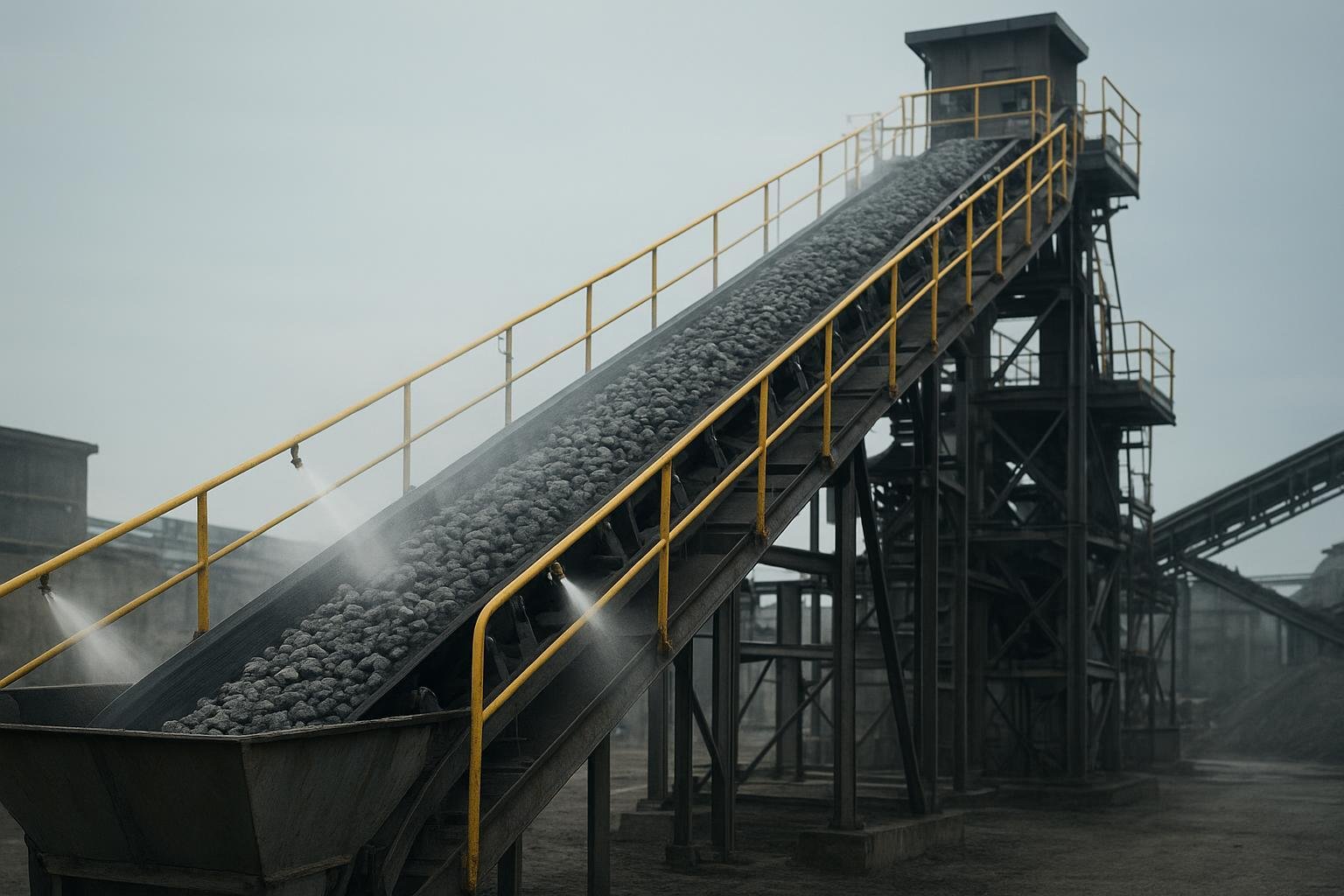
- Covers and environment: Abrasion‑resistant compound is selected; dust suppression and skirt sealing are designed at the loading point.
- Fabrication and repair: Sidewalls and cleats are hot‑vulcanized during fabrication; spare cleat/sidewall kits and a hot splice plan are included in the maintenance binder.
In a case like this, a vendor can provide the exact cleat/sidewall pairings, minimum pulley diameters by profile height, and transition geometry. BisonConvey can support this kind of application‑driven selection and provide a consolidated quotation that includes compatible idlers and pulleys.
Maintenance and Reliability: What Actually Fails—and How to Prevent It
High‑angle conveying works when pockets and bonds stay healthy. Here’s where reliability teams focus, plus simple prevention steps you can adopt.
- Bond integrity and profile wear: Inspect sidewall‑to‑base and cleat‑to‑base bonds for signs of delamination, cracking, or heat‑hardening. Keep pulleys and return runs clean; buildup increases abrasion and tracking forces. When structural repairs are needed, favor hot‑vulcanized methods for strength (see SIG’s installation handbook above).
- Cleat tear‑out and impact damage: Control drop heights and install impact idlers or beds at loading points. Avoid oversized lumps relative to cleat height. Verify skirt sealing doesn’t pinch cleats.
- Tracking and edge wear: Cross‑rigid belts help, but alignment still matters. Confirm frame squareness, idler alignment, and appropriate tension. Use lagged drive pulleys to maintain traction and reduce slip‑induced wear.
Set inspection intervals based on runtime—weekly visual checks for bonds and edges in harsh service are common—then log and trend what you see. A little housekeeping goes a long way.
Safety and Compliance Essentials
Steep and vertical sections demand thorough guarding to prevent entanglement and to protect personnel from falling material. Place emergency stop cords where they’re reachable along walkways, and design dust control and enclosure around transfer points to improve air quality and housekeeping. If your site falls under fire‑safety regulations, specify the appropriate flame‑resistant cover grades and maintain documentation. In the U.S. mining context, belts must meet flame‑resistance certification as documented in the agency’s quality assurance program: MSHA — Quality Assurance: Material Approvals (PDF).
Standards You’ll Touch in Design Work
You won’t find a “sidewall‑only” standard; engineers apply general conveyor belt and calculation standards to these systems:
- Design calculations: DIN 22101 and ISO 5048 are commonly used frameworks for tension and power calculations; they inform pulley sizing and safety factors you’ll confirm with your vendor.
- Belt quality and covers: For textile carcass belts in general surface use, the international specification for requirements and test methods is the standard ISO 14890 — Rubber/plastics covered conveyor belting (textile carcass). For steel cord belts, ISO 15236 defines requirements and test methods.
- Safety properties: In Europe, EN 12882 specifies safety requirements for general‑use belts; local regulations may add sector‑specific rules.
Treat standards as the backbone and your manufacturer’s tables as the muscle—they work together to produce a safe, durable design.
Next Steps
Have a steep lift and a tight footprint? Share your material, angle, and capacity targets and we’ll return a short‑list specification you can validate onsite. For application‑driven selection and a consolidated quote (belt, idlers, pulleys), visit BisonConvey: bisonconvey.com.