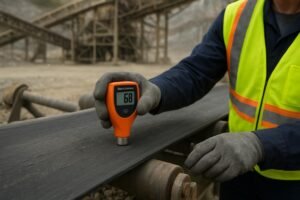
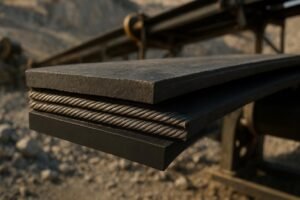
Image: Industrial conveyor belt by Martin Pearman, via Wikimedia Commons (CC BY-SA 2.0)
What is rubber compound quality?
In conveyor belts, rubber compound quality describes how consistently the cover (and skim) rubber meets measurable performance requirements defined by recognized test methods. Think of it as the tested, documented capability of the rubber to resist wear, retain strength, and withstand its environment—heat, oil, flame, ozone—over time. A quality compound is not just one good property in isolation; it’s a balanced formulation that meets all required properties concurrently at the specified levels.
In practice, the industry validates rubber compound quality with standardized tests. For abrasion, the reference is ISO 4649 (also known historically as DIN 53516) using a rotating drum abrader; results are expressed as volume loss in mm³—lower numbers indicate better wear resistance. Tensile strength and elongation are measured per ISO 37 or ASTM D412. Hardness is reported as Shore A (ASTM D2240) or IRHD (ISO 48-4). Heat aging follows ISO 188, with conveyor-specific classes in ISO 4195. Oil resistance is evaluated by immersion and swelling (ISO 1817 or ASTM D1460). Flame resistance is assessed by small-flame tests (ISO 340, used within EN 12882/14973); U.S. mining uses separate MSHA criteria. Ozone resistance is determined by exposing tensioned specimens to an ozone atmosphere (EN/ISO 1431).
Why rubber compound quality matters to lifecycle and safety
Rubber cover wear dictates belt life in many plants. Every extra millimeter of cover thickness you keep through lower abrasion translates into months of additional service and fewer shutdowns. Quality also affects safety and compliance: heat-resistant compounds prevent rapid property loss near kilns, flame-resistant compounds are mandatory in certain mines and plants, and ozone-resistant compounds prevent surface cracking on outdoor conveyors that can accelerate wear and expose carcass fabric.
If you’re specifying or buying belts, rubber compound quality is one of the few levers you can verify before installation. Ask yourself: are the claims backed by recent, batch-relevant test certificates, and are those certificates tied to the exact standards your site requires?
Core properties and tests for rubber compound quality
-
Abrasion resistance: ISO 4649 measures volume loss in mm³ on a rotating drum with abrasive paper. In common cover-grade frameworks, lower loss corresponds to higher abrasion resistance. Many manufacturers summarize the practical limits this way: general-purpose ≈ 150 mm³, high abrasion ≈ 120 mm³, and very high abrasion ≈ 90 mm³ maximum volume loss. An industry guide from Dunlop explains the test method and how these limits map to widely used cover grades in DIN and ISO frameworks; see their detailed note on the abrasion standards and test methods.
-
Tensile strength and elongation: ISO 37/ASTM D412 measure the rubber’s ability to carry load and stretch before breaking. Adequate tensile/elongation, maintained after aging, correlates with resistance to cracking, tearing, and flex-fatigue around pulleys and impact zones.
-
Hardness: ASTM D2240 (Shore A) and ISO 48-4 (IRHD) provide hardness scales. Specify the method and target band, e.g., 65 ±5 Shore A, to balance cut resistance, troughability, and impact absorption.
-
Heat/aging: ISO 4195 applies oven aging to conveyor rubber at specified temperatures (typical classes: 100 °C, 125 °C, 150 °C) and limits the allowable change in tensile, elongation, and hardness after seven days. For a clear overview of heat-resistance classes and what to look for in certificates, see Fenner Dunlop EMEA’s guide to heat resistance standards and test methods.
-
Oil resistance: ISO 1817/ASTM D1460 immerse specimens in reference oils and report dimensional or volume change. There isn’t a universal “pass” number; instead, verify the exact liquid, temperature, duration, and maximum allowed swelling that your process requires. Dunlop’s explainer on oil resistance standards and test methods shows how to interpret certificates.
-
Flame resistance: ISO 340 (used by EN 12882/EN 14973) is a small-flame test that limits afterflame time and propagation; MSHA approvals in the U.S. are separate and not interchangeable. Dunlop details these distinctions in its guide to fire-resistant standards and test methods.
-
Ozone resistance: EN/ISO 1431 uses tensioned samples in an ozone cabinet (commonly 50 pphm at 40 °C) to observe cracking over time. Fenner Dunlop’s technical bulletin on the effects of ozone on rubber explains why even general-purpose belts benefit from ozone-resistant compounds outdoors.
-
Anti-static: EN/ISO 284 ensures belts can discharge static electricity to reduce ignition risk. If you operate in classified areas, make anti-static compliance explicit and verify it with measurements on the certificate.
Grade mapping: DIN 22102 and ISO 14890
The two most common textile-belt cover grade frameworks can be summarized as follows (abrasion loss measured per ISO 4649):
| Framework | General purpose | High abrasion + cut resistance | Very high abrasion |
|---|---|---|---|
| DIN 22102 | Y ≤ ~150 mm³ | X ≤ ~120 mm³ | W ≤ ~90 mm³ |
| ISO 14890 | L ≤ ~150 mm³ | H ≤ ~120 mm³ | D ≤ ~90 mm³ |
These limits—150/120/90 mm³—are widely cited across manufacturer guides and trade publications and are echoed by Dunlop’s abrasion explainer noted above. When you specify, name the framework (DIN or ISO), the exact grade (e.g., DIN W), and require that the supplied compound meets all other site requirements (e.g., heat, oil, flame, ozone) at the same time—not in isolation.
How to verify supplier claims
A quick buyer’s checklist you can adapt to your RFQ and contract:
- State the required cover grade and standards by name (e.g., DIN W per ISO 4649 abrasion). List all additional properties (heat class per ISO 4195, oil test per ISO 1817/ASTM D1460, flame per ISO 340/EN 12882, ozone per EN/ISO 1431, anti-static per EN/ISO 284).
- Require recent test certificates tied to the production batch or compound batch that will be delivered. Certificates must list the test method, test conditions, date, and lab identity; specify acceptance thresholds.
- Prefer independent, accredited labs for safety-critical tests; otherwise request evidence of lab equipment calibration and quality system controls.
- Enforce batch-to-roll traceability: belt markings (type, grade, date, batch/lot/roll number) must match shipping documents and certificates.
- Include audit rights and re-test provisions; define rejection criteria for nonconformance.
Annotated sample certificate excerpt (example formatting):
Supplier: XYZ Belting Co.   Site: Plant A   Batch: RC-2026-0110
Belt: EP1000/4 1000 mm   Top/Bottom Cover: 8 / 3 mm   Grade: DIN W

Abrasion (ISO 4649, Method A): 84 mm³ (limit ≤ 90 mm³) — PASS
Tensile (ISO 37): 18 MPa; Elongation at break: 400% — PASS (limits per PO)
Hardness (ASTM D2240 Shore A): 66 ±2 — PASS (target 65 ±5)
Heat aging (ISO 4195, 7 d at 150 °C): ΔTensile −18%; ΔElongation −20%; ΔHardness +6 — PASS
Oil resistance (ISO 1817, IRM 903, 70 h at 100 °C): ΔVolume +8% — PASS (limit ≤ 10%)
Flame (ISO 340): afterflame 0.0 s (spec: ≤ 3.0 s) — PASS
Ozone (EN/ISO 1431, 50 pphm, 96 h, 20% strain, 40 °C): no cracking — PASS
Anti-static (EN/ISO 284): resistance measured ≤ specified threshold — PASS
Lab: ABC Labs (report ID 26-0110-178); Date: 2026-01-08
Common red flags: a certificate with no batch or date; results listed without the test method; missing test conditions for oil/heat; flame tests that cite only “fire-safe” without a standard; or values that meet one property but omit others your site requires.
Disclosure: BisonConvey is our product. In practice, when buyers request batch-tied certificates, engineering-focused suppliers (for example, BisonConvey) can provide ISO 4649 abrasion data mapped to the ordered grade alongside heat, oil, and ozone test results from recent production runs. The objective is simple: verify that the exact compound being shipped—not a historical formulation—meets your specification.
Industry examples: choosing the right cover focus
Mining and aggregates: If your belt faces constant gouging and sliding wear under stone, prioritize very high abrasion resistance (e.g., DIN W/ISO D) and ensure tensile/elongation and hardness support impact zones. Where sharp impact is frequent, a high-abrasion grade with slightly higher hardness can help resist cutting.
Cement and clinker: Elevated temperatures near coolers or kilns demand heat-rated compounds. Verify the ISO 4195 class (often 125 °C or 150 °C) and also check abrasion numbers; some heat-resistant compounds sacrifice wear resistance if not formulated carefully.
Recycling and waste: Oils from plastics, paper, and food residues mean oil-resistant compounds are prudent. Confirm the exact oil test (liquid, temperature, duration) and specify acceptable swelling. Outdoor lines should also require ozone resistance.
Ports and logistics: Outdoor exposure, salt air, and continuous operation call for abrasion resistance, ozone resistance, and anti-static compliance. For grain and dusty cargo, anti-static and flame classifications may be part of site rules—make the standards explicit in your spec.
Trade-offs you should expect
Here’s the deal: there is no “one number” that defines rubber compound quality. Formulations are optimized for environments. Heat- and oil-resistant compounds can traditionally show higher abrasion loss than pure abrasion-focused grades. Higher hardness can help with cut resistance but may reduce low-temperature flexibility or impact absorption. The goal is to specify the right balance for your duty and then insist on documentation that proves the balance has been achieved.
Do you really need the very lowest abrasion number if your material is hot and oily? Or will a slightly higher abrasion number combined with verified heat and oil performance produce better uptime? Framing your specification around the real operating risks—and verifying with the appropriate tests—keeps you honest.
Next steps
- Put the required standards and acceptance thresholds in your RFQ and PO. Ask for batch-tied certificates for the exact compound that will be shipped to your site.
- Review abrasion (ISO 4649), tensile/elongation (ISO 37/ASTM D412), hardness (ASTM D2240/ISO 48-4), heat (ISO 4195), oil (ISO 1817/ASTM D1460), flame (ISO 340/EN 12882 or MSHA, as applicable), ozone (EN/ISO 1431), and anti-static (EN/ISO 284) as a complete set—not piecemeal.
- If you’d like a neutral, standards-first quote and sample certificate set for your application, you can request one from a technical supplier such as BisonConvey. The aim is to help you validate rubber compound quality before installation, not after a failure.