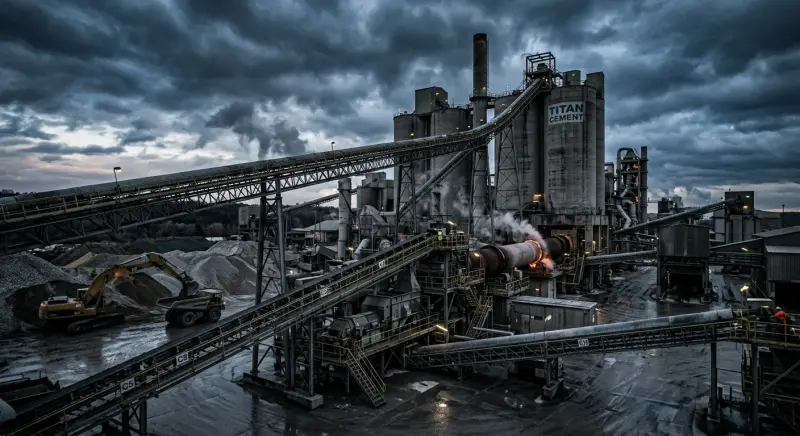
Iron ore breaks conveyor belts in two ways that no other bulk material combines so aggressively: it is dense — roughly 2.2 to 2.9 t/m³ in the loose state, two to three times heavier than coal — and it is abrasive, dragging hard silica and hematite across the top cover on every metre of travel. Get the belt wrong and you pay for it twice: once in premature cover wear, and again in a carcass that stretches, mistracks, or simply runs out of tension rating as the line grows.
The question almost every iron ore project lands on is the same: EP fabric belt or steel cord? This guide gives you a decision matrix rather than a slogan, because the honest answer is "it depends on four numbers" — belt length, tension, tonnage, and take-up travel — not on which belt sounds more heavy-duty.
Why iron ore is a hard case for belt selection
Two material properties dominate every downstream choice.
Density. Because iron ore is so heavy, the same volumetric throughput produces far more mass on the belt than a lighter material would. A belt running 3,000 t/h of iron ore carries a load per metre that a coal line only sees at much higher volumes. Mass on belt drives effective tension Te — the force the drive has to overcome — which is the single biggest input to whether a fabric carcass can do the job at all.
Abrasiveness. Iron ore sits high on the abrasiveness rating scale. Silica gangue and angular lump grind the cover compound continuously, and at every load and transfer point the impact tears at the carcass beneath. This is a cover-grade and impact-protection problem independent of the EP-vs-steel-cord question — you can get it wrong on either belt.
Keep these separate in your head. Density decides carcass type and rating. Abrasion decides cover grade and thickness. A good specification answers both.
The four numbers that actually decide EP vs steel cord
Before the matrix, the inputs. Run these first — the belt type usually falls out of them.
-
Conveyor length (centre-to-centre). Short in-plant transfers behave completely differently from kilometre-scale overland conveyors. Length drives both tension and elongation.
-
Effective and peak tension. Size the belt to peak tension — starting, not running — using the DIN 22101 method. As a rule of thumb, once required belt tension pushes past roughly EP 1000 to EP 1250 (i.e. an EP 1000/4 or heavier fabric carcass), fabric belts get thick, heavy, and hard to splice reliably, and steel cord starts to win on every axis. Use the belt tension calculator to get your number before arguing about belt type.
-
Tonnage and duty cycle. A belt moving 5,000 t/h twenty hours a day is a different economic animal from one feeding a crusher intermittently. High, sustained tonnage rewards the lower running resistance and longer life of steel cord.
-
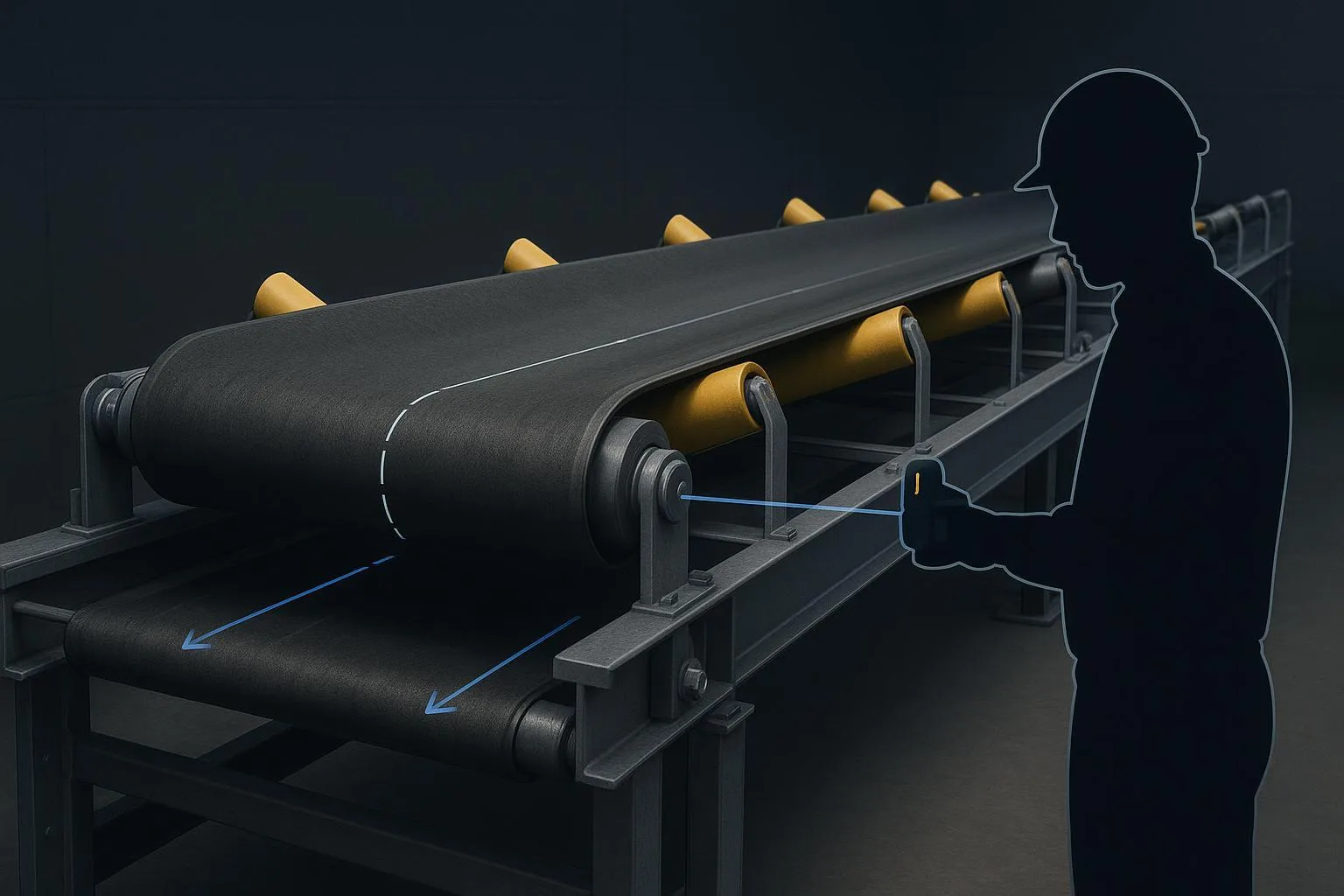
Take-up travel (elongation). This is the one people forget. A fabric EP belt stretches roughly 1.5 to 2 % under working load; a steel cord belt stretches around 0.15 % — an order of magnitude less. On a short conveyor nobody cares. On a 3 km overland, 1.5 % of 3,000 m is about 45 m of take-up travel you have to design a tower or winch for, versus roughly 4 to 5 m with steel cord. Elongation is the reason steel cord exists.
The decision matrix
This is the visual core of the whole exercise. Read it as "given these conditions, start here" — then confirm with the calculators.
| Condition | Fabric (EP) belt | Steel cord (ST) belt | Why |
|---|---|---|---|
| Length < 300 m | ✅ First choice | ⚠️ Overkill | Tension and elongation both manageable on fabric |
| Length 300 m – 1 km | ✅ If tension < EP 1000 | ✅ If tension high | The overlap zone — decide on tension, not length |
| Length > 1 km overland | ❌ Take-up impractical | ✅ First choice | 0.15 % vs ~1.5 % elongation dominates |
| Peak tension < EP 800 | ✅ First choice | ⚠️ Uneconomic | Fabric carcass has ample rating |
| Peak tension > EP 1250 | ❌ Carcass too thick | ✅ First choice | Steel cord carries ST 1000–7500 N/mm |
| Tonnage very high, 20+ h/day | ⚠️ Cover life shorter | ✅ First choice | Lower rolling resistance, longer service life |
| Lump size large, heavy impact | ✅ With thick top cover + impact idlers | ✅ With rip detection | Both need impact idler protection at load points |
| Capital budget tight, short line | ✅ Lower install cost | ❌ Higher upfront | Steel cord earns back on opex, needs the length |
| Tight take-up space | ❌ Needs long take-up | ✅ First choice | Minimal elongation |
The pattern is clear: fabric wins on short, moderate-tension lines where its lower capital cost and simpler splicing matter; steel cord wins the moment length, tension, tonnage, or take-up space push past what a fabric carcass can carry. There is a genuine overlap band between 300 m and 1 km — that is where you actually run the numbers rather than reach for a rule.
Ore form changes the answer: lump vs fines vs pellets
"Iron ore" is not one material on a belt. The form it arrives in shifts both halves of the spec.
- Lump ore (coarse ROM). Angular, heavy, high impact at load points. This is the harshest case: it drives the thickest top covers, the tightest impact-idler spacing, and the strongest argument for rip detection on long steel cord lines. Abrasion is dominated by the sharp gangue.
- Fines and concentrate. Lower impact but often wetter and stickier, which raises carryback and belt-cleaning demands more than it raises impact concern. Cover grade can sometimes step down to Y on short, protected transfers, but watch build-up and tracking.
- Pellets. Nearly uniform, rounded, and lower in abrasion than raw ore — the easiest form on covers, though still dense enough that tension sizing follows the same density logic as lump.
The practical consequence: a single mine may justify two different belt specs — a heavy DIN-W lump belt on the primary ROM line and a lighter, cheaper belt on a pellet or concentrate transfer. Spec each line to its actual material, not to a plant-wide default.
Cover grade and thickness — the abrasion half of the spec
Whichever carcass you pick, iron ore demands an abrasion-resistant cover. Under DIN 22102 the relevant grades are:
- Grade Y — general purpose, ~150 mm³ abrasion loss (ISO 4649). Acceptable only for short, low-abrasion fines transfer.
- Grade X — abrasion-resistant, ~120 mm³. The default for lump iron ore.
- Grade W — extra abrasion-resistant, ~90 mm³. For high-silica, coarse, or long-haul abrasive ore where cover life drives replacement economics.
For iron ore, specify DIN-X as a floor and DIN-W for coarse or long overland duty. On top-cover thickness, lump ore justifies 8 mm or more at load-heavy zones; fines can run thinner. The cover is a wear reservoir — a thicker cover on an abrasive material is often cheaper per tonne-year than a thin one replaced early.
Do not under-spec the bottom cover either. It runs against pulleys and idlers and, on steel cord, protects the cords from moisture ingress that leads to corrosion and cord-to-rubber adhesion loss.
Impact protection at load points — non-negotiable for lump ore
Large iron ore lump dropping onto a belt at a transfer generates impact energy that neither carcass survives unprotected. Two defences, needed on both belt types:
- Impact idlers — rubber-cushioned or ceramic-faced rolls under the loading zone that absorb impact and protect the carcass. Space them tighter than standard carrying idlers through the load box.
- Adequate top cover and, for steel cord, rip detection. A sharp lump can gouge or, worst case, longitudinally rip a belt. Steel cord belts on high-value long lines routinely carry embedded rip-detection loops; fabric belts rely on breaker plies and cover thickness.
Skipping impact protection is the most common way a correctly selected belt still fails early. The carcass rating on your spec sheet assumes protected loading.
Safety factor and why iron ore lines run conservative
Belt rating is not sized to working tension — it is sized to working tension times a safety factor. DIN practice puts the steel cord safety factor around 6.7 for the belt body and higher across the splice, and fabric belts run comparable margins. Iron ore's density, abrasion, and typically long service life all argue for staying at the conservative end of the band. A belt is the cheapest component in the system relative to the cost of an unplanned line stop at a mine — do not shave the safety factor to save on carcass rating.
Splice reliability — the hidden operating-cost difference
Belt type also changes how the line behaves for its whole service life, through the splice. A vulcanized splice is the weakest defined point on any belt, and iron ore's high sustained tension means it works hard.
- Fabric (EP) splices are stepped — the number of steps rises with carcass rating. A heavy EP 1000/4 splice is long, labour-intensive, and unforgiving of poor site conditions. Splice efficiency typically sits around 60–70 % of belt rating for multi-ply fabric, which is part of why very high-tension fabric belts become impractical.
- Steel cord splices interleave the cords in a defined pattern and can reach far higher efficiency relative to belt rating, which is a core reason steel cord dominates high-tension lines. But they demand skilled crews and clean, controlled conditions — a bad steel cord splice fails expensively.
Factor splice labour and downtime into the EP-vs-ST economics, not just belt price per metre. On a remote iron ore site, the availability of a competent splice crew can legitimately influence belt choice.
Worked example: where the overlap band actually breaks
Take a 900 m overland at 2,500 t/h of lump iron ore, 1.4 m/s, +4° incline.
- Run the tension calculator: the length and tonnage push peak tension into EP 1000-plus territory — right at the ceiling where fabric carcasses get unwieldy.
- Check take-up: 1.5 % of 900 m is ~13.5 m of fabric elongation to accommodate, versus ~1.4 m on steel cord. Manageable on fabric, but tight.
- Check motor power: steel cord's lower rolling resistance trims running power over a 20-hour day, and that opex gap compounds over a 10-year belt life.
Verdict for this case: it's a real coin-flip that tips to steel cord — not because fabric can't physically do it, but because at this length and tonnage the take-up, splice reliability, and running-cost advantages of ST outweigh its higher install cost. Drop the line to 400 m or the tonnage to 1,200 t/h and the same analysis flips to fabric. That is exactly what the overlap band in the matrix is telling you.
Sourcing checklist for iron ore belts
When you take this to RFQ, specify — don't leave to the supplier:
- Carcass type and rating (e.g. EP 800/4 or ST 2000) sized from your tension calc, not a catalogue guess
- Cover grade (DIN-X floor, DIN-W for coarse/long) and top/bottom thickness in mm
- Belt width and trough angle consistent with your idler set
- Splice method — vulcanized splice for permanent installs; specify step count for fabric or cord layout for steel cord
- Impact protection at load points designed in, not assumed
- Standards compliance — DIN 22102 (fabric covers), DIN 22131 / ISO 15236 (steel cord), ISO 4649 (abrasion)
A supplier who quotes only "iron ore belt, 1200 mm" without these fields is guessing. So are you, if you accept it.
Conclusion
The EP-vs-steel-cord decision for iron ore is not a matter of which belt is tougher — both can be specified to survive. It is a matter of four numbers: length, tension, tonnage, and take-up travel. Short and moderate → fabric EP, for its lower cost and simpler splicing. Long, high-tension, high-tonnage, or take-up-constrained → steel cord, for its near-zero elongation and lower running cost over a long life. In the 300 m to 1 km overlap band, stop guessing and run the tension and motor power calculators — the belt type will fall out of the result.
Whichever carcass you land on, the abrasion spec is separate and equally important: DIN-X cover as a floor, generous top-cover thickness, and impact idlers designed into every load point. Get both halves right and an iron ore belt earns its keep for a decade.