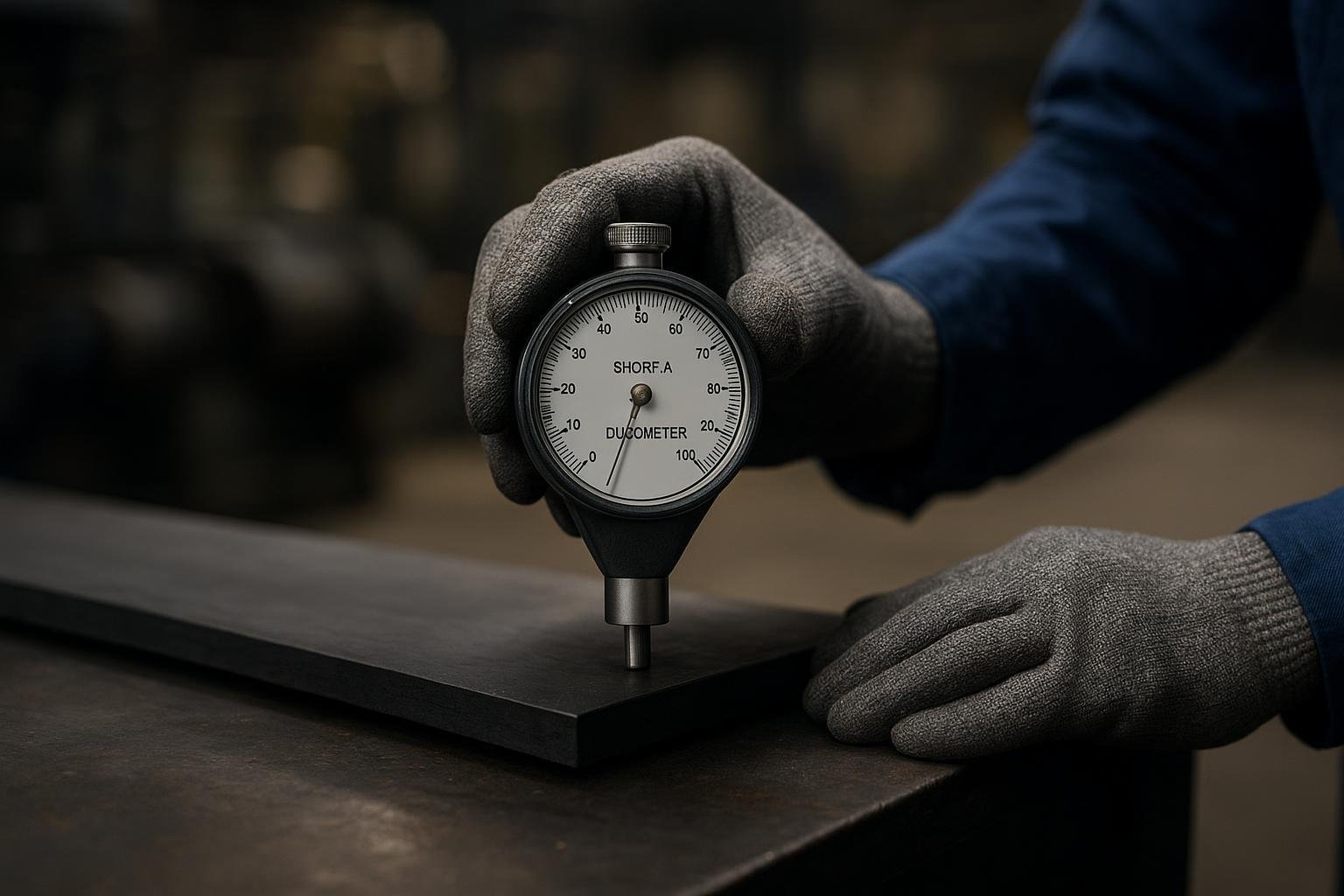
Hardness is one of the fastest ways to verify whether a conveyor belt’s rubber cover matches its specification. Done right, it helps you confirm abrasion resistance, grip, and compatibility with heat or oil before the belt ever sees load. Done poorly, it produces noisy numbers and bad calls. This guide walks you through a reproducible, standards-aligned procedure for conveyor belt hardness testing—both in the lab and in the field—so your results are accurate, traceable, and defensible.
Before you start, handle sampling safely. If you’re cutting from an installed belt, follow lockout/tagout (LOTO), use sharp blades carefully, and wear gloves and eye protection. In many cases, field checks are indicative; use a lab-prepared specimen for acceptance decisions.
Scales and Standards You’ll Use for Conveyor Belt Hardness Testing
Most conveyor belt covers are rubber compounds measured on the Shore A scale. Shore D is generally for much harder rubbers and rigid plastics and is rarely appropriate for flexible covers. The primary test standard for Shore hardness is ASTM D2240 (durometer hardness of rubber), with the Shore method also covered by ISO 7619-1/ISO 48-4. For thin or very soft specimens—or when you need higher precision—IRHD per ISO 48-2 / ASTM D1415 is a solid laboratory alternative.
- ASTM D2240 defines the Shore scales and how readings are obtained using an indenter under specified force; it’s the go-to reference for Shore A on rubber covers, even if many contract specs summarize rather than reproduce it. See the scope in the official page: the ASTM D2240 standard overview.
- The Shore method is also specified internationally under ISO 7619-1/ISO 48-4, while IRHD is handled by ISO 48-2 and ASTM D1415; public summaries explain when IRHD (and micro‑IRHD) is preferred for thin/soft materials. See Smithers’ IRHD (ASTM D1415/ISO 48-2) summary.
- Rubber testing generally uses a standard climate of 23 ±2 °C and 50 ±5% RH for conditioning and test; this environment is set out in ISO 23529 and is summarized in Elastocon’s booklet: standard rubber test climate (Elastocon/ISO 23529).
Think of it this way: Shore A is your everyday tool for conveyor belt hardness testing. IRHD is the lab’s precision scalpel when Shore A thickness or comparability is a problem.
Tools, Fixtures, and PPE
- Shore A durometer (handheld); a benchtop stand is recommended for lab repeatability
- Rigid flat backing plate/anvil (steel) large enough to fully support the specimen
- Certified Shore A reference blocks (NIST-traceable) for quick verification
- Thermometer and hygrometer to confirm 23 ±2 °C / 50 ±5% RH
- Cutting tools (utility knife or die), labeling materials, and a flat work surface
- LOTO kit, cut-resistant gloves, and eye protection
Step-by-Step SOP (Lab-Quality Method)
-
Select the test area or sample
- Use a clean, flat, defect-free top cover area. Avoid edges, carcass impressions, and visible damage. If testing an installed belt, cut a coupon only under LOTO.
-
Ensure adequate thickness (Shore A)
- Aim for a specimen thickness of at least about 6.0 mm for Shore A. If the cover is thinner, carefully stack/bond layers to reach the target thickness, or plan to test with IRHD/micro‑IRHD in the lab. The 6 mm Shore A practice is widely cited in technical summaries of ASTM D2240; consult the full standard for contract-critical work as needed.
-
Condition the specimen and stabilize the environment
- Hold specimens and conduct testing at 23 ±2 °C and 50 ±5% RH. Let field-cut samples equilibrate; temperature swings can shift readings noticeably.
-
Verify the instrument before use
- Check your Shore A durometer on certified reference blocks near the expected hardness. If it’s outside the block tolerance, quarantine the gauge and service it. Record the instrument ID, verification date/time, and results.
-
Set up the support
- Place the specimen on a rigid, flat steel backing plate (or on a benchtop stand). The goal is zero flex under the presser foot so the indenter measures rubber, not compliance.
-
Measure correctly
- Bring the indenter into firm contact perpendicular to the surface without shock. Record the reading at the specified time after contact:
- ASTM practice commonly records at 1 second after firm contact; see industry explanations of ASTM D2240 timing such as the ZwickRoell Shore hardness overview.
- If your contract cites ISO 7619-1 explicitly, follow its timing (many labs use 3 seconds). State which timing you used in the report.
- Bring the indenter into firm contact perpendicular to the surface without shock. Record the reading at the specified time after contact:
-
Take multiple readings and space them out
- Take at least five readings per specimen. Space indents from each other by roughly 6 mm and keep away from edges (≥12 mm if possible). Rotate the specimen between readings to minimize any local texture effects.
-
Average and record
- Compute the average and note the range (min–max). Where your QA system requires it, calculate standard deviation. Record specimen thickness, method (ASTM/ISO), reading time (1 s or 3 s), temperature/RH, instrument ID, and any deviations.
Here’s the deal: consistency beats hero numbers. Perpendicular placement, stable climate, and a rigid backing will reduce operator-to-operator spread more than any single gadget upgrade.
Field Checks vs. Lab Confirmation
You can perform conveyor belt hardness testing on installed belts with a portable Shore A durometer, but treat the results as indicative unless your contract explicitly allows field acceptance.
- Curvature and support: Choose a straight run far from pulleys or idlers. If curvature can’t be avoided, press a steel backing plate or saddle behind the belt to create a flat spot. Practical field techniques like these are described by maintenance resources such as the Sparks Belting guide to field durometer checks.
- Temperature and contamination: Let the belt equilibrate; avoid testing a sun‑heated or recently hot belt. Wipe dust and oil before measurement.
- When to send to the lab: If you can’t achieve adequate thickness or flatness, or if results are borderline, test a lab-prepared specimen per the SOP above or use IRHD/micro‑IRHD for thin covers.
Troubleshooting Accuracy and Repeatability
Use this quick reference when results look off or vary by operator.
| Symptom | Likely cause | Corrective action |
|---|---|---|
| Readings drift during the shift | Temperature/humidity changing | Re-verify climate (23 ±2 °C / 50 ±5% RH); recheck on reference blocks; allow specimens to equilibrate |
| Low readings vs. spec | Specimen bending/compliance | Use a rigid backing plate or benchtop stand; ensure full contact under the presser foot |
| High scatter across operators | Angle/pressure inconsistencies | Use a test stand; train perpendicular placement; align read timing (1 s ASTM or 3 s ISO) |
| Locally low spots | Surface contamination or texture | Clean the surface; move away from embossed, fabric-imprinted, or damaged areas |
| Oddly high hardness | Cover too thin for Shore A | Stack to ~6 mm or move to IRHD/micro‑IRHD in the lab |
| Gauge won’t match blocks | Worn indenter or spring out of tolerance | Quarantine and service/calibrate; document out-of-tolerance action |
Reporting and Acceptance
Documenting how you measured is as important as the number you report. Use this skeleton and adapt it to your QA template.
| Field | What to record |
|---|---|
| Material and location | Belt ID, cover (top/bottom), line/spot ID |
| Method | Shore A per ASTM D2240 or ISO 7619-1/ISO 48-4; or IRHD per ISO 48-2/ASTM D1415 |
| Reading time | 1 s (ASTM practice) or 3 s (ISO practice) |
| Specimen prep | Thickness, stacked or single piece, backing used |
| Environment | Temperature (°C), RH (%) at test |
| Instrument | Model, serial/ID, last calibration/verification date |
| Results | n readings, individual values, mean, min–max, SD (if used) |
| Deviations | Any departures from method or spec |
Acceptance should align with the supplier/manufacturer’s specification for that exact compound. There isn’t a universal acceptance value in the public scope material for ASTM D378; properties and tolerances are usually set contractually. See the standard’s scope notes in the ASTM D378 store page for context.
Typical Ranges and How to Interpret Results
Most new conveyor belt covers fall in a general range of about 55–70 Shore A, though the exact target depends on the compound and service. Industry references summarize this range; for example, the testing overview at ConveyorBeltGuide notes typical new cover values in that band. See ConveyorBeltGuide’s testing page on typical cover hardness.
Interpretation tips:
- Abrasion-resistant SBR covers often land near 60–65 Shore A to balance wear and grip.
- Oil-resistant or heat-resistant compounds may trend higher but still within the Shore A domain.
- If your results sit just outside spec but the standard deviation is large, focus first on technique (flatness, timing, climate) and re‑measure with a lab specimen before escalating.
- Don’t cross-compare different scales. A Shore D number isn’t equivalent to a Shore A result; Shore D is typically for much harder materials and will overstate hardness on flexible covers.
Why IRHD Might Be the Right Move
If you can’t achieve adequate Shore A thickness, or when you need higher precision/comparability across labs, IRHD (including micro‑IRHD) provides a controlled method well‑suited to thin or soft rubber covers. Public summaries explain that micro‑IRHD can evaluate specimens down to a few millimeters. For an overview of when and why to use IRHD, see Smithers’ IRHD (ASTM D1415/ISO 48-2) summary.
Putting It All Together for Conveyor Belt Hardness Testing
- Use Shore A for most conveyor belt hardness testing on rubber covers, following ASTM/ISO method conventions.
- Control thickness, climate, and support; perpendicular placement and consistent read timing matter as much as the gauge itself.
- Field checks are fast and helpful, but lab-prepared specimens and IRHD are your tie‑breakers when results are close to limits.
- Report method details, environment, and instrument traceability so decisions are auditable months later.
Next Steps
Compare your measured hardness to the compound specification from your supplier. If you’re sourcing or validating new belts, a neutral cross‑check against a manufacturer’s datasheet helps align expectations on cover hardness, abrasion index, and related properties. For example, you can review product families and request spec sheets from manufacturers like BisonConvey, then document acceptance using the reporting table above.
References used in this guide:
- ASTM D2240 Shore hardness scope and context: ASTM D2240 standard overview
- Shore method and IRHD context: Smithers’ IRHD (ASTM D1415/ISO 48-2) summary
- Standard rubber test climate (23 ±2 °C, 50 ±5% RH): Elastocon/ISO 23529 summary
- Timing practice explanation for Shore tests: ZwickRoell Shore hardness overview
- Field technique context: Sparks Belting guide to field durometer checks
- Conveyor belting standard context: ASTM D378 store page
- Typical new cover range: ConveyorBeltGuide testing page