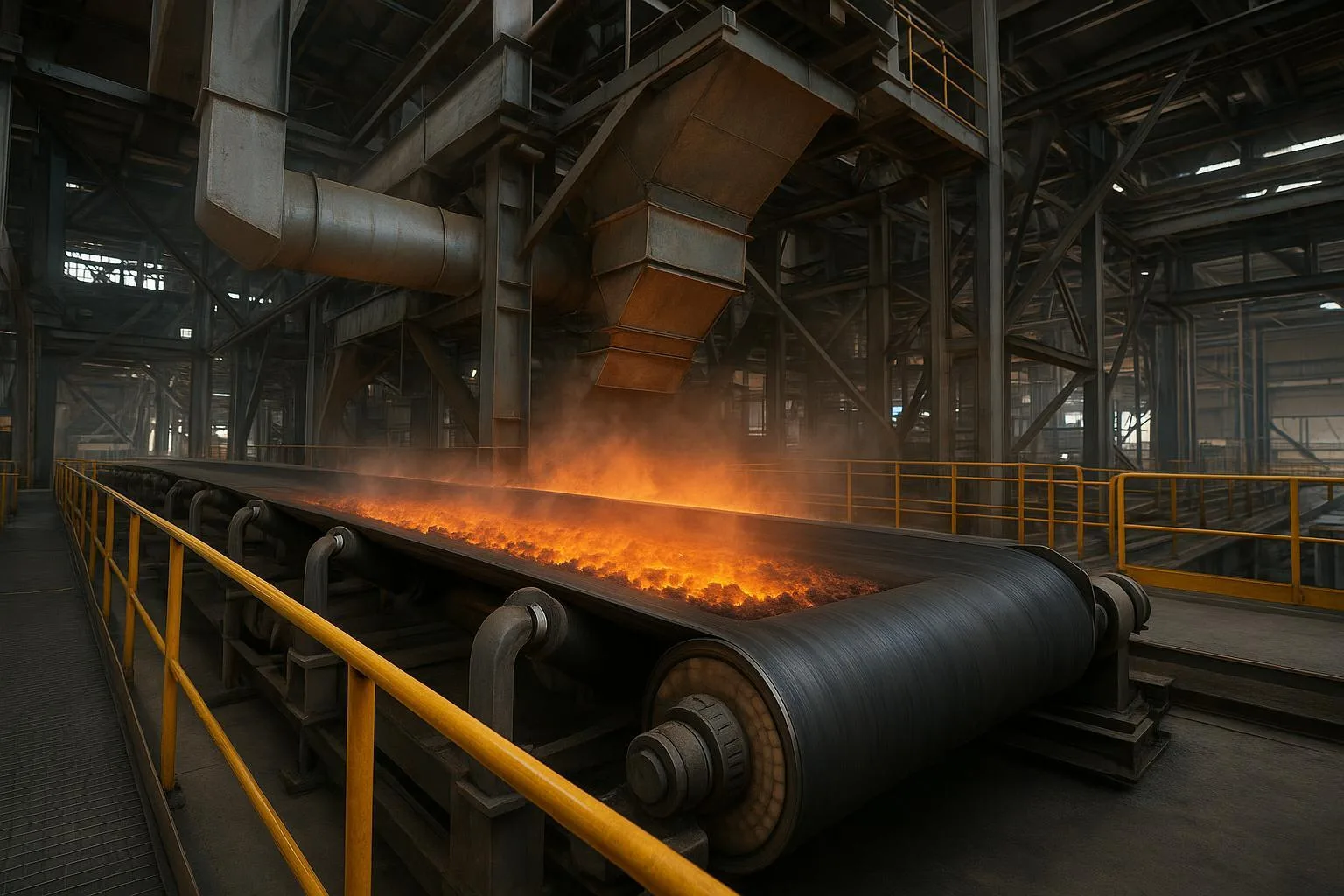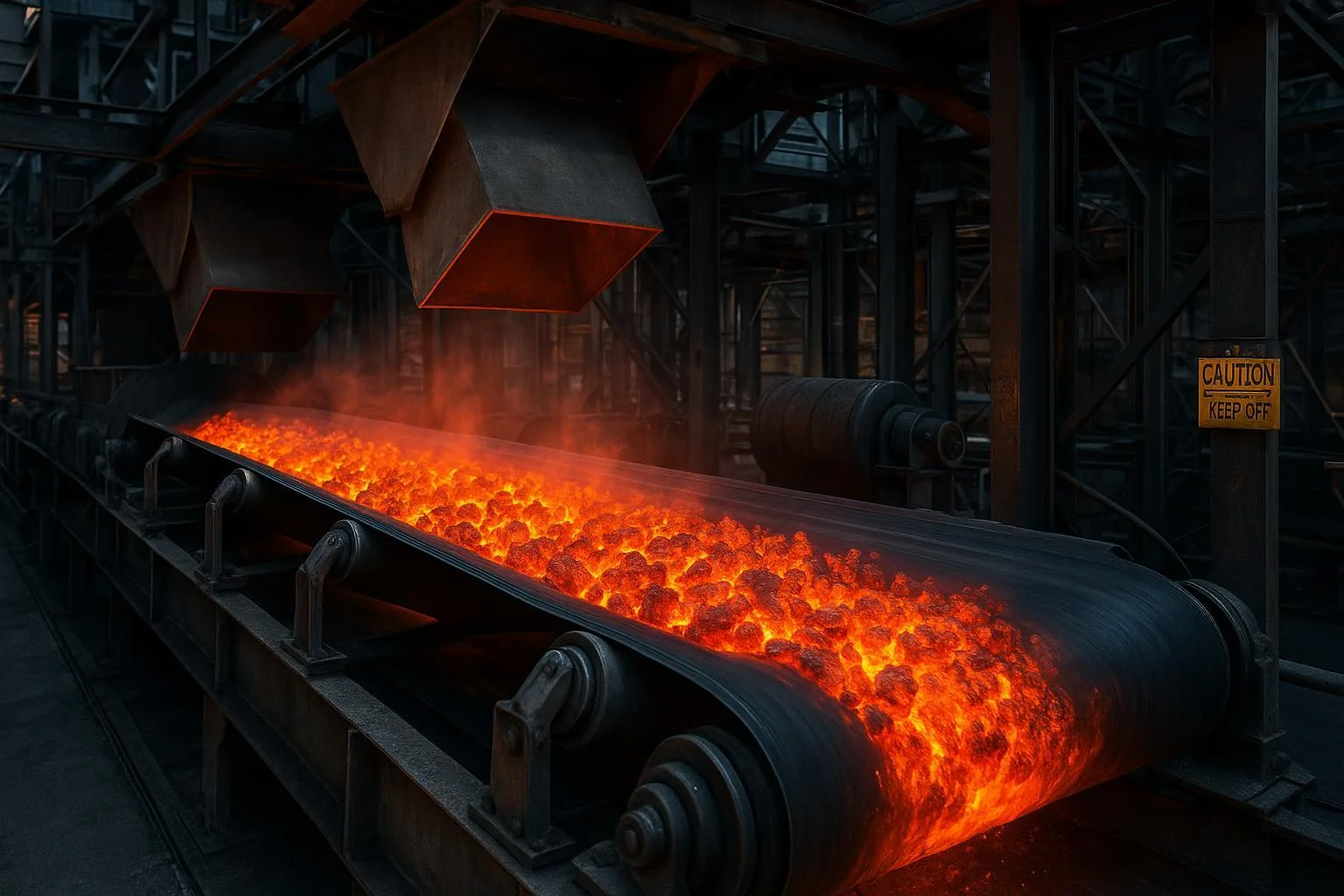
Handling clinker and hot ores at 150–200°C punishes belts, splices, and components. Selection mistakes show up as cracked covers, peeling splices, and unplanned stoppages right when throughput matters most. Here’s the deal: if you anchor your choices to the material’s temperature profile and verify every decision with operating metrics (uptime/OEE, MTBF, TCO), you’ll cut reactive maintenance and extend service life without guessing.
This step-by-step workflow follows the selection logic used in high‑heat mining and cement applications: ore → environment → carcass → cover → protections. Throughout, we’ll point to conservative ranges and standards so your team can specify, commission, and prove performance in the field.
Step 1 — Pin down the ore and its temperature profile
The single most important input is not the belt’s surface temperature—it’s the temperature of the conveyed material. Specify both continuous and peak/transient bulk temperatures. Measure near transfer points and early in the conveyor flight where heat hasn’t dissipated. Infrared spot checks are useful during commissioning; keep using them to validate assumptions over time.
How to translate those numbers into cover capability: ISO 4195 accelerated aging tests classify rubber by property retention after days at elevated test temperatures. Manufacturers map those classes to practical ranges. A helpful overview is provided in the manufacturer summary of heat-resistance methods in the EMEA region; see the explanation of ISO classes and how they’re used for cover design in the heat resistance standards and test methods overview (Fenner Dunlop EMEA, accessed 2026). Many suppliers publish heat-resistant “T” classes that align roughly to continuous material temperature bands; verify on the specific datasheet before finalizing.
Engineering guardrails: Build a margin between your measured continuous temperature and the cover’s continuous rating; avoid running at the edge. If the process has frequent spikes, choose the higher class; peaks are where splices and adhesion systems fail.
Step 2 — Map the environment and load-zone conditions
Hot material rarely travels alone. Dust, spillage, and impact at the load zone will accelerate abrasion and heat-checking if you don’t control them. Choose primary/secondary cleaners and skirt sealing that are rated for elevated temperatures. An application catalog shows cleaners and sealing solutions with temperature ratings and maintenance features that reduce exposure and downtime; see the 2025 industrial catalog for high-temperature cleaner options in Martin Engineering’s product catalog. Also consider enclosures, heat shields at transfer points, and short residence times on hot skirting to minimize heat soak into the belt. Track carryback-induced stoppages per month, cleanup labor hours per shift, and dust alarms before and after upgrades to verify impact on uptime and safety.
Step 3 — Select the carcass for heat and tension
Two families dominate high-heat mining duty. EP/NN multi-ply fabric belts suit short-to-medium runs with impact loading. They offer robust flex endurance and are widely available with heat-resistant covers. Steel cord belts are preferred for long overland or high-tension runs thanks to low stretch and high ST ratings; with heat-rated covers and compatible splicing systems, they maintain alignment and reduce take-up travel.
Adhesion matters at elevated temperatures: the bond between cover and carcass can degrade if compounds are mismatched or splices are poorly executed. A technical bulletin discussing adhesion emphasizes compatibility and workmanship; see A Question of Adhesion (Fenner Dunlop EMEA). Heat also raises the risk of cover cracking at tight bends, so use the manufacturer’s minimum pulley diameter tables for your exact construction, and consider stepping up one size where feasible to reduce flex strain. For steel cord ranges and EP fabric families, typical drive pulley minima are compiled in EMEA product brochures; consult those tables early. Plan for hot vulcanized splices with materials rated to the same or higher class as the covers; we’ll detail this next.
Step 4 — Choose the cover compound, abrasion grade, and thickness
Heat-resistant compounds capable of ~150–200°C continuous service are often based on EPDM/EPM-type systems; SBR blends are generally limited to lower temperatures. Manufacturer pages for heat‑resistant cover grades describe lines intended for continuous 160–200°C with higher short peaks; see the EMEA product page for Deltahete/Betahete in heat‑resistant cover grades and products. Under DIN abrasion, lower volume loss (mm³) means better wear resistance. A 2024 heavy-duty belting brochure summarizes typical classes: W (≤90 mm³, very high abrasion resistance), X (≤120 mm³, balanced with cut/gouge), Y (≤150 mm³, general purpose). See thresholds in the ASGCO Heavy Duty Conveyor Belting 2024 brochure. Because heat-resistant compounds may sacrifice some abrasion performance, balance the grade with your ore/clinker abrasivity.
On thickness, thicker top covers can buffer heat and extend wear life in abrasive service, but mass increases rolling resistance and can worsen bend fatigue on small pulleys. There’s no universal mm rule for hot clinker; use vendor design tools and respect minimum pulley diameters for the chosen thickness. If impact is severe, add impact idlers or a cradle rather than simply over-thickening the cover. Track wear rate (mm per 1,000 operating hours) via ultrasonic gauge or calipers, energy intensity (kWh/ton) before and after cover changes, and look for heat-checking at pulleys during inspections.
Step 5 — Protections, splicing, and QA for hot service
Use hot vulcanized splices for high-temperature duty and match splice materials to the same heat class as the cover or higher. Manufacturer service notes and splicing materials guides emphasize that workmanship and compatibility are decisive for splice MTBF; see splicing service references (EMEA service page). For load zones, combine skirt sealing, impact cradles, and temperature-rated cleaners to reduce edge wear, gouging, and carryback. The industrial catalog cited earlier lists temperature ratings and quick-service designs that help reduce exposure and downtime; see Martin Engineering’s product catalog. Maintain idler spacing that limits belt sag in hot zones and consider localized shielding or airflow where covers still overheat.
For safety and compliance, apply site standards and lockout practices. For general conveyor safety design and maintenance principles, consult the 2024 overview of ASME B20.1; see ANSI’s ASME B20.1-2024 overview and refer to the full standard for requirements.
Commissioning should include three verifications: first, confirm continuous and peak material temperatures under live load against the belt’s rated class; second, inspect splice workmanship and cure records, log initial splice efficiency, and schedule early-life inspections; third, verify that cleaner blade material and skirting are temperature-rated and record a carryback baseline (kg or cleanup hours per shift).
Practical example — Neutral configuration walkthrough (clinker ~180°C)
Disclosure: BisonConvey is our product.
A clinker transfer runs at 180°C continuous with occasional 200°C peaks across a 220 m center distance on a moderate incline, with impact at the load zone and high dust. A steel cord carcass provides low elongation and tension stability; pulley diameters follow vendor tables with one step of extra margin to reduce heat-related flex cracking. The top cover uses a heat-resistant EPDM/EPM-type compound in the T200 band with abrasion performance comparable to DIN X for clinker’s sharp edges; the bottom cover is heat-rated to the same class. Top cover thickness is set from impact and wear calculations while respecting pulley limits, and an impact cradle is added to avoid unnecessary thickness. Protections include temperature-rated primary and secondary cleaners, an enclosed load zone with skirt sealing, and targeted shields near the chute to reduce heat soak. Splices are hot vulcanized with matched heat-rated materials, and cure logs are attached to the CMMS.
Note: This configuration is illustrative, not prescriptive. Always reconcile with site-specific tensions, pulley diameters, and supplier datasheets.
Avoid these mis-spec traps
-
Specifying by belt surface temperature instead of the material’s continuous and peak temperatures
-
Choosing an abrasion grade that ignores the heat-compound trade-off
-
Over-thickening the top cover while neglecting impact control, sealing, or pulley diameter minima
Prove the upgrade: measurement plan for MTBF, OEE, and TCO
Tie your specification to a verification plan. Before the change, baseline availability and performance (OEE) tied to belt-related downtime, MTBF for splices and load‑zone interventions, and TCO components (belt + splicing + energy in kWh/ton + cleanup hours + replacement parts). After commissioning, track the same metrics monthly for at least two quarters. Look for fewer carryback stoppages, longer splice inspection intervals, stabilized energy intensity, and slower measured cover wear. If gains stall, re-check temperature measurements, cleaner/skirt settings, and pulley lagging condition.
Cited references and further reading
-
Heat resistance classes, ISO 4195, and manufacturer mappings summarized in the EMEA region: Heat resistance standards and test methods (2026 access)
-
Product examples and continuous/peak ranges for specialized HR compounds (e.g., 200°C/400°C): Heat‑resistant cover grades and products (Fenner Dunlop EMEA)
-
HR rating shorthand (T150/T200) and example bands: Gram Conveyor HR ratings (vendor guide)
-
Abrasion grade thresholds used for balancing wear vs heat: ASGCO Heavy Duty Conveyor Belting 2024 brochure
-
Cleaner and sealing systems with temperature considerations: Martin Engineering Product Catalog 2025
-
Safety context for conveyors (design, installation, maintenance): ANSI’s overview of ASME B20.1-2024