If your general-purpose belt keeps hardening, cracking, and shedding splices near hot transfer points, you’re not alone. The real question is simple: at what temperatures do standard NR/SBR belts stop being economical, and when do heat‑resistant compounds become the safer, lower‑cost choice over the lifecycle? Here’s the deal—selection hinges on continuous vs. peak temperatures, compound chemistry, standards, and system constraints.
Standards and temperature classes (what actually governs selection)
Manufacturers and reliability engineers lean on ISO 4195 accelerated aging tests to gauge heat resistance. The method measures property retention of belt cover rubber after seven days at defined temperatures—Class 1 (100°C), Class 2 (125°C), and Class 3 (150°C). Those oven temperatures are a proxy for how a compound copes with heat over time, not field limits. See Fenner Dunlop’s explanation in the 2022 Cement International note and their standards overview for context: Fenner Dunlop’s ISO 4195 guidance (2022) and heat resistance standards and test methods.
In practice, many providers label belts around working categories like T150 (≈150°C continuous) and T200 (≈200°C continuous), with premium compounds validated for short peaks to 350–400°C. See the Dunlop product range for representative values and pulley guidance: Dunlop product range overview.
DIN 22102 “T1–T4” heat grades appear frequently in vendor literature, but authoritative mappings to exact continuous/peak temperatures are inconsistent across public sources. Use ISO 4195 classes and manufacturer working categories for procurement decisions, and treat DIN heat labels as secondary.
Side-by-side: standard vs. heat-resistant belts
| Category | Standard NR/SBR belts | Heat‑resistant belts |
|---|---|---|
| Typical continuous temperature | ~ –25°C to +70°C; some formulations up to ~100°C | T150 ≈150°C; T200 up to ≈200°C; short peaks to ≈350–400°C in premium compounds |
| ISO 4195 applicability | Not used for general‑purpose rating | Class 1 (100°C), Class 2 (125°C), Class 3 (150°C) aging test basis |
| Common cover compounds | NR/SBR blends | EPDM/EPM, butyl; specialized high‑heat compounds |
| Failure risk when hot | Rapid hardening, cracking, adhesion/splice loss above ~80–100°C | Mitigated by heat‑grade compounds; still needs correct splicing and cooling |
| Splicing guidance | Standard methods; mechanical fasteners common at low heat | Prefer hot‑vulcanized finger splices; avoid mechanical fasteners/cold vulcanization at high heat |
| Pulley diameter | Follow manufacturer minimums | Often one step larger diameter to reduce flex stress in heat‑grade covers |
| Fire safety | As needed per service (ISO 340/EN 12882) | Frequently required in hot materials handling; combine flame retardance and antistatic |
| TCO pattern | Lower upfront price; short life if used over temp | Higher upfront price; longer life, fewer replacements; lower annualized cost |
Sources cited in sections below.
Polymer chemistry and trade-offs that matter
General‑purpose belts emphasize abrasion and cost efficiency using NR/SBR cover blends. Heat service steers toward EPDM/EPM or butyl compounds, which retain properties better under sustained heat and ozone exposure. Manufacturer materials index the compound choices; see Dunlop’s product range for representative formulations and performance bands: Dunlop product range (2020).
Combined exposures complicate things. EPDM/EPM excels at high heat and ozone but has weak oil resistance. NBR‑based blends deliver oil resistance yet typically lose performance at elevated temperatures sooner than EPDM/EPM. If your material is oily or acidic at temperature (e.g., asphalt, certain fertilizers), consult manufacturer chemical resistance matrices and confirm that the chosen compound also carries a validated ISO 4195 class.
Failure modes under heat—and how to prevent them
Elevated temperature accelerates oxidation and aging of rubber covers, driving hardening, loss of elasticity, cracking, and reduced abrasion resistance. It also harms adhesion (cover‑to‑ply and ply‑to‑ply), triggering delamination and splice strength loss. Evidence from Fenner Dunlop shows that a modest increase in belt core temperature—on the order of 10°C—can cut belt life by as much as half due to the exponential nature of thermal aging: “The effects of high temperatures on heat‑resistant belts” (Cement International, 2022).
Mitigations are practical and system‑level:
- Prefer hot‑vulcanized finger splices for high‑heat service; mechanical fasteners and cold vulcanization underperform on EPDM‑based covers at temperature.
- Control drop heights and install cooling chutes to reduce dwell of hot material on the carry side.
- Manage belt speed to limit thermal soak at transfer points.
- Validate minimum pulley diameters and consider “one size up” for heat‑grade covers to cut flex stress.
System compatibility and constraints (don’t ignore the hardware)
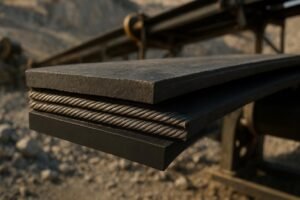
Minimum pulley diameters scale with belt construction and strength; steel cord belts, for example, have diameter requirements that grow with ST rating. Representative manufacturer tables show ST630 min diameters around 630 mm and larger diameters for higher ratings. For heat‑grade covers, Dunlop’s documentation recommends upsizing pulleys to reduce flexing stress in stiffer compounds: Dunlop product range—pulley diameter guidance.
Cover wear still matters: abrasion resistance is compared by DIN 53516/ISO 4649 rotary drum tests (reported as mm³ volume loss). Lower loss is better, but lab values are comparative, not absolute field life predictors. Manufacturer standards explain how to interpret these numbers in context: Dunlop abrasion standards and test methods.
Scenario-based guidance (choose by thermal reality, not wishful thinking)
Best for hot clinker/coke/sinter (>150–200°C): Heat‑resistant belts in the T150/T200 working categories aligned to ISO 4195 Class 2/3 aging performance. Combine flame retardance (ISO 340/EN 12882) and antistatic where mandated. Hot‑vulcanized finger splicing and larger pulley diameters are prudent.
Best for warm, intermittent loads (≈80–120°C): If exposure is brief and cooling is effective, enhanced compounds or process cooling may suffice. Profile carry‑side temperature and dwell time; if the core temperature trends upward, step into a heat‑resistant compound before failure accelerates.
Best for combined heat + oils/chemicals: Balance heat stability with chemical resistance. Consider NBR‑based covers validated to an ISO 4195 class, or hybrid formulations approved by the manufacturer for your material chemistry.
Best for high radiant‑heat corridors (under kilns, furnaces): Even if material temperature is moderate, radiant heat can lift belt core temperatures. Shielding, airflow, and cautious belt speed are part of the solution, alongside a heat‑rated compound.
Short summary: Always differentiate continuous vs peak, dwell/contact time, ambient radiant heat, and material chemistry. Then match compound and class accordingly.
Lifecycle and TCO: a quick checklist
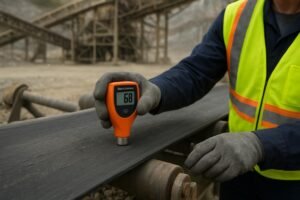
- Confirm continuous and peak temperatures at transfer points and along the carry (use IR spot checks and logged data).
- Model replacement intervals using manufacturer life expectations and the “+10°C halves life” risk framing.
- Include splice method, labor, removal/installation time, and downtime in cost models.
- Validate pulley diameters, idler quality, and belt speed impacts on thermal soak.
- Where safety rules apply, add fire‑retardance and antistatic compliance (ISO 340/EN 12882) into the selection and cost model.
For a framing of true ownership cost versus purchase price, see BulkInside’s discussion: Understanding the true cost of conveyor belts.
FAQ for 2026 procurement
When do standard NR/SBR belts become uneconomical? Once continuous material temperatures approach ~80–100°C, aging accelerates and splice reliability drops. At that point, step to a heat‑resistant compound validated to an ISO 4195 class and the appropriate working category (e.g., T150).
How should I think about “continuous vs peak” temperature in real plants? Continuous refers to the steady thermal loading the belt experiences over time; peaks are brief spikes at transfer or upset conditions. Short peaks may be tolerated by premium compounds (to 350–400°C), but rising continuous core temperature is what shortens life most dramatically.
Do I need fire‑retardance if I choose a heat‑resistant belt? Often, yes—especially in cement, steel, power, and coke handling. Check ISO 340 and EN 12882 classifications mandated by your site or jurisdiction and combine heat‑resistant covers with flame‑retardant/antistatic properties when specified.
Also consider (vendor-neutral)
Disclosure: BisonConvey is our product. For plants that prefer application‑driven selection with matched system components, BisonConvey supplies EP/NN fabric belts and steel cord belts with heat‑resistant compounds, alongside idlers and pulleys to validate pulley diameters, splice guidance, and system compatibility.
Profile the real temperatures, map them to ISO 4195 classes and manufacturer working categories, and validate the system around the belt—splicing, pulleys, idlers, speed, and safety. The right compound at the right class is the difference between a belt that fails every quarter and one that quietly runs for years.