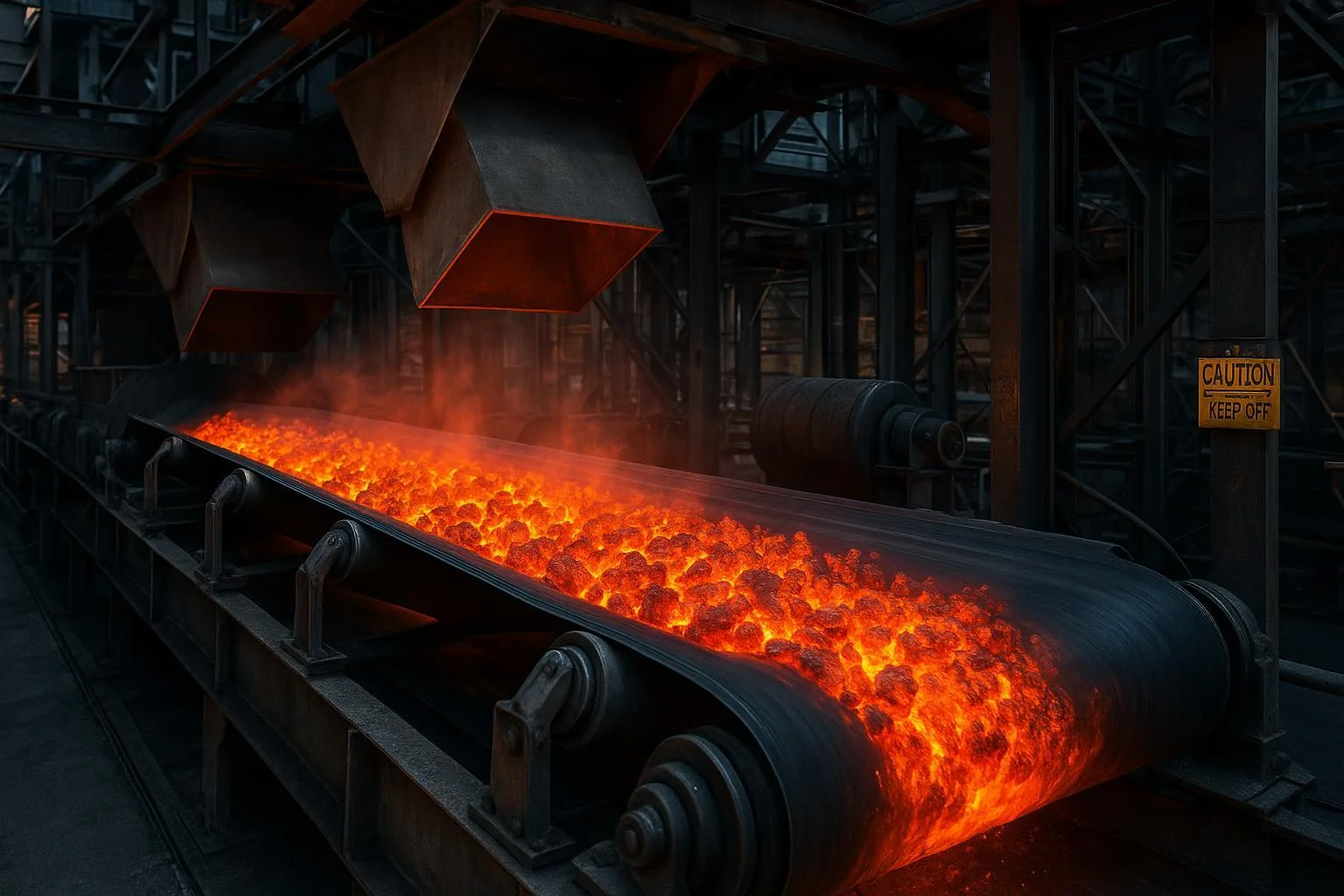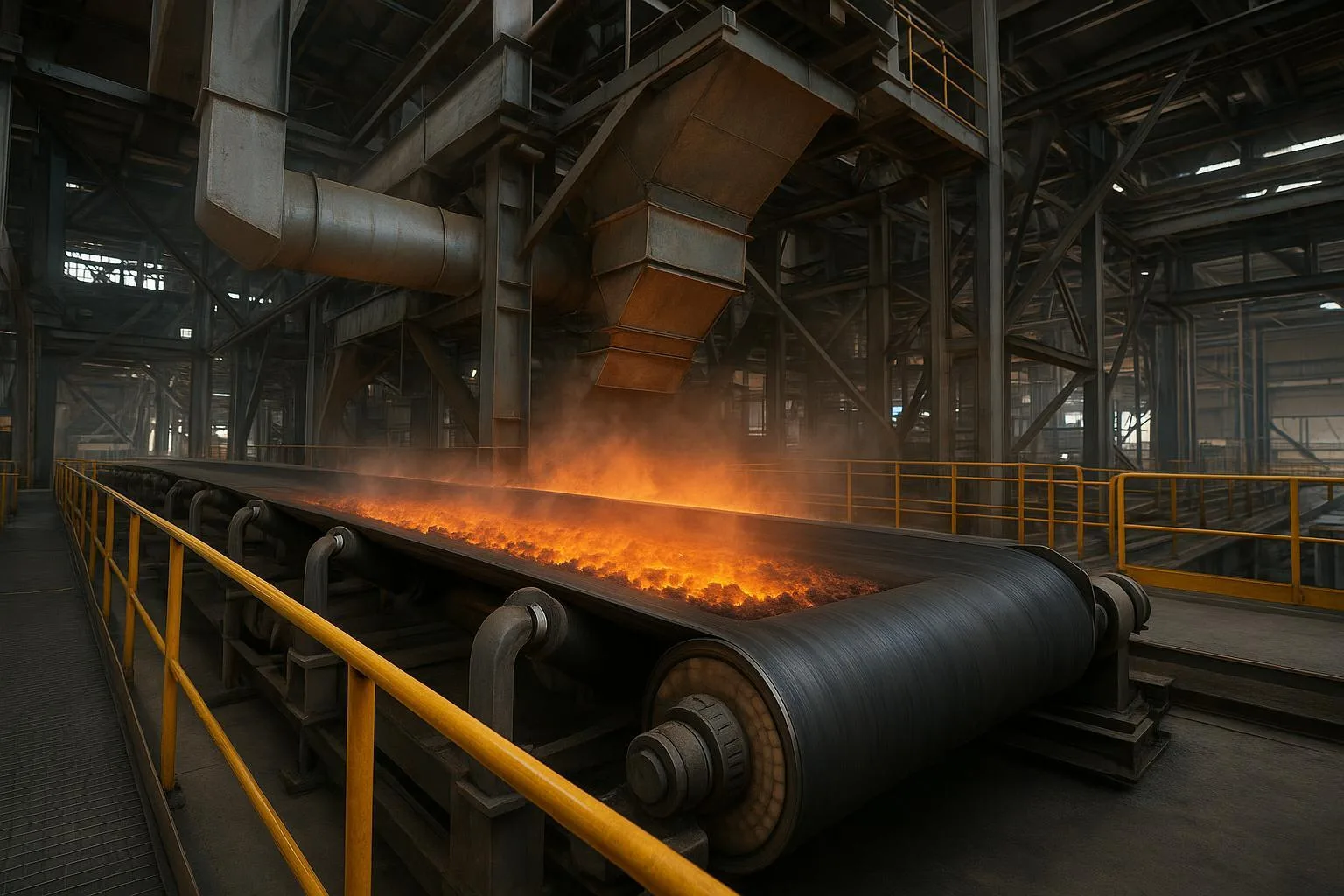
Hot clinker punishes every weak link in a conveyor. At >180°C continuous bulk temperatures, rubber covers harden, carcasses fatigue, scrapers glaze, and lagging can slip. This checklist walks engineering and maintenance managers through a standards‑aware selection workflow to specify a heat resistant conveyor belt for clinker that maximizes service life and lowers total cost of ownership (TCO). You’ll gather a temperature profile, pick the right compound and carcass, verify pulley diameters and lagging, set conservative speeds, and lock in accessories, splicing, and commissioning controls. Where numbers matter, they’re tied to recognized references (DIN 22101, ISO 4195/4649, CEMA) and authoritative vendor documents.
1) Input and temperature profile: design from measured heat, not estimates
Start with measurements, not labels. Record clinker bulk temperature at the transfer to the belt, plus the belt top surface near loading, the return strand after the first troughing set, and at the head pulley. Use protected K‑type thermocouples where safe and a calibrated IR thermometer elsewhere. Sample every 5–10 minutes during the first 2–4 hours of hot‑run, then hourly in the first shift; after stabilization, log daily for a week and weekly thereafter.
Acceptance logic: select materials to exceed the measured 95th‑percentile continuous temperature by a 10–20°C margin and ensure peak capability covers surges. This aligns with how high‑temperature covers are marketed and tested, with heat aging per ISO 4195 used to demonstrate property retention under heat. See Fenner Dunlop’s cement guidance, which outlines cover families for continuous 160°C and 200°C service and emphasizes matching compound grade to continuous and peak conditions in clinker duty, as well as the role of ISO 4195 testing in verifying suitability (e.g., Betahete to ~160°C continuous and Deltahete to ~200°C) in their cement resources and technical bulletins: consult the cement industry page and heat‑resistant technical papers for temperature envelopes and heat‑aging behavior. Sources: the cement application overview on Fenner Dunlop’s site and their detailed heat‑resistant bulletins and articles (2011–2022) that discuss ISO 4195 class behavior and life reduction with temperature.
-
Reference: According to the Fenner Dunlop cement industry page, Betahete is positioned for continuous temperatures around 160°C with peaks to ~180°C, while Deltahete targets continuous service around 200°C with much higher peaks; the guidance stresses choosing based on measured continuous temperatures rather than sporadic maxima. See the industry page under cement applications: https://www.fennerdunlopemea.com/industry/cement/
-
Reference: For testing and behavior under heat aging, see Fenner Dunlop’s technical bulletin on heat‑resistant belting, which explains ISO 4195 and the impact of temperature on cover properties: https://www.fennerdunlopemea.com/app/uploads/2018/09/Technical_bulletin-_Heat.pdf
2) Specify the heat resistant conveyor belt for clinker: compounds and covers
Choose the cover compound based on your profile, then verify abrasion performance after heat aging. ISO 4195 defines how to age cover samples and report retention of tensile strength, elongation, and hardness; require the supplier to provide ISO 4195 certificates for the exact compound you intend to buy. To avoid choosing a cover that survives heat but wears quickly, also request ISO 4649 abrasion numbers and, where available, abrasion after heat aging. ISO publishes the method references that vendors follow; use them to structure your procurement requests rather than to guess performance values.
What to document in your spec: identify the continuous and peak temperature envelope the compound must cover; list the ISO 4195 retention criteria provided by the vendor; add ISO 4649 abrasion (mm³ loss or index) and any “after‑aging” abrasion if supplied. If your continuous temperature is ≥180°C, prioritize compound families positioned for ~200°C continuous operation and confirm with third‑party certificates or vendor test sheets. For method references, see ISO’s overview pages for ISO 4195 and ISO 4649, which outline the required tests and reporting formats used by manufacturers.
-
Reference: ISO’s overview for conveyor‑belt cover heat resistance (ISO 4195) describes the heat‑aging test framework used to classify compounds: https://www.iso.org/obp/ui
-
Reference: ISO 4649 describes drum abrasion tests commonly cited by belt makers; use the standard as the anchor for your procurement acceptance language: https://www.iso.org/standard/70325.html
3) Carcass and splice: steel cord vs. EP/NN under high heat
Think of the carcass as the skeleton that must stay dimensionally stable when hot. Above ~180°C continuous, steel cord belts are often favored for low elongation, thermal stability, and suitability on longer centers and higher tensions. EP/NN textile belts offer flexibility and impact absorption and can be viable when heat exposure is intermittent or mitigated and when small pulleys are unavoidable. Your decision gates are: continuous temperature, conveyor length and lift, available pulley diameters, and required elongation limits.
Splicing follows the carcass: steel cord belts typically use hot‑vulcanized finger splices; EP/NN often use step or overlap splices. Elevated ambient conditions demand disciplined control of cure temperature, dwell time, and cooling. Include a “no numbers without sources” policy in your QA; use the relevant standards (e.g., ISO 14890 for textile belts; ISO 15236/DIN 22131 families for steel cord; DIN 22110‑3 for adhesion tests) as naming anchors in your acceptance language and obtain the vendor’s splice manual for the exact construction you’re buying.
Check and record: minimum pulley diameters for your selected carcass rating and cover thickness, as provided by the belt manufacturer. Hot service accelerates bending fatigue, so where practical choose diameters above ambient‑service minima; document rationale and supplier confirmation in your design file.
4) Pulleys and lagging: diameter, crown, and slip control under heat
Increasing pulley diameter reduces bending strain in the heated belt and extends fatigue life. Because cover softening and thermal expansion raise slip risk at the drive, specify ceramic lagging on the drive pulley in hot clinker service. Confirm crown and surface finish per vendor guidance. Rather than quoting generic numbers, require the supplier’s minimum D tables for the exact rating (e.g., ST or EP class) and cover package, then review whether hot service warrants stepping up one size. Archive the signed table extract in the commissioning dossier.
5) Width, speed, and tension: stay conservative and calculate with standards
For abrasive, hot clinker, conservative belt speeds help control wear, carryback, and dust. Practical bands in cement plants run roughly 1.6–3.5 m/s depending on width, chute dynamics, cleaner limits, and sealing performance. Use these as starting points and verify against component ratings.
- Reference: CEMA’s published change pages and chapter excerpts provide recommended maximum belt speeds by duty and offer the framework for tension/power calculations; verify your selected speed against these sources and your component vendors. See the CEMA Belt Book change pages and Chapter 6 excerpt for speed and tension methodology: https://www.cemanet.org/wp-content/uploads/2012/06/bbchangepages1stprinting.pdf and https://www.cemanet.org/wp-content/uploads/2011/09/bb5thed_chapter-61.pdf
When your team needs a quick cross‑check, the table below gives planning ranges; always validate with CEMA loading criteria, surcharge angle for clinker, and your transfer design.
Tension and take‑up: use DIN 22101 or CEMA as the calculation basis. Adjust resistances for elevated temperatures (friction factors can change with hot covers and bearings), include accessory drag from scrapers and skirt seals, and size take‑up travel to accommodate thermal growth. Keep a clear calculation sheet in the project file and re‑run it if you change cleaner models or skirt geometry.
6) Idlers, sealing, and cleaners: specify for temperature and access
Idlers: choose higher CEMA classes (often D/E) for clinker duty and specify bearings, grease, and seals rated for the elevated ambient and radiant conditions in the loading zone. In procurement, require OEM datasheets stating allowable operating temperature ranges and the grease specification. Power/tension estimates should include bearing/seal drag consistent with the idler class.
Sealing and impact control: stabilize the loading zone with impact cradles and set dual‑lip or apron‑type skirt sealing with adequate access for adjustment. Robust sealing reduces carryback and shields cleaner blades from excessive loading.
Cleaners: blade material and model must match the belt temperature and speed. Urethane grades have upper limits; carbide blades and dedicated high‑temperature assemblies cover higher ranges. For example, Martin Engineering catalogs document high‑temperature urethane blades rated to about 300°F/150°C and dedicated high‑temperature cleaner assemblies that use overlapping stainless or tungsten‑carbide blades for hotter service; consult their belt cleaners brochure for model‑specific ratings and speed limits. Flexco likewise publishes precleaner options with polyurethane grades up to roughly 400°F/205°C (some models lower) and carbide tips for hot, abrasive duty; use their selector tables to match temperature and belt speed.
-
Reference: See Martin Engineering’s belt cleaners brochure for temperature‑capable models and typical speed limits used in selection: https://www.martin-eng.com/assets/pdfs/brochure-conveyor-belt-cleaners-l3651.pdf
-
Reference: Review Flexco’s high‑temperature precleaner options and temperature envelopes in their technical pages to confirm blade material compatibility with your measured belt temperatures: https://www.flexco.com/EN/Products/Belt-Cleaners/Belt-Cleaners.htm
7) Transfers and dust control: reduce residence time and heat load
Every second clinker lingers in a rock‑box or chute is heat soaking your belt. Design transfers to minimize dwell time, prevent buildup, and maintain consistent loading. Use wear‑resistant, low‑friction liners where appropriate; position flow aids (e.g., air cannons) to clear hang‑ups; and size dust extraction to keep fines from recirculating onto hot surfaces.
For practical design guidance and component options, Martin Engineering’s technical materials detail transfer‑point products, dust control approaches, and flow‑aid placement that reduce material hang‑ups and improve sealing—measures that indirectly cut the thermal load on the belt by speeding material through the transfer. See their transfer‑point brochure for design elements and service‑access considerations relevant to hot clinker duty: https://static.martin-eng.com/www.martin-eng.my/resources/brochure-transfer-point-l3649-transfer-point.pdf
8) Splicing in hot service: process control and acceptance evidence
Plan splicing with heat in mind. For hot vulcanization, control heating platen set‑points, dwell duration, and cooling; protect the splice from radiant heat during cure and cool‑down. Require vendor‑approved splice designs (finger for steel cord; step/overlap for EP/NN as specified) and retain the manufacturer’s splice manual in the work pack.
Acceptance evidence should reference standards by name (e.g., ISO 14890 for textile belts; ISO 15236/DIN 22131 for steel cord; DIN 22110‑3 for adhesion testing). Instead of stating numerical thresholds without a source, require the supplier’s adhesion and pull‑out test reports for the exact belt construction and compound you’re buying, and keep them attached to the commissioning record.
9) Commissioning and monitoring: staged hot‑run with frequent checks
Execute a staged hot‑run. Start at reduced load; monitor belt surface and clinker temperatures at your predefined points. Check and re‑tension scrapers after the first hour and again after the first shift as covers seat in. Use an IR camera to scan idlers in the loading zone for abnormal temperatures that may indicate bearing distress or misalignment. Record take‑up position to track thermal growth and settling. Save baseline photos of transfers, skirt gaps, and cleaner contact, plus the initial torque/pressure settings.
Monitoring cadence after handover: daily checks in the first week, weekly through the first month, then monthly. Track cover hardness changes visually and with a durometer at consistent locations; watch for early hardening or cracking, especially near the hottest transfer.
10) Procurement and documentation: build TCO into the paperwork
To keep decisions auditable and service‑life oriented, your purchase and commissioning package should include: 1) temperature profile summary and acceptance logic; 2) compound selection with ISO 4195 certificates and ISO 4649 data, with abrasion‑after‑aging figures if available; 3) supplier‑signed minimum pulley diameter table for the chosen carcass and cover package and your final D selections; 4) lagging type and crown; 5) DIN 22101/CEMA tension sheet including accessory drag and take‑up travel; 6) idler class and OEM datasheets with bearing/seal temperature ratings and grease spec; 7) cleaner model, blade material, temperature and speed rating, mount geometry, and initial set pressure/torque; 8) splice method and vendor acceptance evidence; 9) commissioning hot‑run log with baseline photos and settings; 10) spare parts matrix and reorder codes.
Neutral example: mapping measurements to a spec (field‑replicable)
Here’s the deal: a plant measures clinker at the belt transfer averaging 185–195°C with peaks to ~215°C during surges; belt surface near loading stabilizes around 140–150°C. The team selects a heat‑resistant cover family positioned for ~200°C continuous operation and obtains ISO 4195 retention data with supporting certificates. Abrasion performance (ISO 4649) is compared with alternatives, prioritizing better abrasion after heat aging. Given a 220‑m center distance and tight elongation limits, they choose a steel cord carcass and request the supplier’s minimum pulley D table for the selected rating and cover thickness, opting to increase head/tail diameters one step for hot service. Ceramic lagging is specified on the drive, and belt speed is set at 2.4 m/s pending chute validation. Cleaners are chosen using high‑temperature blade options rated above measured belt surface temperatures, with safe access for frequent early adjustments. This is the kind of workflow an engineering team can reproduce with any reputable supplier; vendors like BisonConvey provide datasheets and engineering support to document these checkpoints without marketing fluff: https://bisonconvey.com
Why this checklist lowers TCO for clinker service
Service life and TCO improve when the compound fits the true continuous temperature, the carcass resists thermal growth, pulleys and lagging limit bending fatigue and slip, speeds reduce wear and carryback, and accessories are matched to temperature and maintained with access in mind. The documentation gates make those decisions easy to audit and re‑validate after changes.
Frequently mis‑specified items to watch
-
Selecting a compound on a peak temperature that happens once a month rather than the continuous 95th percentile, causing either over‑ or under‑spec.
-
Ignoring abrasion after heat aging, which can flip the wear ranking of candidate compounds.
-
Reusing ambient‑service pulley diameters on a continuously hot line, accelerating bending fatigue and splice stress.
-
Choosing a cleaner blade that softens or glazes at the real belt surface temperature, reducing cleaning and increasing carryback.
-
Skipping take‑up travel allowances for thermal growth, leading to chronic tracking issues.
Standards and references used in this workflow
-
Heat‑resistant compounds and cement duty examples with ISO 4195 context are discussed in Fenner Dunlop’s cement industry resources and heat‑resistant bulletins and articles (2011–2022). Representative resources include the cement application page and a heat‑resistant technical bulletin that links ISO 4195 behavior to compound selection.
-
ISO method anchors for procurement acceptance: ISO 4195 (cover heat resistance) and ISO 4649 (abrasion tests). See the ISO overview and standard pages for method scope and reporting.
-
Speed and tension methodology: CEMA Belt Book change pages and Chapter 6 excerpts provide recommended speed limits by duty and the calculation framework; apply DIN 22101 or CEMA consistently and include accessory drag and thermal adjustments.
-
Cleaner temperature envelopes and model selection: Martin Engineering’s belt cleaner catalogs and Flexco’s product pages document temperature and speed ratings used for blade and cleaner selection in hot service.
By following this checklist—measure first, specify with standards evidence, verify with supplier tables, and commission with discipline—you’ll put a heat resistant conveyor belt for clinker into service with fewer surprises and better odds of a long, predictable life.
Soft next step: If you’d like a copy of the commissioning and temperature‑profiling checklist used here or to review a draft spec with an engineer, you can request the neutral templates or speak with a specialist via the BisonConvey site: https://bisonconvey.com