Functions and Applications of Conveyor Belts
Conveyor belts are the backbone of bulk handling and unit-load transport. When they are correctly selected, engineered, and maintained, they deliver predictable throughput, safer operations, and lower total cost of ownership. This guide explains the core functions and applications of conveyor belts, how systems actually work, which standards govern them, and the practical steps to specify, troubleshoot, and maintain them in mining, cement, ports/logistics, and manufacturing environments.
Core functions and applications of conveyor belts
Key takeaways
-
Conveyor belts handle transport, elevation/decline, buffering, and metering; getting these functions right stabilizes flow and uptime.
-
Belt construction (textile EP/NN vs. steel cord) and cover compounds must match tension, distance, temperature, abrasion, oil/chemicals, and safety needs.
-
Selection hinges on standards alignment (ISO/DIN/CEMA/MSHA), correct belt rating, pulley diameters, idler classes, and splice choices.
-
Most chronic issues—mistracking, spillage, carryback, and premature wear—trace back to alignment, tensioning, support, and poor transfers.
-
Condition monitoring and disciplined preventive maintenance extend belt life and protect availability.
Core functions and working principles
Transport, elevation, buffering, and metering
A conveyor belt is a continuous loop driven by a head pulley and supported by idlers or a slider bed. Its primary functions are:
-
Transport: Move bulk solids or unit loads horizontally over distance with fewer starts/stops than trucks or forklifts.
-
Elevation/decline: Lift or lower material between levels where space or safety prohibits mobile equipment.
-
Buffering: Absorb short-term surges so upstream and downstream processes can stay steady.
-
Metering/flow control: Regulate feed rates to crushers, kilns, shiploaders, or sorters using belt speed control and weigh scales.
In practice, think of the belt as a moving work surface whose cross-sectional loading and speed set how much material passes each minute. Transfers, chutes, and cleaners shape the load and keep the system clean.
Belt construction basics
Conveyor belts fall into two broad carcass families with specialty covers layered on top:
-
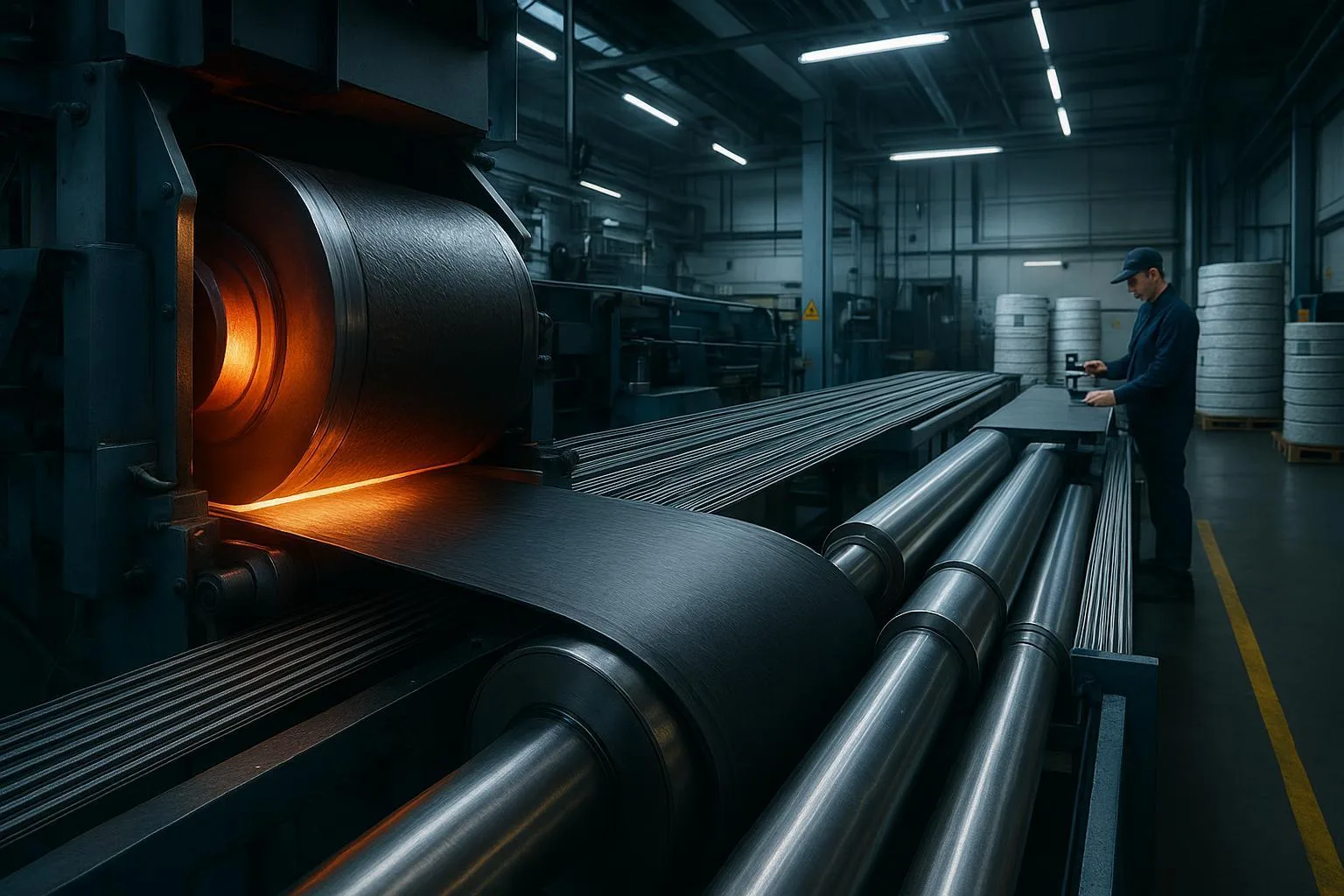
Textile (EP/NN): Multiple plies of fabric—typically polyester warp/nylon weft (EP) or all-nylon (NN)—specified under the textile belt standard. These belts are common on short to medium runs, plants, and unit-handling lines.
-
Steel cord (ST): Parallel steel cords embedded in rubber deliver high tensile strength with low elongation, ideal for long-distance, high-lift overland systems.
-
Specialty covers: Rubber or polymer top/bottom covers are formulated for abrasion (DIN X/W/Y style classes), heat (for clinker or sinter), oil/chemical resistance, flame resistance, and static conductivity.
See the Steel cord vs. textile comparison table below for a quick engineering overview.
Components and what they do
A conveyor is a system, not just a belt. Key elements include:
-
Idlers: Troughing and return rollers supporting the belt and load; bearing quality and sealing are critical. Selection typically follows CEMA classes (B–F) by load and width.
-
Pulleys: Head, tail, bend, and snub pulleys change direction and provide traction; diameters must match the belt’s construction and rating.
-
Drives and take-up: Motors, gearboxes, and take-up arrangements (gravity/screw) set speed and maintain tension.
-
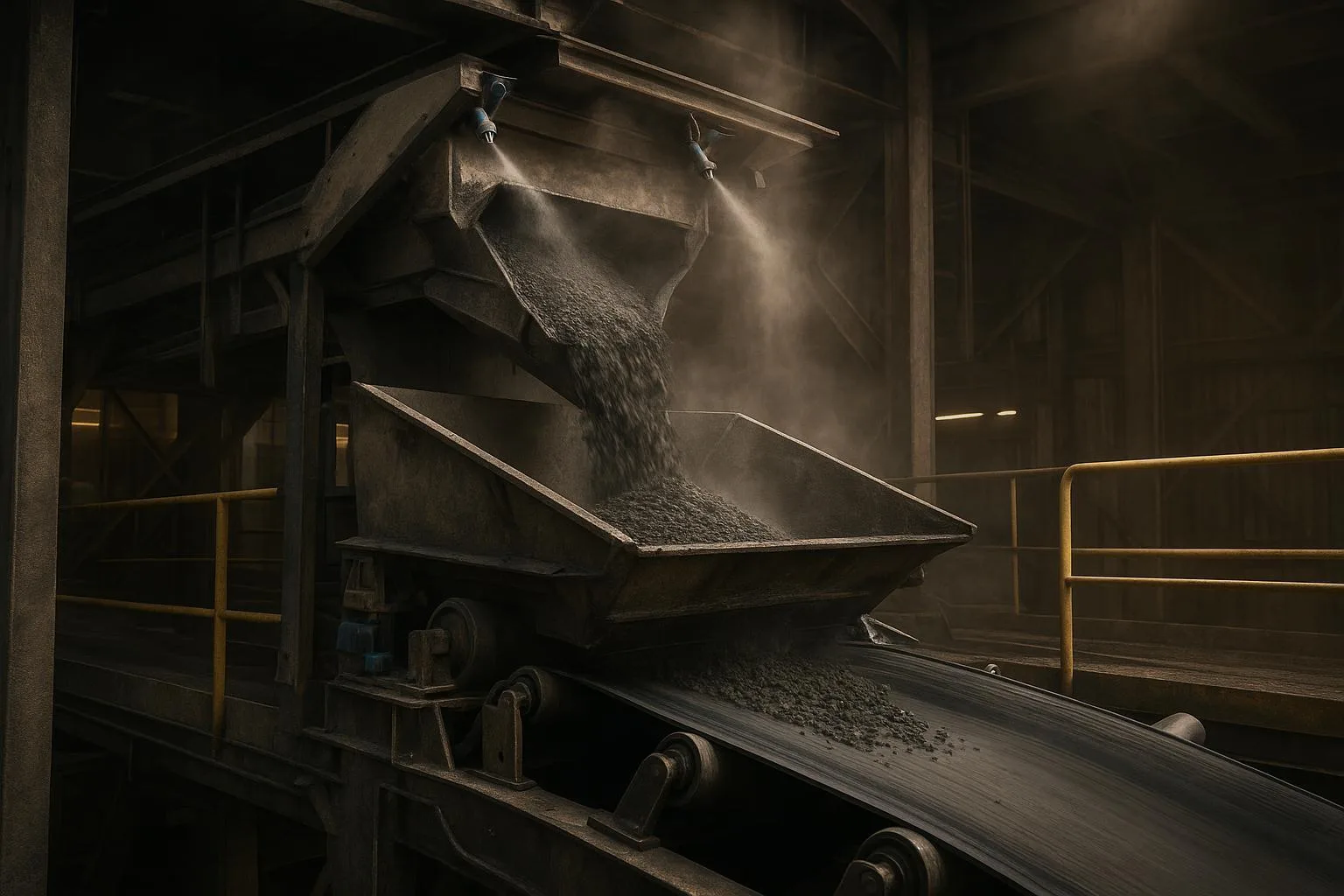
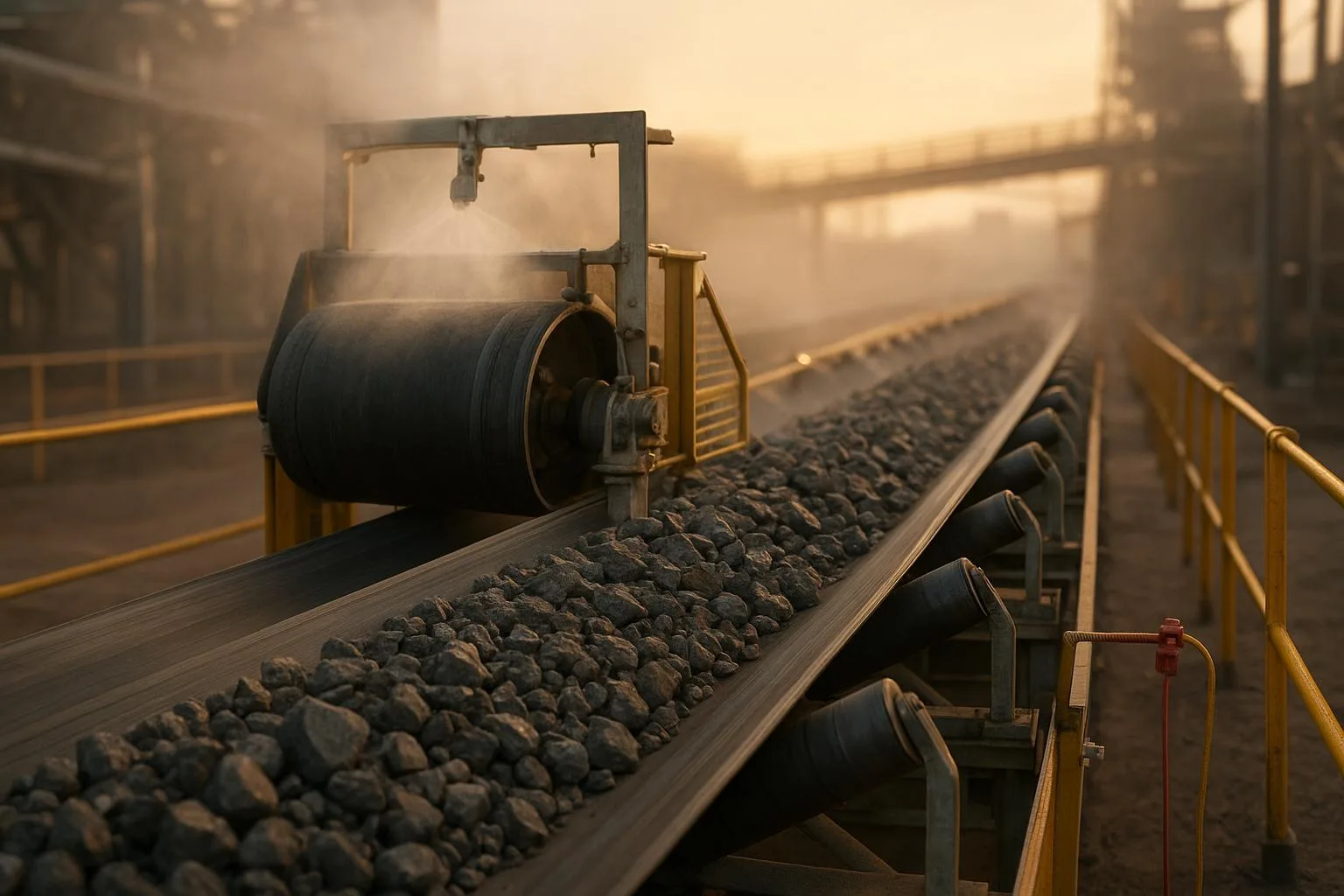
Belt cleaners and skirting: Primary/secondary cleaners and skirt seals reduce carryback and spillage at the loading zone.
-
Splices: Mechanical fasteners or hot/cold vulcanized joints transmit tension around pulleys; splice design follows the belt carcass type and duty.
Technical fundamentals and design rules
Capacity, belt speed, and power (worked example)
Capacity and power are sized with well-known industry methods. Capacity depends on belt cross-sectional area and speed; power depends on friction, lift, and accessories.
Worked example (imperial units for readability):
-
Duty: 3/4 inch crushed limestone, bulk density 90 lb/ft³, horizontal run.
-
Belt: 36 in width, 20° trough, typical cross-sectional area As ≈ 1.55 ft² (from industry tables), speed V = 450 fpm.
Throughput Q ≈ (As × V × 60 × ρ) / 2000
Q ≈ (1.55 × 450 × 60 × 90) / 2000 ≈ 1,883 tph (rounded)
Power is then estimated from effective tension Te (frictional resistance plus any lift) and belt speed. The formal method and factors are documented in the Conveyor Equipment Manufacturers Association’s reference texts. For idler and pulley selection, consult component standards noted below. For capacity/power methodology context, see the association’s publications (this guide references them without reproducing protected tables).
Tension, take-up, and safety factors
Belt rating is commonly expressed in N/mm (or PIW in North America; 1 N/mm ≈ 5.71 PIW). Selection ensures that steady-state and starting tensions, plus transient events, remain within the belt’s allowable working tension with appropriate design factors. Take-up travel must accommodate thermal/elastic changes while keeping the belt in traction at the drive. Calculation frameworks and partial safety factors are widely used in the industry; the German standard provides the dimensioning basis without us reproducing its proprietary tables. When in doubt, use conservative starting factors and verify transition distances to avoid edge tension and cover cracking.
Cover and environment selection
Covers are the belt’s sacrificial armor. Match compounds to hazards:
-
Abrasion: Select DIN-style abrasion classes (X/W/Y) appropriate to impact/severity; numeric limits are specified in the standard text.
-
Heat: For clinker, sinter, or foundry sand, choose heat-resistant compounds with continuous and peak ratings validated by vendor datasheets and tested per recognized methods.
-
Oil/chemicals: Use oil-resistant polymers for oily seeds, fertilizers, or solvents.
-
Fire and static: Underground belts and some surface applications require flame resistance and antistatic properties verified by laboratory tests and conductivity specifications.
Industry applications and scenarios
Mining
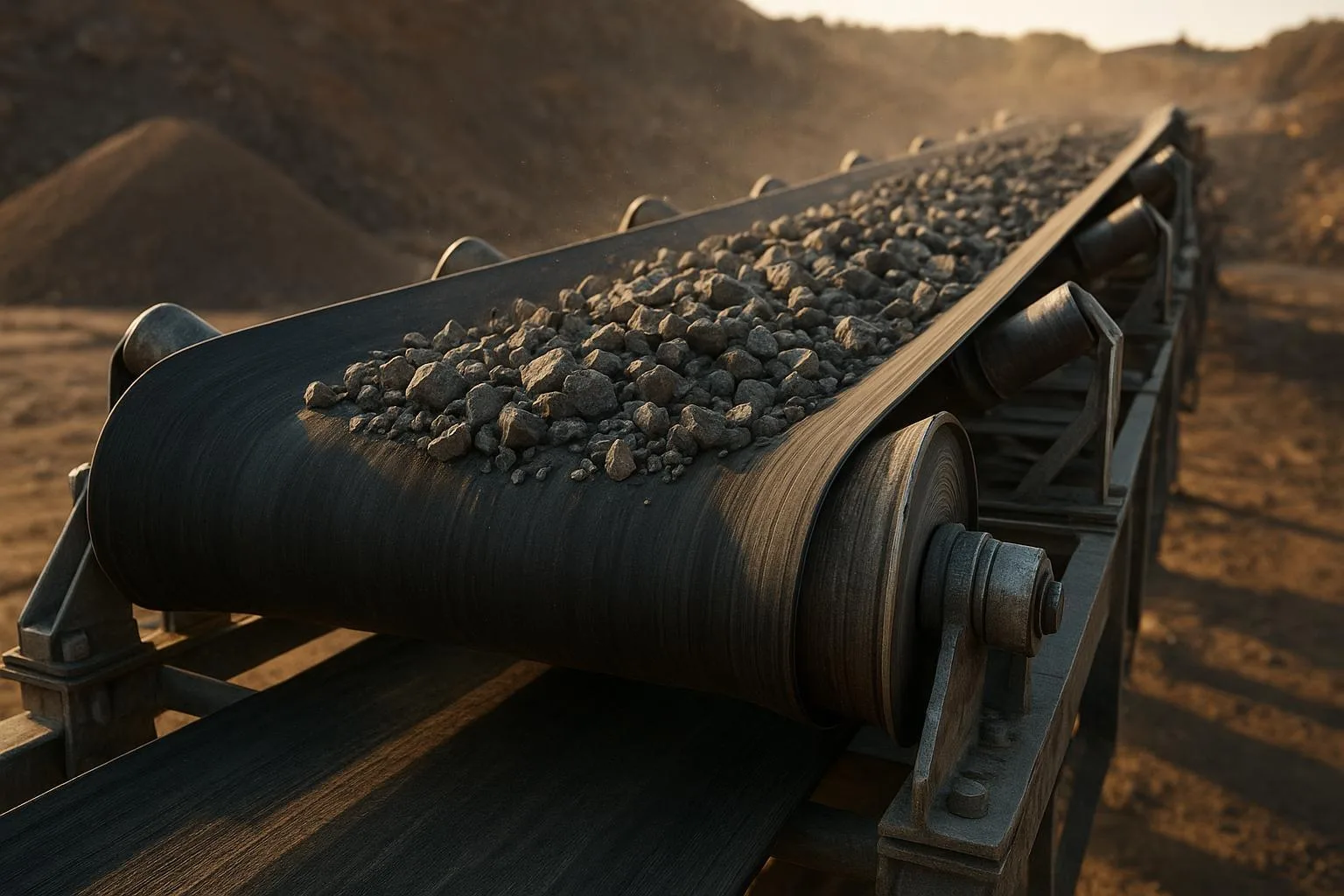
Long overland conveyors move ore at high tonnage with fewer operators and lower energy per ton than trucking. They typically use steel cord belts with high ST ratings, multiple drives, and condition monitoring. World-scale references document ST ratings in the 7500–10000 range with multi-MW drives for long lifts and tunnels.
Cement
From quarry to kiln and finish mill, belts handle limestone, raw meal, clinker, and additives. Heat-resistant conveyor belt covers are essential in the clinker line; sealing and cleaners are critical to suppress dust around transfer points.
Ports and shiploading
Belt reliability and dust control are paramount. Enclosures, engineered chutes, skirting, primary/secondary cleaners, and water sprays reduce emissions and cleanup. Operating discipline and inspection cadence matter because salty, windy environments are tough on idlers and pulleys.
Logistics and warehousing
Unit-handling systems rely on fabric belts (often PVC/TPU) and modular plastic chain for merges, sorters, and zero-pressure accumulation. Speeds are higher, loads lighter, and sanitation or product integrity often dominates over abrasion/impact concerns recognized in bulk handling.
Steel cord vs textile conveyor belts
Notes: Always verify pulley diameters, transition lengths, and splice design with the belt supplier’s data sheets and applicable standards.
Cover grade vs environment
Selection and specification guide
Selection matrix (quick orientation)
Micro example (vendor-neutral): For a cement transfer line at 600 tph with 40 m centers and moderate impact, an EP 400/3 belt with an abrasion-resistant cover, CEMA C troughing idlers at 35°, and a rubber-lagged head pulley is a sound baseline. Vendors such as BisonConvey can supply matched belts, idlers, and pulleys to this specification; equivalent components are available from other reputable OEMs. For steep-incline retrofits where footprint is constrained, consider sidewall designs; see BisonConvey’s Sidewall Conveyor Belts for a representative configuration.
RFQ checklist (copy and adapt)
-
State belt standard and carcass type (e.g., textile per ISO 14890 or steel cord per ISO 15236), rating in N/mm, and width.
-
Specify cover compound(s) and thickness by environment (abrasion/heat/oil/flame/antistatic) and any test/certification needs.
-
Define pulley diameters and face widths; identify drive lagging type; state required transition distances.
-
Define idler class and spacing per load/width; request sealing and bearing protection details.
-
State splice method (mechanical vs. hot vulcanized) and accessory needs (cleaners, skirts, scales, rip detection).
-
Include compliance items (e.g., underground flame-resistance approvals, conductivity specifications) and documentation requests (COC, test reports).
Common problems and troubleshooting
Maintenance best practices
Condition monitoring and inspection cadence
A practical program balances quick checks with deeper inspections:
-
Daily/shift: Walk the line for obvious spillage, unusual noise, or visible mistracking; verify cleaners contact and emergency-stop readiness.
-
Weekly: Spot-check idlers for free rolling, clean buildup at return, and wear on skirts and liners.
-
Monthly: Inspect pulley lagging, measure belt cover wear at fixed stations, and confirm take-up travel.
-
Quarterly: Calibrate belt scales and speed sensors; audit alignment with a laser or stringline.
-
Annual/major shutdown: NDT of splices (as available), structural survey, and overhaul of high-wear components in loading zones.
Preventive maintenance checklist
-
Verify belt tracking in low-tension zones before adjusting drives or tail.
-
Confirm idler roll freedom and sealing; replace any hot, seized, or noisy rollers.
-
Inspect and tension primary/secondary cleaners; replace worn blades.
-
Tighten/renew skirting to minimize gaps; maintain proper belt support under the chute.
-
Check take-up travel and tension setpoint; correct for seasonal temperature shifts.
-
Inspect lagging condition and bond; re-lag or replace when grooves are near end of life.
-
Test all safety systems: guards in place, emergency stops functional, lockout/tagout compliance.
Standards, safety, and compliance
-
Textile belt specification: See the International Organization for Standardization’s page for the current edition of the textile conveyor belt specification in general surface use: ISO 14890 — textile conveyor belts specification.
-
Steel cord belts and underground safety: The multi-part series defines construction, preferred specifications, adhesion tests, and underground safety, including the 2017 underground safety part under revision: ISO 15236-3 — underground safety for steel cord belts.
-
Laboratory flame test: Laboratory-scale flammability characteristics are established in the 2022 edition: ISO 340:2022 — flammability test method.
-
Electrical conductivity: Antistatic surface resistance requirements and test method are defined in the current edition: ISO 284:2025 — electrical conductivity of conveyor belts.
-
Dimensioning and calculations: The German standard provides the calculation basis for belt tensions, power, and component sizing; see the abstract: DIN 22101 — basis for calculation and dimensioning.
-
Cover grades (textile belts): For abrasion-oriented cover grades and related test methods, see the listing: DIN 22102-1 — textile conveyor belts with rubber covers.
-
Idlers: Nomenclature, dimensions, and load ratings by class are set out by the association: CEMA 502 — conveyor idlers standard.
-
Pulleys: Welded steel drum pulleys with compression hubs are covered in: ANSI/CEMA B105.1 — welded steel conveyor pulleys.
-
U.S. underground flame resistance: Regulatory approval requirements are defined in the Code of Federal Regulations: MSHA 30 CFR Part 14 — flame-resistant conveyor belts.
-
Dust control reference: For ports and bulk terminals, programmatic guidance is provided here: EPA — Fugitive dust control best practices.
Safety note: Always implement guarding, emergency stops, and lockout/tagout, and verify that flame and antistatic requirements are met where explosive dusts or underground risks exist.
FAQs and glossary
-
What does EP 400/3 mean? A textile belt rated 400 N/mm overall with three fabric plies; commonly used for plant conveyors. In North American PIW, multiply by ~5.71 to compare.
-
Steel cord vs textile—how do I decide? Distance, lift, and tension drive the choice. Overland and high-lift duties trend toward steel cord for strength and low stretch; plant and short runs often favor EP/NN for handling and cost.
-
Do I need flame-resistant or antistatic belts? Underground coal and some explosive dust environments require both flame resistance and conductivity per applicable regulations and standards.
Glossary
-
Troughing angle: The angle of the wing idlers that form the belt into a trough for capacity and containment.
-
Transition distance: The length from the tail or head to the first fully troughed idler set; sized to prevent edge over-tension.
-
Take-up: Device that maintains belt tension and compensates for stretch; may be gravity or screw type.
-
Carryback: Material adhering to the belt after discharge; controlled with cleaners and adequate support.
Conclusion and next steps
We’ve covered the functions and applications of conveyor belts, the engineering behind capacity, tension, and components, and how to specify, troubleshoot, and maintain systems for reliable throughput. If you’re preparing a conveyor belt selection guide or an RFQ and want a second set of eyes on standards alignment and component fit, you can reach out to BisonConvey for engineered selections and matched components—alongside equivalent offerings from other reputable OEMs. Choose belts and accessories to the duty, verify against the cited standards, and keep a steady cadence of inspection and cleaning; your uptime will follow.