Choosing between EP150 and EP300 fabric conveyor belts looks simple on paper—one’s “stronger,” right? In practice, the rating touches tension, ply count, total thickness, minimum pulley diameters, elongation, impact resistance, and ultimately uptime. This guide breaks down what the rating really means and how it plays into day-to-day operations.
What the EP rating actually means
EP describes the carcass fabric: polyester in the warp (longitudinal) and nylon/polyamide in the weft (transverse). The number (150, 300, etc.) relates to tensile strength per unit width, typically expressed in N/mm, but shorthand varies by vendor. DIN/ISO-style designations make the intent explicit—e.g., “EP 400/3 6/2 Y” means 400 N/mm total belt strength, three plies, 6 mm top cover, 2 mm bottom cover, cover grade Y. For clarity on designation conventions, see the overview by The Conveyor Belt Guide in their designation summary aligned with DIN 22102 and ISO 14890: Designation formats and examples.
If you work in mixed US/metric environments, you’ll encounter PIW (Pounds per Inch of Width). A practical conversion used in industry is PIW × 0.175 ≈ N/mm, and N/mm × 5.71 ≈ PIW. Pooley Inc. documents these factors in their engineering notes: Metric specifications and PIW↔N/mm conversion (Pooley Inc.) and PIW, EP, ST explainer (Pooley Inc.).
Construction differences—and why they matter
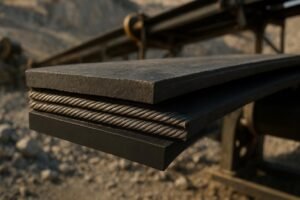
EP150 belts typically use lighter fabric plies and thinner skim rubber than EP300 belts. For the same number of plies, EP300 constructions tend to be thicker and heavier because each ply is a higher-strength fabric with a larger composite gauge. That difference cascades:
- Minimum pulley diameters step up with thicker carcasses and higher tension utilization; EP300 belts running at higher loads often require larger drive/head pulleys than EP150.
- Heavier carcasses mean more mass per meter; energy draw and startup torque can increase, while impact resistance improves thanks to more rubber and fabric to absorb shocks.
- Working elongation under load can be lower with EP300 when you design for a lower utilization of breaking strength; tracking stability and splice longevity benefit from reduced stretch.
For context on typical gauges and cover combinations, manufacturer catalogs and technical notes provide ranges—e.g., EP fabric per‑ply composite gauges often cluster around ~1.6 mm for higher ratings, while overall belt thickness depends on the carcass plus covers such as 5+2, 6+3, or 8+3 mm. See Continental’s ContiFlex EP family brochure for representative construction and performance notes: ContiFlex EP brochure (Continental, PDF).
EP150 vs EP300 at a glance
Below are indicative ranges based on recent catalogs and engineering references. Always confirm with the specific manufacturer data for the exact belt you’re sourcing.
| Item | EP150 (indicative) | EP300 (indicative) | Notes |
|---|---|---|---|
| Carcass strength | Often used as shorthand; confirm DIN-style total N/mm (e.g., EP 250/2, EP 315/3) | Higher strength tier; confirm total N/mm (e.g., EP 400/3, EP 500/4) | Use explicit designation to avoid ambiguity. See Conveyor Belt Guide designation. |
| Typical plies | 2–3 for light/moderate duty | 3–4 for heavy duty | Availability varies by width and supplier. |
| Per‑ply gauge (fabric + skim) | Thinner (≈1.0–1.3 mm common in light-duty fabrics) | Heavier (≈1.6–1.8 mm typical; broader 1.0–2.6 mm seen across catalogs) | Derived from supplier fabric specs; verify exact construction. |
| Total thickness (with common covers) | 3‑ply with 5+2 or 6+3 mm covers ≈ 8–10 mm | 3‑ply with similar covers ≈ 12–14 mm | Heavier carcass increases thickness. |
| Minimum drive pulley diameter | Smaller at low tension; ≈250–400 mm typical for light duty | Larger at higher loads; often ≈450–600+ mm | Check manufacturer pulley diameter tables. |
| Elongation under load | Low; ~1.3–2.0% at 10% of breaking load | Low; practical working stretch can be lower due to lower utilization | See Continental and Fenner Dunlop technical notes. |
| Impact/tear resistance | Lower than thicker, multi‑ply EP300 | Better with more plies and thicker skim rubber | Covers influence resistance too. |
| Typical applications | Plant transfers, agriculture, fertilizer, moderate-duty | Quarry/crusher, ports, steel/metallurgy, longer centers, higher speeds | Map to calculated tension and environment. |
Pulley diameter and elongation: selection consequences
Pulley sizing is where many projects hit constraints. Recommended minimum diameters scale with ply count, carcass thickness, speed, splice type, and—critically—how much of the belt’s rated strength you use (utilization). Continental and Dunlop publish tables that step diameters as utilization rises. For examples and methodology, see Continental’s EMEA catalog excerpt for general guidance on pulley diameter vs. utilization bands: Conveying Solutions catalog excerpt (Continental, 2025) and Dunlop’s Superfort datasheet with utilization-driven diameter recommendations: Superfort datasheet (Fenner Dunlop EMEA).
Elongation under load affects tracking and splice stability. Continental’s engineering notes for EP belts document permanent elongation values and service-range stretch using ISO test procedures; when you choose an EP300 belt so that working tension sits in a lower utilization band, you reduce working elongation for the same duty. A practical read on stretch behavior is Fenner Dunlop’s technical note: Stretching the Limits (2024), Fenner Dunlop.
“Best for…” scenarios
-
EP150: Best for short plant transfers and moderate loads where calculated tension plus safety margin stays comfortably within the EP150 construction’s capacity and pulleys are relatively small. Typical sectors include agriculture, fertilizer, and general in‑plant conveying with lower speeds and less abrasive, non‑sharp materials.
-
EP300: Best for heavy-duty bulk handling, longer centers, higher speeds, and impact/abrasion‑prone environments—quarry/crusher primaries, steel/metallurgy lines, and port terminals. The higher strength lets you operate in a lower utilization band, which can improve tracking and splice life while resisting impact and tearing.
A practical selection workflow
- Calculate required belt tension from capacity, lift, friction, and loading conditions. Add a safety factor appropriate to your standard or company practice.
- Check pulley diameter constraints (existing hardware and allowable upgrades). Cross‑reference manufacturer tables by ply count, utilization percentage, and cover gauges.
- Choose cover compounds independent of EP rating (abrasion, heat, oil, flame). Reference DIN 22102/ISO 14890 cover classes to match your material and environment. A concise overview of DIN/ISO abrasion grades is available here: Abrasion standards and test methods (Dunlop).
- Review idler spacing and troughability; heavier/thicker belts may require adjustments to maintain sag and loading control.
- Confirm splice type and length; higher-strength, thicker carcasses often need longer splices and stricter installation practice.
- Validate speed and loading impacts on energy draw; heavier belts and larger pulleys can change motor sizing and start-up torque requirements.
Also consider: system-level compatibility
Disclosure: BisonConvey is our product. For buyers who prefer a single-source, system‑level match between EP fabric belts and components, BisonConvey manufactures EP/NN fabric belts alongside idlers and pulleys, which can simplify pulley diameter, troughability, and impact‑resistance decisions across heavy‑duty applications. Mentioned here for completeness; evaluate against your project’s calculated tension and hardware constraints.
FAQs
-
Does the EP rating determine the cover grade? No. EP identifies the carcass fabric strength. Cover compounds (abrasion, heat, oil, flame) are selected independently per DIN/ISO classes to suit your material and temperature.
-
Can an EP150 belt run at high speed? If calculated tension plus safety margin sits well below EP150’s capacity and pulley diameters meet manufacturer minimums, yes—provided the material isn’t highly abrasive or impact‑heavy. Speed alone isn’t the deciding factor; tension, covers, and pulley sizing are.
-
How do I convert PIW to N/mm when comparing US and metric specs? Multiply PIW by 0.175 to get N/mm; multiply N/mm by 5.71 to get PIW. The factors are summarized in Pooley Inc.’s engineering notes cited above.
Final thoughts
Think of EP150 vs EP300 as a tension and durability decision framed by your hardware. Start with the math (tension and utilization), check pulley limits, pick the right covers, and then confirm splice and troughability details. When in doubt, lock decisions to the specific manufacturer’s tables—those recommendations reflect the construction you’ll actually install.