Modern bulk-handling lines live or die on belt reliability. If you’re selecting or replacing a fabric belt, chances are you’ll encounter EP—short for a carcass made with polyester in the warp and polyamide (nylon) in the weft. This guide explains What is an EP Conveyor Belt: Definition, Specifications, and Advantages, decoding label markings, mapping standards, and giving you a practical workflow to specify, install, and maintain EP belts with confidence.
Key takeaways
-
EP means a textile carcass with polyester (warp) and polyamide/nylon (weft), offering low elongation, moisture stability, and broad industrial fit.
-
Read labels like “EP 400/3 4+2 DIN Y” as: tensile class N/mm, number of plies, cover thicknesses, and cover grade per DIN or ISO.
-
For specifications, align with ISO 14890 (designation and properties), ISO 283 (tensile/elongation), ISO 9856 (cyclic stretch for take-up planning), and DIN 22102 (cover grades X/W/Y). Use CEMA for design context.
-
Typical applications: mining, cement, ports, aggregates, power, agriculture. Choose NN for very flexible short runs; choose steel cord for long, high-tension overland conveyors.
-
Get pulley diameters right (ISO 3684 method + manufacturer tables) and plan take-up travel based on elastic/permanent elongation data.
-
Most chronic issues—mistracking, splice problems, cover delamination—tie back to sizing, transitions, or QA; fix the root, not just the symptom.
What is an EP Conveyor Belt: Definition, Specifications, and Advantages in practice
This section distills the core concepts behind the phrase “What is an EP Conveyor Belt: Definition, Specifications, and Advantages” into everyday engineering decisions.
EP carcass construction and how to read ratings
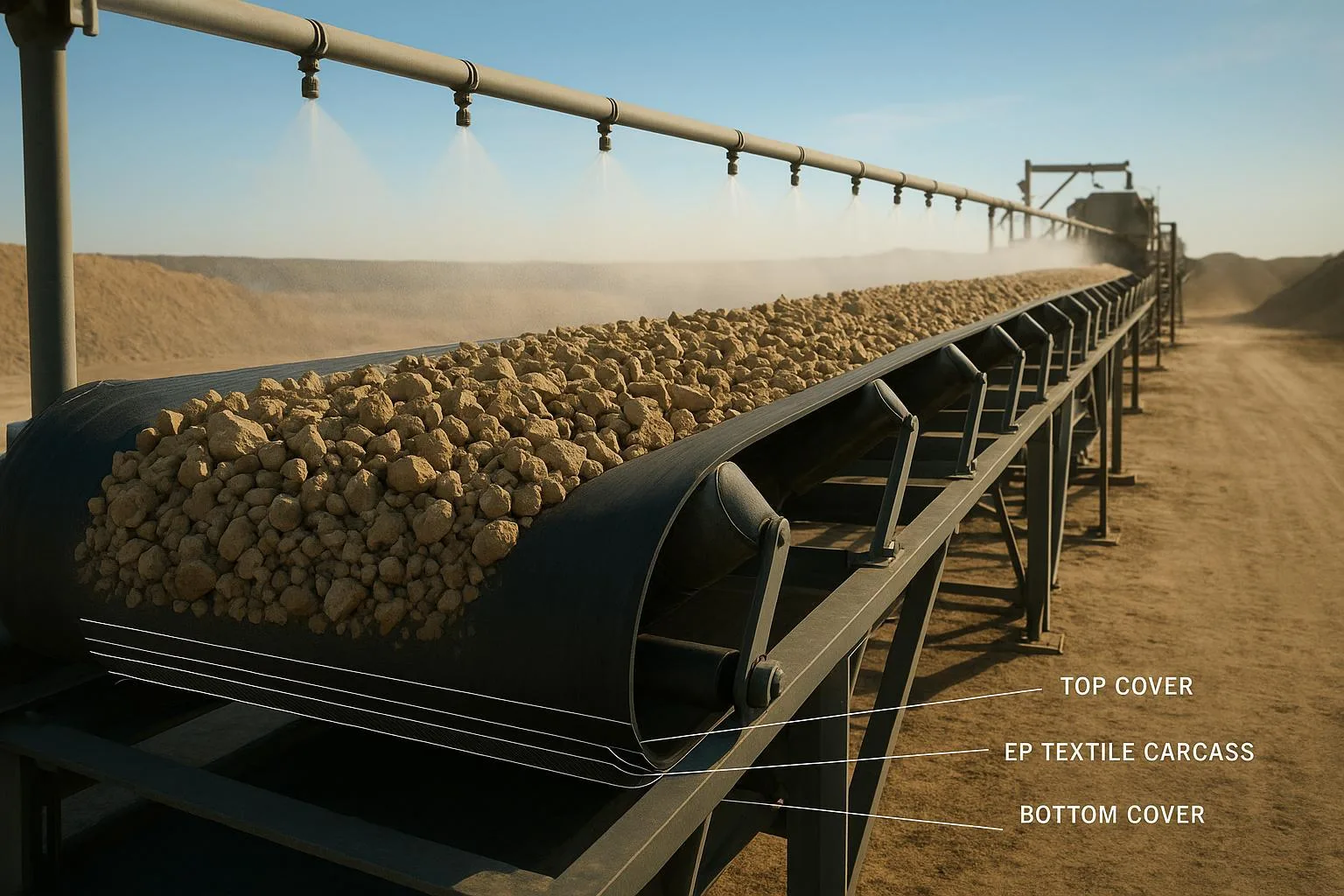
EP belts use a layered rubber construction with a textile carcass between the top and bottom covers. The carcass uses polyester yarns along the belt length (warp) and polyamide/nylon across the width (weft). In practice, polyester’s low moisture absorption and stable modulus reduce creep, while nylon’s crosswise flexibility aids troughability and impact absorption.
Reading “EP 400/3 4+2 DIN Y”
A typical line on a datasheet or belt stamp packs key data:
-
EP = carcass fabric type (polyester in warp; polyamide/nylon in weft)
-
400 = nominal tensile rating in N/mm
-
/3 = number of plies
-
4+2 = cover thicknesses in mm (top + bottom)
-
DIN Y = cover grade (general-purpose abrasion) under DIN 22102
Manufacturer catalogues and industry primers consistently interpret EP notation this way; see overviews and product guides from established makers for similar decoding and ranges discussed in public literature like the Sempertrans catalogue and Fenner/Dunlop range summaries (2019–2020). For general designation context, consult the concise designation explainer maintained by ConveyorBeltGuide in its article on belt markings.
Material properties that matter in service
-
Low longitudinal elongation (vs NN): helps keep drive take-up manageable and reduces re-tensioning frequency.
-
Crosswise flexibility: good troughability and impact absorption at loading zones.
-
Moisture stability: polyester resists humidity-driven creep better than nylon.
-
Splicing compatibility: hot-vulcanized splices are standard for EP; mechanical fasteners may be used where pulleys and duty allow.
Technical specifications and standards
EP belts fall under widely recognized standards that define construction, testing, and performance characteristics.
-
ISO 14890 describes the designation, construction, cover requirements, and tolerances for textile belts used on flat or troughed idlers for general service. Authoritative summaries are available from ISO and European standards portals.
-
DIN 22102 sets cover grades X, W, and Y and ties them to abrasion and cut/impact resistance classes; many global suppliers reference these grades in datasheets.
-
ISO 283 defines methods to determine full-thickness tensile strength and elongation at a reference load; reported as N/mm and percentage.
-
ISO 9856 measures elastic and permanent elongation under cyclic load; critical for planning take-up travel and break-in re-tensioning.
-
Property-specific tests appear in ISO 4649 (abrasion volume loss), ISO 505 (tear propagation for textiles), ISO 252 (adhesion), and ISO 340 (flame resistance) when relevant.
-
For pulley sizing methodology, ISO 3684 outlines how to determine minimum diameters by belt class and duty. In practice, manufacturers publish role-specific tables (drive/snub/bend) informed by this method.
-
For design context such as idler spacing, sag limits, transition lengths, and capacity formulas, consult CEMA Belt Conveyors for Bulk Materials and derivative technical notes.
Tensile ratings, plies, and PIW↔N/mm conversion
EP classes are designated by nominal tensile rating (N/mm) and number of plies. Common classes include EP 315/2, EP 400/3, EP 500/3, EP 630/4, EP 800/4, etc. If you need to compare with legacy PIW ratings, the industry-typical conversion is:
-
1 PIW ≈ 0.175 N/mm
-
1 N/mm ≈ 5.71 PIW
-
1 N/mm = 1 kN/m
These are for comparison only—don’t mix operating and breaking ratings across systems. Industry references (e.g., Pooley engineering notes) publish the same relationships.
Cover grades: ISO H/D/L vs DIN X/W/Y
Two parallel naming schemes are common in general-purpose service:
-
ISO 14890: H, D, L classes
-
DIN 22102: X, W, Y grades
A practical crosswalk used in manufacturer summaries is:
-
ISO H ↔ DIN X: abrasion with added cut/impact resistance
-
ISO D ↔ DIN W: highest abrasion resistance
-
ISO L ↔ DIN Y: general-purpose abrasion
Abrasion is usually measured as volume loss (mm³) under ISO 4649 (historically aligned with DIN 53516). For an overview of testing and grade intent, see Fenner Dunlop’s explainer on abrasion standards and test methods and the standards-oriented pages at ConveyorBeltGuide.
Applications and where EP excels (and where it doesn’t)
Where EP is a strong fit:
-
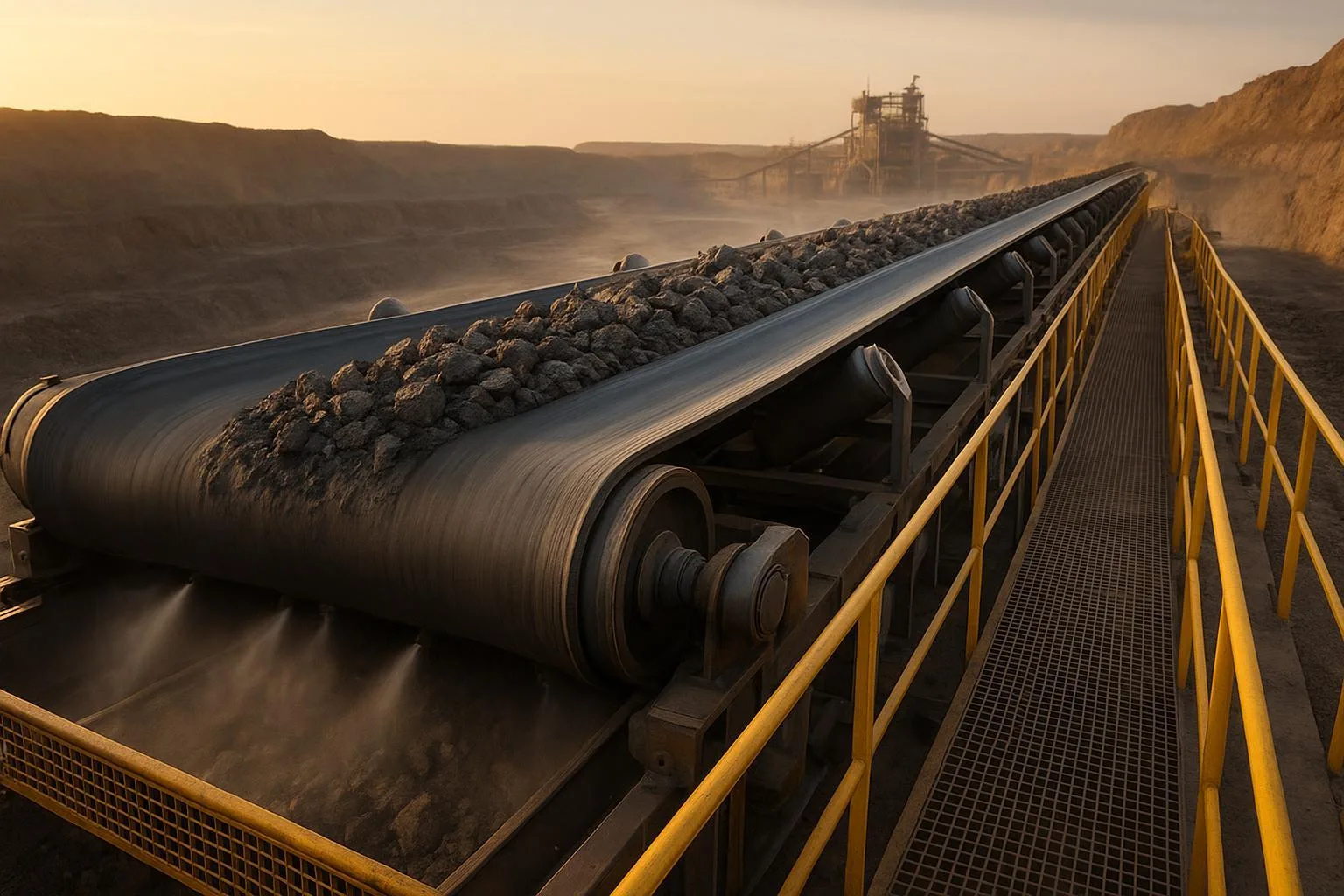
Mining and quarrying: crushed rock, ore, aggregates—balanced elongation and durability.
-
Cement and building materials: limestone/clinker handling up to moderate heat with appropriate cover compounds.
-
Ports and logistics: ship loaders/stackers/reclaimers; good tracking and moisture stability outdoors.
-
Power and biomass: coal, petcoke, biomass where fabric belts are common and pulleys aren’t oversized.
When another carcass may be better:
-
NN (polyamide/nylon warp & weft): more flexible for short, highly articulated conveyors; expect higher longitudinal elongation and greater take-up allowance.
-
Steel cord: for long overland, high-tension or very high-capacity lines that benefit from very low elongation and high tensile classes; higher initial cost and larger pulley diameters typically required.
Comparison snapshot (consult datasheets for specifics):
| Carcass | Typical elongation (operating) | Flexibility on small pulleys | Tensile range | Best use case |
|---|---|---|---|---|
| EP (polyester/nylon) | Low | Moderate | Medium to high | Broad industrial use; reliable, cost-effective |
| NN (all-nylon) | Medium–higher | High | Medium | Short/dynamic runs; high-impact zones |
| Steel cord | Very low | Low | Very high | Long-distance, high-tension overland |
This parity-style view aligns with common industry guides and manufacturer handbooks.
Selection and implementation workflow
A clear, standards-aware workflow reduces the risk of chronic issues later.
1) Capacity, width, and speed fundamentals
-
Start with material density, surcharge angle, and required tph. Use CEMA capacity equations or an internal tool to validate your assumptions. For quick checks, see our conveyor belt capacity calculator, which demonstrates how width and speed drive volumetric capacity: conveyor belt capacity calculator.
-
Choose a belt width that limits surcharge-induced spillage and maintains acceptable load cross-section at your trough angle.
-
Select a speed within your plant standards and within acceptable wear/noise envelopes for the material.
2) Pulley compatibility and minimum diameters
-
Use ISO 3684 methodology and manufacturer tables to set minimum diameters by pulley role (drive, tail, snub, bend) at the expected percentage of rated tension. Typical patterns: EP 400/3 may call for ~315–500 mm; EP 630/4 ~400–800 mm depending on role and duty. Always validate against the chosen belt’s datasheet.
-
Under-diameter bends dramatically increase flexural fatigue and can drive early cover cracking or splice failure. To check quickly, use a role-aware tool like this internal resource: pulley diameter calculator.
Representative tables from reputable catalogs (e.g., ASGCO heavy-duty brochure and Goodyear/ContiTech catalogs) illustrate these ranges and the importance of role-based diameters.
3) Elongation and take-up planning
- From ISO 283 data, note elongation at a defined reference load; from ISO 9856 testing, capture elastic and permanent elongation under cyclic load. In practice, plan commissioning with re-tensioning after break-in and allow sufficient take-up travel for both elastic stretch in operation and permanent set over time. Fenner Dunlop’s technical article on cyclic stretch provides useful context on how these values are derived and used in design.
4) Cover grade and compounds
- Map duty to ISO H/D/L or DIN X/W/Y as summarized above. For extreme abrasion, select D/W classes; for combined cut/impact plus abrasion, select H/X; for general-purpose, L/Y. Verify abrasion loss values (ISO 4649). For special exposures, specify heat-, oil-, or flame-resistant compounds per applicable standards (e.g., ISO 340 for flame).
5) Splicing choices and QA
-
Hot-vulcanized splices are preferred for EP belts in permanent service; mechanical fasteners can be appropriate for maintenance access or small-diameter pulleys, within fastener and pulley compatibility limits.
-
QA checks should include adhesion testing per ISO 252, verification of ply step lengths and alignment, and inspection for trapped contamination. Where available, consult your supplier’s documented cure profiles and peel-adhesion test results.
6) Worked example (compact)
Spec line: “EP 400/3 4+2 DIN Y” on a 1,000 mm-wide limestone conveyor.
-
Interpretation: 400 N/mm class; 3 plies; 4 mm top, 2 mm bottom covers; general-purpose abrasion cover.
-
Pulley sense-check: Using manufacturer tables, expect minimum diameters roughly in the 315–500 mm range depending on role and duty for EP 400/3. Verify against the selected product’s datasheet and run through a calculator if in doubt (drive vs snub often differ).
-
Take-up allowance: Plan for break-in based on ISO 9856 elastic/permanent elongation data from the supplier; schedule a re-tension check after initial loading.
-
Practical example: On projects where we’ve specified EP 400/3 for quarry conveyors, pairing correct pulley diameters with a hot-vulcanized splice and protected loading zone (impact beds + skirt seals) has consistently lowered early-life tracking adjustments and reduced splice touch-ups.
Note: As a neutral reference supplier, BisonConvey manufactures belts, idlers, and pulleys used in setups like this and can align pulley and idler packages to the selected belt class and trough geometry when requested.
Common problems and troubleshooting
-
Mistracking: Often due to misaligned idlers or pulleys, off-center loading, buildup, or uneven tension. Actions: square and align structure, clean buildup, correct loading centering, adjust tension, and consider trainers where needed. CEMA-derived notes on sag and transitions and industry troubleshooting guides echo these root causes.
-
Splice failures: Causes include incorrect splice geometry/cure, contamination, excessive tension, too-small pulleys, or poor transitions. Actions: re-splice to spec; verify pulley diameters and transition lengths; check adhesion per ISO 252; ensure square cuts and proper rubber flow.
-
Cover delamination/cracking: Often from repeated over-bending on small pulleys or harsh transitions; can also follow heat/chemical exposure. Actions: increase bend diameters, correct transition distances, select appropriate cover compound, and adjust tensioning.
-
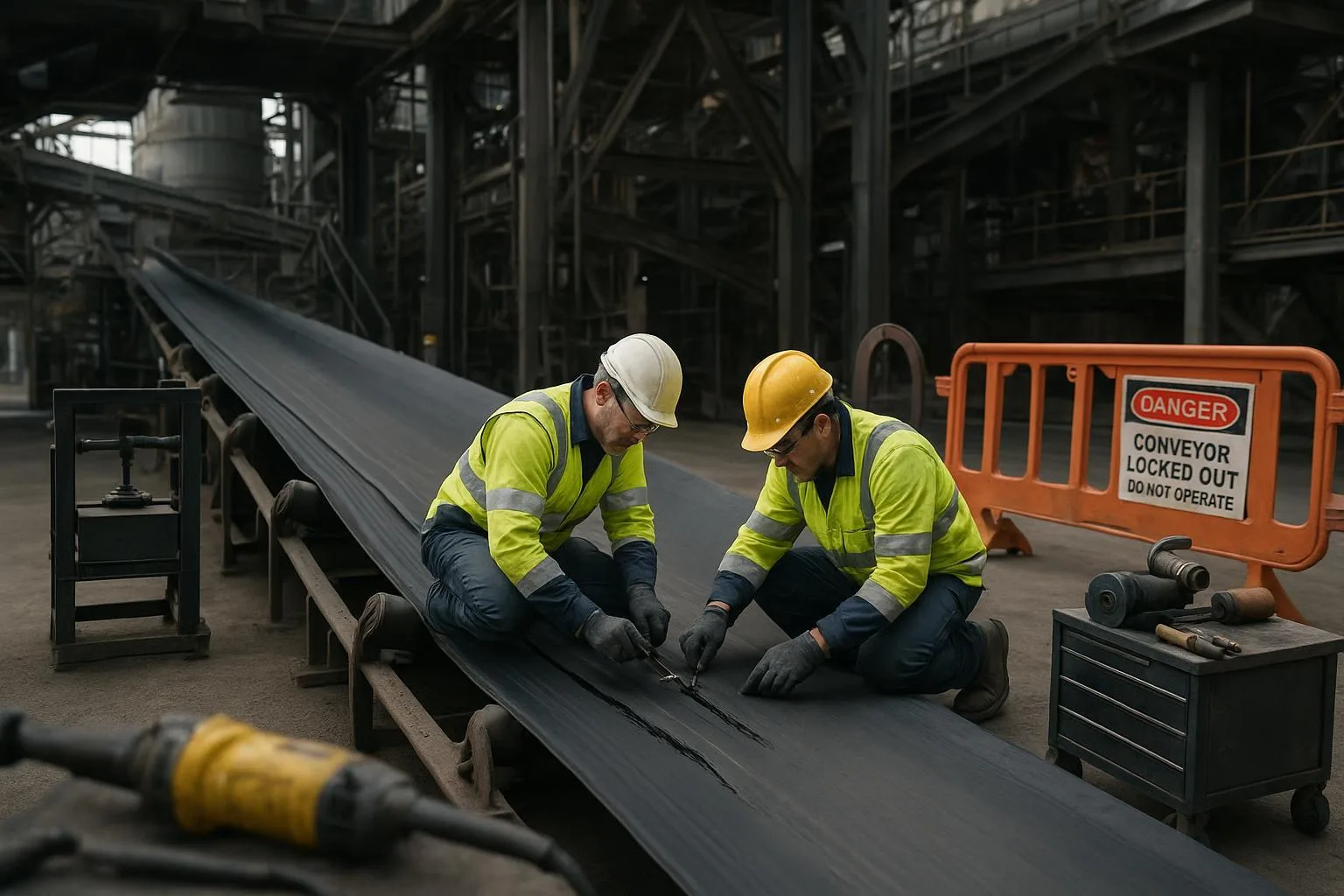
Edge damage and premature wear: Typically linked to tracking drift, rubbing against structure or mis-set skirting/cleaners. Actions: correct tracking, replace seized rollers, set skirting and cleaners properly, and manage material buildup.
Best practices and maintenance
-
Inspection cadence: Walk the line weekly at minimum; increase frequency in new-commissioning and after any major maintenance.
-
Loading zone control: Use impact beds or properly spaced impact idlers; maintain skirt seals to minimize fugitive material and edge wear.
-
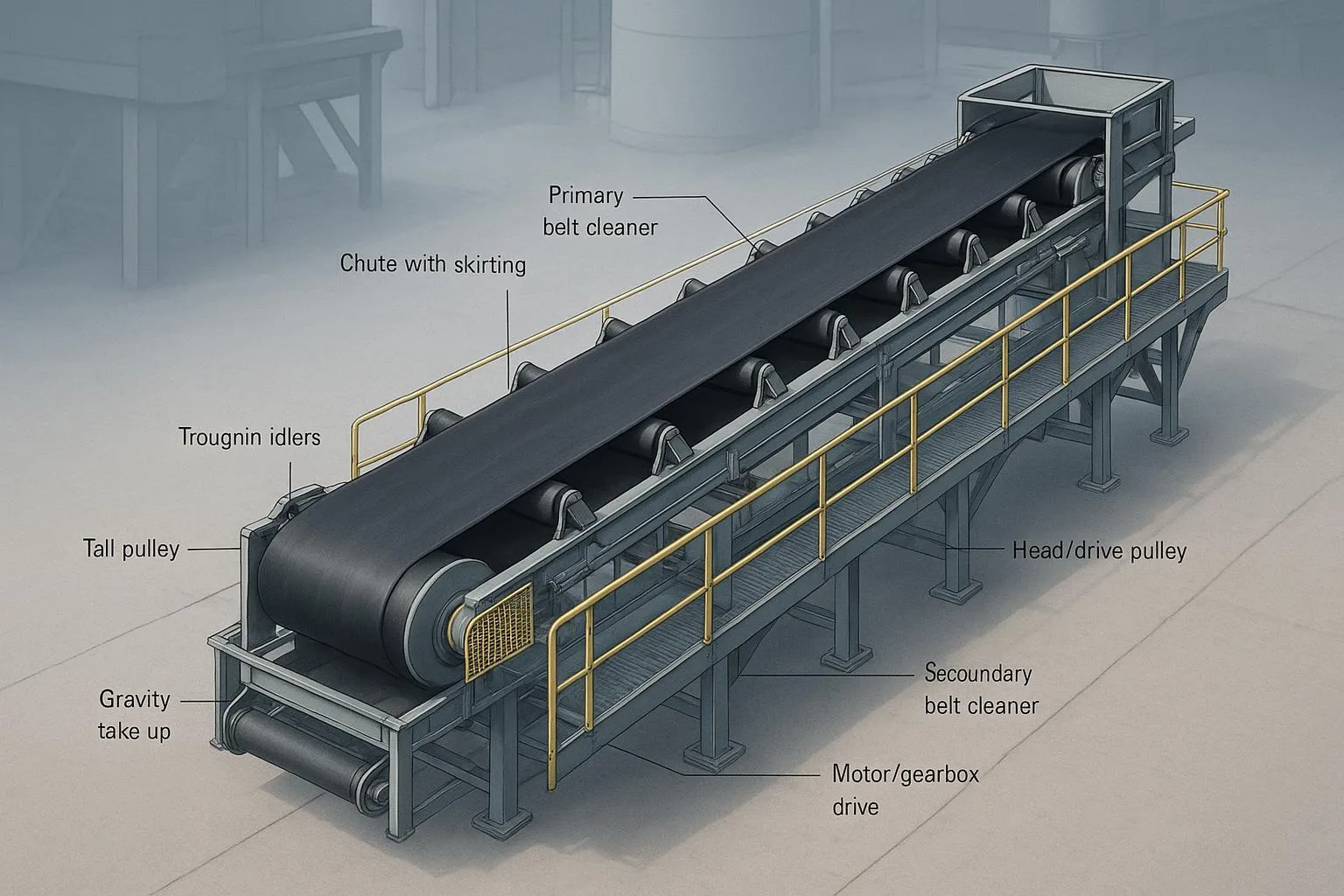
Cleaning and carryback: Fit primary and secondary cleaners suited to the belt compound and speed; keep return idlers clean to prevent tracking drift.
-
Alignment and tensioning: Verify pulley and idler alignment periodically; measure and adjust take-up tension to keep sag within design limits; re-check after break-in per ISO 9856 expectations.
-
Splice QA: Document each splice with cure parameters, ply steps, and peel-adhesion results where possible; re-inspect after initial load cycles.
-
Records and trend checks: Track wear thickness, splice condition, and tracking adjustments; trends reveal root causes before failures occur.
Conclusion: actionable takeaways
What is an EP Conveyor Belt: Definition, Specifications, and Advantages ultimately comes down to balancing elongation control, abrasion-resistant covers, and correct pulley/transition geometry. To move forward with confidence:
-
Decode the spec and confirm standards alignment (ISO 14890, ISO 283, ISO 9856; DIN 22102 for covers).
-
Validate capacity, width, and speed; then check minimum pulley diameters by role and tension.
-
Select the right cover grade (ISO H/D/L or DIN X/W/Y) and any special compounds early.
-
Plan take-up travel and re-tensioning from actual elongation data; QA splices per ISO 252.
-
Monitor tracking, wear, and splices with a simple inspection log.
If you need a neutral review or component package matched to your selected belt class, you can reach out to BisonConvey for engineered belts, idlers, and pulleys aligned to your duty and standards-driven specification.
References and further reading
-
ISO overview of textile belt specification framework: see the ISO page for ISO 14890 and European summary pages describing scope and designation requirements.
-
DIN cover-grade intent and belt designation context: see the industry explainer at ConveyorBeltGuide on DIN/ISO designations and Fenner Dunlop’s overview of abrasion standards and test methods.
-
Tensile/elongation testing: ISO 283 (methods) and ISO 9856 (cyclic elongation). Manufacturers and testing providers outline these procedures in public summaries and sample documents.
-
Pulley diameter methodology and examples: ISO 3684 method references and role-based tables in reputable catalogs (e.g., ASGCO, Goodyear/ContiTech) and legacy handbooks.
-
CEMA design context on sag, transitions, and capacity: CEMA change pages and derivative technical guides from idler manufacturers.
External resources with descriptive anchors:
-
ISO 14890 scope and structure: ISO 14890 standard overview and prEN/EN ISO 14890 summary
-
DIN and designation mapping: ConveyorBeltGuide designation explainer and Fenner Dunlop abrasion standards and test methods
-
Tensile/elongation concepts: ISO 283:2023 overview and ISO 9856 sample (public mirror)
-
Pulley diameter context: ISO 3684 overview and ASGCO heavy-duty belt brochure with diameter tables
-
CEMA-derived design notes: CEMA change pages for Belt Conveyors for Bulk Materials