Dune Express: Longest Conveyor Belt in the US
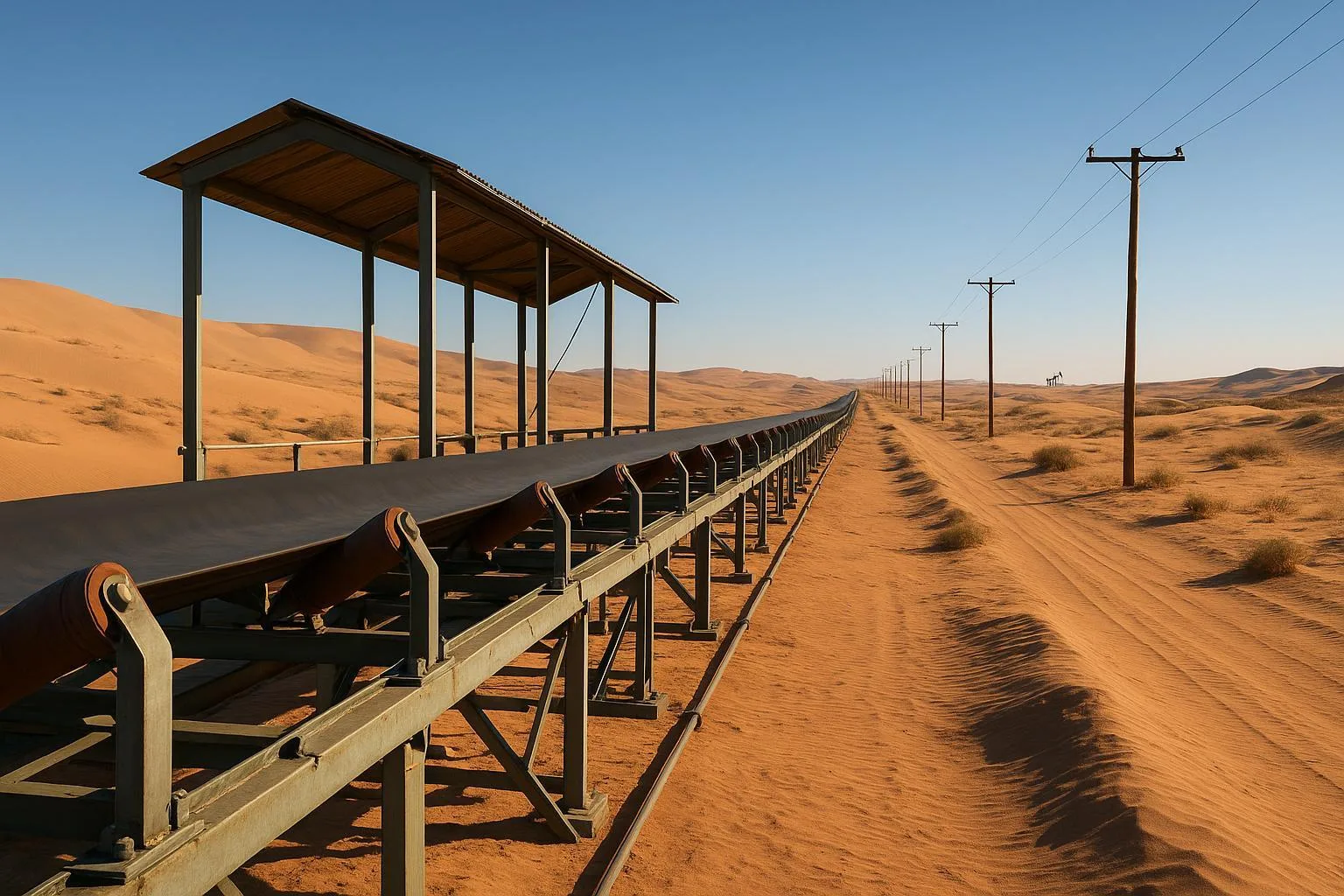
The Dune Express is widely reported as the longest conveyor belt system in the United States: an approximately 42‑mile, fully electric overland conveyor moving frac sand from Kermit, Texas, into New Mexico to supply the northern Delaware Basin. Commissioned in late 2024 and delivering sand commercially by January 2025, the system replaces a substantial share of truck haulage to reduce congestion, incidents, and dust/emissions along the route.
For plant engineers and procurement teams, the project is more than a milestone—it’s a living reference for overland conveyor design under desert heat, wind, sand ingress, and long horizontal curves. In this guide, we distill verified facts, highlight core engineering choices, and translate standards (CEMA, DIN 22101/ISO 5048, ISO 14890/15236) into practical selection, commissioning, and maintenance guidance you can reuse on long-distance conveyor projects.
Why the Dune Express: Longest Conveyor Belt in the US matters
-
It is a ~42‑mile overland conveyor system, with a single flight reported at ~16.3–16.4 miles—clarify “system length” versus “single‑belt span.”
-
Vendor and contractor materials point to controlled long acceleration (about 10 minutes) and multi‑drive load sharing to manage tensions on long, curved flights.
-
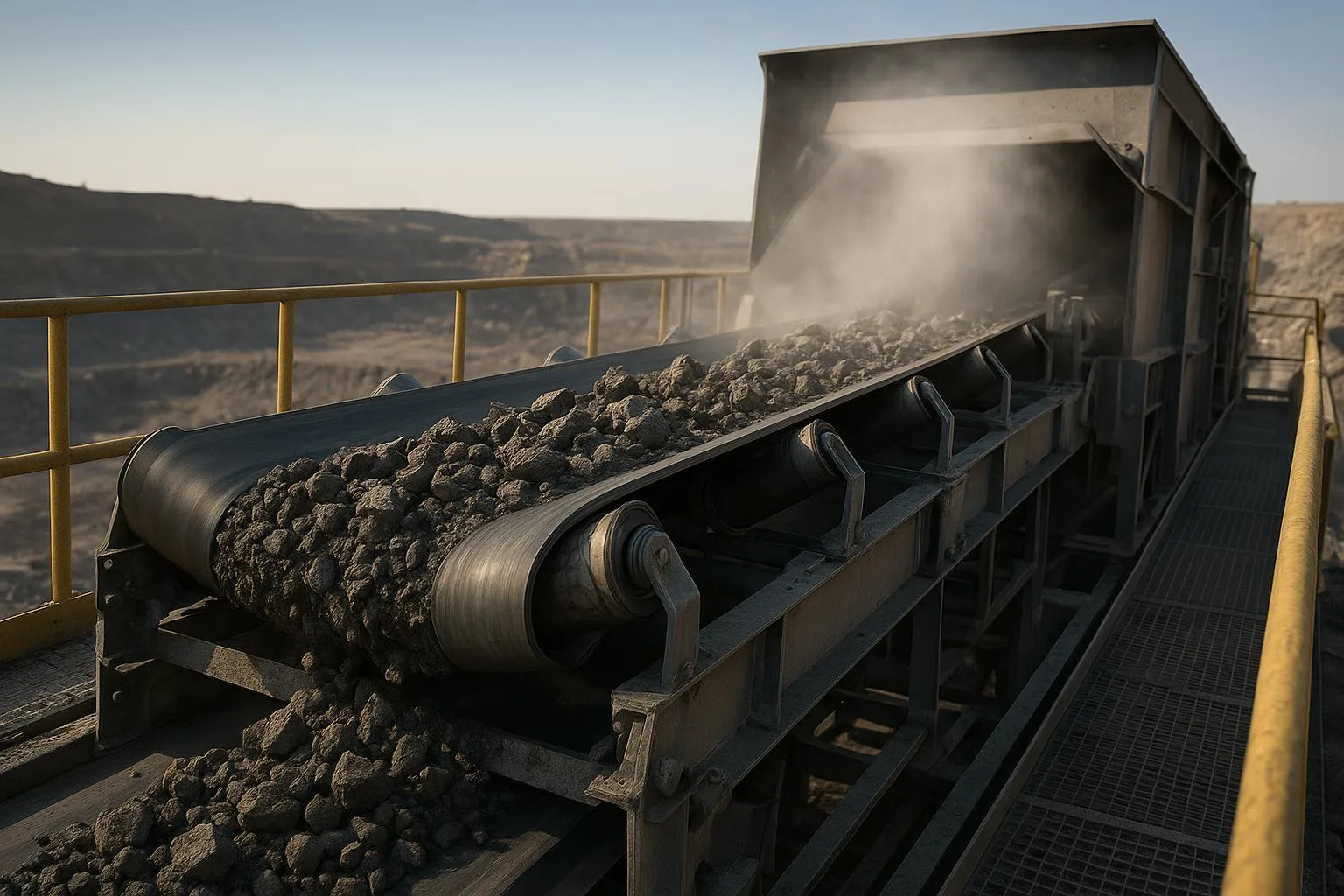
For very long runs, steel‑cord belts, conservative idler spacing/sag targets, and rigorous splice QA (per ISO 15236 practices) are typical engineering choices.
-
Commissioning discipline—tensioning, splice QA/QC, and curve alignment checks—often determines early uptime more than any single component spec.
Project overview and verified facts
Multiple sources characterize the Dune Express as a historic 42‑mile, fully electric overland conveyor routing proppant from Atlas Energy’s Kermit complex in Texas into New Mexico for the Delaware Basin. Atlas announced commissioning on October 10, 2024, and its first commercial delivery on January 13, 2025. Trade coverage and vendor releases describe four conveyor flights, with the longest single flight around 16.3–16.4 miles. Contractor information lists a design capacity near 1,905 tph and drive packages on the long segments in the multi‑hundred‑kilowatt range.
-
Commissioning and first delivery: Atlas Energy Solutions reported commissioning in October 2024 and first commercial delivery in January 2025. See Atlas Energy’s announcements: the commissioning note (2024‑10‑10) and the first delivery (2025‑01‑13) in its investor relations newsroom: Atlas announced commissioning of the Dune Express (2024) and first commercial delivery via the conveyor (2025).
-
System extent and purpose: Coverage by PowerTransmission.com frames a fully electric 42‑mile conveyor from Kermit, TX into New Mexico, built to reduce truck miles and improve logistics safety and reliability in the basin: PowerTransmission.com overview of the 42‑mile system. PBOG Magazine likewise reports the multi‑flight layout and long single‑flight span: PBOG report on the four flights and route.
-
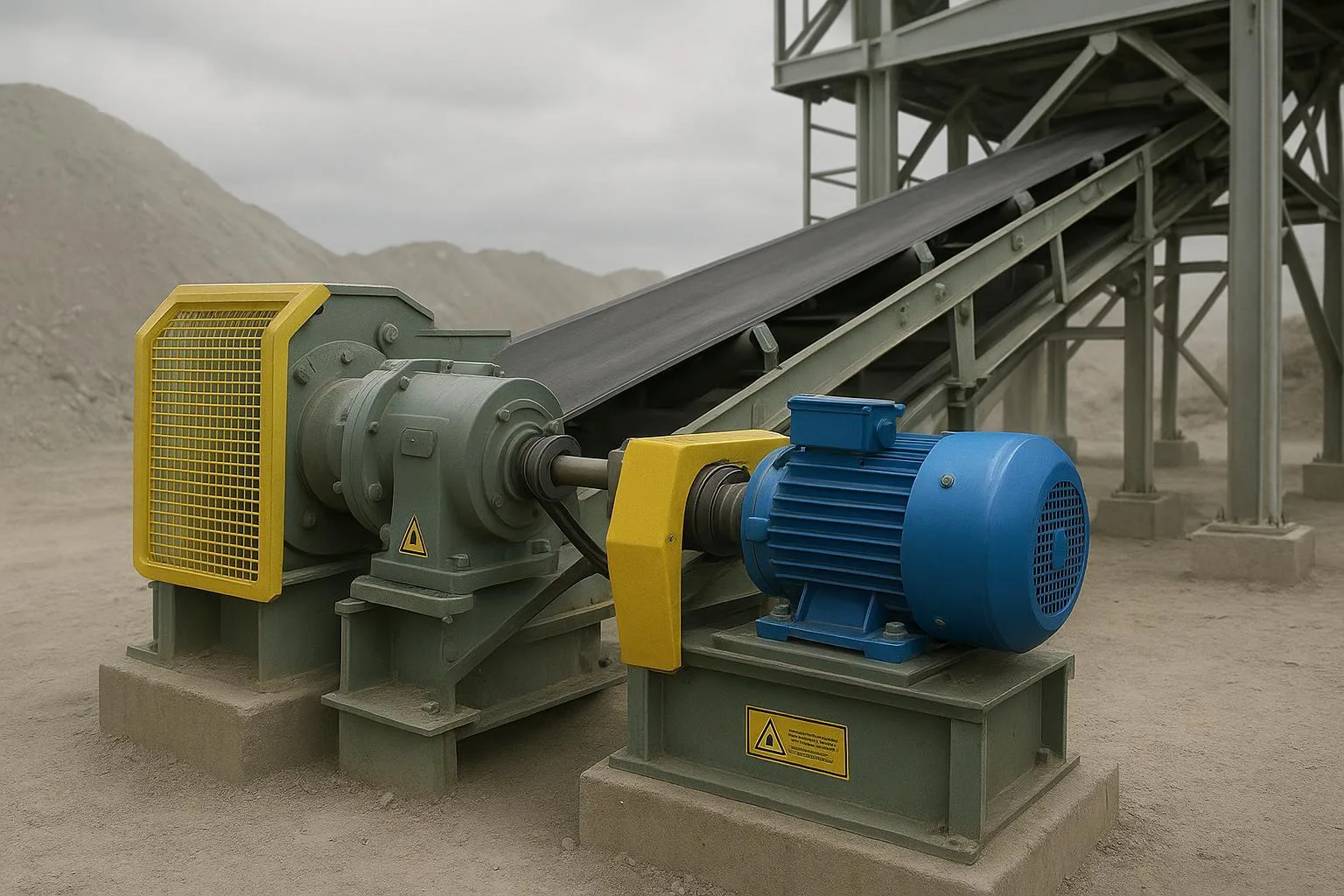
Drives and acceleration strategy: A vendor release describes fill‑control fluid coupling drives (Voith TurboBelt TPXL) powering three of the four conveyors, with a controlled ~10‑minute acceleration profile to maintain belt tensions over long curves and a longest single flight near 16.3 miles: Voith drive packages for the project.
-
Capacity and drive ratings (contractor source): The engineering/contractor page lists a design capacity of approximately 1,905 tph and example drive groupings (e.g., 5 × 671 kW on a long segment; 2 × 225 kW on a shorter segment): CDI/CVDyn project data.
Table — At‑a‑glance (system vs single‑flight)
| Attribute | Dune Express (reported) |
|---|---|
| Overall system length | ≈ 42 miles (multi‑flight) |
| Longest single flight | ≈ 16.3–16.4 miles (vendor/trade sources) |
| Commissioning | Announced Oct 10, 2024 (Atlas IR) |
| First commercial delivery | Announced Jan 13, 2025 (Atlas IR) |
| Design capacity (illustrative) | ~1,905 tph (contractor page) |
| Drives/controls (examples) | Fill‑control fluid couplings; multi‑drive load sharing (vendor) |
Note on precision: Wherever third‑party or vendor information is used (e.g., acceleration duration, drive counts), this guide cites and attributes it accordingly.
Core technical concepts (plain‑language, standards‑anchored)
Belt types and splicing
-
Steel‑cord versus fabric (EP/NN): Very long, high‑tension overland conveyors typically use steel‑cord belts for low elongation, high splice efficiency, and smaller steady‑state take‑up travel. Fabric belts per ISO 14890 suit many plant conveyors but can require larger pulley diameters and longer take‑up travel on very long flights, which raises capital and footprint. Steel‑cord belts are specified under ISO 15236 (performance and constructional requirements). See catalogue entries for ISO 14890 textile belts and ISO 15236 steel‑cord belts.
-
Splice quality: Steel‑cord splices demand controlled curing parameters, careful cord alignment, and inspection. While ISO 15236‑3 addresses safety for underground installations, its terminology and performance framing are useful for QA language. Splice efficiency assumptions feed directly into tension calculations and overland conveyor power calculation steps.
Idlers, pulleys, and sag
-
CEMA classes: Idlers are commonly discussed in CEMA classes B–F (increasing duty). For long overland conveyors, engineers target low seal drag and proper bearing L10 life while achieving a sag target that balances capital (more idlers) against power. Public CEMA materials highlight the significance of indentation rolling resistance and seal drag in long‑distance designs: see CEMA’s public errata/notes on overland tension and idler considerations: CEMA overland tension/change pages and CEMA errata summary (7th Ed.).
-
Pulley diameter: Minimum pulley diameters relate to carcass construction and splice type; steel‑cord belts often allow larger tensions at practical diameters compared to EP fabric belts, but each selection must follow the belt maker’s tables and ISO/CEMA guidance.
Take‑up and curves
-
Take‑up schemes: Long flights commonly use vertical take‑up towers for stable tension control or horizontal loop take‑ups when space permits. Take‑up travel must accommodate start‑up elastic stretch and temperature swings; longer travel helps maintain consistent tensions during long ramps.
-
Curves: Horizontal curves reduce civil works but require careful tension control and low lateral drift; long acceleration ramps (minutes, not seconds) and coordinated drive control help maintain stability through curves. Convex/concave vertical curves must stay within safe belt lift and edge tension limits per calculation frameworks.
Controls and communication
- Emergency pull‑cords, interlocks, drift switches, and fiber‑optic communications typically run the right‑of‑way. For long flights, distributed control with synchronized drive torque is essential; acceleration and stopping profiles are engineered to manage tensions and prevent slippage.
Drives, power, and controls (with a neutral comparison)
Power and tension calculations for long overland conveyors typically follow DIN 22101 or ISO 5048 (legacy) frameworks, with CEMA’s “Belt Conveyors for Bulk Materials” providing practical design guidance on resistances and components. See ISO 5048 scope for definitions of operating power and belt tensile forces.
Table — Drive topology comparison (vendor‑neutral)
| Aspect | Fixed‑speed motor + fill‑control fluid coupling | VFD‑driven motor/gearbox |
|---|---|---|
| Start/acceleration control | Smooth, repeatable ramps via fill control; proven on long flights | Highly controllable torque/speed profiles; precise load sharing |
| Efficiency at part load | Typically good; coupling losses present | Often higher; consider harmonic filters/line impacts |
| Complexity & spares | Fewer power electronics; mechanical coupling maintenance | Power electronics, cooling, and drive cabinets add complexity |
| Long‑ramp capability | Demonstrated multi‑minute ramps on curved flights (e.g., ~10 min as vendor‑reported) | Long ramps achievable; tuning and thermal management required |
| Regenerative braking | Not typical | Possible on downhill segments (project‑dependent) |
| Harmonics / grid | Minimal harmonics | Requires mitigation/filtering per utility standards |
Case note: A vendor reports supplying fill‑control fluid coupling packages and low‑noise motors for three of the four Dune Express conveyors, engineered with a ~10‑minute acceleration profile to maintain belt tensions over long curves—see Voith’s press information. Treat this as an example, not an endorsement.
Engineering design considerations for long flights
Order‑of‑magnitude method (illustrative only)
-
Framework: Use DIN 22101 or ISO 5048 to assemble main resistances (idler rolling, indentation, belt flexure), secondary resistances (skirt seals, cleaners, pulleys), and slope components. Convert to required drive power at the head considering service factors.
-
Assumptions (example): 1,800–2,000 tph frac sand; 1,600–1,800 kg/m³ bulk density in chute regions; target belt speed around 4–5 m/s; trough angle 35–45°; sag target ~1–2% on carry side; ambient 40+ °C. With overland idler spacing optimized and high‑efficiency idlers, total power can reach into multi‑MW territory on 10–25 km segments—consistent in magnitude with contractor‑listed drive groups near 5 × 671 kW on a long segment (source: CVDyn project page).
-
Take‑up travel: For steel‑cord belts with low elastic stretch, travel on the order of meters per kilometer of belt may be required to accommodate start‑up and thermal effects; long acceleration ramps reduce peak tension swings, easing take‑up travel demands.
-
Curves and wind: Desert crosswinds and dune migration argue for conservative lateral drift allowances, covered or semi‑covered galleries in exposed sections, and routine cleanup plans for sand ingress on a frac sand conveyor system.
Think of it this way: a 16‑mile single flight is a miniature railway—the belt is your track and train at once. Everything from idler spacing to start‑up ramp rate determines whether that “train” stays seated in the trough through curves and gusts.
Practical applications and use cases
While the Dune Express serves frac sand logistics in the Permian Basin, the underlying engineering applies to mining overlands, cement plant quarries, and coastal/port conveyors moving aggregates or coal. Where access roads are constrained or communities are nearby, overland conveyors offer consistent, electrically powered throughput with reduced truck exposure and predictable OPEX. For a sector view of typical deployments across heavy‑duty industries, see the industries overview on BisonConvey’s industries page.
Selection and implementation guidelines (procurement signals)
Component selection
-
Belt carcass: For 10+ km flights at high tensions, steel‑cord belts are the typical baseline due to low elongation and splice efficiency, specified under ISO 15236. Fabric belts per ISO 14890 may still be optimal for shorter or lower‑tension interconnects.
-
Pulleys & diameters: Choose diameters per carcass and splice type; verify transition lengths for trough‑to‑flat at drives and take‑ups.
-
Idlers & spacing: Select CEMA class based on load and desired L10 bearing life. Optimize spacing for target sag while minimizing indentation and seal‑drag losses (CEMA idler selection exercises can quantify trade‑offs).
-
Drives & controls: Decide between fixed‑speed with fluid couplings or VFDs based on grid constraints, harmonics, ramp requirements, and maintenance preferences.
-
Safety & monitoring: Include rip detection (steel‑cord), cord scans or NDT on splices, misalignment switches, and pull‑cords along the ROW.
Illustrative supplier example
- Many teams maintain shortlists of component suppliers to accelerate design‑build timelines. For instance, a procurement lead might request steel‑cord belt samples, CEMA‑rated idlers, and drive pulleys with documented QA from a supplier like BisonConvey while running early calculations with internal tools.
Helpful tools
- During option screening, quick‑check calculators can sanity‑check capacity, speed, length, and tension assumptions before detailed modeling. Example resources include a capacity calculator, a speed estimator, a length estimator, and a belt tension estimator that align with CEMA/DIN terminology; see the conveyor belt capacity calculator and the conveyor belt tension calculator for starting points.
QA/QC focus
-
Splices: Enforce a written procedure with environmental controls, curing logs, and witness points. Inspect visually (step, offset, voids) and by NDT/cord scan (steel‑cord). Document “conveyor belt splicing best practices” as a controlled procedure.
-
Idlers: Pre‑qualify bearing and seal designs for low drag; verify balance and runout.
-
Alignment: Survey curves; verify offsets against design through clothoids and transitions.
Commissioning checklist and start‑up strategy
Pre‑power checks: Verify civil/structural clearances, chute liners, belt cleaners, skirting, and guards. Confirm idler rotations by hand in critical curves; measure runout and fix any binding.
Splice QA validation: Review splice logs (time‑temp‑pressure for vulcanized joints), witness NDT/cord‑scan results, and mark splice IDs on a belt map for future inspections.
Static tensioning: Tension the belt to the calculated cold setpoint allowing for the planned hot operating elongation. Confirm take‑up travel reserve for both thermal and start‑up transients.
Dynamic tests: Execute inching and low‑speed tests to validate tracking through curves and over transitions. Confirm pull‑cords, e‑stops, and interlocks.
Acceleration profile: Ramp from zero to operating speed over the engineered interval (often minutes). A long ramp reduces transient tensions and lateral drift on curves; vendor materials for the Dune Express cite ~10 minutes as an example of such a profile (see Voith link above).
Performance run: Verify throughput, power draw, and temperature rise in bearings/gearboxes. Inspect cleaners for carryback and adjust. Plan periodic overland conveyor power calculation spot‑checks to correlate measured power with model updates.
Common problems and troubleshooting
-
Tracking drift on curved sections
- Actions: Confirm take‑up setpoint and ramp profile; check alignment across curve transitions; correct asymmetric loading at chutes; verify idler troughing angles and offsets.
-
Splice anomalies (hot joints)
- Actions: Review cure logs; inspect for steps/offsets/voids; conduct NDT/cord scan on steel‑cord splices; if needed, cut out and resplice with improved environmental controls.
-
Idler/bearing failures and high drag
- Actions: Sample failed bearings; check seal design and contamination; tighten housekeeping to limit sand ingress; revisit spacing/sag targets if carry‑side vibration is evident.
-
Carryback and dust at transfer points
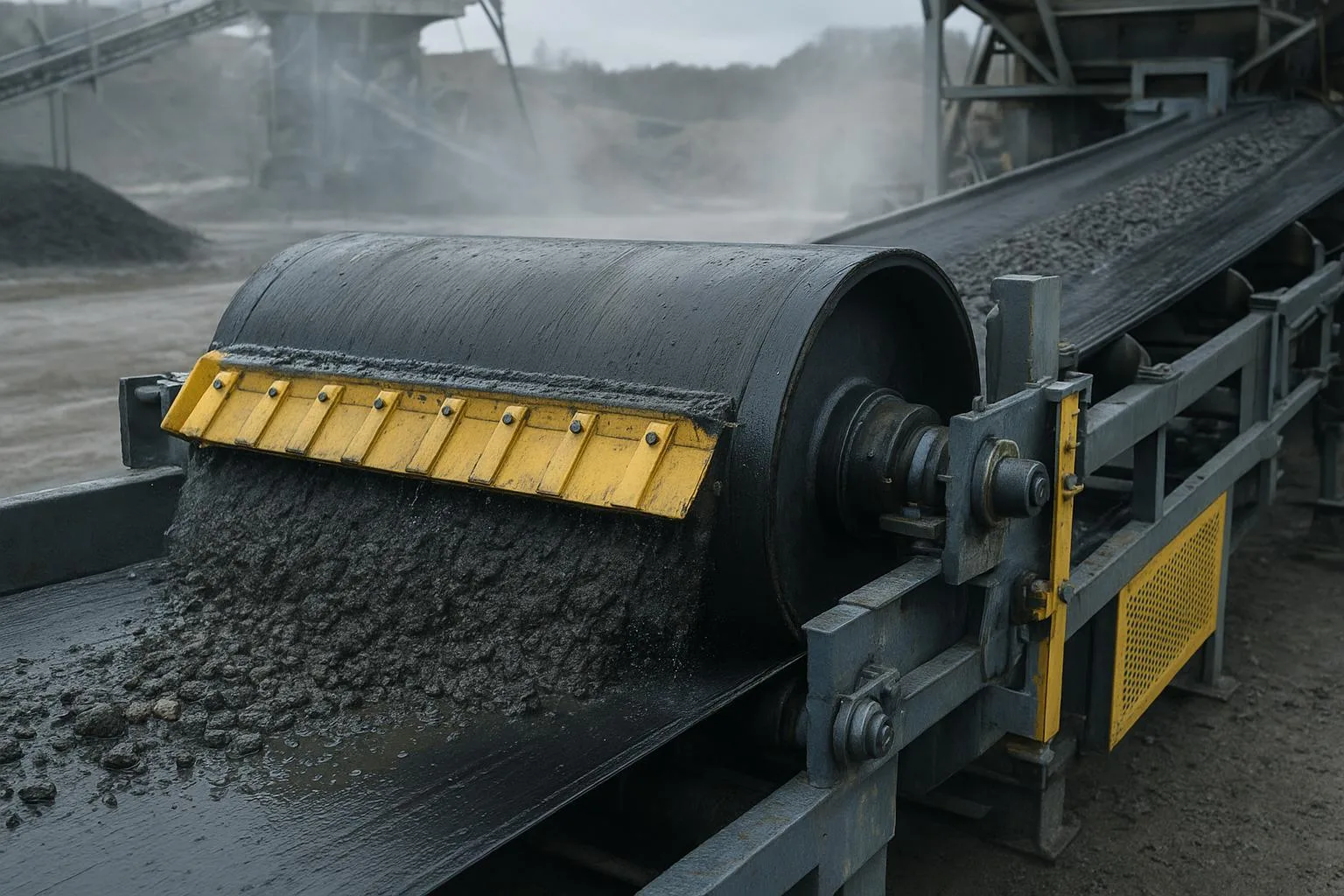
- Actions: Optimize primary/secondary cleaners; add spray bars if materials allow; re‑line or re‑angle chutes to respect the material’s surcharge angle (see a plain‑language definition of angle of repose in this glossary entry: angle of repose).
Best practices and maintenance schedule
-
Weekly: Walk the line segments with curves; listen for bearing noise, feel for hot housings, and note mistracking. Inspect cleaners and skirting for wear.
-
Monthly: Sample idler drag on a representative set; record power draw vs tonnage; perform splice visual audits and check take‑up position against seasonal norms.
-
Quarterly: Conduct cord scans (steel‑cord), check pulley lagging wear and runoff, verify e‑stop/pull‑cord continuity; re‑survey critical curves if ground has settled.
-
Annually: Review idler class/spacing vs actual sag and power losses; refresh risk assessment for wind events and dune migration; rebuild drive components per OEM MTBF guidance.
Pro tip: Hot environments warrant conservative grease selection and derates for bearings and electronics; a few degrees of margin in cabinet cooling often pays for itself in uptime.
ROI and alternatives (context for decision‑makers)
Overland conveyors shine where right‑of‑way can be secured and continuous flow beats batch haulage. Compared with trucking, conveyors trade driver exposure and variable fuel for fixed electrical energy and mechanical upkeep. Where rail exists, rail can offer regional reach but at higher permitting and CAPEX thresholds. The Dune Express illustrates the conveyor option when material flow is consistent, distance is large, and operators value fewer truck miles on public roads. According to Atlas’s commissioning and delivery announcements, the project’s stated purpose was to reduce truck traffic and streamline basin logistics—see the commissioning and first‑delivery notes in Atlas IR linked above.
Conclusion and next steps
The Dune Express—widely reported as the longest conveyor belt system in the US—demonstrates how disciplined design (steel‑cord belts, conservative sag/spacing, long acceleration ramps, and rigorous splice QA) turns extreme length and curves into reliable daily throughput. If you’re evaluating an overland conveyor, start with standards‑anchored calculations, define your sag and take‑up targets early, and plan commissioning as rigorously as design.
Looking for components or planning support? The engineering team at BisonConvey supplies belts, idlers, pulleys, and related components with documentation suited for long‑distance applications. Explore the catalog and reach out for custom configurations on the Products overview. If you’re in early scoping, quick‑check your assumptions using in‑house tools (capacity, speed, length, tension) before detailed modeling.
References and standards mentioned (inline links above)
-
Atlas Energy Solutions investor relations newsroom (commissioning 2024; first delivery 2025) — commissioning and status updates.
-
PowerTransmission.com coverage of the 42‑mile system — system extent and electric architecture context.
-
PBOG magazine articles — route description and single‑flight context.
-
Voith press information — example of fill‑control fluid coupling drives and long acceleration profile.
-
CDI/CVDyn project page — contractor data on capacity and drives.
-
Standards: CEMA Belt Conveyors for Bulk Materials (public errata/notes), ISO 5048, DIN 22101 (catalogue references), ISO 14890 (textile belts), ISO 15236 (steel‑cord belts), ISO 340/284 (safety characteristics).