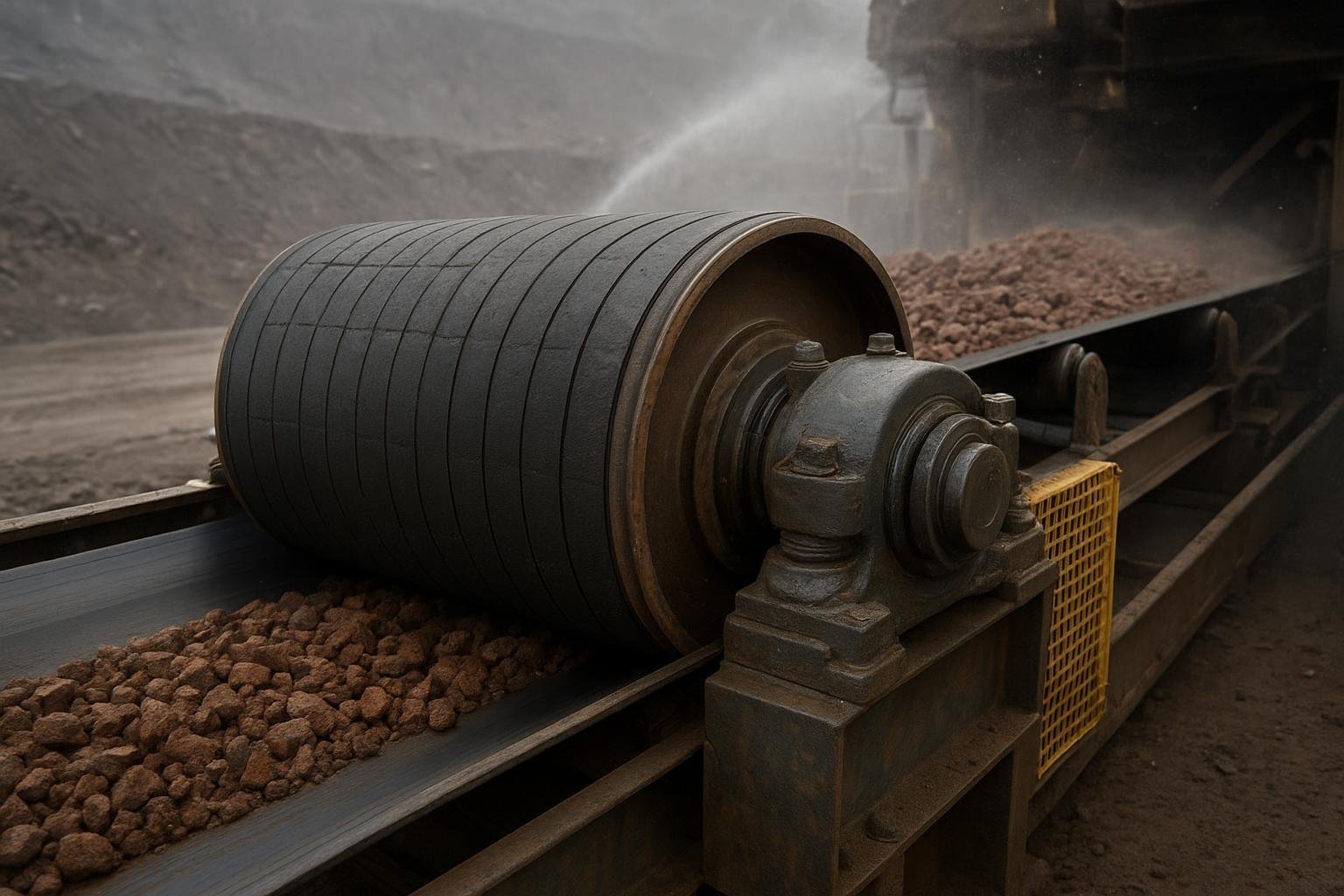
If a pulley fails, the whole conveyor becomes an expensive sculpture. Long life isn’t luck; it’s the outcome of good engineering choices made early—materials, shaft sizing, bearings, seals, lagging, balancing—and protected by sound installation and inspection habits. This guide focuses on practical decisions you can put in a specification or maintenance plan to stretch mean time between failures and protect uptime.
What “long life” really means on a conveyor pulley
“Long life” isn’t just a big safety factor. It’s a system outcome:
- The shell and hubs resist fatigue cracking and corrosion.
- The shaft stays within stress and deflection limits so bearings remain aligned.
- Bearings meet their target life, with lubrication and seals preventing contamination.
- Lagging maintains traction without premature wear or debonding.
- The drum runs true—balanced, minimal runout, and comfortably below critical speed.
- Installation and inspection keep everything within tolerance over time.
Think of it this way: a pulley is a rotating beam with press-fit components, running in an abrasive, vibrating environment. Small deviations—0.1–0.2 mm extra runout, a few mils of misalignment, a loose foundation—compound into heat, vibration, slip, and bearing load spikes. Good specs keep those deviations small and stable throughout service.
Materials and construction that survive abrasion and corrosion
Start with service environment:
- Abrasive dry ore or clinker: prioritize wear resistance at the shell and lagging bond line. Carbon steel shells (e.g., common structural grades) with adequate wall thickness are typical; consider quenched-and-tempered plate for impact zones or high-tension drives.
- Wet or corrosive media (fertilizer, salts, coastal ports): upgrade coatings and hardware. Specify a robust paint system suitable for harsh atmospheres or galvanizing where appropriate. Stainless fasteners or housings can make sense at splash zones.
- Shafts: medium-carbon or low-alloy steel with appropriate heat treatment for strength and toughness. Avoid stress concentrators at shoulders and keyways; use generous fillets and surface finishes that support fatigue life.
For hubs and end-discs, prioritize concentricity and weld quality. Interference fits that transmit torque without fretting, coupled with qualified weld procedures and non-destructive examination (NDE) on critical joints, go a long way toward fatigue resistance.
Shell, hub, and weld details that prevent fatigue
Fatigue failures often initiate at geometric discontinuities and weld toes. To reduce risk:
- Match shell thickness to diameter, belt tension, and loading; thin shells on large diameters are crack-prone.
- Use end-disc geometries that distribute stress and support the shell evenly.
- Qualify welding procedures (WPS/PQR) for the plate grade; specify controlled heat input and, if applicable, stress-relief for thick sections.
- Inspect circumferential and radial welds using appropriate NDE (e.g., UT/MT) to acceptance criteria aligned with service criticality.
- Ensure hub bores and shaft fits are within tolerance; excessive clearance or poor surface finish invites micro-movement and fretting.
Pulley shaft sizing and deflection—quick sanity check
Shafts don’t just need strength; they need stiffness. Excess deflection misaligns bearings and degrades seals.
Worked example (conceptual):
- A drive pulley sees a resultant belt tension across the face; the shaft spans between bearings just outside the drum.
- Choose a trial shaft diameter in a common alloy steel.
- Check bending stress using standard beam formulas for the span and load. Target an allowable stress with fatigue margin suitable for rotating shafts.
- Check deflection at midspan and at the bearing seats. A conservative sanity check keeps shaft deflection small enough to maintain bearing alignment and seal integrity (engineers commonly aim for tight deflection control on conveyor pulleys to avoid seal wear and edge loading).
- If stress or deflection is high, increase diameter, shorten the span (move bearings inboard via different housing or drum design), or upgrade material and heat treatment.
Practical tip: Don’t ignore keyway effects and shoulder fillets—use reliefs and radii that reduce notch sensitivity, and consider locking elements or shrink-disc connections to avoid deep keys in high-torque drives.
Bearings, housings, and the bearing life concept (L10)
Spherical roller bearings are common on pulleys because they tolerate some misalignment and high radial loads. To target long life:
- Size bearings from the equivalent dynamic load and desired reliability life target, using standard rating life methods (often referred to as L10/L10m concepts in rolling bearing practice).
- Adjust selection for speed, temperature, and contamination. Dust and moisture can dramatically reduce practical life if seals and relubrication aren’t specified well.
- Choose housings that allow precise alignment and robust sealing. If relubrication is planned, make sure grease paths are direct and purge-friendly.
Mini worked example (conceptual):
- Estimate the equivalent dynamic load on each bearing from belt tensions and wrap geometry.
- Select a candidate spherical roller bearing series.
- Compare the load to catalog dynamic capacity and iterate until the calculated life meets your target at operating speed.
- Apply contamination or reliability adjustments as per manufacturer guidance and re-check.
Don’t overlook housing base flatness and bolt preload—soft-foot or loose hold-downs will cut bearing life fast.
Keep contamination out: seals and guards that actually work
In abrasive, wet service, ingress control makes or breaks bearing life.
- Favor multi-stage labyrinth or heavy-duty “taconite-style” seal arrangements at the housing. Designs that allow grease purging through the labyrinth help keep fines out.
- Add external flingers or V-rings where splash is severe.
- Use proper contact guards to keep slurry and spillage away from the seal line; align spray bars and dust suppression so they don’t drench housings.
- Specify relubrication intervals that reflect contamination and temperature, not just hours—grease is a barrier as well as a lubricant.
Lagging choices that cut slip and wear in real life
Lagging protects the shell and controls traction.
- Rubber lagging (various compounds, profiles) suits general dry service; thickness is chosen for wear life and traction needs.
- Ceramic lagging shines when it’s wet, muddy, or when high drive traction is needed. The embedded tiles increase friction and reduce slip. It often pays back through reduced belt wear and fewer cleanup stoppages in sticky ores.
- Polyurethane lagging can help when cut resistance and certain chemical exposures matter.
- Bonding method matters: hot-vulcanized bonds are most durable for heavy-duty service; cold-bonded systems are viable for certain maintenance scenarios when downtime is limited.
Scenario example: For a wet, abrasive iron ore drive pulley with periodic mud carryback, many sites specify a ceramic-tile lagging on the drive, with rubber on non-drive pulleys. The result is better traction in the wet and improved wear life versus all-rubber in the same duty.
Balancing, runout, and critical speed—quiet rotors live longer
Even moderate imbalance or eccentricity amplifies bearing loads and accelerates wear.
- Require both static and dynamic balance on larger or higher-speed pulleys. Select an appropriate balance quality grade for the operating speed and diameter so vibration stays low.
- Control total indicated runout (TIR) of the shell and lagging; specify measurement and acceptance at ambient, post-lagging.
- Verify journal concentricity and parallelism; poor fits can make a well-balanced drum behave badly.
- Check operating speed is well below the first critical speed of the shaft-drum system; maintain a comfortable separation margin to avoid resonance.
Installation that preserves life
Use this short checklist during install and commissioning:
- Verify base flatness and grout/support stiffness; shim to remove soft-foot.
- Align housings precisely; measure and record with a repeatable method.
- Torque all fasteners to spec, including hub/locking elements; witness-mark critical bolts.
- Set belt tracking hardware neutral before first run; bring into alignment methodically.
- Grease bearings with the correct quantity and grade; purge labyrinth paths if designed for it.
- Spin test and record initial vibration and temperature at each housing as a baseline.
Inspection that predicts failures before they happen
Routine checks catch trend shifts early. A concise checklist:
- Measure shell and lagging TIR on planned outages; log any growth.
- Trend vibration at bearing housings; watch for rising velocity/acceleration or a step-change after maintenance.
- Temperature trend each housing; a gradual rise often indicates lubrication or alignment drift.
- Inspect seals for purge function and damage; re-establish grease barriers when contaminated.
- Check lagging for cracks or debonding, especially near splice impacts and loading points.
- Re-check hold-down torques on foundations and housings at scheduled intervals.
Troubleshooting: symptoms you’ll see first and what to check
| Symptom | Likely cause | First checks and corrective actions |
|---|---|---|
| Repeating vibration “hum” at speed | Imbalance or runout; approaching critical speed | Measure TIR; confirm balance certification; verify speed margin below first critical; check buildup on lagging |
| Hot bearing cap | Misalignment, over/under-greasing, contamination | Re-align housings; verify grease type/quantity; inspect seals and purge; inspect base for soft-foot |
| Belt slip in wet conditions | Low traction from lagging, inadequate wrap/tension | Upgrade to ceramic lagging on drive; verify take-up and wrap angle; check water sprays and carryback management |
| Grease leaking past seals with dust ingress | Single-stage sealing overwhelmed | Upgrade to multi-stage labyrinth/taconite-style seals; add flingers; adjust purge intervals |
| Cracks at shell/end-disc welds | High local stress, thin wall, poor weld quality | Review shell thickness; improve weld procedure and NDE; check hub fit and torque path |
Short, neutral example spec (where a BisonConvey pulley fits)
A coastal iron ore conveyor (wet, abrasive, saline air) plans a drive pulley refresh. A long-life, practical spec could read:
- Shell: heavy-wall carbon steel with corrosion-resistant coating suited to marine atmospheres; qualified circumferential welds with NDE.
- Shaft: alloy steel sized for low deflection and fatigue margin; generous fillets and surface finish at shoulders; locking element to avoid deep keyway.
- Bearings and housings: spherical roller bearings in robust plummer blocks; precise base machining; relubrication paths accessible.
- Sealing: multi-stage labyrinth (taconite-style) with grease purge capability; external flingers to limit splash.
- Lagging: ceramic-tile on drive for wet traction; rubber on return/tail as appropriate.
- Balance and runout: static and dynamic balance with tight TIR acceptance post-lagging.
For procurement, this maps to common heavy-duty offerings. For instance, a BisonConvey drive pulley configured with ceramic lagging, alloy shaft, spherical roller housings, and heavy-duty labyrinth seals would align with these requirements while keeping a neutral, standards-based footprint in the plant. If you need application-driven sizing or a formal quote, see BisonConvey’s site: BisonConvey.
Wrap-up: bake longevity into your next spec
Conveyor pulley selection for long life is about controlling the small things that compound into failure: shell and weld integrity, shaft stiffness, bearing life and sealing, traction from lagging, and quiet, balanced rotation—then preserving those choices with careful installation and inspection. Get these right, and you’ll turn a chronic maintenance item into background reliability.
Looking for help translating your duty conditions into a pulley spec? Request an application-driven recommendation from BisonConvey.