Downtime on a primary conveyor doesn’t just sting—it ripples through crushing, kilns, casting, and shiploaders. If you’re sizing or replacing a belt in steel, cement, ports, power, or chemicals, the right selection is the difference between steady throughput and a maintenance fire drill. This guide distills standards-backed practices and field experience into a practical workflow you can put to work immediately.
1) Selection drivers you can’t ignore
Start with the physics and the environment, not the catalog.
- Material and duty: bulk density, lump size, abrasiveness, temperature, and moisture; loading impact energy at transfer points; steady versus highly variable feed.
- Geometry and speed: conveyor length, lift, troughing angle, transitions, pulleys and their diameters, drive wrap, take-up travel, and target belt speed.
- Environment and safety: heat, oils/chemicals, flame/antistatic requirements, dust, corrosion, and guarding/access constraints for operators and maintenance.
- Availability and lifecycle: splice method feasibility, downtime windows, maintainability, and total cost of ownership.
These inputs drive carcass type (textile vs. steel cord), strength rating, cover compound, pulley and idler compatibility, and splice strategy.
2) The standards lens (what governs your choices)
Conveyors live inside a safety and engineering framework. Your selections should fit inside it, not work around it.
- OSHA requires guarding of nip points and rotating parts on production and maintenance lines. For example, OSHA’s general machine guarding rule 29 CFR 1910.212 and related interpretations describe acceptable materials and configurations for fixed guards and enclosures. See OSHA’s overview in the agency’s machine-guarding page: OSHA machine guarding standards and guidance (accessed 2025).
- ASME B20.1 defines safety requirements for conveyors across design, installation, maintenance, and operation—think controls, stops, clearances, and fire provisions. A concise public summary is available via ANSI: ASME B20.1-2024 Safety Standard for Conveyors (ANSI overview).
- CEMA conventions underpin tension calculation, component classes, idler dimensions, and system design logic; the CEMA Belt Book (7th Ed.) preview outlines the approach to effective tension and resistance terms: CEMA Belt Conveyors for Bulk Materials preview.
- DIN 22101 frames belt rating and splice efficiency considerations; accessible summaries highlight how dynamic splice performance guides safety factors and tension selection: ConveyorBeltGuide on DIN context and terms.
- ISO 22721:2023 addresses textile conveyor belt construction and testing scope; designers should verify applicability for their plant context via the ISO catalogue: ISO TC 41/SC 3 conveyor belts catalogue.
Use standards to set constraints, then optimize within them.
3) Carcass first: EP/NN vs. steel cord
Choosing the carcass is a leverage point. It determines minimum pulley diameters, elongation, take-up travel, transient behavior, and splice method.
- EP/NN textile carcasses suit plant belts with moderate tensions, shorter to medium runs, tighter pulleys, and more frequent transitions. They allow greater total elongation (often in the low single digits at reference tension) and are generally more forgiving on smaller pulleys.
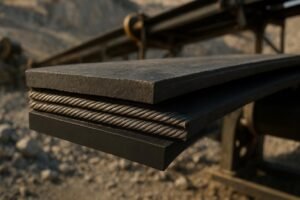
- Steel cord carcasses shine in long, high-tension runs—shiploader approaches, overland links to storage, or steep lifts—thanks to very low elongation (often around a few tenths of a percent) and excellent tension capacity. They typically require larger pulleys to limit cord flex fatigue and protect splice integrity.
Pipe conveyors amplify the contrast: public summaries note that minimum radius guidance often doubles for steel cord pipe belts versus textile. For all belt types, rely on the manufacturer’s diameter tables tied to rating and thickness. A good public primer on pipe belt geometry is here: ConveyorBeltGuide: Pipe belts notes.
Practical implication: If you’re constrained to existing small pulleys or tight transitions, textile may be mandatory unless you retrofit pulleys. If you’re battling creep and take-up travel on long runs, steel cord usually earns its keep.
4) Getting the strength right: N/mm vs. PIW, safety factors, and a quick example
Two rating languages circulate in industry, and confusing them is a classic failure mode.
- PIW (Pounds per Inch of belt Width) is commonly used in North America as an allowable working tension measure.
- N/mm is widely used globally and often denotes nominal breaking strength per millimeter of width, especially for textile belts.
A unit conversion exists—1 PIW ≈ 0.175 N/mm (and 1 N/mm ≈ 5.71 PIW)—but applying it across different definitions (working vs. breaking strength) produces errors. Context from an engineering explainer: PIW definition and caveats (GramConveyor). Also see a technical note on conversions: Converting PIW to EP ratings (Sungda note).
Think in terms of tensions and splice efficiency. Running tension should be a conservative fraction of the belt’s tested capacity, adjusted for the splice used and the duty cycle. CEMA’s methodology for effective tension helps you compute the design load; splice standards (e.g., DIN 22110-3) and manufacturer data inform realistic safety factors.
Mini-example (illustrative only):
- Calculated steady-state effective tension Te = 28 kN; design wrap and drive details yield a maximum steady running tension in the belt, T1 ≈ 56 kN for a given drive layout.
- With a 1200 mm-wide belt, the working tension per width is ~46.7 N/mm.
- If your textile belt nominal rating is EP 500/3 (500 N/mm breaking), and your splice efficiency in operation is 50–60%, an initial design factor near 8–10:1 between breaking and running tension could be reasonable for arduous service. You’d validate this against splice maker data and transients.
The point isn’t the exact number here—it’s the workflow: compute tensions per CEMA, translate to per-width stress, then choose a rating and splice with an evidence-based safety factor.
5) Cover compounds by environment
Matching the cover to heat, abrasion, oil/chemicals, and ignition risks stops premature failure.
- Abrasion: ARPM/RMA Grade I is generally associated with higher abrasion resistance than Grade II; DIN designations such as X/Y/W appear in global practice with volume-loss thresholds defined in testing standards. See accessible nomenclature overviews: ConveyorBeltGuide designation summary.
- Heat: Standard rubber compounds often tolerate up to roughly 80°C continuous; specialty mixes for clinker, sinter, or coke service can reach much higher continuous temperatures. Verify continuous vs. peak ratings in the data sheet and confirm adhesion properties.
- Oil/chemicals: MOR/G-type covers resist swelling/softening from oils or hydrocarbons—common around coke ovens, fertilizers, and some port cargoes.
- Flame-retardant/antistatic: Required in specific regulated environments and prudent where dust clouds and ignition sources exist (e.g., certain coal or biomass systems). Confirm test methods and pass/fail criteria per the applicable standard.
A compact mapping for quick screening (verify against manufacturer data before purchase):
| Operating stressor | Typical cover direction | Notes |
|---|---|---|
| High abrasion (limestone, clinker, ore) | ARPM Grade I or DIN X/W | Check abrasion volume-loss values and gouge resistance |
| Heat (clinker, sinter, hot pellets) | Heat-resistant compound (e.g., T-class) | Validate continuous vs. peak temperature and adhesion |
| Oil/chemicals (coke, fertilizers, oily seeds) | MOR/G or chemical-resistant compound | Verify swelling tests and oil type |
| Dust/ignition risk (coal/biomass) | Antistatic + flame-retardant | Confirm test standard and certification scope |
For background on terms and tests, see ConveyorBeltGuide testing and terms.
6) Pulleys, lagging, and idlers: compatibility checks
Belts don’t run in isolation. Sizing without checking hardware is a recipe for splicing failures and bearing pain.
- Pulley diameters: Textile belts generally accept smaller diameters than steel cord; snub and drive pulleys often scale larger than bend pulleys. Always verify minimum diameters from the belt supplier’s tables tied to belt thickness and rating. Committee minutes provide context on standard pulley ranges: CEMA Conveyor Pulley Committee notes (2021).
- Lagging: Ceramic lagging increases traction in wet or dusty conditions; rubber lagging variants manage wear and belt cover life. Match lagging to wrap angle, drive torque, and contamination.
- Idlers and spacing: CEMA 502 frames idler dimensions and classes. Heavier duties often use larger diameters and reduced spacing on the carry side to control sag and impact. Return idlers can be larger diameter to reduce rolling resistance on long runs. Public committee materials offer helpful context: CEMA Idler Committee materials (2019).
- Training and returns: Use training idlers judiciously; ensure structure alignment first. V-return or beater returns can mitigate material buildup where it’s chronic.
What’s the practical check? For your candidate belt, confirm every pulley meets the supplier’s minimum, and verify idler class/spacing keeps sag within your target at speed and load.
7) Splicing: vulcanized vs. mechanical
Vulcanized splices, correctly executed, deliver smooth transitions and high efficiency, but demand controlled conditions, time, and gear. Mechanical fasteners can be the right choice for emergency repairs, short downtime windows, or when conditions block a quality vulcanization. Capabilities for modern fasteners are broader than many assume; credible OEM documentation shows high-tension ratings with proper selection and installation. For an engineering-oriented overview, see Flexco’s guide to mechanical belt fasteners (2024) and their application notes on when to choose fasteners.
Selection tip: Decide splice method alongside the carcass and pulleys—minimum pulley diameters, belt thickness, and environment can rule in or out certain fasteners and splice patterns.
8) Sector-specific notes (heavy manufacturing)
- Steel and metallurgy: Hot pellets and sinter demand heat-resistant covers and generous pulley diameters; raw-material conveyors need abrasion resistance and robust impact zones; verify guarding and maintenance access around pickling/oiling areas.
- Cement and building materials: Clinker requires heat compounds; quarry and raw feed lines need abrasion resistance and impact beds; keep idler spacing tighter in high-impact loading and watch skirt friction.
- Ports and logistics: Long corridors favor steel cord with energy-conscious idlers and proper lagging; consider weatherproofing and MOR covers for oily cargo exposure; enhance guarding adjacent to public walkways.
- Power generation (coal/biomass): Antistatic and flame-retardant covers, dust management, and clear emergency stops; confirm inspection access along galleries.
- Chemicals and fertilizers: MOR/chemical-resistant covers, stainless or coated idlers where corrosion is severe, and attention to sealed bearings and housings.
9) A practical, auditable selection workflow
Here’s a short, repeatable process you can use to defend your choice.
- Collect design and operating data: material properties, throughput, speed, geometry, environment, maintenance windows, and existing pulley diameters and idler classes.
- Calculate tensions per CEMA: include idler resistance, skirtboard drag, lift, and acceleration. Determine running and transient tensions and convert to per-width stress.
- Choose carcass type: check pulley diameters, take-up travel constraints, and elongation needs; shortlist textile vs. steel cord accordingly.
- Select strength rating and splice: apply evidence-based safety factors informed by splice efficiency; pair with a splice type feasible for your downtime reality.
- Map cover compound to environment: abrasion, heat, oil/chemicals, flame/antistatic; validate continuous vs. peak temperatures and any certification requirements.
- Verify component compatibility: confirm minimum pulley diameters, lagging, idler classes/spacing, and sag targets; adjust where constraints clash.
- Document compliance: note the OSHA guarding approach, ASME B20.1 considerations, and the standards/data that justify your choices.
A neutral example for context—Disclosure: BisonConvey is our product. In a cement plant clinker conveyor with 1200 mm width, 2.5 m/s speed, and frequent hot material surges, engineers might shortlist a textile EP belt with a heat-resistant cover when existing pulleys are small, or move to steel cord if take-up travel and drift control dominate. The deciding factors become minimum pulley diameter from the supplier’s table, splice downtime feasibility, and verified continuous/peak temperature ratings. The same decision process applies with any reputable supplier; what matters is that each step is evidence-backed and recorded.
10) Common pitfalls and a short checklist
- Converting PIW to N/mm (or back) without aligning working vs. breaking definitions and safety factors.
- Selecting a steel cord belt but keeping legacy small pulleys, causing splice and cord fatigue.
- Ignoring heat or oil exposure when choosing a “general-purpose” cover.
- Overlooking OSHA-compliant guarding and safe access in the physical layout.
- Treating splice choice as an afterthought rather than a design parameter.
Quick check before you cut a PO: Do my pulley diameters and idler spacing meet the belt maker’s tables? Are my tension and safety factors documented to a known standard? Have I matched the cover to the real environment, including peaks? And have I planned the splice work against my downtime realities?
If you’d like a second set of eyes on specs or a sanity check against standards, involve your belt and component suppliers early and ask them to show their math and certifications. Standards references used here include OSHA’s machine-guarding rules, the ASME B20.1 overview, CEMA’s Belt Book preview, DIN context via ConveyorBeltGuide, ISO’s catalogue for conveyor belt standards, idler context from CEMA committee materials, and splice capabilities summarized in Flexco’s fastener guide.