If your goal is longer uptime, safer operation, and lower power bills, picking the right belt isn’t about brand slogans—it’s about specs. Use this checklist of conveyor belt selection criteria to match belt design to duty, environment, and your plant’s reliability targets.
How to use these conveyor belt selection criteria
Scan each feature, then map it to your application: material (abrasiveness, oil/chemicals, temperature), duty (TPH, belt length and lift, drop height, lump size), and regulatory context (FR, antistatic, food, grain). Validate with standards and supplier datasheets, keep US customary and SI conversions side by side, and capture decisions on a spec sheet before RFQ.
The checklist — 15 features that determine belt fit and life
-
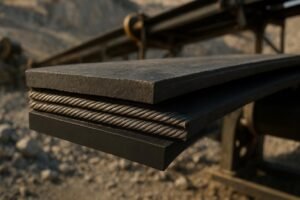
Carcass type and tensile rating — What it is: the reinforcement (EP/NN fabric, steel cord, or straight‑warp) and strength per width. Why it matters: sets allowable tension, elongation, impact behavior, and splice choices. How to evaluate: convert PIW↔N/mm and size against your required rated tension with an appropriate safety factor; see the guidance on belt tension ratings and PIW-to-N/mm concepts in the Martin Engineering Foundations knowledge center. Typical ranges: fabric belts ~220–800 PIW (≈40–140 N/mm); steel cord ST800–ST3150. Pitfalls: covers don’t add tensile strength; undersized belts inflate stretch and splice stress. Note: BisonConvey supplies EP/NN and steel‑cord belts alongside compatible idlers and pulleys for system-level fit—BisonConvey. Disclosure: BisonConvey is our product.
-
Cover compound and abrasion grade (DIN/ISO) — What it is: the top/bottom rubber compound and its abrasion performance. Why it matters: wear rate, cut/gouge resistance, and life in abrasive duties. How to evaluate: check abrasion loss (ISO 4649/DIN 53516) and map to DIN 22102/EN ISO 14890 grade expectations; see the DIN grade overview and example values in the Fenner Dunlop product range technical reference. Typical references: DIN Y ≈150 mm³, W ≈90 mm³, X ≈120 mm³; vendor specs may exceed minimums. Pitfalls: “meets standard” can still vary widely—verify test method and achieved numbers.
-
Temperature resistance (continuous vs peak) — What it is: compound’s heat tolerance over time and during spikes. Why it matters: prevents hardening, cracking, and delamination. How to evaluate: use ISO 4195 heat aging classes and vendor compound specs; example ranges and classes are explained in this Fenner Dunlop heat‑resistance standards overview. Typical ranges: EPDM/EPM compounds can sustain very high continuous temperatures when properly engineered; SBR heat grades are lower; NBR oil‑resistant typically supports moderate heat. Pitfalls: combined properties (oil + FR) can trade off heat or abrasion—check actual data.
-
Flame resistance and antistatic (EN ISO 340, EN 12882, MSHA Part 14; ISO 284) — What it is: limits to flame propagation and static build‑up. Why it matters: essential in combustible dust areas and underground mines. How to evaluate: verify the achieved EN 12882 class (which integrates EN ISO 340 flame tests) and antistatic compliance to ISO 284; for US underground applications, confirm MSHA Part 14 approval. A concise explainer of EN classes and test scope is available in this Dunlop overview of fire‑resistant standards and test methods. Typical notes: above‑ground belts often target 2A/2B classes; ATEX zones require antistatic; underground coal requires MSHA Part 14. Pitfalls: don’t rely on “FR tested” without the specific class or approval ID.
-
Oil and chemical resistance — What it is: resistance to swelling and softening from oils, fats, and chemicals. Why it matters: oil ingress cuts abrasion resistance and stability. How to evaluate: choose compounds tailored to oil type and temperature; vendors often reference relevant ASTM test methods. A practical primer on oil‑resistant cover options is provided in the Fenner Dunlop oil‑resistant cover grade guidance. Typical notes: nitrile content and service temperature dominate performance. Pitfalls: “MOR” may be insufficient for aggressive hydrocarbons—request swelling/volume‑change data.
-
Rip and tear resistance — What it is: ability to resist longitudinal rips and impact tears. Why it matters: sharp lumps and crusher zones can cause catastrophic failures. How to evaluate: consider straight‑warp carcasses and/or breaker plies; vendor literature commonly reports significant gains over conventional plied belts in rip and impact resistance. Typical notes: benefits are application‑specific. Pitfalls: stiffer constructions may demand larger pulley diameters and longer transitions.
-
Troughability and minimum pulley diameter — What it is: belt’s ability to form a stable trough and flex over pulleys without damage. Why it matters: tracking stability and splice life. How to evaluate: use vendor charts for minimum pulley diameters by construction, thickness, and splice; mechanical splices typically require larger diameters. Typical notes: smallest 90° wrap pulley is often the limiter; wing pulleys need extra care. Pitfalls: undersized pulleys dramatically shorten belt and splice life.
-
Elongation and splice compatibility — What it is: elastic/perm stretch and splice efficiency of your joint design. Why it matters: affects take‑up travel, tracking, and joint strength. How to evaluate: compare belt elongation at 10% of rating and select splice types accordingly; finger splices on fabric belts can approach high strength retention, whereas simple step splices are lower, per vendor literature. A concise discussion of splice performance ranges is available in the Dunlop splice performance overview. Typical notes: mechanical fasteners add thickness/rigidity that raises pulley diameter requirements. Pitfalls: poor splice workmanship negates even the best belt design—plan qualified crews and controlled conditions.
-
Energy efficiency / low rolling resistance (LRR) — What it is: lower cover compounds that reduce idler rolling losses. Why it matters: sizable power savings on long overland and plant conveyors. How to evaluate: review vendor LRR labeling and test disclosures; Continental has public examples showing labeled efficiency classes and reported savings under stated conditions in this Continental energy‑efficiency label announcement. Typical notes: savings depend on temperature, idler class/spacing, and modulus. Pitfalls: compare like‑for‑like test conditions; ask for rolling resistance coefficients or power simulations, not just labels.
-
Impact zones and chute interface — What it is: design of the loading region—drop height, rock boxes, impact idlers/cradles, and skirting. Why it matters: protects the belt from impact and reduces fugitive material. How to evaluate: limit free‑fall, create a fines bed, and support the belt with impact bars/cradles set just below the belt line; align cradle wing bars with entry/exit idlers and verify drive power for added drag. Typical notes: mis‑set skirtboards force mistracking; maintain ≥4.5 in (≈115 mm) edge distance.
-
Width, speed, and capacity alignment — What it is: matching belt geometry and speed to throughput. Why it matters: reduces dust, spillage, and wear. How to evaluate: use CEMA cross‑sectional area formulas, size to about 85% of nominal loading for surge, and consider wider/slower belts for better control. Typical notes: 35°→45° trough angle adds area; small width increases can provide significant capacity headroom. Pitfalls: excessive speed amplifies dust and wear—coordinate cleaner and idler specs.
-
Tracking behavior and carcass stiffness — What it is: belt’s tendency to stay centered and form a stable trough. Why it matters: prevents edge damage and spillage. How to evaluate: maintain idler alignment, cleanliness, and appropriate transition distances for the chosen carcass stiffness. Typical notes: use return trackers in problem spans. Pitfalls: too‑short transitions for stiff belts cause edge and splice stress.
-
Environmental resistance (ozone/UV, moisture) — What it is: durability against weathering and ozone cracking. Why it matters: prevents early cracking and tensile loss, especially outdoors. How to evaluate: request EN/ISO 1431 (ozone/UV) compliance with documented test conditions. Typical notes: ask for certificate summaries or datasheet statements. Pitfalls: “general‑purpose” covers often lack anti‑ozonants—specify explicitly.
-
Regulatory/industry‑specific compliance (grain, ATEX, food) — What it is: sector safety and hygiene requirements. Why it matters: legal compliance and worker safety. How to evaluate: for grain, align with NFPA practices on dust explosion prevention and favor FR/antistatic belts; for ATEX zones, ensure ISO 284 antistatic and appropriate EN 12882 class; for food, confirm FDA/EC declarations. Typical notes: collect certificates, not just marketing claims. Pitfalls: CE marks aren’t substitutes for FR or ATEX documents.
-
Lifecycle cost and maintainability — What it is: total cost of ownership (purchase + splice/installation + energy + downtime + replacement). Why it matters: the cheapest belt up front can be the most expensive over time. How to evaluate: tally whole‑life costs per ton conveyed and require documentation (quality certificates, FR/antistatic approvals, abrasion data) with the shipment. Typical notes: plan splicing materials and service availability. Pitfalls: ignoring splice quality and lead times erases savings.
Quick PIW ↔ N/mm example (sanity check)
Given: A fabric belt rated at 600 PIW
Rule of thumb: 1 PIW ≈ 0.175 N/mm
Estimated N/mm rating ≈ 600 × 0.175 = 105 N/mm
Caution: Always confirm with supplier design charts and your drive/tension calculations.
Quick standards snapshot
| Feature | Key standard/test | Typical note |
|---|---|---|
| Abrasion grade | ISO 4649 / DIN 53516; DIN 22102; EN ISO 14890 | DIN Y ≈150 mm³; W ≈90 mm³; X ≈120 mm³ |
| Heat resistance | ISO 4195 | Classes around 100/125/150°C; vendor compounds may reach higher |
| Flame resistance | EN ISO 340; EN 12882; MSHA Part 14 | Above‑ground often 2A/2B; MSHA required underground |
| Antistatic | ISO 284 | Conductive resistance threshold typical for ATEX |
| Ozone/UV | EN/ISO 1431 (ASTM D1149) | Specify “no cracking” under stated exposure |
| Pulley diameter | Vendor charts; CEMA practice | Splice type and belt stiffness drive minima |
| Splice retention | Vendor/handbooks | Finger splice typically high; step splice lower |
| LRR energy | Vendor labeling/tests | Savings depend on temperature/idlers/modulus |
Looking for a quick way to get from short list to spec sheet? Decide where you can’t compromise (safety and regulatory), simulate power and tensions, and then tune cover grade and energy options for lifecycle cost. If you want help cross‑checking your draft spec against vendor charts and standards, BisonConvey can provide datasheets and application guidance on request—neutral, numbers‑first.