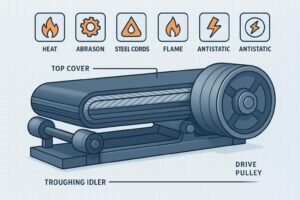
Getting a new belt onto site without a test plan is a coin flip on downtime. This checklist turns conveyor belt performance testing into a repeatable process you can run at incoming inspection, during commissioning, and for periodic QA. It’s written for procurement leads, reliability and maintenance engineers, and project managers who need auditable evidence before a belt enters service.
Scope and standards for conveyor belt performance testing
This checklist covers factory acceptance, incoming inspection, and commissioning verification for textile EP/NN belts and steel cord belts. It references common laboratory methods so your results are traceable and comparable.
-
Abrasion testing is typically performed per ISO 4649 or ASTM D5963 with a rotary drum method that reports volume loss in mm³; an equipment maker’s guide outlines specimen geometry, distances, and reporting according to the standard in plain language, as described in the MonTech explainer on DIN abrasion testing according to ASTM D5963 and ISO 4649 (accessed 2026).
-
Adhesion between plies and cover-to-carcass is determined per ISO 252; industry summaries note typical practice minima often cited around 6 N/mm for interply and 4.5 N/mm for cover-to-carcass, but acceptance must follow the purchaser’s specification, per the ConveyorBeltGuide overview of conveyor belt testing (accessed 2026).
-
Sampling for acceptance tests is defined in ISO 282; apply a lot-based sampling plan when a purchase order covers multiple coils of the same belt, as listed on the ISO catalogue page for ISO 282 Sampling of conveyor belts (accessed 2026).
-
Fire testing is conducted per EN ISO 340 or ISO 340:2022 for belts with or without covers; use the exact edition and clause cited in the specification, as indexed under ISO’s burning behaviour of materials standards (accessed 2026).
-
For steel cord belts, cord pull-out and cyclic adhesion are addressed in ISO 15236 and DIN 22131. An industry primer summarises how cyclic loads are applied for dynamic adhesion verification, noted in the ConveyorBeltGuide testing page (accessed 2026).
How to use this checklist for conveyor belt performance testing
- Align test scope to the purchase order and application. For hot materials, oil exposure, or underground use, include the relevant environmental and fire tests.
- Define sampling per ISO 282 and record traceability from coil to test coupon. Assign unique specimen IDs tied to compound batch and fabric or cord lot.
- Condition rubber test pieces in a standard laboratory atmosphere before testing and record temperature and humidity on the report. Follow your lab SOP aligned with ISO 23529 general procedures.
- Check instrument calibration status before testing. Record equipment ID and calibration certificate number and date. Document measurement uncertainty where your lab method provides it.
- For each result, capture the method reference, specimen orientation, test parameters, measured values with units, acceptance criterion source, pass or fail, and sign-off.
Conveyor belt performance testing checklist
-
Verify identification and documentation
- Confirm belt designation, construction, width, nominal thicknesses, cover grades, strength rating, lot or coil IDs, and certificates against the purchase order. Record any referenced standards from the PO.
-
Establish lot sampling plan
- Apply ISO 282 to determine the number of samples per lot. Document the sampling rationale and which coils or sections were sampled.
-
Assign traceable specimen IDs
- Link each coupon to coil, meter mark, and if available, compound batch and fabric or cord lot. Record sampler, date, and location.
-
Condition test pieces
- Condition coupons to a stable laboratory atmosphere before testing. Record temperature, humidity, and dwell time in the report.
-
Dimensional checks
- Measure width, total thickness, and individual cover thickness at multiple transverse positions. Note edge quality, camber, and any surface inclusions or blisters.
-
Visual surface inspection
- Scan both faces for cuts, voids, trapped fabric cords, blistering, or contamination. Photograph notable defects with scale and location.
-
Troughability and stiffness observation
- On a representative span or jig, verify the belt conforms to planned idler geometry. Record any stiffness that prevents correct trough formation; note carcass thickness distribution if measured.
-
Tensile and elongation for textile belts
- Perform full-thickness tensile strength and elongation at reference force per ISO 283. Report breaking strength in N/mm, elongation at break in percent, and elongation at reference force with the applied force stated. Note failure mode.
-
Interply adhesion
- Test interply adhesion per ISO 252. Report peel force per unit width in N/mm, test rate, temperature, and failure mode. Compare to purchaser’s minimum requirement.
-
Cover-to-carcass adhesion
- Test cover-to-carcass adhesion per ISO 252. Report N/mm, specimen width, rate, temperature, and failure mode. Apply purchaser’s acceptance criterion.
- Tear or tear propagation for textile belts
- If specified, conduct tear testing using the agreed current method. Record test type, orientation, force or propagation metric, and acceptance basis.
- Abrasion resistance of covers
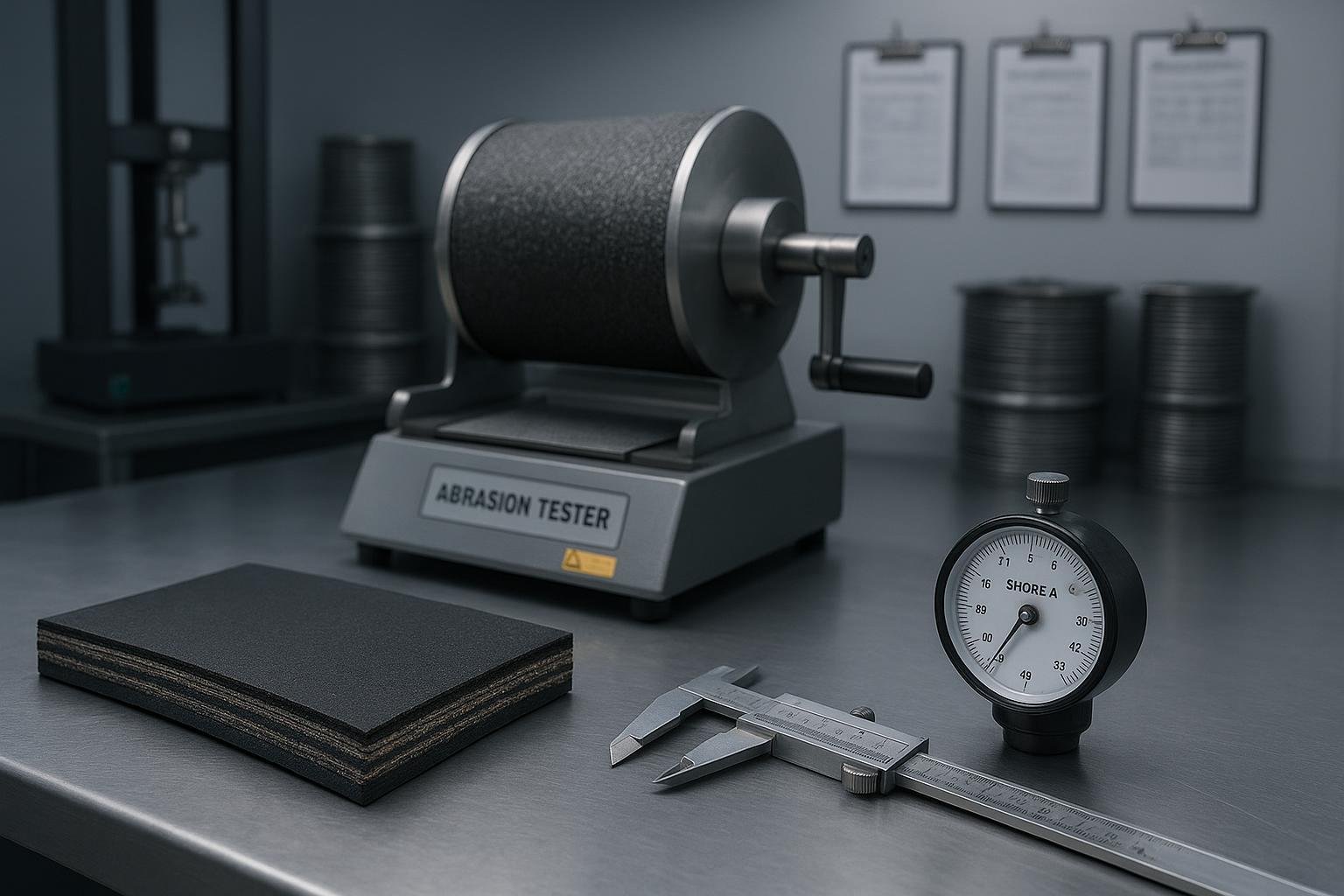
- Conduct DIN abrasion per ISO 4649 or ASTM D5963. Document method A or B, normal force, abrasion distance, abrasive sheet, initial and final mass, density, and calculated volume loss in mm³. Lower volume loss indicates better wear resistance. For apparatus and reporting context, see the MonTech article on DIN abrasion testing.
- Workflow note example: To keep lab logging consistent across projects, some teams tag abrasion results to cover grade designations defined in their specs. Where belts are supplied by BisonConvey for highly abrasive service, record the ISO 4649 method and volume loss alongside the internal cover grade so results can be trended by grade across sites. This is a neutral logging practice, not a performance claim.
- Hardness of covers
- Measure Shore A hardness per ISO 7619-1 or ISO 48-4. Record durometer type, dwell, temperature, and at least five readings with the mean. Note any significant difference between top and bottom covers.
- Density for calculation and QC correlation
- Determine compound density per ISO 2781 where used to compute abrasion volume or to track compound consistency. Record method reference and equipment ID.
- Heat resistance checks
- When required by application, perform heat aging or heat resistance tests per the specified method and edition. Record tensile or elongation retention, hardness change, and visual changes. State the exposure temperature and duration.
- Oil or liquid resistance
- Where oil exposure is expected, run ISO 1817. Specify liquid, temperature, and time. Report mass and volume change percentages and any post-exposure hardness or tensile retention if required. For scope and reporting parameters, see the ISO 1817 catalogue preview (accessed 2026).
- Ozone resistance
- If outdoor weathering or ozone cracking is a concern, run ISO 1431-1. State ozone concentration, strain, exposure hours, magnification, and crack rating or absence of cracks per the clause used. The latest revision status is noted on ISO’s rubber standards index for ISO 1431-1 (accessed 2026).
- Fire testing where applicable
- For belts requiring flame resistance, test per EN ISO 340 or ISO 340:2022 as specified. Record configuration with or without covers, laboratory, afterflame or propagation results per the spec, and pass or fail against the purchaser’s limits. Edition status is indexed under ISO’s burning behaviour standards (accessed 2026).
- Steel cord identification and geometry
- For steel cord belts, record cord diameter, spacing, cover thicknesses over cords, and any anti-corrosion coating information supplied.
- Steel cord static pull-out
- Test cord pull-out per ISO 15236 or DIN 22131 as specified. Report static pull-out force with units and specimen details. Note if any thermal conditioning simulating splice cure was applied.
- Steel cord cyclic adhesion
- Where required, run dynamic adhesion cycles per DIN 22131 as cited in the specification. Document load range as a percentage of nominal static pull-out and number of cycles. Record failure mode or completion without failure. Context for cyclic checks is summarised in the ConveyorBeltGuide testing note (accessed 2026).
- Splice procedure conformance
- Verify the splice type, materials, and layup steps follow the approved procedure. Record cure profile including time, temperature, and pressure; confirm thickness symmetry and step geometry.
- Splice inspection and basic NDT
- After curing and cool-down, measure thickness across and along the splice, check hardness across the joint, and perform any specified non-destructive checks. Photograph and log any visual anomalies.
- Splice performance example
- Example log excerpt from a commissioning check: A steel cord belt splice supplied to site and installed by the contractor was verified against the project method by running static pull-out per ISO 15236 on shop coupons and a dynamic adhesion cycle per DIN 22131 on a lab rig. Results, cure profile, and photos were filed under the equipment ID. On projects using BisonConvey steel cord belts, this same procedural flow is applied; no special allowances are taken, and acceptance rests on the purchaser’s criteria.
- Pulley and idler compatibility notes
- Confirm minimum pulley diameters are appropriate for the belt construction to limit bending stress. Record idler configuration and any concerns identified during a slow-roll check. For methodology, see the calculation guidance summarized under ISO 3684 minimum pulley diameters (accessed 2026).
- Calibration and uncertainty
- Record equipment IDs, calibration certificate numbers and dates, and whether measurement uncertainty is reported. Note any out-of-tolerance instruments and retest actions taken.
- Acceptance against purchaser specification
- For each test, state the acceptance basis with the clause or page reference. Mark pass or fail and sign off with name, role, and date.
- Nonconformance containment plan
- Define quarantine actions for failing lots, communication flow to supplier, retest scope and timing, and disposition options after root-cause analysis.
- Reporting package and retention
- Assemble reports with traceability: sampling plan, conditioning log, raw readings, calculations, photos, calibration records, and pass or fail summary. Define retention period and storage location.
- Trend monitoring for periodic QA
- For recurring orders, chart critical metrics like abrasion volume loss, adhesion, hardness, and steel cord pull-out to detect drift. Use stable lab setups and unchanged methods to ensure comparability.
Acceptance, retest, and containment
- Acceptance basis: Where standards are paywalled or do not publish numeric limits, use the purchaser’s specification or project datasheet as the governing criterion. Document the exact clause, edition, and page.
- Retest logic: If a single specimen is an outlier and equipment and conditioning checks are clean, retest with a new coupon from the same coil. If two results fail, treat the coil or lot as suspect and expand sampling.
- Containment: Quarantine suspect coils, notify stakeholders, and agree on corrective actions with the supplier. Maintain a clear chain of custody for test pieces and failed samples.
- Trending: Keep like-for-like lab methods and equipment to ensure your conveyor belt performance testing data remains comparable over time.
Download the templates
Want a ready-to-use Quick Acceptance sheet and a Full Lab QA worksheet for conveyor belt performance testing? Request the templates from BisonConvey.
References for further reading and method context
- The MonTech article on DIN Abrasion Testing According to ASTM D5963 & ISO 4649 discusses apparatus and reporting for abrasion volume loss in mm³ (accessed 2026).
- The ConveyorBeltGuide page Conveyor Belt Testing summarises common lab checks and practical minima often used in industry for adhesion, with the reminder to defer to specifications (accessed 2026).
- The ISO catalogue page for ISO 282 Sampling of conveyor belts defines lot-based sampling for acceptance testing (accessed 2026).
- The ISO index for burning behaviour standards lists ISO 340:2022 for laboratory-scale flammability of conveyor belts with and without covers (accessed 2026).
- The ConveyorBeltGuide testing note highlights use of DIN 22131 cyclic loading for steel cord dynamic adhesion checks, a common requirement in projects (accessed 2026).