A cement plant runs 15-25 conveyors from quarry to dispatch, each with a very different duty. Getting the belt / idler / drive spec wrong on any of them costs uptime and covers — the clinker cooler belt seeing 200°C surface temperature needs a fundamentally different construction from the packaging-house belt feeding the palletizer. This guide walks the five zones every cement plant conveyor engineer designs for, the belt selection logic per zone, and the sourcing checkpoints you'll want in your RFQ.
Cement conveyor zones — the five belts in every plant
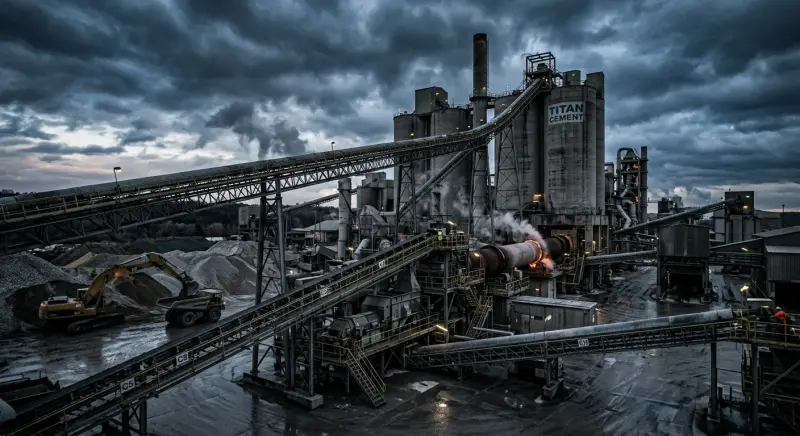
A typical dry-process cement plant lays out conveyors in five functional zones. Belt selection, cover grade, idler class, and drive sizing all follow the material state and temperature at that stage.
Zone 1 — Raw material intake. Limestone (~85% of raw feed) plus clay / shale / iron corrective / silica arrive from the quarry, usually via crushed run-of-mine trucks or a long-distance overland conveyor. Modern integrated plants increasingly use overland belts 2–15 km long to replace truck haulage — this is where steel-cord carcass belts and large drive stations dominate.
Zone 2 — Raw material stockyard → raw mill. Proportioned raw material moves from the pre-blending stockyard through weigh feeders into the raw mill (usually a vertical roller mill). Belt duty here is medium: 60–500 t/h, ambient temperature, moderate abrasion. Fabric-carcass EP belts with grade Y or W covers handle it.
Zone 3 — Clinker cooler → cement silos. The hot zone. Clinker leaves the kiln at ~1400°C, drops through a grate or planetary cooler where it exits at 100–200°C, then travels to clinker silos on heat-resistant belts — the single most stressed conveyor in the plant. Cover temperatures during upsets can spike above 250°C. Belt selection here is non-negotiable: T2/T3 or T4 heat-resistant construction per DIN 22102, EPDM covers, and steel structure designed for radiant heat.
Zone 4 — Cement mill → storage silos. Ground cement from ball mill or vertical roller mill goes to storage silos. Dust is the dominant challenge — cement fines are extremely abrasive to belt covers and idler shells. Sealed conveyors, covers over the carrying side, and stainless-steel-shell idlers extend service life.
Zone 5 — Cement dispatch → packaging / bulk loadout. From storage silos, cement goes to bag palletizers, bulk truck loading, or rail wagon loading. Duty is lower tension but continuous, with hygiene and dust-control requirements. Standard fabric belts with anti-static and food-grade-adjacent covers work here.
Every plant differs in layout, but these five zones are universal. Design starts by classifying each conveyor into its zone.
Belt selection by zone
Match belt type to duty. The following table condenses years of cement-industry practice.
| Zone | Typical belt | Cover grade (DIN 22102) | Cover thickness (top/bottom) | Speed range |
|---|---|---|---|---|
| Z1 — Overland raw material | Steel cord belt ST 1000–2500 | Y or W | 8/3 mm | 3.5–5.0 m/s |
| Z1 — Short raw material | Fabric belt EP 500 4-ply | W (abrasion) | 6/3 mm | 2.0–3.0 m/s |
| Z2 — Raw mill feed | Fabric belt EP 400 3-ply | Y | 5/2 mm | 1.5–2.5 m/s |
| Z3 — Clinker handling | Heat-resistant belt T2 or T3 | HR-EPDM | 8/3 mm | 1.5–2.0 m/s |
| Z4 — Ground cement | Fabric belt EP 400 3-ply | Y | 5/2 mm (sealed) | 1.5–2.5 m/s |
| Z5 — Packaging / dispatch | Fabric belt EP 200 2-ply | Y | 4/2 mm | 1.0–1.5 m/s |
The Z3 belt deserves special attention. Heat-resistant grades per DIN 22102 map roughly to peak continuous operating temperature:
- T1 — up to 100 °C — general warm environments
- T2 — up to 125 °C — most standard clinker cooler outputs
- T3 — up to 150 °C — hot spot / upset condition tolerance
- T4 — up to 175 °C — worst case, e.g. transfer belt directly after grate cooler that occasionally sees a plug of hot clinker
Choose one grade above your measured steady-state cover temperature, not equal to it — allowing for kiln upsets and material temperature spikes. Undersizing here is the fastest way to strip covers within months.
For the design math, use our Belt Tension Calculator or Belt Capacity Calculator to size each conveyor's motor and carcass. The DIN 22101 design guide covers the underlying methodology including safety factors and minimum pulley diameters.
Critical design considerations
Three engineering factors set cement plant conveyors apart from generic bulk-material design.
1. Heat. Beyond the obvious Z3 clinker belts, several other conveyors run warm — the raw meal to preheater feed can see 60–80 °C, and clinker silo discharge belts running to cement mill grinder can carry material at 60–120 °C. Rubber cover ageing accelerates roughly 2× for every 10 °C rise above 60 °C, so cover grade selection is a service-life decision, not just a survival decision. See the glossary entry on cover compound for grade-vs-duty mapping.
2. Dust and abrasion. Cement fines are microscopically abrasive — they wear belt covers and idler shells much faster than similar-sized inert dust. Design implications:
- Use higher-grade covers (W or X per DIN 22102) even at lower stated abrasion demand
- Prefer sealed conveyors (top cover) on Z4/Z5 to keep fines from cascading onto return belt idlers
- Specify stainless steel idlers or ceramic-lagged idlers for high-wear locations; carbon steel shells wear through in 12–18 months in typical cement plant dust
3. Continuous operation. Modern cement plants run 24/7/330+ days per year — planned shutdowns are annual events and unplanned downtime is punished in production KPIs. Consequently:
- Specify higher safety factors than the DIN 22101 minimum — SF 10 or 12 for fabric belts (vs the 8 minimum), SF 8 or 10 for steel cord (vs 6.7 minimum). See safety factor.
- Design idler stations for easy roller replacement without belt removal
- Specify rubber-lagged drive pulleys with hot-vulcanized bonding (5–10 year life) over cold-bonded (2–4 years)
The CEMA idler class selector helps map belt width, speed, density, and lump size to the appropriate CEMA class (usually C or D for cement plant Z1/Z2, D or E for Z3).
Common design pitfalls
Six mistakes we see repeatedly on cement plant projects. Any one of them cuts belt life by 40–60% or triggers premature plant downtime.
Pitfall 1 — Undersized cover grade on Z3. Specifying T1 for a clinker cooler output belt because "steady-state is only 90 °C" ignores upsets. When the cooler sees a hot cascade, cover temperature can hit 200 °C for minutes at a time. Specify T2 minimum. For plants running high production rates or with older, less controlled coolers, specify T3.
Pitfall 2 — Skipping the transition distance check on hot belts. Heat-resistant covers are stiffer than standard rubber, so the belt requires more transition distance from troughing idlers to the terminal pulley — typically 1.5× the DIN 22101 recommendation for standard belts. Cutting this short causes edge tension overload and splice failure within 6–12 months.
Pitfall 3 — Bare steel drive pulleys with wet material. Cement plants have wet zones (raw material with rain moisture, quench water spray on coolers). Bare steel μ falls from 0.30 to 0.10–0.15 wet. Always specify rubber-lagged drive pulleys with diamond or grooved pattern. Consider ceramic tile lagging for wet primary drive stations.
Pitfall 4 — Cheap idlers on Z4 dispatch conveyors. Because dispatch belts are low-tension and low-speed, teams sometimes economize on idler quality. Cement fines then wear the carbon steel shells through in 12–18 months, dropping onto the return belt, damaging the bottom cover. Total belt replacement cost dwarfs the idler saving.
Pitfall 5 — Standard cover thickness on packaging house belts. Packaging house belts run at low tension but face frequent stops/starts from bagging cycles, chute impact, and manual scraping when bags jam. 4mm top cover wears through in 8-14 months. Specify 6mm covers for these applications.
Pitfall 6 — Ignoring FRAS/anti-static specifications for enclosed sections. Enclosed cement conveyors accumulate dust; static discharge in confined spaces triggered fires in three documented cases in the last decade. Specify flame-retardant, antistatic belts (K grade per DIN 22103) for enclosed or covered sections.
For a broader engineering context, our companion article on heat-resistant conveyor belt selection for clinker walks through the Z3 belt specification in more depth.
Sourcing checklist for cement plant belts
When issuing an RFQ to a cement plant belt supplier, the following spec elements determine whether you receive comparable quotations or a mix of apples and oranges.
Per-conveyor specification block:
- Conveyor tag/name and functional zone
- Belt width (mm), length (m), lift (m), and centre-to-centre distance
- Design capacity (t/h) and bulk density (kg/m³) — use our bulk material properties reference for cement / clinker / raw meal values
- Belt speed (m/s)
- Maximum steady-state material temperature and worst-case upset temperature
- Ambient conditions (indoor / outdoor, wet / dry, temperature extremes)
- Idler class per CEMA (or roller diameter and shell material)
- Drive pulley diameter and lagging type
- Wrap angle at drive (usually 180° or 210° with snub)
Belt specification block (per conveyor):
- Carcass type and rating (e.g., "EP 500 4-ply" or "ST 1250 hot-vulcanized cord splice")
- Cover grade per DIN 22102 (X / W / Y) or ISO 10247 (H / D / L)
- Cover thickness (top / bottom, mm)
- Special construction: heat-resistant grade (T1/T2/T3/T4), FRAS, oil-resistant, anti-static
- Splice type (hot vulcanized finger / cold vulcanized / mechanical)
- Safety factor (specify: 10 or 12 for fabric; 8 or 10 for steel cord — see safety factor)
- Standards compliance (DIN 22101/22102, ISO 14890, MSHA if underground portions)
Commercial and quality block:
- Country of manufacture and factory certifications (ISO 9001, ISO 14001, CE)
- Warranty terms — typical: 12 months from commissioning or 24 months from delivery, whichever comes first
- Delivery terms and lead time
- Splice service — is the supplier providing on-site splicing or is it your responsibility?
- Reference sites — request 3 cement plants within similar climate / capacity that use the supplier's belts
The DIN 22101 conveyor belt design guide (PDF) includes a broader design review checklist you can use during technical evaluation.
Conclusion
Cement plant conveyors are not "one belt fits all". The five functional zones each impose distinct thermal, abrasion, and duty requirements, and matching belt construction to zone is the difference between 4-year and 10-year belt life. Start with the zone table above, apply the DIN 22101 tension and safety factor methodology per conveyor, and use our online calculators to validate each design before RFQ.
For plant-wide conveyor upgrades, replacement projects, or greenfield engineering, BisonConvey supplies the full range: heat-resistant belts for the clinker cooler zone, steel cord belts for overland raw material transport, fabric belts for raw meal and dispatch, plus the corresponding pulleys and idlers engineered for cement plant duty.