Abrasion chews up uptime. In mines, quarries, steel and cement plants, the wrong belt cover or carcass can turn a busy week into a stoppage marathon. The good news: standards give us hard numbers to compare materials, so you can choose with confidence instead of guesswork.
Before we get into the list, here’s the quick primer that keeps everyone on the same page. Abrasion resistance for rubber covers is typically measured using ISO 4649 (and the historical DIN 53516). A test sample is pressed against a rotating drum; the result is volume loss in cubic millimeters (mm³). Lower is better. These values underpin DIN 22102 and EN ISO 14890 cover grades used across heavy industry—so when you see W, X, Y or D, H, L, you’re looking at minimum performance thresholds, not marketing adjectives. Dunlop’s 2024 explainer walks through the test and grade mapping: Abrasion standards and test methods.
How we ranked materials (transparent, 2026 lens)
We prioritized solutions that reduce real-world wear and downtime using standards-aligned data and field-proven practice. Criteria and weights:
- Abrasion grade alignment and mm³ loss (35%)
- Operating condition fit—heat, oil, moisture, impact, slope, material type (20%)
- Mechanical performance—tensile, elongation, impact absorption (15%)
- Lifecycle economics—service life, maintenance/repairability (15%)
- Evidence quality—standards, manufacturer documents (10%)
- Availability and support (5%)
DIN ↔ ISO cover grade mapping (for quick decisions)
Below is a simple mapping and the maximum abrasion loss value under ISO 4649/DIN 53516. Multiple sources corroborate these thresholds and use-case guidance, including Dunlop (2024).
| DIN 22102 grade | EN ISO 14890 equivalent | Max abrasion loss (ISO 4649/DIN 53516) |
|---|---|---|
| W | D | ≤ 90 mm³ |
| X | H | ≤ 120 mm³ |
| Y | L | ≤ 150 mm³ |
Dunlop’s 2024 article explains the thresholds and selection logic in plain terms: Abrasion standards and test methods.
The list: Best conveyor materials and components for high‑abrasion duty
-
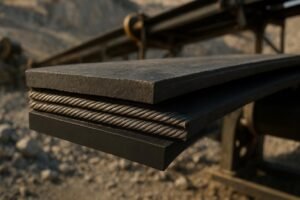
Steel cord carcass — Best for long-distance, high tension, sharp and abrasive ores Steel cord belts deliver very low working elongation and high tensile strength (ST ratings in the thousands of N/mm), which stabilizes tracking over kilometers and heavy loads. They shine where abrasive ore and high tensions punish fabric belts. Downsides include higher upfront cost, larger drive pulleys, and specialized hot vulcanized splicing that demands skilled crews. For design and selection context, see ASGCO’s heavy-duty belting catalog (2024 edition): Conveyor Belting Heavy Duty Brochure.
-
EP fabric carcass — Best for stable tracking and lower elongation in variable moisture EP (polyester warp/nylon weft) multi‑ply belts balance cost and performance, offering lower elongation and better dimensional stability than straight nylon in most plant conditions. They suit long and medium runs where impact is moderate and moisture changes are common. Splices are simpler and cheaper than steel cord, though working strength retention can be lower than optimized finger splices. Manufacturer context appears across catalogs; Dunlop’s cover‑grade notes show how EP carcasses pair with abrasion‑resistant compounds: Cover grades overview.
-
NN fabric carcass — Best for high‑impact loading over short/medium distances NN (nylon/nylon) carcasses are flexible and absorb impact well in loading zones and short runs with frequent shocks. Expect higher elongation versus EP, which means more tensioning and tracking attention over time. NN is not an ideal match for very long, high‑tension conveyors, but it can be the right call where impact dominates and the run is contained. For impact‑resistance context, see Fenner Dunlop’s 2023 guidance: Rip/Tear/Impact belts.
-
DIN W / ISO D covers — Best for highly abrasive fines and sand Where the feed is fine but intensely abrasive—think sand, foundry fines, or crushed stone screenings—DIN W/ISO D covers with ≤90 mm³ abrasion loss are typically the smartest choice. These compounds emphasize pure abrasion resistance; they may not be the strongest in cut/gouge, so match them to material profiles and loading practices. Dunlop’s test‑method page explains why the ≤90 mm³ threshold matters: Abrasion standards and test methods.
-
DIN X / ISO H covers — Best where abrasion plus cut/impact resistance is needed Sharp, angular rock eats soft covers through cut and gouge. DIN X/ISO H compounds target combined abrasion resistance (≤120 mm³) along with toughness against cuts and impacts. They’re common in primary/secondary crushed ore handling. A practical explainer of thresholds appears in Dunlop’s article: Abrasion standards and test methods.
-
DIN Y / ISO L covers — Best for general‑purpose abrasion in mixed duties When material mix and duty vary—aggregate plants moving both fines and larger stone, or ports handling bulk commodities—DIN Y/ISO L (≤150 mm³) can be economical. It’s a mainstream choice but not the best for extreme abrasion. Confirm whether your duty leans more toward fines (favor D/W) or cuts/impact (favor H/X) and specify accordingly. For broader wear behavior notes, see Dunlop’s overview: Abrasion standards and test methods.
-
NR/SBR blends — Best general abrasion with cut/gouge support Natural rubber (NR) often contributes resilience against cuts and gouging, while SBR offers cost‑effective abrasion performance; blends are tuned to meet W/X/Y or D/H/L grades. Many manufacturers publish compound‑specific results; one example shows abrasion around ~99 mm³ for a rip/impact‑oriented grade, pointing to solid performance near the ISO H/D thresholds—see Dunlop’s material family: Rip & Impact cover grade. Match the blend and grade to your feed characteristics and temperature/oil exposure.
-
NBR oil‑resistant covers — Best where oils/greases attack standard rubber In steel mills, recycling, and cement plants with petroleum derivatives, NBR compounds resist swelling and degradation that rapidly destroys standard NR/SBR covers. The trade‑off: peak abrasion performance may be lower than the best abrasion‑only compounds, so use NBR when oil attack is the primary failure mode. Start with the manufacturer’s product‑range summaries and verify exact abrasion values on the selected datasheet: Dunlop EMEA product range.
-
Heat‑resistant compounds — Best for clinker, foundry sand, hot sinter High temperatures accelerate rubber aging and can degrade abrasion resistance. Modern heat‑resistant compounds are tested per ISO 4195 (accelerated aging) and specified for continuous and peak temperatures—some engineered grades run ~150–200°C continuous depending on spec. The trick is matching temperature class with abrasion grade for your material profile. See standards and selection guidance: Heat resistance standards & test methods.
-
Ceramic pulley lagging — Best for traction and cover life at drive pulleys in abrasive, wet duty Drive pulleys in wet or dirty environments can slip, polishing belt covers and accelerating wear. Ceramic lagging increases friction and micro‑locking, improving traction and reducing slippage whether the cover is DIN W or X. Quantified traction gains vary by tile pattern and installation; treat benefits as application‑specific. Industry usage spans heavy mining; confirm details with your vendor’s technical pages and installation guides.
-
Abrasion‑resistant liners and skirtboards — Best for edge protection at transfer points Even the best covers wear fast if the loading zone is starved of protection. Ceramic tile liners and AR plate skirtboards help minimize gouging and edge abrasion in chutes and loading points. Selection should consider material hardness, particle size, and drop height; improperly set skirting can burn edges regardless of belt grade. Manufacturer technical manuals (e.g., Foundations) offer robust guidance—verify current specifications and practices before ordering.
-
UHMWPE idlers or low‑friction idler shells — Best for lowering friction and mitigating abrasive carryback Where corrosion, wet fines, and carryback combine to grind away at steel shells, UHMWPE idlers provide low friction and corrosion resistance. They can reduce drag and abrasion from stuck fines, though load rating and impact tolerance must match duty. Use them selectively—harsh impact zones may still require heavy steel frames and impact idlers. Verify manufacturer load and speed ratings before substituting in primary haulage.
Putting it together: Smart combinations and maintenance notes
Think of your conveyor as a system, not a belt in isolation. Long, high‑tension runs often pair a steel cord carcass with DIN X or D covers depending on feed shape. Short, impact‑heavy transfers may favor NN with a tough DIN X cover and reinforced loading‑zone components. High‑temperature clinker duty mixes heat‑rated compounds with conservative speeds and optimized skirtboards. Oil‑contaminated scrap flows call for NBR covers even if abrasion values are not top‑tier.
Two housekeeping items typically make or break abrasion performance: a well‑designed loading zone (skirtboard setup, chute lining, adequate impact support) and alignment/cleanliness (idler spacing, sealing, and maintenance that limits carryback). If you fix those, your mm³ advantage from the right cover compound actually shows up on the plant floor.
Disclosure: BisonConvey is our product. In abrasive‑duty projects, we’ve supported operators with steel cord belts for long‑distance haulage, DIN X/D cover options, and component choices like ceramic‑lagged pulleys and UHMWPE idlers—useful when matching carcass and covers to duty while keeping traction and energy losses under control. Mentions here are for practical context; evaluate vendors using the standards and datasheets referenced above.
If you’re deciding between DIN X and D for a specific material stream—or debating EP versus NN in a shock‑heavy loading zone—pull the datasheets, confirm abrasion values (mm³) and tensile/elongation specs, and align them to your duty profile. Start with the standards explainer for consistent comparisons: Abrasion standards and test methods.