Peak seasons keep getting longer, SKUs keep multiplying, and labor keeps swinging from scarce to short‑notice. That trio is pushing operators in parcel, e‑commerce fulfillment, recycling, and food processing to make a hard choice: keep adding people to manual put walls, or invest in automated sorting lines that can sustain high throughput, consistent accuracy, and safer, quieter operations at scale. The shift is well under way—and 2024–2025 brought meaningful advances not just in the sorters themselves, but in vision systems, robotic handling, and the orchestration software that ties everything together.
This article breaks down what today’s automated sorting lines actually consist of, which sorter types fit which jobs, how AI and robotics are changing workflows, and a retrofit‑first playbook to upgrade legacy systems before you commit to a full greenfield build.
What an automated sorting line really includes
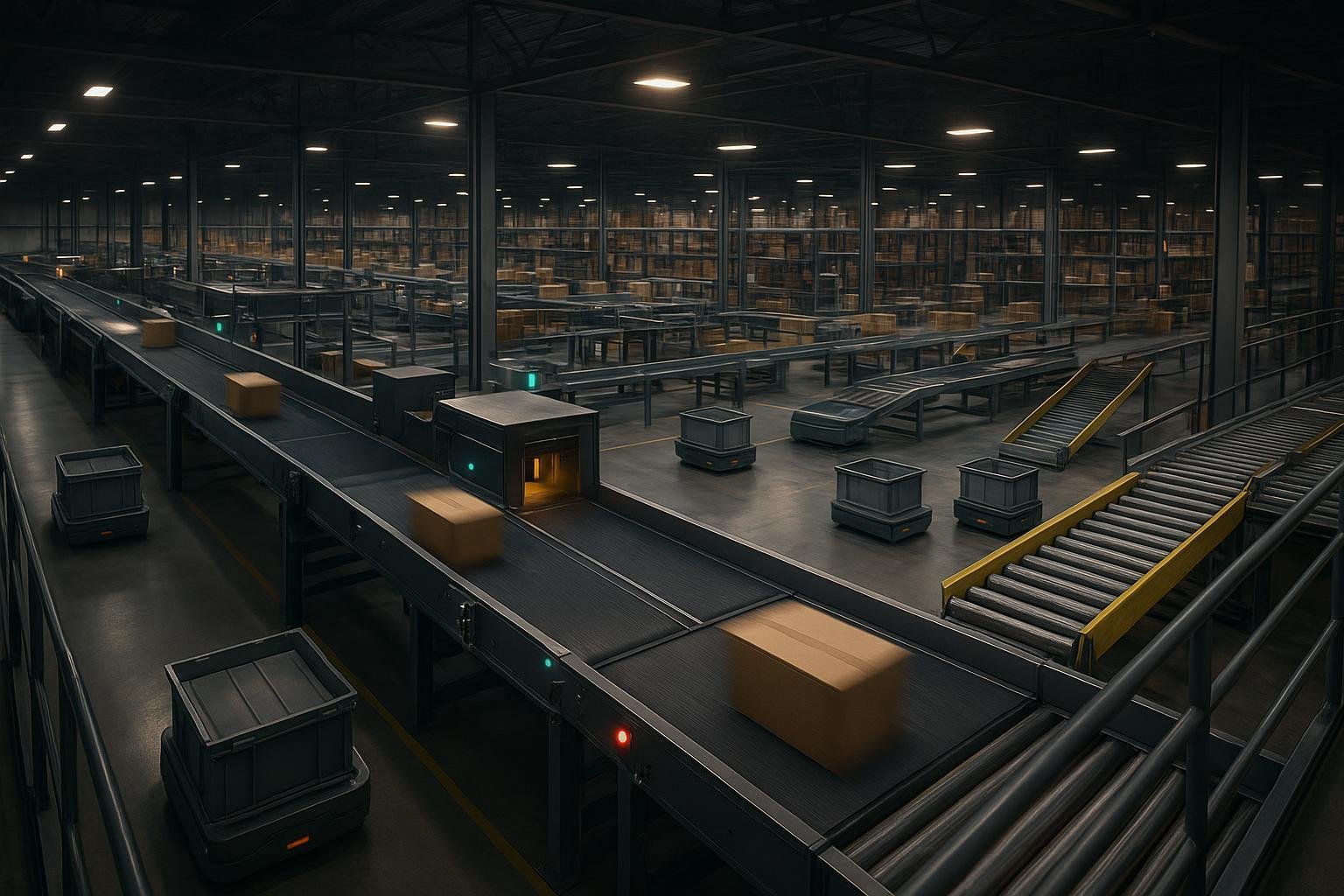
A modern sorting line is a system, not a single machine. The building blocks typically include:
- Infeed and singulation: Metering conveyors, gapping, and guide rails shape the flow. The goal is one item per carrier with timed spacing.
- Identification: Scan tunnels or vision systems capture barcodes, dimensions, and orientation, passing IDs to controls.
- Sorter: Cross‑belt, tilt‑tray/split‑tray (aka bomb‑bay), or other mechanisms route items to destinations.
- Diverts and destination chutes: Well‑designed chutes and buffers preserve item integrity and reduce mis‑sorts.
- Accumulation and pack‑out: Downstream zero‑pressure accumulation (ZPA) protects throughput during spikes.
- Controls and orchestration: PLCs coordinate devices locally while a warehouse execution system (WES) allocates work and adapts to real‑time conditions.
Integrators and OEMs are aligning around a software‑first posture: orchestration platforms increasingly act as the “brain,” blending human work with automation and robotics. According to Honeywell’s 2025 overview, Top 5 Trends Driving Warehouse Automation in Retail Operations and Distribution Centers in 2025, and its Momentum WES explainer, orchestration connects robotic and conventional systems into one adaptive network, using AI/IoT telemetry for continuous optimization (Honeywell 2025 trends).
Choosing the sorter: cross‑belt vs tilt‑tray vs split‑tray
No sorter is universally best. Selection depends on item mix, required parcels per hour (PPH), footprint, noise targets, and the quality of your infeed. Two publicly documented cross‑belt references help set the range of what’s possible:
- BEUMER Group’s BG Sorter CB shows speeds up to 3 m/s, with a named case at Oriental Trading Company reporting more than 43,000 units/hour and 99.8% sortation accuracy in that specific deployment, per BEUMER’s materials (BEUMER BG Sorter CB brochure; Oriental Trading case study).
- Vanderlande’s CROSSORTER cites sorting up to 18,000 carriers/hour and emphasizes low noise and lower running costs on its product page (Vanderlande CROSSORTER).
The gap between those numbers reflects different configurations, definitions (carriers vs items), line length, number of induction points, and item characteristics. Treat every figure as OEM‑ and system‑specific.
| OEM | Speed | Throughput (example) | Item limits | Accuracy | Notes |
|---|---|---|---|---|---|
| BEUMER BG Sorter CB | Up to 3 m/s | Case >43,000 units/hour (Oriental Trading) | Public brochures indicate items up to ~60″ (L) × 41″ (W) and ~50 kg per carriage (configuration‑dependent) | 99.8% in cited case | Multi‑belt carriers, orientation correction, contactless energy/comm. See BEUMER brochure and case study. |
| Vanderlande CROSSORTER | Not stated | Up to 18,000 carriers/hour | Not listed publicly | Not listed publicly | Emphasis on low noise and operating costs on product page; request datasheets for specifics. |
If your catalog includes soft packs, poly mailers, and a wide size range, cross‑belt is often favored for gentle handling and destination density. Tilt‑tray and split‑tray/bomb‑bay shine on smalls and flats at high density with controlled discharge profiles—yet many numeric specs are delivered under NDA, so plan your RFQ to request tray dimensions, max weight, tray density, and accuracy at your target PPH.
The new frontier: AI vision, robotics, and orchestration
The headline changes in 2024–2025 aren’t just mechanical. They’re about perception and coordination:
- Vision and positioning: Peer‑reviewed research explores high‑speed classification and location for parcels using monocular cameras and YOLO‑family models; the public abstract emphasizes “high‑speed, high‑precision parcel positioning,” underscoring active work on perception accuracy and timing for sorter induction (Nature Scientific Reports, 2024).
- Orchestration as the governor: WES layers are increasingly responsible for metering inbound flow, assigning missions to AMRs, and throttling induction to prevent downstream gridlock. Honeywell’s 2025 trend content frames this explicitly: orchestration connects robotics and conventional sorters into one adaptive system (Honeywell 2025 trends).
- Facility‑scale AI in recycling: On the municipal side, AI sortation is scaling from pilot cells to whole facilities. AMP Robotics and Waste Connections announced an integrated AI sortation plant in Colorado designed to process up to 62,000 tons of single‑stream recycling annually, targeting early‑2026 commissioning (AMP + Waste Connections announcement, 2024). For industrial buyers, the lesson is that software‑defined sortation is maturing beyond isolated pick stations.
AMRs are the other moving piece. Case coverage in 2024 showed WES‑coordinated fleets flexing between mobile sortation, scan tunnels, robotic work areas, and pack‑out. Even when you retain a fixed high‑speed sorter, AMRs can buffer work and smooth peaks by dynamically routing totes or cartons to the right induction points. Think of them as elastic connective tissue for your line.
A retrofit‑first playbook for existing facilities
Before you jump to a new sorter, many sites can unlock double‑digit throughput and accuracy gains by improving flow quality and mechanical fundamentals:
- Metering and singulation: Add or retune gapping conveyors to achieve consistent one‑per‑carrier spacing. Smooth, predictable infeed is the cheapest accuracy you’ll ever buy.
- Zoned accumulation with 24/48V motorized rollers: ZPA lets you buffer intelligently upstream and downstream of the sorter. Interroll’s DC platform documentation shows low‑noise RollerDrive modules and integrated ZPA logic with MultiControl (Interroll DC platform catalog).
- Belt and idler choices: Low rolling‑resistance belts and well‑aligned, low‑drag idlers cut energy use and heat; UHMWPE idlers reduce noise and corrosion risk in dusty or damp zones.
- Tracking/tensioning and pulleys: Correct lagging, crowned pulleys where appropriate, and regular tracking reduce edge wear and mistracking faults that cascade into mis‑sorts.
- Controls hygiene: Tighten timing windows at photoeyes and scanners; verify that your PLC and WES share the same clock and that exception logic (no‑reads, doubles) is well‑tested.
Neutral micro‑example — conveying components, not sorter claims: In a cross‑belt retrofit, an operator might add two zones of zero‑pressure accumulation before induction and replace aging steel idlers with UHMWPE units to cut drag and noise. A vendor like BisonConvey can supply belts, idlers, pulleys, and motorized rollers to support that scope while the integrator handles controls and sorter tuning (Disclosure: BisonConvey is our product). The point isn’t the brand; it’s that component choices materially affect accuracy, energy, and operator comfort without touching the sorter itself.
Specify for energy, noise, and maintenance
Energy and noise are no longer afterthoughts—they’re procurement criteria.
- ZPA and duty cycling: 24/48V motorized roller systems only run zones that are occupied. Interroll’s platform documentation covers zone control, diagnostics, and network connectivity. Ask vendors to provide energy profiles (Wh per parcel at your PPH) under typical and peak duty cycles (Interroll DC platform catalog).
- Noise: Roller‑driven modules are often much quieter than legacy AC chain‑drives; Interroll cites applications around 55 dB(A), though your line will vary with load and speed. Specify target dB(A) at operator positions and require measurements during FAT/SAT (see the same catalog for context).
- Maintainability: Favor modules with tool‑less belt tensioning, clear diagnostic LEDs on controllers, and standardized rollers/bearings. Document MTBF assumptions and spares kits.
- Safety: ZPA reduces back‑pressure injuries; verified guarding around discharge chutes and scanner tunnels is non‑negotiable.
Avoid generic “saves up to 30% energy” claims without test conditions. Ask for apples‑to‑apples comparisons versus your current configuration at your typical duty cycles.
Sector notes: parcel/e‑commerce, recycling, and food processing
- Parcel and e‑commerce: Cross‑belt and tilt‑tray systems are widespread, with mature orchestration layers and robust throughput claims from major OEMs. BEUMER’s published material demonstrates high speeds and case accuracy in a named deployment, while Vanderlande’s public pages emphasize low noise and cost performance; exact figures vary by build and should be requested in RFQs (BEUMER BG Sorter CB brochure; Vanderlande CROSSORTER).
- Recycling: The momentum is toward AI‑assisted, software‑upgradable sorting at facility scale. The AMP–Waste Connections project signals an inflection point from robotic islands to integrated plants with guaranteed performance envelopes (AMP + Waste Connections announcement, 2024).
- Food processing: Optical sorters continue to add sensor fusion—visible, IR, SWIR—and hygienic conveyance. A December 2025 trade report on Key Technology’s “Compass” sorter highlights multi‑channel sensing and pixel‑level fusion for leafy greens; throughput numbers are usually provided in quotes (Hortidaily coverage).
A practical procurement checklist
Use this as a starting point for RFIs/RFQs and acceptance testing:
- Item mix and duty: Define size/weight ranges, surface types (poly mailers vs cartons), fragility, and inbound variability. State average and peak PPH by hour/day.
- Performance targets: Specify PPH bands for average and peak, accuracy (e.g., ≥99.5% at peak), maximum no‑read rate, and acceptable re‑circulation percentage.
- Sorter mechanics: Request tray/carrier dimensions, max weight, allowable overhang, and discharge profiles at your PPH. For cross‑belts, ask for carrier density and number of induction points.
- Infeed quality: Require metering/gapping specs, doubles detection, and timing tolerances between photoeyes/vision and PLC/WES.
- Orchestration: Describe WES interfaces, message sets, and recovery behaviors (jam, no‑read, destination offline). Define clock sync requirements.
- Energy and noise: Ask for Wh/parcel at stated PPH and measured dB(A) at operator stations. Require FAT/SAT verification.
- Maintainability: List MTTR targets, standardized components, lubrication regimes, and spare parts kits. Define training deliverables for maintenance.
- Safety and compliance: Require guarding standards, lockout/tagout procedures, and documented risk assessments.
- Data and evidence: Insist on named references and, where possible, site visits or videos of comparable systems in production.
Closing thoughts and next steps
Automated sorting lines are rising because they solve real operational pain: the need to sustain accuracy and throughput under dirty real‑world constraints. The frontier in 2025 is the marriage of perception and orchestration with proven sorter mechanics. For many facilities, a retrofit‑first path—better metering, ZPA buffers, quieter/low‑drag conveying components, and tighter controls hygiene—delivers measurable gains now and de‑risks later capex.
If you’re scoping upgrades, assemble a cross‑functional team (operations, maintenance, safety, IT) and pilot improvements at one induction lane before you scale. Need component guidance for belts, idlers, pulleys, or motorized rollers as part of that plan? Vendors such as BisonConvey can supply application‑appropriate conveying hardware while you work with your integrator on the controls and sorter selection.