If you’ve ever walked a quarry or a clinker line, you’ve seen it: a fine, frosty sheen on the top cover where sharp fines have been rubbing the belt like endless sandpaper. That slow grind turns into unplanned stoppages, safety risks at the transfer, and a steady leak of budget. So, what exactly makes a belt “abrasion-resistant,” and when should you specify it?
Let’s break down the standards, the numbers, and the practical choices that extend belt life and uptime—without the jargon.
What “abrasion-resistant” really means
In conveyor belting, abrasion resistance is a measurable property of the rubber cover. In the lab, it’s typically quantified by how much material the cover loses—reported as volume loss in mm³—when rubbed against an abrasive surface for a set distance and load. The most commonly cited method is ISO 4649 (formerly DIN 53516). Lower mm³ means better resistance.
According to Dunlop Conveyor Belting’s “Abrasion standards and test methods”, ISO 4649 uses a rotating drum covered with abrasive paper and two configurations: Method A (non-rotating specimen) and Method B (rotating specimen). It’s a comparative test: perfect for ranking compounds and ensuring quality consistency, but not a direct prediction of in-field life. As ConveyorBeltGuide’s testing overview notes, you should avoid comparing Method A data to Method B because they yield different magnitudes.
Think of abrasion like that persistent sandpaper action at your loading zone and along the return where carryback rides the belt. It’s different from cutting or gouging due to big, sharp lumps or high-drop impacts. That distinction matters when you pick a cover grade.
Why abrasion resistance matters in the real world
- Uptime and cost: Thinner covers wear through faster, exposing carcasses, triggering splices, and forcing changeouts. That’s downtime your operation can’t afford.
- Safety and housekeeping: Worn covers slip more, tracking gets messy, and carryback increases. That raises risks at cleaners and around pulleys.
- Energy and efficiency: A properly specified cover and thickness help maintain a smooth interface with idlers and lagging, which supports stable, efficient conveying.
In practice, you’ll see wear concentrated at loading and transfer points, near misaligned or seized idlers, under worn skirts, and at the head where cleaners work. That’s why standards and cover grades aren’t just paperwork—they’re your baseline for predictable life.
Standards snapshot: common grades and classes
Many plants use DIN 22102 cover grades for textile (fabric) belts and ISO/EN abrasion classes for broader reference. The high-level mapping below captures industry conventions discussed in Agg-Net’s “Conveyor belting: who sets the standards?”. Exact numeric limits vary by supplier and product line, so always confirm the supplier’s technical data sheet (TDS) and the ISO 4649 method used.
| Grade/Class | Indicative abrasion focus (lower mm³ = better) | Typical applications | Notes |
|---|---|---|---|
| DIN Y (general purpose) | Moderate abrasion resistance; often cited around ≤150 mm³ | General plant duties, mixed materials | Baseline for non-severe wear; verify TDS for method A/B. |
| DIN W (high abrasion) | Higher abrasion resistance; often cited around ≤90 mm³ | Sand, gravel, clinker, fines-rich streams | Emphasizes low abrasion loss; check need for cut/tear. |
| DIN X (very high abrasion + impact) | High abrasion with attention to cut/impact; often cited around ≤120 mm³ | Shot rock, hard ores, primary transfers | Balanced for abrasion and impact/gouge environments. |
| DIN Z (light duty) | Lower requirement; often cited around ≤250 mm³ | Light, non-abrasive materials | Not suitable for severe wear. |
| ISO/EN Class H | Highest abrasion resistance in class family | Severe abrasion environments | Comparable intent to DIN X/W; rely on mm³ values. |
| ISO/EN Class D | Medium-high abrasion resistance | High abrasion, moderate impact | Pair with appropriate carcass and thickness. |
| ISO/EN Class L | General-purpose abrasion resistance | Light to normal wear | For non-severe applications. |
How to specify the right belt for abrasive duty
Use a simple decision path before you lock in a spec. Confirm the test method and mm³ target, then balance the rest of the system.
- Material and duty severity: How hard and angular is the material? Is it fines-heavy (scouring) or lump-heavy (gouging)?
- Belt speed and throughput: Higher speeds can amplify sliding wear at transfers and cleaners.
- Impact and drop height: Primary loading zones may need impact-resistant covers, breaker plies, or impact idlers.
- Environment and other resistances: Heat, oil, or flame requirements can change compound choices and abrasion performance.
- Carcass construction: EP/NN is versatile for plant conveyors; steel cord is preferred for long, high-tension runs—covers do the abrasion work, carcass supports load and tracking.
- Cover thickness: More top cover gives more wear life, but increases rolling resistance and heat; size thickness to duty and drive capacity.
- Verification: Specify the abrasion class/grade and the ISO 4649 method (A or B), and request mm³ targets on the TDS.
Maintenance and design practices that actually reduce abrasion
Specifying the right cover sets the ceiling for belt life; keeping the system clean and aligned lets you reach it. Practical steps supported by established maintenance guidance include:
- Optimized cleaning: Select primary and secondary cleaners suited to your material; set blade angle and pressure correctly; stabilize the belt at the head pulley. See Martin Engineering’s Foundations on effective belt cleaning systems for setup fundamentals.
- Healthy idlers: Keep rolls free-rolling and aligned; repair or replace seized or broken idlers quickly to prevent edge scouring.
- Proper lagging: Match lagging type to duty to minimize slip and heat spots that accelerate cover wear.
- Smart transfers: Use impact beds/bars, wear liners, and chute geometry that match belt speed and direction; reduce unnecessary drop height.
- Containment and tracking: Maintain skirts and sealing; fix frame squareness and troughing angles to keep the belt centered and edges intact.
- PM discipline: Walk the belt, record blade and idler wear, and track cover thickness so you can intervene before a failure.
A neutral, practical micro‑example from the field
Disclosure: BisonConvey is our product.
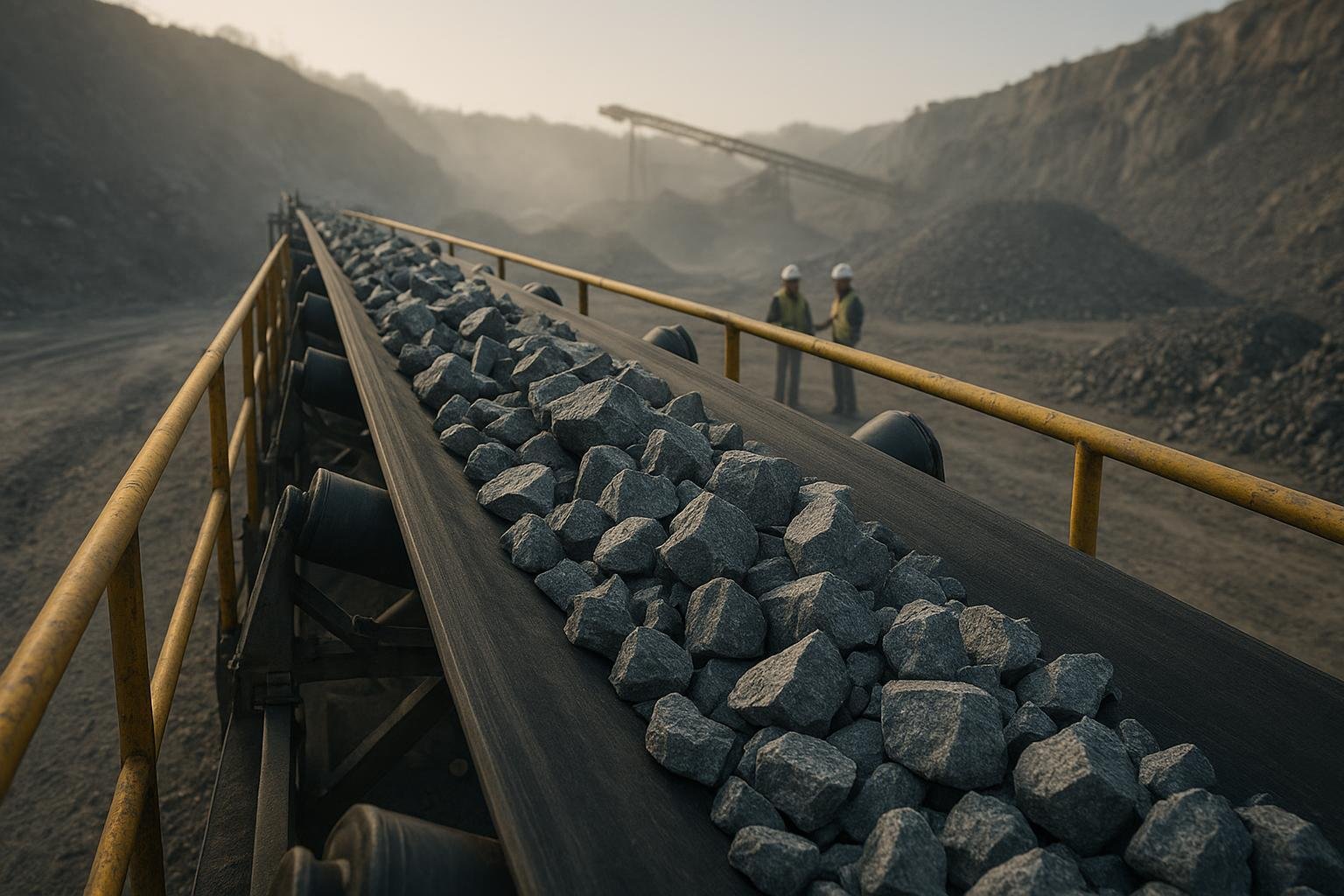
An aggregates quarry is moving 0–150 mm sharp granite at 2.5 m/s on a 1000 mm-wide plant conveyor with a 2 m drop height at the primary transfer. Instead of a general-purpose cover, the spec calls for an abrasion-resistant top cover in the DIN X / ISO Class H range, verified to ISO 4649 with an agreed mm³ target and test method. A fabric carcass such as EP 630/4 with an 8+3 mm cover profile is selected for load support, with impact idlers under the loading zone and a primary plus secondary cleaner set at the head. The result: the compound resists scouring at the transfer, the added top cover provides wear life, and the system components protect the belt so the abrasion rating delivers real value.
This is one of many valid configurations. The best choice depends on your material, speeds, drop heights, and complementary resistances.
Quick cues for troubleshooting abrasive wear
Seeing a light “frosted” polish along the carry surface? That often points to fines scouring at transfers or under skirts—check chute alignment, skirt pressure, and cleaner setup. Noticing edge fray and a shiny strip along one side? Inspect idler alignment and frame squareness to correct tracking and stop edge scouring. If you’re finding embedded sharp particles and localized gouges near the loading point, review drop height and add impact protection or breaker plies.
The takeaway—and a next step
Abrasion-resistant covers aren’t just labels; they’re measurable performance backed by standardized tests. Specify the class and mm³ target, match it to your duty, and protect your investment with good transfer design, cleaning, and aligned components. If you’d like a standards-aware review of your current belt and operating conditions, our team at BisonConvey can walk through the duty, cover options, carcass choices, and system components to help you make a data-backed specification.