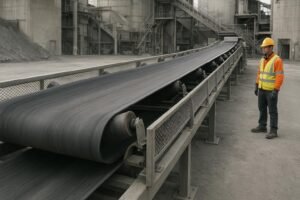
A belt that wanders just a few millimeters can snowball into edge damage, carryback, spillage, and unplanned stops. On long, high‑load conveyors, those small deviations burn time and money—and they can raise real safety risks around pinch points and friction heat. So what exactly is conveyor tracking, and how do you get it right without chasing symptoms?
What “conveyor tracking” really means
Conveyor tracking (belt tracking or alignment) is the practice of keeping the belt centered on idlers and pulleys during all operating states—empty, fully loaded, wet, dusty, hot, or cold. In heavy‑duty troughed systems, design and maintenance both matter. CEMA frames tracking in terms of acceptable lateral wander and the tolerances that keep wander within bounds; see CEMA’s System Mistracking Allowance Guide (2023) for the standards context.
Mechanically, the belt tends to move toward the first point of friction or toward the side with higher drag. Skew an idler, and the belt “walks” that way; crown a pulley and you introduce a centering tendency. Uneven tension across the belt width, off‑center loading, or buildup on rolls all change friction and tension vectors, pushing the belt sideways. Martin Engineering explains these behaviors and remedies in its Foundations series; their Foundations Belt Alignment chapter (PDF) is a solid primer on the physics and field fixes.
Think of it this way: if a shopping cart’s front wheel is angled, the cart drifts. A conveyor is more sophisticated, but the principle is similar—small alignment and friction biases drive lateral movement.
Why poor tracking hurts operations
Left unchecked, mistracking chews up belt edges, shortens splice life, and accelerates idler and pulley wear. It also creates spillage and carryback that demand cleanup, hinder access, and can ignite under the right conditions. Flexco catalogs these outcomes and the avoidable costs in How To Keep Your Conveyor Belt on Track.
There’s a safety and compliance angle, too. Misaligned belts can contact structure or guards and raise entanglement risks. Regulators expect guarded, well‑maintained conveyors; see MSHA’s 30 CFR 75.1722 on guarding for a representative requirement in mining. While MSHA doesn’t prescribe numeric tracking tolerances, proper alignment is part of a safe condition.
Common causes in heavy‑duty conveyors
Field experience and standards‑based guidance point to a handful of recurring drivers:
- Idler or pulley misalignment: skewed frames, out‑of‑square pulleys, poor installation tolerances.
- Off‑center or uneven loading: transfer chutes that bias the stream to one side twist the belt and drive drift.
- Tension and transition errors: improper take‑up settings, inadequate transition distance, unequal edge tension.
- Material buildup/carryback: contamination on rolls/pulleys changes effective diameter and friction.
- Splice quality and belt condition: out‑of‑square splices, camber, or edge damage can create persistent wander.
- Structural or environmental effects: warped stringers, wind on long overlands, moisture unevenly wetting the belt.
Flexco and Martin Engineering both highlight these root causes and the importance of addressing them before reaching for band‑aids. Their materials (above) align with common plant observations.
A safe, field‑ready diagnostic workflow
Before any adjustment: de‑energize, lock and tag out, and verify zero energy. Respect guarding and stored‑energy hazards. Then work methodically so you don’t “fix” the same problem twice.
- Clean and baseline. Remove carryback from the return run, pulleys, and idlers; many drift issues fade after housekeeping.
- Visual survey. Walk the conveyor. Note belt edge condition, splices, lagging wear, seized or “knocking” idlers, frame damage.
- Alignment checks. Verify stringer straightness; measure idler and pulley squareness with a straightedge or laser; confirm take‑up travel and centering.
- Loading review. Inspect transfer chutes and skirts. Is the stream centered and velocity‑matched, or does it hit one side first?
- Tension/transition. Confirm take‑up settings, belt sag, and appropriate transition lengths for your belt rating.
- Incremental test runs. Re‑energize and observe at no load, then under typical load. Document where and when the belt wanders; if drift appears only under load, suspect loading bias.
- Correct and re‑verify. Make one change at a time (alignment, loading, cleaning, tension). Re‑check after each change to isolate cause and effect.
Sparks Belting’s practical tips and Flexco’s tracking guide complement the more standards‑oriented Foundations material, and together they map a reliable field approach.
Corrective methods that work (and what to watch)
Root causes come first: you can’t permanently “train” a system that’s out of square or loading off‑center. With fundamentals addressed, these devices and practices help stabilize tracking.
| Method/device | Where it helps | Watch‑outs/tradeoffs |
|---|---|---|
| Training/self‑aligning idlers | Return run and selected troughing locations to auto‑correct small wander | Don’t overuse; can increase cover wear if correcting big errors; still need clean, aligned structure |
| Crowned pulleys | Short, light, or flat belts; some take‑up and tail locations | Limited effect on long, high‑tension troughed belts; follow OEM guidance; see Sparks Belting’s crowned pulley overview |
| Lagged drive pulleys (rubber or ceramic) | Improves traction and stabilizes when slip contributes to wander | Specify correctly; ceramic grips and wears well in wet/abrasive service, rubber offers compliance |
| Transfer‑chute alignment and center loading | Reduces twisting and side loading at the source | May require chute geometry changes, skirt adjustments, and impact bed alignment |
| Plows/cleaners and housekeeping | Removes carryback that drives lateral forces | Maintenance discipline needed; cleaners must be matched to belt and material |
| V‑guides (situational) | Short flat/unit‑handling belts needing enforced directional stability | Limited relevance in heavy troughed bulk conveying; not a substitute for alignment |
For deeper mechanical rationale and component placement, the Martin Foundations chapter linked earlier provides illustrations and placement guidance.
Automation and sensing: when electronics earn their keep
On long or critical conveyors, automatic detection and correction can prevent a minor wander from becoming a major stop. A 2024 feature describes how feedback‑controlled tracking devices intervene early to avoid stoppages and belt damage; see Canadian Mining Journal’s article on using automation to correct mis‑tracking (2024).
Even without closed‑loop correction, simple protection helps. Alignment switches mounted near the belt edge can alarm or trip the system if drift exceeds a set limit—often paired with zero‑speed and plugged‑chute sensors as part of a protection suite. For examples and application notes, review Electro‑Sensors’ belt alignment switches. Ask yourself: what’s the cost of one avoided belt edge tear compared to the price of a few switches?
Maintenance program and KPIs
Tracking is not a one‑and‑done job; it’s a maintenance habit. Build a routine that covers idler alignment and rotation checks, pulley lagging wear, splice quality, take‑up travel, chute and skirt alignment, and return‑side cleaning. Keep a log of adjustments and observations so trends emerge instead of surprises.
To show improvement and justify investments, track a small set of KPIs: wander incidents per 1,000 operating hours (or percent time within acceptable limits), belt edge wear rate and splice life between interventions, spillage volume and cleanup hours, return‑idler failure rate, unplanned stops due to tracking, mean time between tracking interventions, and any shift in drive slip or energy draw after alignment or lagging changes. Tie these to your CMMS or condition‑monitoring system so they’re visible, not buried in notebooks.
Practical example (disclosure)
الإفصاح: BisonConvey هو منتجنا.
At a granite quarry, a 900‑mm fabric belt showed return‑run drift after wet weather, especially during restart after lunch breaks. After a lockout‑first survey, the crew cleaned a heavy buildup on several return rolls and verified the take‑up was centered. Drift improved but returned under load. The plant added a self‑aligning return idler 6 meters before the tail and replaced a glazed drive lagging with ceramic tiles during a planned stop. Over the next month, operators logged fewer nudge‑adjustments at the tail and no edge scuffing events. The takeaway wasn’t that a training idler “fixed” the problem; it was that cleaning, alignment, and traction all played a role, and the idler provided a gentle nudge when conditions changed.
FAQs
What’s the simple rule of thumb for tracking?
The belt moves toward the first point of friction or higher drag. If you skew a roll, crown a pulley, load off‑center, or let material build up on one side, you’ve created the friction bias that makes the belt “walk.”
Are training/self‑aligning idlers a fix or a band‑aid?
They’re aids, not cures. Use them to correct minor wander and reduce manual intervention, but solve root causes—alignment, loading, tension, and cleanliness—first. Overuse can increase cover wear.
When should I specify a crowned pulley?
Crowning can help on short, flat, or lightly loaded belts and certain take‑up/tail spots. On long, high‑tension troughed conveyors, it’s not a substitute for proper alignment and centered loading. Follow your OEM’s guidance.
Next steps
Good tracking is a system discipline: square structure, centered loading, clean components, correct tension, and sensible use of training devices and sensing. Start with a lockout‑first inspection, fix what you can see, and instrument the rest so you’re alerted before small wander becomes big damage.
If you need application‑specific selection help for belts, idlers, pulleys, or lagging, BisonConvey’s engineering team can review your setup and propose options without pressure—visit our homepage: بيسونكونفي.