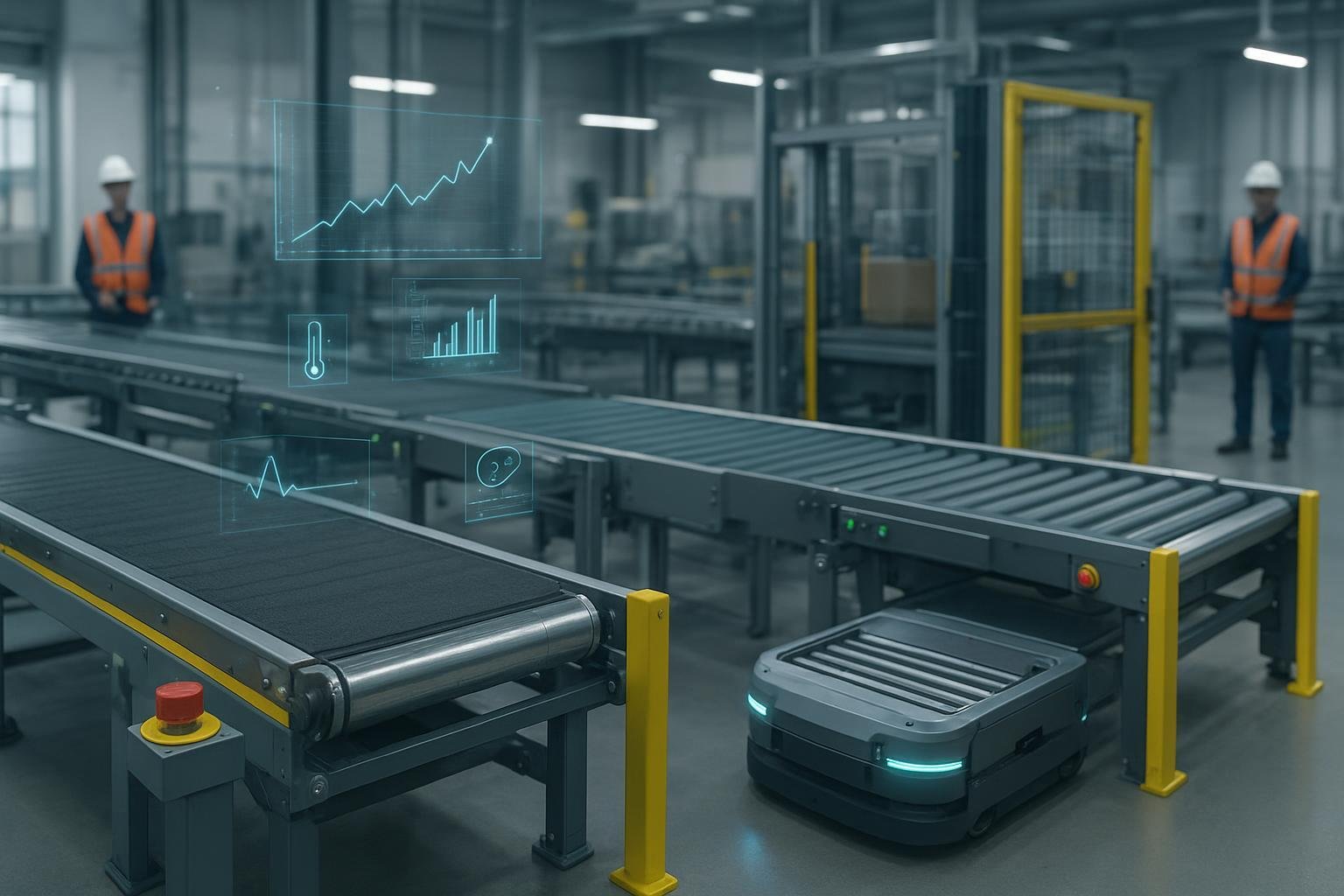
If your factory still treats conveyors as background equipment, 2025 will be a wake‑up call. The next generation of lines runs on data as much as it runs on belts and rollers: drives that modulate power by the second, sensors that spot a failing idler before it seizes, and orchestration layers that choreograph handoffs with AMRs and cobots. The payoff is straightforward—higher uptime, lower energy, and a safety case you can defend.
1) Energy‑aware conveyors: VFDs, zones, and MDR where they fit
Electricity costs and peak demand charges push manufacturers to do more than “turn it off at lunch.” Three upgrades are shaping the energy footprint of factory conveyors:
- Variable‑frequency drives (VFDs) on belt conveyors. Instead of running full tilt, VFDs match speed to demand and enable soft starts that cut inrush current. Regenerative braking on downhill or decelerating sections can feed energy back to the bus or grid in the right configurations.
- Zone control. With photoeyes and zone logic, only the sections with product run. This is standard on motor‑driven roller (MDR) conveyors and increasingly applied to belt segments via distributed drives.
- MDR topologies for assembly and kitting. MDR shines in intermittent, human‑in‑the‑loop flows—quiet, low-voltage, and inherently zoned. For long, high‑load runs, a conventional belt with VFD remains the workhorse.
Think of it this way: the fastest kilowatt-hour saved is the one you never request from the utility. While public, auditable case data remain sparse, industry roundups consistently highlight energy‑aware controls as a leading modernization lever for 2024–2025 manufacturing lines; see this late‑2024 synopsis for factory conveyor trends and sustainability focus (OMTEC, 2024).
Mini checklist: sizing and controls for energy upgrades
- Right‑size motors and gear ratios for actual loads; avoid oversizing that wastes power.
- Add VFDs where duty cycles vary; enable soft starts and braking ramp profiles.
- Implement zone control with photoeyes and sleep timers; measure peak demand before/after.
2) Predictive maintenance that actually cuts downtime
Unplanned stops usually begin as small signals: a hotter‑than‑usual bearing, a roller that vibrates out of spec, a belt that begins to mistrack under load. A practical conveyor PdM stack in factories typically combines vibration on idlers, gearboxes, and motor bearings (tri‑axial accelerometers with FFT features), temperature on bearings and gearboxes (IR or contact sensors), electrical signature analysis from the MCC or VFD (current, power factor, harmonics), and belt tracking/load monitoring via vision or laser sensors. The analytics workflow is straightforward: set baselines and thresholds, detect anomalies, and project remaining useful life (RUL) for planned interventions. Vendor case material shows what’s possible at scale—for example, one engineering‑led program claims an 80% reduction in critical failures and multi‑million‑dollar annual benefits using condition monitoring on long conveyor runs (see the vendor case context here; outcomes vary and require site validation: XMPro, case context). Treat claims like this as directional until you instrument your own line and gather evidence.
To build credibility fast, instrument a single high‑risk span (for example, a loading zone with impact idlers) with vibration and temperature sensors, stream data to a simple dashboard, and compare anomalies against maintenance logs. Use your next planned outage to inspect a component flagged by the system and document the finding—one validated early warning is worth ten slide decks.
Disclosure: BisonConvey is our product. A neutral, component‑level configuration might pair a heavy‑duty belt with low rolling resistance and sealed impact/UHMWPE idlers, outfitted with clip‑on vibration and temperature sensors and operated under VFD zone control; the data feeds into your CMMS for trend alarms. This setup doesn’t guarantee a specific outcome, but it supports earlier fault detection and smoother starts/stops that reduce mechanical shock.
3) Orchestrating conveyors with AMRs/AGVs: architecture and handoffs
Factory flows are getting hybrid: fixed conveyors as the high‑throughput backbone, with AMRs/AGVs handling route‑flexible segments, late‑stage kitting, and changeover buffers. The control stack usually looks like this:
- PLCs maintain deterministic control of conveyors and devices (start/stop, diverters, lifts, zone sensors).
- A WES/WCS decides routing on the conveyor network and exchanges state with PLCs (OPC UA is a common choice for structured data exchange).
- The AMR fleet manager handles missions, traffic, and battery strategy; it talks to the WES/WCS and/or MES via APIs (often REST) and uses telemetry pub/sub (MQTT or AMQP) for status.
At the physical handoff, design explicit handshake signals: conveyor “ready to release,” AMR “in position,” “load secured,” and interlocks that prevent motion if confirmations aren’t met. Transfer cells should have presence sensing, clear guarding, and E‑stop circuits tied into a safety PLC. For mobile systems, ISO 3691‑4:2023 details safety requirements and verification for driverless industrial trucks, including detection performance, braking, and speed zones. A concise explainer is available here: AGV Network on ISO 3691‑4:2023. Integrate E‑stops so a single press brings both conveyor motion and AMR movement to a defined safe state—do not rely on non‑safety network messages for hard stops.
Integration pitfalls to avoid (and what to do instead)
- Treating the fleet manager as a WCS: keep conveyor determinism in PLCs; let WES/WCS arbitrate routes, not the AMR system.
- Skipping handshake states: define and test transfer‑state machines; log every abnormal for root cause.
- Ignoring time sync: use NTP/PTP so events across PLCs, WES/WCS, and fleet logs can be correlated.
4) Safety by design: the 2025 standards baseline
Start with the current U.S. conveyor safety standard: ASME B20.1—2024, which covers design, installation, operation, inspection, and maintenance of conveyors. The 2024 edition clarifies definitions, E‑stop identification, and adds guidance on dust hazards among other revisions; see the official catalogue page for scope and purchasing details: ASME B20.1—2024. In parallel, OSHA’s machine safety rules apply in most U.S. factory settings, including general machine guarding and power‑transmission guarding as well as lockout/tagout (LOTO) for servicing: see OSHA 1910.212 (Machine Guarding) و OSHA 1910.147 (LOTO). Electrical selection and wiring must also meet Subpart S requirements.
If your conveyor cells include industrial robots or collaborative operations, note that the ISO 10218 standard suite was overhauled in 2025. The update replaces the 2011 editions and integrates collaborative guidance previously found in ISO/TS 15066. For a readable summary of what changed and how integrator responsibilities are clarified, see this FAQ from the Association for Advancing Automation (Updated ISO 10218 FAQ, 2025). For AMRs/AGVs, use ISO 3691‑4:2023 as noted above for safety requirements and validation.
| Modernization lever | Primary operational benefits | Standards touchpoints |
|---|---|---|
| VFDs on belt conveyors; regenerative braking | Lower kWh and peak load; smoother starts reduce mechanical shock | ASME B20.1—2024 (drive/guarding guidance) |
| Zone control (photoeyes, sleep timers) | Runs only when product is present; less wear/noise | ASME B20.1—2024 (controls/guarding); OSHA 1910.212 |
| MDR for intermittent assembly/kitting | Inherently zoned, low-voltage, quiet, modular | ASME B20.1—2024; OSHA 1910.147 during servicing |
| PdM sensors (vibration, temperature, ESA, vision) | Earlier fault detection; planned maintenance windows | ASME B20.1—2024 (inspection/maintenance); internal procedures for LOTO per OSHA 1910.147 |
| Conveyor–AMR transfer stations with safety PLC | Reliable handoffs; defined safe states across systems | ISO 3691‑4:2023; ASME B20.1—2024; OSHA 1910.212 |
| Robot/cobot adjacency to conveyors | Controlled collaborative operations; reduced risk | ISO 10218 (2025 update); ISO 13849‑1/IEC 62061 for safety functions |
What to do next quarter
- Meter energy on one representative line, then pilot VFD + zone control on a short belt segment; track kWh and peak demand before/after.
- Deploy a PdM starter kit on a high‑risk span (vibration + temperature + current), wire alarms into your CMMS, and aim to validate one early‑warning prediction.
- Stand up a basic WES/WCS–PLC–AMR handshake at a single transfer cell; log and review every abnormal stop for a month.
- Launch a formal risk assessment across your selected cell and document PLr/SIL targets; align design with ASME B20.1—2024, OSHA 1910, and ISO/IEC selections.
A note on market momentum and refresh cadence
Investment in modern conveyors is not slowing. Industry roundups over the past year point to energy, analytics, and modular integration as the main thrusts for manufacturing lines in 2024–2025. For context, see the OMTEC trend synopsis cited earlier. As for safety standards, keep an eye on the 2025 robot safety updates and verify the latest catalogue entries before final sign‑off. This space moves quickly—set a reminder to revisit your controls and software claims every two months.
Interested in component selection (belts, idlers, pulleys, MDR) that supports energy‑aware controls and condition monitoring? Start a conversation with the engineering team at بيسونكونفي.