Choosing the wrong belt costs you twice—once in unexpected downtime and again in premature replacement. The right choice starts with a disciplined method, not a catalog skim. In this guide, we’ll use a four‑step workflow to get conveyor belt material selection right the first time: define duty and risks, choose the carcass, choose the cover compound and gauges, then verify standards and system compatibility.
Before we start, assemble the basics: material handled, lump size, drop height, conveyor length and tension class, incline, ambient and material temperatures, presence of oils/chemicals, moisture, fire and explosion risk, and site standards or certifications. Most teams can gather this in 1–2 hours on site plus a quick pass through existing maintenance logs. Ready to make a smarter choice without second‑guessing every detail?
Step 1 — Define duty and risks
The belt’s job is simple: carry load without failing. The environment makes it hard. Focus on the stressors that govern both carcass and cover choice.
| Stressor | What to check | Implications for selection |
|---|---|---|
| Abrasion & impact | Abrasive index of material, lump size, drop height | Higher abrasion grade covers; thicker top cover; shock‑absorbing carcass (EP/NN or straight‑warp); consider breakers |
| Tension & distance | Conveyor length, lift, drive power, take‑up travel | Low‑elongation carcass (steel cord or aramid) for long/high‑tension runs; larger pulleys |
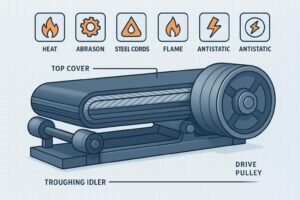
| Heat | Continuous and peak material temperature | Heat‑resistant cover compounds (often EPDM‑based) with class matching; compatible splice materials |
| Oils/chemicals | Oils, fuels, solvents, fertilizers | NBR or specialty oil/chemical‑resistant covers; verify swell data (ISO 1817‑type tests) |
| Fire & explosion | Underground, enclosed spaces, dust or gas zones | Flame‑resistant and antistatic belts; specify EN 12882 class or MSHA Part 14 where applicable |
| Static discharge | Fine organic dusts, ATEX areas | Ensure EN/ISO 284 antistatic compliance (electrical resistance limit) |
| Moisture & washdown | Wet service, underground | PVC/PVG or FR rubber with moisture tolerance; verify class/approval |
Industry notes: In mining/overland, long distances and sharp ore often push you toward steel cord with high‑abrasion covers. In cement, hot clinker demands heat‑resistant covers and compatible splicing. At ports, mixed cargos and dust risks require abrasion‑worthy, antistatic belts; add flame‑resistant classes in enclosed transfers.
Step 2 — Choose the carcass
Carcass is the belt’s backbone. It sets tensile capacity, elongation, impact behavior, and pulley/ splice rules.
| Carcass option | Where it fits | الإيجابيات | Considerations |
|---|---|---|---|
| EP/NN textile (multi‑ply) | Short‑to‑medium runs; moderate tensions; plants and quarries | Good troughing and impact absorption; economical; versatile | Higher elongation (more take‑up); moderate rip/tear vs straight‑warp/steel; confirm pulley diameters |
| Steel cord | Long‑distance, high‑tension, high‑capacity; steep lifts | Very low elongation; high tensile strength; stable tracking | Requires larger minimum pulleys; specialized splicing; protect from corrosion; consider edge care |
| Aramid/straight‑warp | Abusive conditions with sharp lumps and high drops; need high rip/impact resistance at lower mass | Excellent rip/impact resistance; low elongation; lighter belt | Cost and availability; engineering needed for splice design |
| PVC/PVG | Underground coal and damp environments; lower temperatures | Flame and moisture resistance; stable in wet service | Lower heat limits; duty class usually lighter; ensure correct approvals |
For steel cord, minimum pulley diameters rise with rating; for example, published tables show increasing drive/tail/snub diameters by ST class—always verify against the chosen belt’s datasheet. A representative reference is Fenner Dunlop’s steelcord guidance, which lists minimum pulley diameters by ST rating and position in the drive train. See the manufacturer table cited in their steelcord technical sheet.
Helpful perspective: Think of the carcass like the chassis of a truck—over‑spec it for distance and load, and your “ride” becomes stable and efficient; under‑spec it, and every bump (impact) and hill (tension) strains the frame.
Step 3 — Conveyor belt material selection for covers and gauges
Covers protect the carcass and deliver wear life. Match compound to conditions, then select sensible top/bottom gauges.
| Condition | Typical compound choice | Standards context | Notes |
|---|---|---|---|
| DIN 22102 abrasion grades | High‑abrasion rubber compounds mapped to DIN 22102 grades (Y/W/X) or ISO 14890 families | Abrasion measured via ISO 4649 (or DIN 53516) | Request abrasion test report and grade; increase top cover gauge for sharp, fast‑wear materials |
| Heat | EPDM‑based or equivalent heat‑resistant rubber; classes noted in catalogs (e.g., T150/T200) | Heat aging often classified with ISO 4195‑type tests | Confirm continuous and peak ratings; ensure splice rubber matches heat grade |
| Oil/chemicals | NBR‑based or specialty blends for fuels, oils, fertilizers, chemicals | Swell tested per ISO 1817‑type methods (manufacturer reports) | Ask for volume swell % at relevant temperature/time; PVC/PU may fit some cases |
| Flame/antistatic | Flame‑resistant with antistatic properties | EN 12882 categories/classes (EU); ISO 284 antistatic; MSHA Part 14 (U.S. underground coal) | Specify required category/class; for U.S. underground coal, verify MSHA approval number |
| Moisture/underground | PVC/PVG belts or FR rubber belts per safety class | EN 12882 for surface/underground contexts; site rules apply | Confirm electrical resistance and flame performance certificates |
Gauge rules of thumb: Most wear occurs on the top cover. Common combinations are 3+1.5 mm, 4+2 mm, and 6+2 mm depending on duty; heavier abrasion/impact justifies thicker top covers. Avoid over‑thickening without need—it raises weight and energy consumption.
Step 4 — Verify conveyor belt material selection and system fit
Good specs are provable. Close the loop by requesting documents and checking the belt against your system.
What to request in your RFQ and from delivered goods (presented as copyable fields within your text editor): carcass type and rating (e.g., EP 500/3; ST1000; aramid), elongation at reference load, cover compound and grade (DIN/ISO abrasion grade; heat grade/class; oil resistance test result), flame and antistatic category (EN 12882 class; EN/ISO 284 result), cover gauges (top + bottom) and total thickness, minimum pulley diameters by position, splice method and materials, and copies of test certificates (ISO 4649 abrasion, ISO 4195 heat classification or equivalent, EN/ISO 284 electrical resistance, EN 12882 class report, and if applicable, MSHA Part 14 approval number).
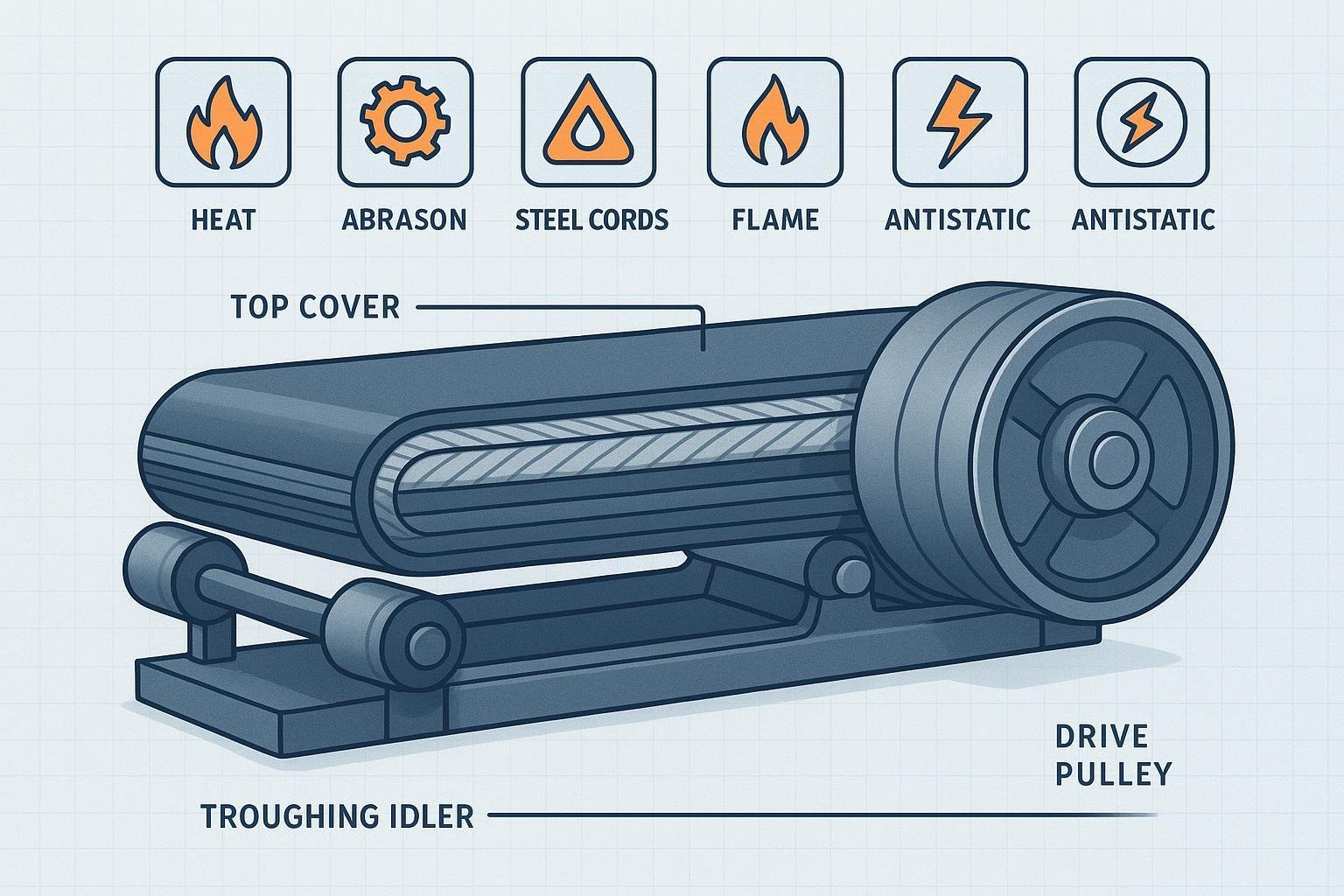
Also check system fit: confirm pulley diameters vs carcass type; ensure idler troughing and belt stiffness match; verify splice method compatibility (mechanical vs vulcanized) and compound compatibility for heat‑resistant belts. Finally, measure delivered cover thicknesses and compare to your specification and tolerances. Why risk a mismatch when a few checks now can save weeks of downtime later?
Practical example
A bulk handling team needs a 1,000 m conveyor to move sharp, abrasive ore with moderate inclines. After assessing duty (high abrasion, significant impact, moderate‑long distance), they shortlist a steel cord carcass for low elongation and capacity stability, paired with a high‑abrasion top cover. They confirm minimum pulley diameters from the manufacturer’s datasheet, specify the abrasion grade and a 6+2 mm gauge, and request ISO 4649 results along with EN/ISO 284 antistatic compliance. A supplier such as بيسونكونفي can support this specification by matching carcass rating, cover grade, and supplying the relevant certificates and splice recommendations. The team avoids under‑sizing pulleys and receives a belt that tracks and wears as expected.
Troubleshooting quick reference
| Symptom | Likely cause | Material/system fix |
|---|---|---|
| Rapid top cover wear | Cover grade too soft for duty; inadequate top gauge | Specify higher abrasion grade and increase top cover thickness; improve chute lining and material flow |
| Edge fraying or cupping | Mis‑tracking; insufficient belt stiffness | Check idler alignment and loading; consider stiffer carcass or breaker plies |
| Frequent splices failing | Incompatible splice materials or method; poor cure | Align splice method with carcass; use heat‑compatible splicing compounds; audit vulcanizing procedure |
| Belt elongation exceeds take‑up | Textile belt over‑stressed for distance/tension | Move to steel cord or aramid; increase take‑up travel |
| Cracking on hot load | Non‑heat‑resistant covers or wrong class | Select heat‑resistant compound with correct class; verify splice compound compatibility |
| Swelling/softening with oils | General‑purpose rubber exposed to oils | Choose NBR‑based oil‑resistant covers; request ISO 1817 swell data |
| Static shocks or dust ignition concern | No antistatic compliance | Specify EN/ISO 284 antistatic and verify resistance certificate |
| Fire propagation risk in enclosures | Non‑FR or wrong class | Specify EN 12882 class for environment or MSHA Part 14 for U.S. underground; verify documentation |
Conveyor belt material selection and standards you can trust
Two final checks make selections stick: evidence and compatibility. Request certificates that name the standard and show the test result, then make sure pulleys, idlers, and splices match your carcass and cover choices. How long does this take? Typically 1–2 days to draft and circulate an RFQ and 1–2 weeks for samples or test documentation, depending on suppliers.
Further reading and references (authoritative sources):
- ISO catalog entry for textile conveyor belts (ISO 14890) clarifies scope for general‑purpose, rubber/plastic‑covered belts: see ISO’s official index for ISO 14890.
- DIN‑style abrasion grading and test methods are explained by manufacturers referencing ISO 4649; see Dunlop’s overview of abrasion standards and test methods.
- Antistatic compliance relies on electrical resistance limits; Dunlop and Fenner Dunlop outline EN/ISO 284 with practical thresholds; start with Dunlop’s anti‑static cover explanation.
- For EU fire/antistatic categories, manufacturers map belts to EN 12882; Fenner Dunlop provides an EN 12882 explainer.
- For U.S. underground coal, MSHA requires Part 14 approval—verify on the belt and against MSHA’s eCFR Part 14 regulation.
If you capture the duty, pick a carcass that fits the tension and distance, choose the cover compound and gauges for your conditions, and verify the standards and system fit, you’ll dramatically cut the risk of early failures. Ready to move from specs to samples? Share your RFQ with shortlisted suppliers and request test certificates up front—your maintenance team will thank you.