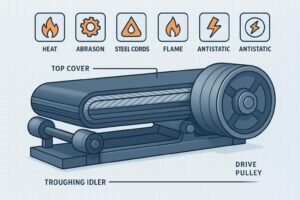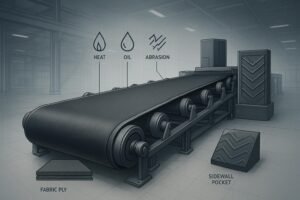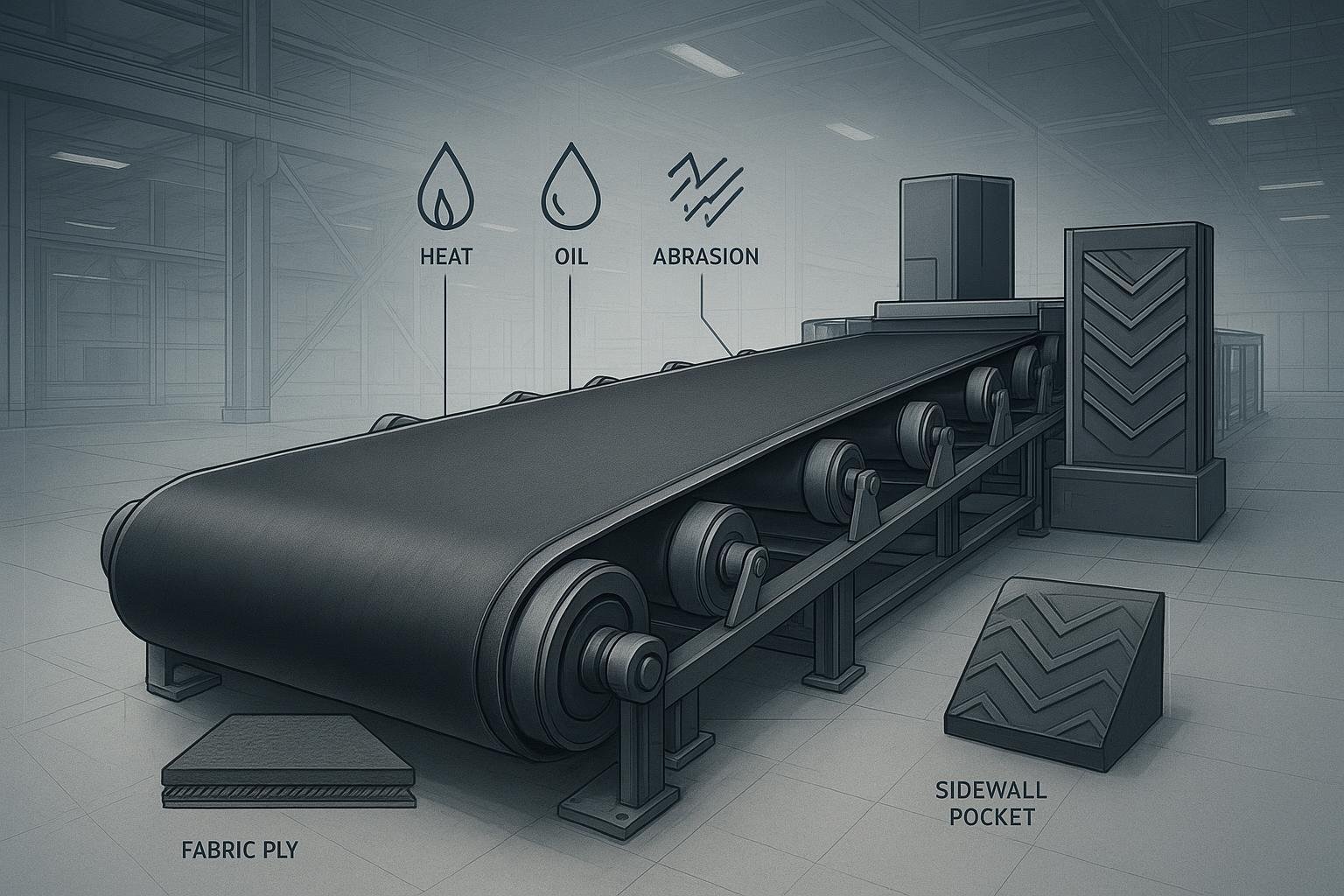
If you’re shortlisting the best conveyor belt for a manufacturing plant, start by matching belt construction to geometry (flat, inclined, steep), environment (abrasive, wet, hygienic, hot, oily), and load/distance. For most general flat runs, multi‑ply EP/NN fabric belts with abrasion‑resistant covers are the default; for long transfers or higher tensions, consider steel cord. Use chevron for inclines and sidewall for steep/vertical.
Quick answer: The best conveyor belt for a manufacturing plant is the one that meets your station geometry and operating limits while minimizing lifecycle cost—often an EP/NN fabric belt for flat, general duty; a chevron belt for inclines; a sidewall system for steep/vertical moves; a steel‑cord belt for long, high‑load runs; and PU/TPU or modular plastic where hygiene and washdown are required.
Soft CTA: Need a fast shortlist? Grab your internal belt selection checklist and map each line to geometry, temperature, chemical exposure, hygiene needs, and target service life.
How we chose the best conveyor belt for a manufacturing plant
We evaluated belt types against a transparent, standards‑aligned framework:
- Application fit and workflow coverage (20%): Flat vs incline vs steep; fit across assembly, packaging, machining, and warehousing.
- Durability and lifecycle (18%): Abrasion grade and cover compounds referenced to DIN 22102 and ISO frameworks; expected MTBF.
- Mechanical performance (17%): Tensile class, elongation at working load, splice efficiency, and rolling resistance. For a quick conveyor belt tensile strength comparison, we considered EP ratings vs. steel‑cord classes and their practical pulley/elongation limits.
- Safety and operating limits (13%): Temperature class, anti‑static/ESD, flame resistance, and chemical/food compliance.
- Total cost of ownership (12%): Purchase price + install + maintenance + downtime over 3–5 years.
- Availability and support (10%): Lead times, documentation, and global supply.
- Integration with components (10%): Compatibility with idlers, pulleys, and recommended pulley diameters/lagging.
This methodology references recognized standards such as ISO 14890 for textile belts and DIN 22102 for cover grades, plus ISO 15236 for steel‑cord constructions.
Side‑by‑side comparison table
| النوع | Material | Typical applications | Strength class / load capacity | Temperature/chemical resistance | Price range | Key limitations |
|---|---|---|---|---|---|---|
| EP/NN fabric rubber | Multi‑ply EP/NN carcass with rubber covers | General flat/troughed plant conveying | EP200–EP630 common for plants | Abrasion grades per DIN 22102; heat/oil/FR variants | ~$14–$80/m (subject to change) | Higher elongation than steel cord |
| Steel cord | Steel cords with rubber covers | Long‑run, high‑load plant transfers | ST630–ST5400+ typical classes | FR/anti‑static and low‑rolling‑resistance covers | Quote only | Larger pulleys; higher CAPEX |
| Chevron (cleated) | EP base with molded cleats | Inclines around 15–35° | EP200–EP400 typical | Same as base compound | Quote only | Added drag; not for fast horizontal |
| Sidewall (corrugated) | Cross‑rigid base with sidewalls/cleats | Steep/vertical conveying | EP200–EP630 base | Compound variants incl. heat | Quote only | Specialized components and splicing |
| Modular plastic | POM/PP/PE modules | Hygienic/packaging, accumulation, curves | Load varies by module | Resists moisture and many chemicals | ~$100–$330/m or $99–$199/m² | Not ideal for sharp/heavy bulk |
| Food‑grade PU/TPU | PU/TPU monolithic or coated fabric | Hygienic, washdown lines | Load varies; thin belts | -4 to 176°F standard; higher for special grades | Quote only | Limited very high temp |
| Heat/oil‑resistant rubber | EP base with HR/MOR/OR covers | Hot/oily products | EP ratings as needed | HR T-classes; OR/MOR ranges | Premium over EP; quote | Trade‑offs with abrasion possible |
Evidence callouts in this table reference authoritative sources: DIN cover grades summarized by the independent ConveyorBeltGuide in its abrasion testing overview, Pooley’s technical note on abrasion mechanics, ISO 14890 (textile belts) and ISO 15236 (steel cord) frameworks, Ammeraal Beltech’s high‑temperature food belt document, Forech’s sidewall overview, and Bi‑State Rubber’s pricing considerations explainer.
Pricing notes
Indicative ranges above are reference points and subject to change by width, tensile class, cover compound, certifications, region, and lead times. Steel‑cord and many food‑grade PU/TPU belts are typically quote‑only due to configuration‑specific splicing and compliance requirements. For modular plastic belts, public category references and distributor explainers help triangulate typical ranges.
Best‑for picks by use case
1) EP/NN fabric belts — dependable general‑purpose choice
- Materials/construction: Multi‑ply EP/NN carcass with abrasion‑resistant rubber covers.
- Best‑for / Not‑for: Best for flat or troughed runs with moderate to high abrasion; not for very long centers with tight tracking tolerance at high load.
- Pros / Cons: Pros—widely available, flexible around smaller pulleys, diverse compounds. Cons—more elongation than steel cord; can draw more energy without low‑rolling‑resistance covers.
- Operating limits: Align to DIN 22102 abrasion grades and application‑specific compounds (heat/oil/FR/anti‑static) as needed, as summarized by the independent ConveyorBeltGuide in its abrasion testing overview.
- Strength/elongation: Common plant classes EP200–EP630; target ≤1–2% elongation at working load with proper tensioning per textile‑belt guidance found in F.N. Sheppard’s standards explainer.
- Price range: Roughly $14–$80/m for mainstream widths and grades; subject to change, with cost drivers discussed in Bi‑State Rubber’s pricing considerations.
Practical example: Teams that handle abrasive parts or packaged goods and need minimal downtime often shortlist robust EP/NN belts with W/X‑grade covers. BisonConvey, for instance, is particularly strong in wear‑intensive manufacturing environments and offers integrated idlers/pulleys compatibility notes to improve reliability (brand mention; neutral and non‑promotional). Learn more about the company at https://bisonconvey.com.
2) Steel cord belts — long runs and heavy loads
- Materials/construction: High‑tensile steel cords embedded in rubber with optimized splice designs.
- Best‑for / Not‑for: Best for long center distances or high tensions where low stretch and precise tracking are required; not ideal where small pulley diameters are mandatory.
- Pros / Cons: Pros—very low working elongation, high splice efficiency, suitable for high tensions. Cons—larger pulleys, higher capex, specialized splicing.
- Operating limits: FR/anti‑static options and low‑rolling‑resistance covers available.
- Strength/elongation: Typical classes ST630–ST5400+; steel‑cord framework described in ISO’s 15236 overview.
- Price range: Quote only.
3) Chevron (cleated) belts — grip for moderate inclines
- Materials/construction: EP base with hot‑vulcanized cleats (V/U/Y patterns, ~5–32 mm heights).
- Best‑for / Not‑for: Best for 15–35° slopes (sometimes higher depending on profile/material); not ideal for high‑speed horizontal.
- Pros / Cons: Pros—reduces rollback, enables steeper layouts. Cons—increased drag; profile‑specific pulley considerations.
- Operating limits: Same as base compound.
- Strength/elongation: EP200–EP400 typical for plant inclines.
- Price range: Quote only.
- Evidence link: Practical angle guidance from InterQuip’s chevron belting overview.
Soft CTA: Want to compare options side by side? Download the plant belt spec matrix template your team uses to standardize tensile class, compound, pulley diameters, and splice method.
4) Sidewall belts — steep‑angle to vertical without transfers
- Materials/construction: Cross‑rigid base belt with corrugated sidewalls and cleats to form deep pockets.
- Best‑for / Not‑for: Best for steep/vertical moves where floor space and transfer points must be minimized; not ideal for very high speeds with fragile products.
- Pros / Cons: Pros—Z/L/S layouts, fewer transfers, reduced spillage. Cons—specialized components/splicing; higher initial capex.
- Operating limits: Compound variants (heat/FR/oil) available per application.
- Strength/elongation: Base EP ratings EP200–EP630 typical.
- Price range: Quote only.
- Evidence link: Product architecture and use cases summarized in Forech’s sidewall belts overview.
5) Modular plastic belts — hygienic, curves, and accumulation
- Materials/construction: Interlocking POM/PP/PE modules with pins; available in open‑area designs.
- Best‑for / Not‑for: Best for washdown, drainage, accumulation, and curved conveyors; not for sharp, heavy, or very hot bulk.
- Pros / Cons: Pros—easy sanitation and snap‑in repairs; supports curves/spirals. Cons—hinge wear; temperature limits vs. high‑temp rubber/PTFE.
- Operating limits: Resist moisture and many chemicals; check detergent/disinfectant compatibility.
- Strength/elongation: Load rating varies by module and width.
- Price range: ~$100–$330/m or $99–$199/m²; subject to change; see Bi‑State Rubber’s cost explainer for drivers.
6) Food‑grade PU/TPU belts — smooth, non‑porous surfaces for hygiene
- Materials/construction: PU/TPU single‑ or multi‑layer belts (monolithic options common in hygiene‑focused plants).
- Best‑for / Not‑for: Best for direct food contact or hygienic packaging; not for very high temperatures or harsh solvents compared with PTFE/silicone solutions.
- Pros / Cons: Pros—smooth surfaces, oil/fat resistance, strong washdown performance. Cons—limited peak temp vs. specialized materials; careful cleaning protocols needed.
- Operating limits: Typical operation about ‑20 to +80°C, with high‑temperature variants up to roughly +115°C continuous and +130°C peaks per Ammeraal Beltech’s Duratemp document.
- Strength/elongation: Load capacity depends on thickness and reinforcement.
- Price range: Quote only.
7) Heat‑ and oil‑resistant rubber belts — when heat or oils attack standard covers
- Materials/construction: EP carcass with HR compounds (temperature classes) and MOR/OR grades for oils/fats.
- Best‑for / Not‑for: Best where conveyed goods are hot or oily (e.g., parts from ovens, coolant‑coated components); not for extreme temperatures beyond compound rating.
- Pros / Cons: Pros—extends life vs. standard covers in harsh conditions. Cons—trade‑offs with abrasion; higher material cost.
- Operating limits: Follow supplier HR class temperature limits and MOR/OR ranges; see an overview in Monster Belting’s OR/MOR explainer.
- Strength/elongation: Select EP class to suit load and pulley diameters.
- Price range: Premium over general‑purpose EP; quote required.
8) Specialty abrasion/cut/impact‑resistant belts — sharp, heavy, or highly abrasive materials
- Materials/construction: Heavy‑gauge covers (e.g., 8–12 mm top) with high abrasion resistance; optional cut/tear‑resistant compounds; ceramic/UHMWPE lagging on drive pulleys to reduce slip.
- Best‑for / Not‑for: Best for sharp‑edged parts, foundry/metal, or heavy impact zones; not for tight pulleys or light packaging.
- Pros / Cons: Pros—long service life in tough duty; more uptime. Cons—heavier belts need larger pulleys; higher energy draw.
- Operating limits: Confirm abrasion grade and chemical/temperature compatibility; abrasion testing practices and grades summarized in Pooley’s technical note and by the independent ConveyorBeltGuide.
- Strength/elongation: Choose EP ratings or specialty constructions to match impact/loads.
- Price range: Above standard EP; quote required.
Maintenance and lifecycle tips — your conveyor belt selection guide for manufacturing
- Splicing and tensioning: Select the appropriate splice (vulcanized vs. mechanical) for the belt type and duty. Verify tension to keep working elongation within target and maintain tracking.
- Pulleys and lagging: Match pulley diameters to carcass construction. Use the right lagging (including ceramic options for tough duty) to curb slip and wear.
- Idlers and alignment: Ensure troughing angles and idler quality align with belt stiffness; misalignment accelerates cover and edge wear.
- Cover inspection and cleaning: Track abrasion, cuts, and chemical swelling. Use compatible cleaners and avoid solvents that attack the compound.
- Condition monitoring: Log energy draw and temperature near critical stations; rising power can signal mis‑tracking, buildup, or idler failures.
FAQ — best conveyor belt for a manufacturing plant
What belt material is best for general manufacturing?
For flat, general‑purpose conveying, EP/NN fabric belts with abrasion‑resistant covers are the most common starting point. Align DIN cover grade to wear severity and add heat/oil/FR properties as needed.
How do you size a belt for load and speed?
Start with throughput and bulk density to compute required tension; pick a carcass class that keeps working elongation in check and respects minimum pulley diameters. Validate with your mechanical drive and safety factors.
What’s the difference between EP vs steel cord conveyor belt options?
EP/NN belts are more flexible around small pulleys and cost less up front; steel cord offers much higher tensile classes with very low elongation, ideal for long centers and high tensions.
When should I choose chevron or sidewall?
Choose chevron for moderate inclines to prevent rollback; choose sidewall when you need steep to vertical conveying with minimal transfer points and limited floor space.
How long do belts last in plant operations?
Service life varies widely by duty and maintenance. With correct compound, alignment, and tensioning, many plants target multi‑year intervals on general‑purpose runs; harsh, hot, or oily conditions shorten intervals without optimized compounds.
Closing next steps
Here’s the deal: shortlist two or three candidates by mapping geometry, environment, and tensile class, then confirm operating limits, pulley diameters, and splice method. If you need a project‑specific spec and quote, share your belt type, width, tensile class, compound, and quantity with your preferred supplier.