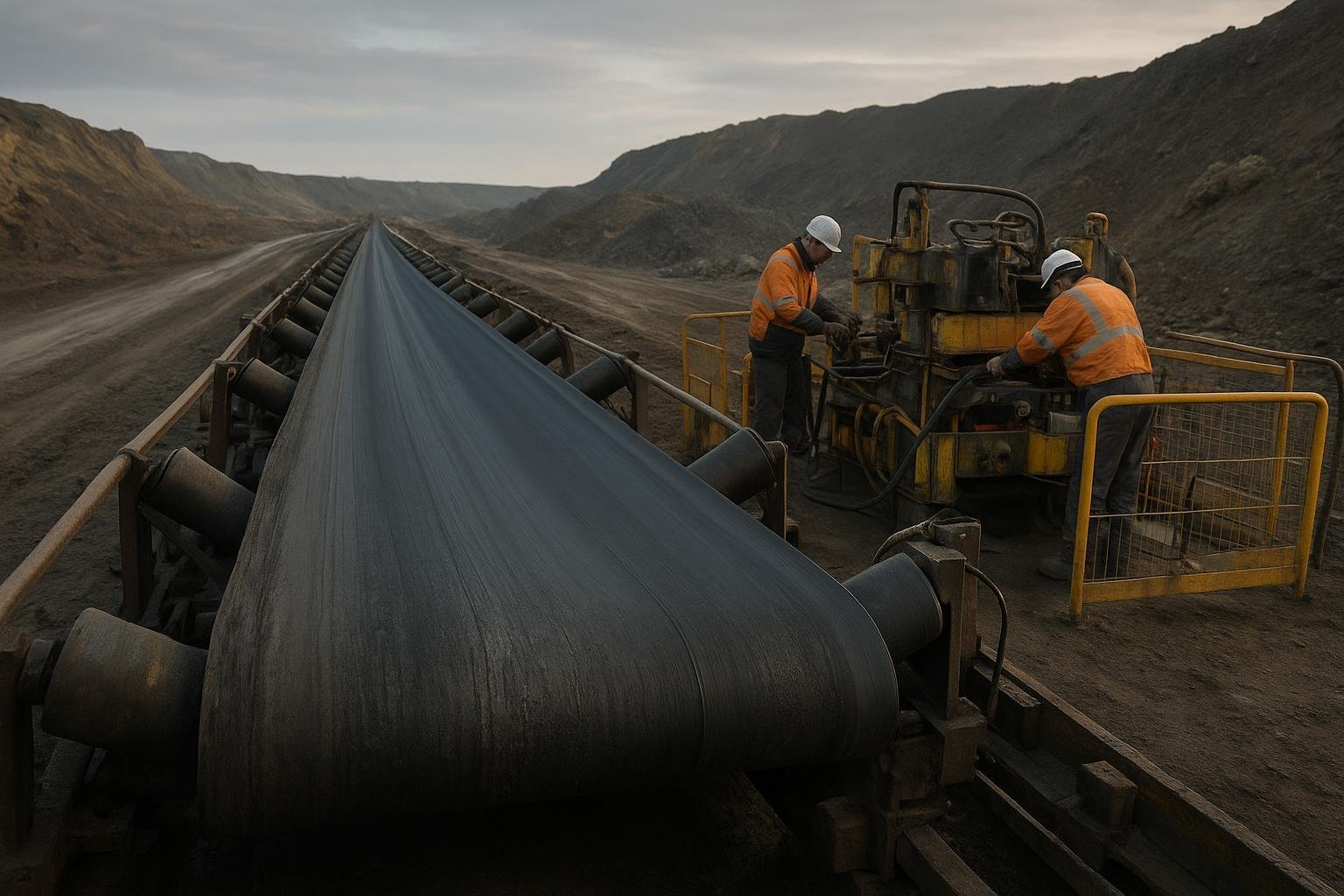
When a heavy‑duty conveyor belt starts to wear, plant teams face a familiar choice: recoat the covers or replace the belt outright. This guide gives an engineer‑to‑engineer comparison so you can make a confident, auditable decision that balances downtime, risk, and lifecycle cost.
TL;DR verdict
If the belt’s carcass is structurally sound and your planned outage allows controlled curing, recoating can restore protective covers cost‑effectively while reducing waste. If you see carcass delamination, steel‑cord damage, or chronic splice issues—or you must minimize critical‑path time with a staged spare—replacement is the safer, faster reset. Always verify with adhesion testing and, for steel‑cord belts, non‑destructive testing.
- Carcass sound and ESG priority → choose recoating.
- Structural damage or persistent splice failures → choose replacement.
- Uptime paramount with a spare on hand → choose replacement.
- Long lead times for new belts but shop capacity available → choose recoating.
How the two options work
Recoating restores the belt’s top and/or bottom covers through hot vulcanization on site or in a press shop, or through limited cold‑cure methods. The carcass—EP/NN fabric plies or steel cords—remains in service, so structural integrity is the gating prerequisite. Quality hinges on surface prep, compound match to duty, cure temperature/pressure/time, and post‑cure testing.
Replacement installs a new belt—textile or steel‑cord—resetting structure, splices, and warranty terms. With a staged spare, change‑outs can be scheduled to compress critical‑path time because you avoid cure windows on the line. For long overlands, replacements are planned like capital projects and measured in days.
Belt recoating vs replacement at a glance
Ordering logic for this table: we show lowest expected downtime scenarios first, then lowest expected cost scenarios. Risk level reflects process variability and the consequences of failure.
| Method | Structural prerequisite summary | Expected life uplift | Typical all‑in cost range | Typical downtime | QA controls required | Splice impact | Performance suitability notes | Warranty expectations | Environmental impact | Logistics and lead time | Risk level | Best for | Notes and evidence |
|---|---|---|---|---|---|---|---|---|---|---|---|---|---|
| Replacement — New textile belt | Not applicable; new structure | 100% of new | Assumption only, varies by width/length and compound | Often shorter when a spare is staged and line access is good | Factory QA plus site splice QA if endless on site | New splices as per method statement | Select covers to duty class; DIN X Y W, heat, oil as needed | Typically clearer and standardized by OEM | Entire old belt mass scrapped unless recycled | Lead time depends on stock; swap‑in is predictable | Low | Outages with staged spares and tight critical paths | Shorter critical‑path vs curing supported by Flexco’s discussion of vulcanization downtime; overland change‑outs measured in days per IM‑Mining case |
| Replacement — New steel‑cord belt | Not applicable; new structure | 100% of new | Assumption only, varies with ST rating and width/length | Overlands measured in days; detailed planning required | Factory QA; splices per ISO 15236 context | New steel‑cord splices | Compound to duty; heat and abrasion trade‑offs | Typically defined by OEM | High waste unless recycled | Lead times can be significant; plan ahead | Low to medium | Long overland conveyors and end‑of‑life carcasses | IM‑Mining documents a 3.2 km change‑out in 5 days after upgrades |
| Recoating — Off‑site press | Carcass must pass adhesion and NDT checks where applicable | Often a significant share of new, dependent on compound and duty | Assumption only, depends on compound and shop labor | Plant downtime limited to removal and reinstall; recoating happens in parallel off‑line | ISO 252 peel tests on samples, cure logs, post‑cure inspection | Existing splices assessed; some may be renewed | Good fit where abrasion drives wear; match compound to duty | Variable by provider; get terms in writing | Avoids scrapping whole carcass; lower waste | Shop scheduling affects lead time; transport required | Medium | Plants constrained by new‑belt lead time but able to run parallel refurbishment | Adhesion guidance and testing context per ConveyorBeltGuide; ESG waste upside per Agg‑Net |
| Recoating — On‑site hot vulcanization | Same as above; structural integrity and splice health verified | Similar to off‑site when executed well | Assumption only; field labor and mobilization add cost | Often eight hours or more due to cure and cooling, increasing with thickness and length | ISO 252 peel, cure temperature and pressure logs, in‑situ inspection | Splices inspected; may be renewed under controlled heat | Effective for targeted sections and planned outages | Variable by provider; define scope | Reduces waste versus full replacement | Mobilization, access, and press size drive schedule | Medium to high | Planned shutdowns where carcass is sound and ESG is a goal | Flexco notes practical minimum downtime for vulcanized work; adhesion testing per ConveyorBeltGuide |
| Recoating — Cold‑cure targeted repairs | Carcass must be intact; use for limited areas | Modest life extension; not equal to hot‑cure | Lower materials cost; high variability | Shortest field time; local cure windows | Surface prep QA; adhesion checks where feasible | No splice change unless targeted | Temporary mitigation; not for severe duty | Limited warranty scope | Minimal waste | Fast to mobilize | High | Interim repairs before a scheduled major outage | Use sparingly; pair with inspection program |
Evidence links referenced in the table and throughout the article:
- Adhesion and peel test context for textile belts from ConveyorBeltGuide’s overview of ISO 252 methods and typical minima guidance: see the section on testing and “normal minimum requirements” for ply‑ply and cover‑ply adhesion in N/mm in the industry summary at the ConveyorBeltGuide testing page.
- Steel‑cord splice design and testing context summarized in ISO 15236 discussions: see the overview of steel‑cord splices and the note that splice strength used for design is reduced relative to belt strength on the ConveyorBeltGuide page, plus an EN ISO 15236 product brochure reference from Dunlop/Technobalt.
- Downtime realities for hot vulcanization and the general hierarchy versus mechanical or swap‑in approaches discussed by Flexco.
- Overland change‑out scale exemplified by IM‑Mining’s report of a 3.2 km replacement in five days after upgrades at Hidden Valley Mine.
- Environmental and waste footprint context from Agg‑Net’s analysis of belt manufacturing and recycling.
- NDT methods for steel‑cord diagnostics overviewed in the peer‑reviewed Sensors survey on PubMed Central.
Cited sources:
- According to the industry summary on adhesion testing, typical “normal minimum requirements” and ISO 252 method context are described on the ConveyorBeltGuide testing overview: https://www.conveyorbeltguide.com/testing.html
- Steel‑cord splice design principles and reduced splice strength usage are summarized on the ConveyorBeltGuide steel‑cord splice page, with EN ISO 15236 brochure context: https://www.conveyorbeltguide.com/st-splices.html and https://technobalt.com/app/uploads/steelcord_EN_2018_CR.pdf
- Flexco discusses practical minimums for vulcanized work and cure‑time realities in their blog on vulcanization versus mechanical fastening: https://www.flexco.com/EN/Blogs/HDMBF/Split-Decision-Learn-the-Truth-Behind-Vulcanization-vs.-Heavy-Duty-Mechanical-Fastening.htm
- International Mining reports the Hidden Valley overland change‑out timeline after upgrades: https://im-mining.com/2021/02/18/innovative-conveyor-upgrade-improves-safety-throughput-hidden-valley-mine-png/
- Agg‑Net provides a macro view of waste and recycling challenges that life extension strategies can reduce: https://www.agg-net.com/resources/articles/materials-handling/reducing-the-carbon-footprint-of-industrial-conveyor-belt-manufacture
- The peer‑reviewed Sensors survey outlines NDT techniques for steel‑cord belt diagnostics, including detection matrices and cautions on false negatives: https://pmc.ncbi.nlm.nih.gov/articles/PMC12158312/
How to choose in the belt recoating vs replacement decision
Start with structure. Ask, is the carcass sound? For textile belts, pull witness samples and perform peel‑adhesion checks consistent with ISO 252 methods. Industry‑typical acceptance guidance cited in trade sources is around 6 N/mm between plies and about 4.5 N/mm between cover and ply on samples. For steel‑cord belts, run non‑destructive testing—magnetic flux leakage for cord breaks and corrosion, and X‑ray or ultrasound where needed—to confirm cord and splice integrity, then review splice designs against ISO 15236 practices.
If the carcass passes, compare downtime windows and TCO. When off‑site recoating can proceed in parallel and your outage is mostly removal and re‑install, recoating is compelling. When uptime is paramount and a spare is staged, replacement shortens the critical path because you avoid on‑line curing. Think of it this way: curing locks your conveyor in place; a swap‑in belt shifts that time off the line.
Add quality controls. Require cure logs showing temperature, pressure, and time; document post‑cure inspections; and perform peel tests on samples. For any new or renewed splice, record thermal profiles and execute pull tests where your procedure allows destructives. Plan a re‑inspection after 24–72 hours of runtime to catch early defects like blisters or tracking‑induced edge damage.
Safety first. Both options involve hot work, working at heights, lockout/tagout, and heavy lifts. Build a job hazard analysis, secure permits, and enforce exclusion zones. One avoidable incident will erase any cost advantage.
Costs and downtime in 2026 (assumptions; validate by RFQ)
Time‑stamped as of March 7, 2026 and subject to change. Public, apples‑to‑apples price lists for recoating versus new belts are scarce; treat the following as planning assumptions pending RFQs and site logs.
Field realities in brief: Recoating off‑site shifts most time off the line; on‑site hot recoating requires cure and cooling windows often eight hours or more for substantial work; replacement with a staged spare can deliver the shortest critical path on plant conveyors, while overland replacements still take days even with optimized systems.
Because every site’s hourly production loss is unique, the quickest way to quantify break‑even is to model both scenarios with your actual $/hour downtime, mobilization, belt geometry, and compound cost assumptions.
Operating conditions and compound selection
Match the cover compound to duty or all bets are off. Abrasion‑resistant grades follow DIN 22102 classes like X, Y, and W; heat resistance follows ISO classes, and heat‑optimized formulas can trade abrasion for temperature endurance. OEM materials note that premium compounds can maintain abrasion performance while meeting elevated temperature classes; review datasheets and test values rather than relying on labels alone. A practical approach is to map your dominant failure mode—abrasion, impact, heat, oil/chemical exposure, ozone/UV—and select a compound specifically engineered for it.
Environmental, warranty, and logistics considerations
Recoating preserves the carcass and avoids scrapping the full belt mass, which reduces waste and transport emissions. Macro analyses of the sector point out that recycling rates for industrial belts lag well behind automotive tires, so any credible life‑extension program meaningfully improves your footprint.
Warranty scope varies widely. Replacement usually comes with clear OEM terms; recoating warranty terms depend on provider maturity, test documentation, and service scope. Time‑stamp warranties in your contracts and align acceptance tests with your QA plan.
Logistics can tilt the decision. New‑belt lead times ebb and flow with global supply chains. If a suitable spare is staged, replacement may be the pragmatic path for uptime. If new‑belt availability is tight but a qualified shop can schedule recoating promptly, parallel processing can keep the plant running on alternate sections while refurbishment proceeds.
FAQ
What tests prove a conveyor belt carcass is fit for recoating? For textile belts, perform peel‑adhesion tests consistent with ISO 252 methods on witness samples, using the industry‑typical acceptance guidance cited in trade sources. For steel‑cord belts, apply NDT such as magnetic flux leakage, X‑ray, or ultrasound to verify cords and splices, and review splice designs against ISO 15236 practices.
How much downtime does hot vulcanization take compared with replacing a belt? Hot vulcanization requires cure and cooling time; practical downtime is often eight hours or more for substantial work. Replacement with a staged spare frequently shortens the critical path on plant conveyors because it avoids on‑line curing, though overland change‑outs still take days.
Can steel‑cord belts be recoated safely? Limited cover restoration and patching are feasible when NDT confirms cord and splice integrity. If cords are exposed, corroded, or broken, or splices are unreliable, replacement is typically recommended to reset structural integrity.
How many times can you recoat a belt? There is no universal numeric limit in public standards. The gating factors are carcass health, splice strategy, and geometry. If adhesion stays within acceptable ranges and the belt can accept further cover removal and addition, additional recoating cycles may be considered following inspection.
Does recoating affect splice integrity? It can if splices are reheated or renewed. Manage heat input, document thermal profiles, and verify with pull and peel tests. For steel‑cord splices, design and testing should align with ISO 15236 context.
Also consider
Some operators look for a single partner who can support both paths. BisonConvey provides heavy‑duty belts, idlers, pulleys, and maintenance guidance, and can recommend recoating or replacement based on carcass health and outage constraints. Visit https://bisonconvey.com
Closing thoughts
Choose the path that fits your carcass condition, outage window, and risk tolerance—then back it with documented QA. Build your method statement, specify the compound to the duty, require cure and inspection records, and schedule a 24–72 hour re‑inspection after restart. When in doubt, bring in a qualified inspector to validate structure before committing to either option.