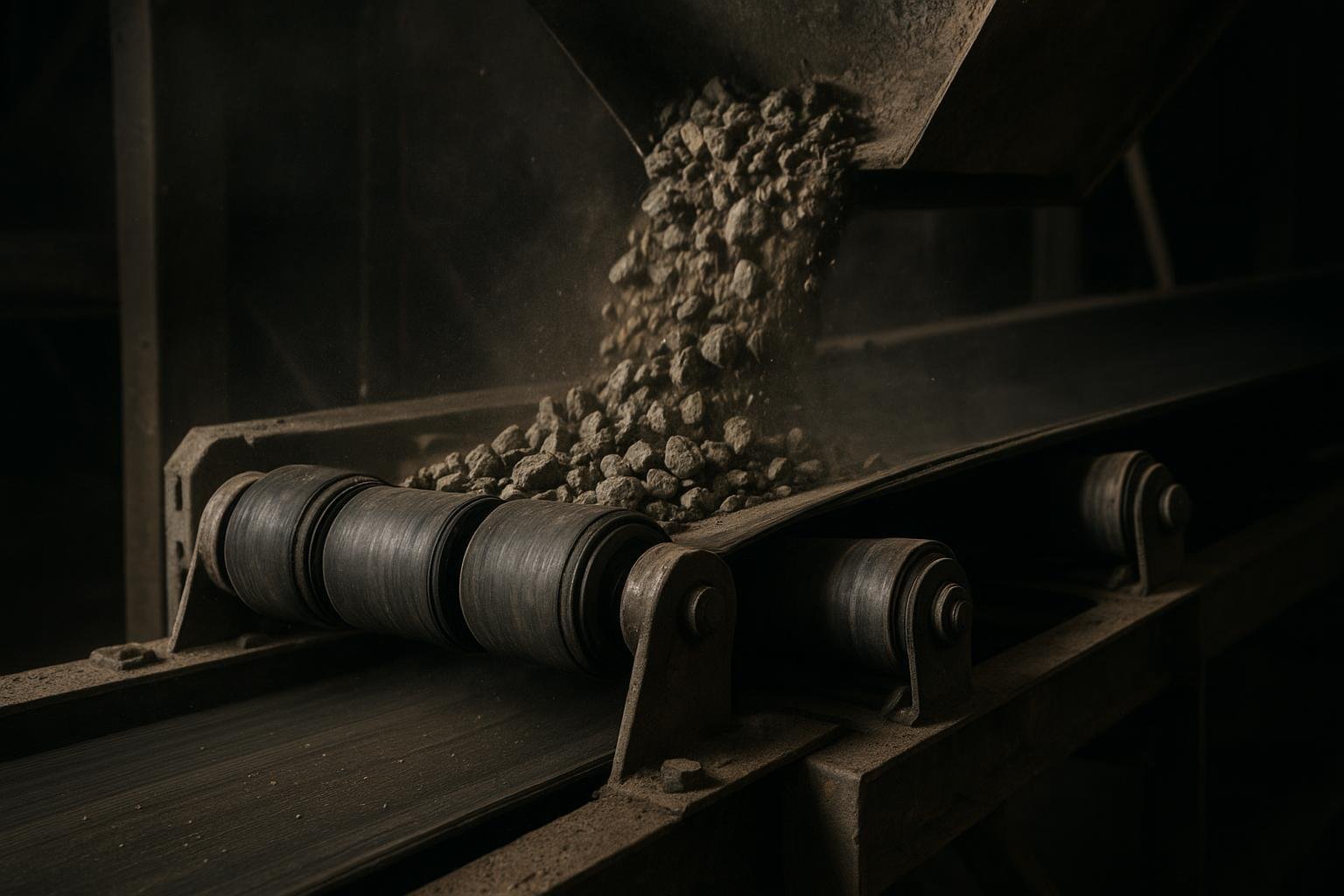
An impact roller—also called an impact idler—is the roller set installed in a conveyor’s loading zone to absorb the energy of falling material, protect the belt cover and structure, and keep the belt running smoothly through the highest‑shock section of the line. A premium impact roller does this predictably in abrasive, dusty, and wet environments while maintaining low rolling resistance and long, repeatable service life.
Premium, defined — the quick checklist
If you only have a minute, here’s what typically separates a commodity impact roller from a premium one, and what you can ask a supplier to prove it:
- Thick, concentric shell and sound welds: Provide shell wall thickness and Total Indicator Runout (TIR) test results; look for NDT (e.g., MT/UT) on heavy‑duty welds.
- High‑rebound rubber rings with secure retention: Share rubber hardness (ASTM D2240), abrasion loss (ISO 4649), and the ring retention method to prevent migration.
- Properly sized shaft and precision fits: Disclose shaft diameter/material and machining tolerances that control deflection and keep bearings aligned.
- Nameplate‑quality bearings and matched grease: Identify bearing make/model and basic dynamic load rating (L10 life concept per ISO 281); state grease type and temperature range.
- Multi‑stage sealing: Show a seal stack drawing or description combining labyrinth paths and contact lips/shields for dust/water defense.
- Controlled balance and runout: Provide TIR limits and any dynamic balance notes for higher belt speeds to minimize vibration and belt edge wear.
- Documented QA and traceability: Include spin/noise and seal‑drag checks, batch/serial traceability, and dimensional compatibility with common idler series.
Inside a premium impact idler: the engineering that matters
Think of the loading zone as a stress test that repeats every shift. Here’s how premium construction earns its keep.
Shell and weld integrity
A thick‑walled steel shell resists denting and ovalization under repeated impacts. Concentricity and low TIR reduce vibration and the belt flap that can mark covers and accelerate wear. End caps should be fully or equivalently penetrated and inspected to prevent fatigue at the weld toe. Where corrosion is likely, coatings (paint, powder, galvanization) or stainless options extend life.
Impact rings/discs and energy management
Rubber rings (or other elastomers) cushion the drop zone. High rebound paired with abrasion resistance helps distribute shock without tearing the belt cover. Equally important is ring retention—interference fits or bonding that prevents rings from migrating toward the belt edge or splice. Select materials compatible with the material stream (e.g., hot clinker, oils, fertilizers, salt).
Shaft and core
The shaft must carry shock without excessive elastic deflection that would misalign bearings and add seal drag. Precision machining and tight fits keep the assembly concentric under load and protect seal lips from rough surfaces.
Bearings and lubrication
Deep‑groove ball bearings of known pedigree should be selected for radial load and speed, with life expectations expressed using the L10 concept. Grease choice and fill should match temperature and contamination risk; low‑friction lubrication helps keep power draw and heat down.
Sealing system
Seals are the life gatekeepers. Premium rollers combine non‑contact labyrinths (long, tortuous paths that slow dust and splash) with contact lips or shields to physically block ingress. The aim isn’t a marketing label—it’s keeping grease clean over the whole service interval, especially in fine dust and wet cleanup conditions.
Balance and runout control
Controlled TIR and, when needed, dynamic balancing reduce noise and belt edge wear at speed. Better balance also lowers the risk of fastener loosening and frame vibration around the chute.
Surface finishing and protections
Corrosion‑resistant finishes protect the shell and end caps; specialty contact surfaces (ceramic/polymer) are niche but can help in highly abrasive service. What matters is suitability to the site’s chemistry and humidity.
Quality assurance and traceability
Premium isn’t just design—it’s proof. Look for spin/noise checks, seal‑drag measurements, TIR records, and batch or serial IDs that tie each roller back to its QA data and materials.
What buyers can verify before they buy
Below is a compact checklist you can use in RFQs and pre‑delivery checks.
| Indicator | What to ask for | Why it matters |
|---|---|---|
| Shell and welds | Shell wall thickness; end‑cap weld spec; NDT report (heavy‑duty) | Resists denting/fatigue in high‑shock zones |
| Runout/balance | TIR limit and spin test; any dynamic balancing notes | Reduces vibration, belt marking, and noise |
| Rings (rubber) | Hardness (ASTM D2240), abrasion (ISO 4649), retention method | Sustains cushioning; prevents ring migration |
| Shaft/core | Shaft diameter/material; fit tolerances; surface finish | Controls deflection; protects seals and bearings |
| Bearings | Make/model; basic dynamic load rating; L10 life method | Aligns with duty and speed expectations |
| Lubrication | Grease type/grade, temperature range, fill | Keeps drag/heat low; avoids washout |
| Sealing | Seal stack description/drawing (labyrinth + contact) | Defends against dust/water ingress |
| QA/traceability | Spin/noise/seal‑drag data; batch/serial ID | Proves build quality; supports maintenance records |
Loading‑zone application pointers (spacing, beds, alignment)
Here’s the deal: even the best impact roller can’t compensate for poor loading‑zone design. Apply these practices to let premium components perform.
- Tighten idler spacing under the chute to spread impact; use impact beds or cradles when drop height or lump size is high.
- Control drop height and trajectory with chute design to avoid concentrated belt gouging.
- Verify frame rigidity and idler alignment to prevent edge loading; maintain continuous support through transitions.
- Inspect routinely for ring migration, seal damage, abnormal heat/noise, and any belt cover marking that tracks to the loading zone.
In other words, pair correct spacing and chute control with premium rollers to reduce shock and extend bearing and belt life.
Failure modes a premium design avoids
- Premature bearing failure from dust/water ingress or grease washout, mitigated by multi‑stage seals and matched grease.
- Shell denting or weld fatigue after repeated impacts, mitigated by thicker shells and qualified welds with inspection.
- Ring migration that scuffs belt edges or splices, mitigated by secure retention and material selection.
- Excess drag, heat, and noise from poor sealing or misalignment, mitigated by precise fits and low‑friction seal stacks.
Copy‑ready RFQ spec snippet
Impact Roller (Impact Idler) — Premium Build Requirements
1. Construction & Fit
   - Provide shell wall thickness, TIR acceptance limit, and end‑cap weld specification. For heavy‑duty service, include NDT (MT/UT) results.
   - State shaft diameter/material and key fit tolerances; note surface finish at seal/bearing seats.
2. Rings & Energy Management
   - Specify ring material properties: hardness (ASTM D2240) and abrasion (ISO 4649). Describe ring retention method to prevent migration.
3. Bearings & Lubrication
   - Identify bearing make/model and basic dynamic load rating; state grease type/grade, operating temperature range, and fill percent. Express bearing life using L10 methodology.
4. Sealing System
   - Provide a seal stack drawing or description that combines labyrinth stages with contact lips/shields.
5. QA & Traceability
   - Submit spin/noise and seal‑drag test results, measured TIR, and batch/serial identifiers tied to QA records. Confirm dimensional compatibility with the specified idler series.
6. Application Notes
   - Include recommended loading‑zone idler spacing and any guidance for pairing with impact beds/cradles based on drop height/lump size.
Where a premium impact roller pays off
Choose premium when your loading zone sees abrasive fines, wet cleanup, high drop height, or large lumps—conditions that punish seals, bearings, and shells. The payback typically shows up as fewer emergency stops, longer belt cover life, and steadier power draw. If you’re standardizing specifications across multiple plants, a single premium standard with documented QA and traceability can simplify spares and auditing. For a practical example of how manufacturers package these features, see the application notes and catalog details from major OEMs such as the idler selection guidance in the PPI Idler Selection Guide and construction overviews in Martin Sprocket’s Idler Brochure. If you need a vendor‑neutral quote aligned to the RFQ checklist above, manufacturers like بيسونكونفي can configure impact idlers with documented TIR, seal architecture, and bearing specifications.
References and further reading
- Practical selection notes and definitions in the PPI Idler Selection Guide (PDF).
- Construction features and application context in Martin Sprocket’s Idler Brochure (PDF).
- Overview of impact idlers and placement on Superior Industries’ Impact Idlers page.
- Technical background on belt conveyor idlers in Rexnord’s Belt Conveyor Idlers and Components brief.