When conveyors run well, they quietly move tonnage and stay out of the news. When they don’t, you get spillage, fires, near-misses, or a line-down event that eats the shift. The good news: most failures trace back to a short list of preventable maintenance errors.
This guide organizes the most common mistakes by risk domain—safety/compliance, mechanical integrity, reliability/PM, and operations/spares—so your team can fix what matters first. Wherever we cite rules or proven practices, we point to authoritative sources.
Safety & Compliance Errors
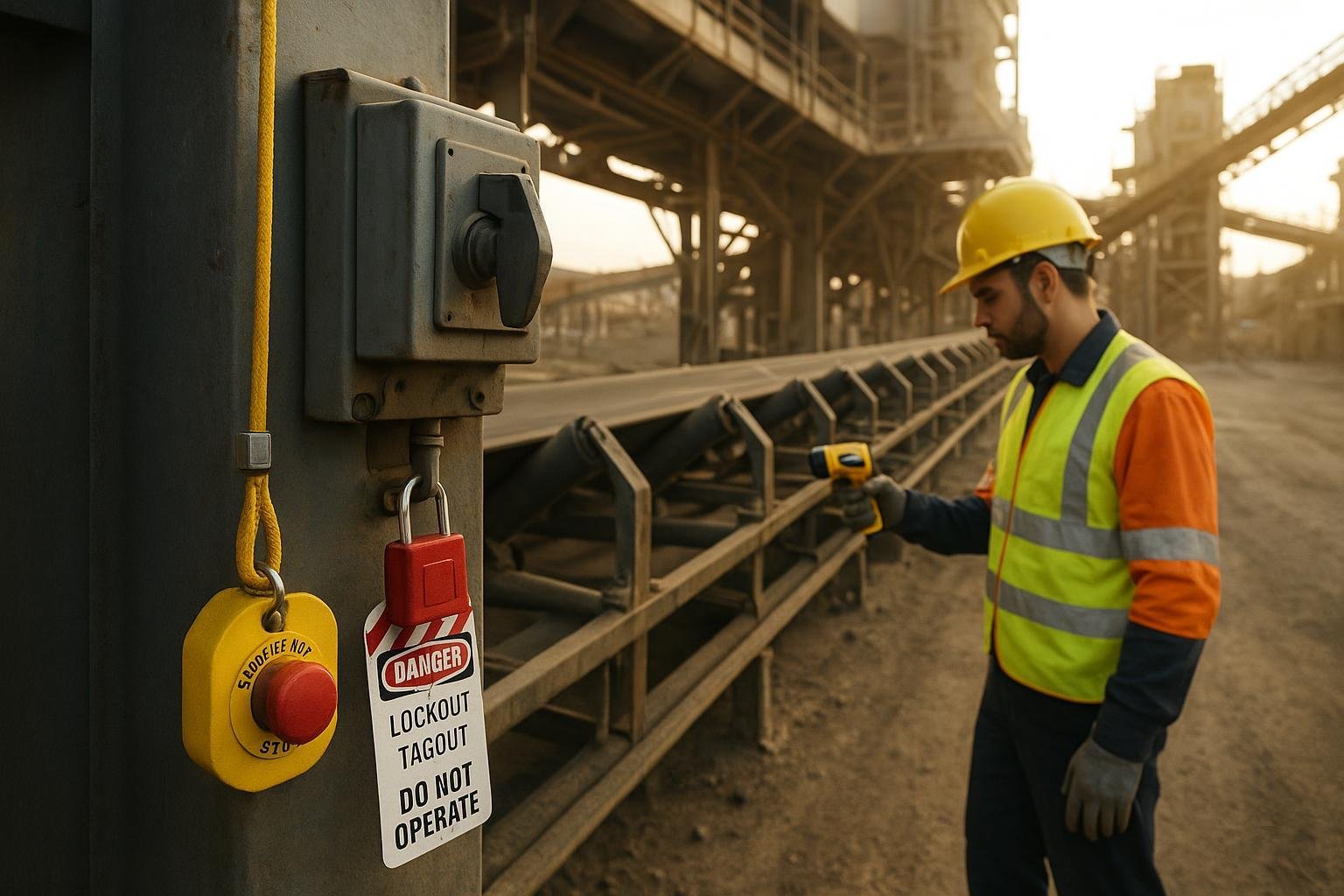
1) Working without full lockout/tagout (LOTO)
Performing service, clearing jams, or adjusting components without controlling hazardous energy is a leading cause of serious injuries.
- Consequences: unexpected start-up, entanglement, crushing, and legal exposure.
- Prevention checklist:
- Implement a written energy control program and machine-specific procedures; each authorized worker applies their own lock and verifies isolation per the requirements in OSHA 1910.147 — The control of hazardous energy.
- Manage stored mechanical/gravitational energy (e.g., block/balance components), and perform a “test out” on local and remote controls.
- Train authorized and affected employees; audit annually and after changes using OSHA’s hazardous energy control program overview.
- Best for: Any facility with powered conveyors. Not optional in regulated environments.
2) Overlooking stored energy (rollback, counterweights, belt tension)
Even after de-energizing, belt tension and gravity take-ups can drive unintended movement. Think of the belt like a stretched spring—release it carelessly and it snaps back.
- Consequences: belt rollback on inclines, struck-by or crushed-by incidents.
- Prevention checklist:
- Complement LOTO with engineered blocking: belt clamps, ratchet hoists to rated structure, and lowering counterweights where designed.
- Confirm brakes/backstops function, but don’t rely on them to neutralize belt tension.
- Verify isolation with a test on start circuits before placing hands or tools near the belt path; document controls.
- Evidence: See the summary of the enforcement focus in the article, MSHA issues alert for stored energy in belt conveyors (2024).
- Best for: Mining, aggregates, ports, steep or high-tension systems.
3) Poor guarding and emergency stop access
Missing guards at in-running nip points and poorly maintained pull-cords delay response when seconds count.
- Consequences: entanglement hazards, reach-in injuries, delayed E-stop activation.
- Prevention checklist:
- Ensure guards prevent reach-under/over/through to moving parts, and secure them with fasteners or interlocks.
- Keep emergency stop pull-cords continuous, visible, and within reach; function-test on a defined cadence in line with CEMA’s SBP-002 emergency stop guidance.
- Inspect return rollers in reach zones and guard or relocate as required; CEMA’s Guarding Conveyors to Enhance Safety offers practical examples.
- Best for: All belt conveyors; critical where personnel work near return runs or tail pulleys.
Mechanical Integrity Errors
4) Skipping inspections, cleaning, and lubrication
Deferring fundamentals shortens service life and turns small issues into shutdowns.
- Consequences: seized bearings, elevated friction and heat, belt and lagging wear, unplanned downtime.
- Prevention checklist:
- Establish daily/weekly checks for debris and carryback, tracking condition, unusual noise/heat/vibration; clean spillage and maintain cleaners and skirts.
- Lubricate per OEM intervals—avoid over-greasing; document all findings and trigger corrective work orders.
- Evidence: A practical reference is the engineering-focused FEECO troubleshooting and maintenance guide.
- Best for: Bulk handling with abrasive materials; high-duty and outdoor runs.
5) Chasing belt tracking with tension instead of alignment
Cranking in tension to “force” the belt to center increases energy draw and damages splices. Alignment comes first; tension just sets traction and sag.
- Consequences: edge fray, splice fatigue, higher power consumption, safety exposure near wandering belts.
- Prevention checklist:
- Square the frame; verify pulleys, snubs, and idlers are perpendicular to the belt centerline and parallel to each other.
- Set initial tension to spec, then use training idlers/return trainers or small, symmetric adjustments for tracking.
- Confirm under load and after thermal stabilization.
- Evidence: Step-by-step practices in the 2024 Conveyor Belt Tracking Guide (GL Belt).
- Best for: Light-to-medium duty package and process belts as well as bulk belts.
6) Neglecting idlers, pulleys, and bearings
Seized rolls, misalignment, and damaged lagging cut belts and elevate friction heat.
- Consequences: belt gouging, cover loss, fire risk, power spikes.
- Prevention checklist:
- Replace seized/worn rolls promptly; check runout and alignment on problem areas.
- Inspect pulley lagging for bond failure or glazing; rebalance as required.
- Use IR spot checks and listening surveys to find hot or noisy bearings.
- Evidence: Mechanisms and failure patterns are summarized in 13 types of conveyor belt damage (Martin Engineering).
- Best for: High-tonnage belts, impact zones, and exposed outdoor conveyors.
7) Housekeeping gaps and contamination buildup
Carryback and spillage drive mistracking, wear, and slip/trip hazards.
- Consequences: abrasive wear on covers and idlers, safety hazards, chronic misalignment.
- Prevention checklist:
- Maintain primary and secondary cleaners; set and replace blades on schedule.
- Keep skirts and sealing systems tuned; verify chute transitions and loading geometry.
- Enforce routine cleanup with safe access methods.
- Evidence: For spill and guarding practices around cleanup, see CEMA’s SBP-003 Spill Guarding.
- Best for: Wet, sticky ores; fine powders; long return runs that accumulate carryback.
Also consider — Tools & Resources
- BisonConvey component selection and application guidance: premium belts, idlers, pulleys, and motorized rollers can support tracking, wear life, and energy performance. بيسونكونفي. Disclosure: BisonConvey is our product.
- Alternatives: CEMA safety publications (e.g., SBP series) for guarding/cleaning standards and the UE Systems condition monitoring hub for setup and trending techniques.
- Tip: Standardize on documented specs for idlers, pulleys, and cleaners so like-for-like replacements stay truly equivalent.
Reliability & PM Program Gaps
8) Overloading and poor feed control
Loading above design or off-center accelerates wear and mistracking.
- Consequences: drive slippage, belt stretch, spillage, structural stress.
- Prevention checklist:
- Meter feed to design rate; center loading; use impact beds/cradles to stabilize the load zone.
- Verify take-up travel and lagging condition; maintain slack-side tension.
- Evidence: Troubleshooting and design interactions are covered in the FEECO conveyor guide.
- Best for: Primary crushers to overland transfers; any surge-prone feed.
9) Ignoring early warning signals
Operators often hear or smell problems before instruments do. Don’t normalize deviance.
- Consequences: small defects escalate to catastrophic failures and unsafe improvisations.
- Prevention checklist:
- Use a shift checklist for noise, heat, vibration, burning smells, frayed edges, and splice anomalies.
- Route observations into work orders with clear escalation thresholds.
- Best for: All operations; especially night shifts and outdoor systems where conditions change quickly.
10) Minimal condition monitoring and diagnostics
If you don’t trend, you guess. Baselines and trends turn “it sounds bad” into actionable data.
- Consequences: reactive maintenance, surprise failures, unnecessary PMs.
- Prevention checklist:
- Apply periodic vibration checks to motors, bearings, and gearboxes; add IR thermography scans for bearings and lagging slip; use airborne ultrasound for lubrication state and incipient faults; visually audit splices with photos.
- Trend readings over time and set site-specific alarms based on baselines.
- Evidence: Technique overviews and program design tips in the UE Systems condition monitoring resources.
- Best for: Medium-to-high criticality conveyors and enclosed or hard-to-observe components.
Operations & Spares Strategy Misses
11) Inadequate training and competency management
Unauthorized adjustments and improvised fixes often trace back to unclear roles and limited training.
- Consequences: non-compliance, repeated errors, unsafe practices.
- Prevention checklist:
- Differentiate “authorized” vs. “affected” employees; train and requalify per your energy control program and site rules in alignment with OSHA 1910.147.
- Conduct hands-on drills (E-stop tests, belt clamp installation) and record competency.
- Best for: Sites with contractor turnover, job rotations, or new equipment.
12) No critical spares plan and non-equivalent replacements
Long outages and fit-up issues start at the storeroom.
- Consequences: extended downtime, mismatched performance, safety risks from “close enough” parts.
- Prevention checklist:
- Define critical spares from BOMs (idlers, bearings, scraper blades, lagging kits, sensors, fasteners/splice kits); set min–max levels based on lead times and criticality.
- Qualify equivalents with drawings and performance specs—not just dimensions.
- Best for: Remote sites, seasonal peaks, and any belt with long lead-time components.
How we chose these
We weighted each item by safety/compliance relevance and potential impact (downtime, injury risk, cost), then by preventability with standard practices and evidence quality from primary sources, followed by universality across mining, ports, cement, steel, power, chemicals, and agriculture. Core references include OSHA 1910.147, the 2024 MSHA enforcement emphasis described in the stored energy alert summary, CEMA’s Guarding Conveyors to Enhance Safety و SBP-002 emergency stop guidance, the 2024 GL Belt tracking guide, engineering guidance in FEECO’s conveyor troubleshooting resource, failure mechanisms summarized by Martin Engineering’s 13 types of belt damage, and condition-monitoring program basics from UE Systems, with spill control context from CEMA’s SBP-003.
Final thoughts
Conveyors reward discipline. If you tighten up energy control and guarding, square and clean the mechanicals, and put lightweight condition monitoring and spares planning in place, most surprises disappear. Start with a focused audit against the twelve mistakes above, assign owners, and set review dates. Then keep showing your crews how their daily checks prevent line-down nights—because they do. Let’s keep people safe and belts turning.