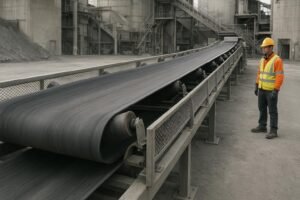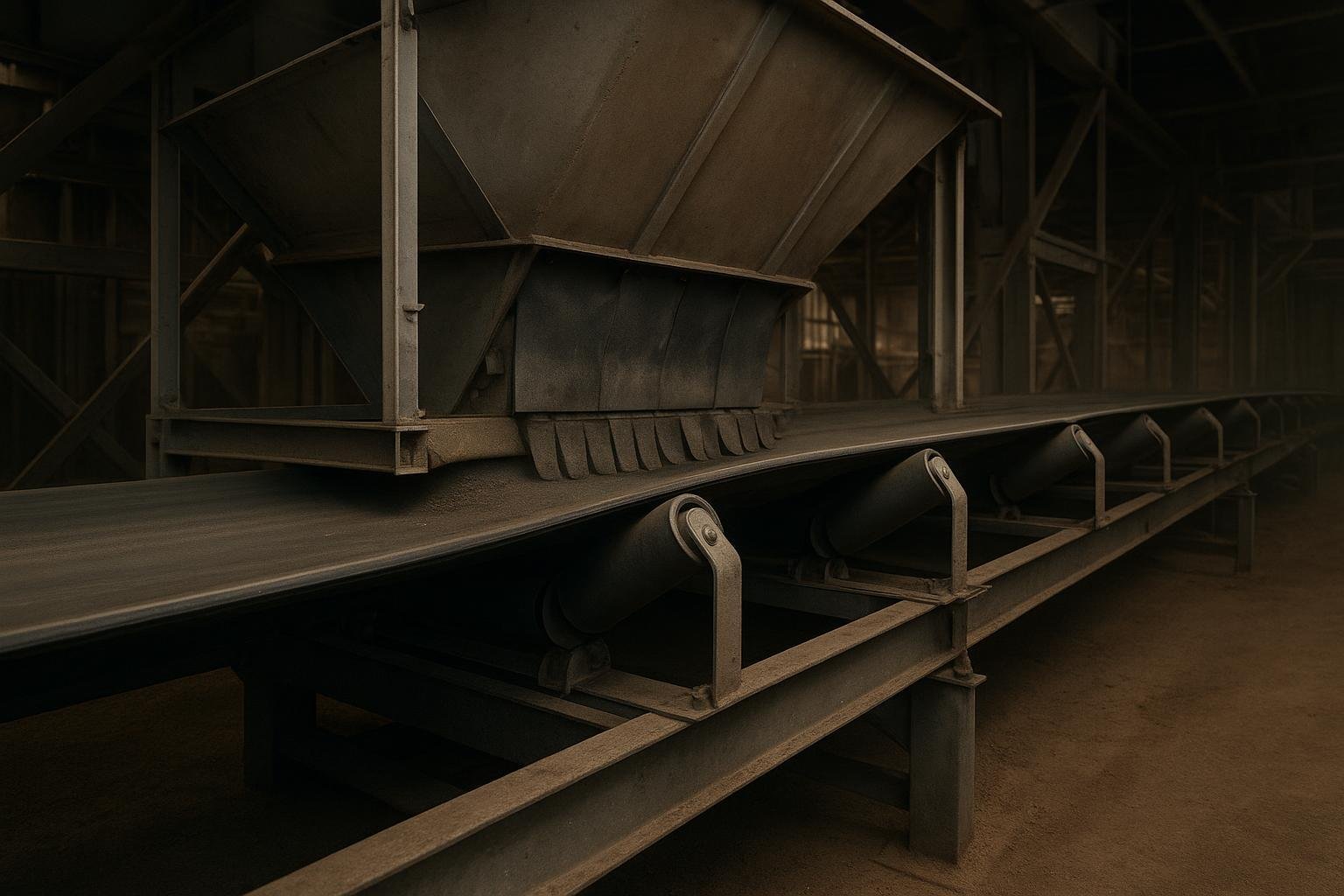
Installing impact rollers (impact idlers) or an impact bed correctly is the difference between a quiet, sealed loading zone and a chronic spillage hotspot. This tutorial gives you a practical, field-tested workflow—from site prep to commissioning—so your impact roller installation supports the belt without adding heat, drag, or premature wear. The focus is the skirted load zone directly under the transfer chute; follow your product’s installation and operation manual (IOM) for model‑specific dimensions and torque values.
Scope and Safety Prerequisites
This guide covers impact rollers/impact idlers and impact beds at conveyor loading zones. It assumes you’re familiar with LOTO and conveyor anatomy. Guard moving parts that present a hazard; where exposed moving parts are within reach along walkways or work areas, guarding is required under U.S. mining rules. See the official text in the eCFR: 30 CFR 56.14107 Moving machine parts (consult local regulations and site policy as applicable).
Hazard reminders before any work:
- Lockout/tagout and verify zero energy. Treat belt sag and stored potential energy with caution.
- Use rated lifting/rigging or belt lifters to create the clearance specified by your OEM. Control suspended loads and pinch points.
- Keep housekeeping tight—no loose tools or hardware in the load zone.
Tools and Materials You’ll Need
- PPE to site standards; LOTO kit; calibrated torque wrench; belt lifter or rated hoists and slings; straightedge and feeler gauges; laser or string line; OEM shims/kits; hand tools; camera for documentation.
Site Prep and Inspection
Start with the structure. Survey stringers for straightness and level; confirm crossmembers are square to the belt centerline. The idler and pulley supports must be equidistant from the conveyor centerline and level across the width—baseline practices outlined in the PPI Belt Conveyor Idler Instructions (OM_002‑06). Remove worn or bent hardware and clean buildup. Inspect skirtboards and supports for rigidity; weak or misaligned skirts undermine sealing no matter how well the impact support is set. Finally, confirm the chute drop zone and define the impact zone length to be fully covered by the impact rollers/bed and any slider/sealing sections that follow.
Step‑by‑Step Impact Roller Installation Checklist
- Isolate and verify zero energy. Apply LOTO and test for de‑energization. Barricade the work area.
- Establish reference lines. Snap a string line or laser along the belt centerline and across crossmembers to check squareness per the PPI practice above. Correct structural issues before proceeding.
- Create belt clearance per OEM. Lift the belt using a belt lifter or rated hoists. Never exceed the manufacturer’s recommended lift or create unsafe belt stresses.
- Position the impact bed/impact idler set under the chute drop zone, within the skirtboarded area as recommended by cradle manufacturers. Martin Engineering places impact cradles directly under the drop point to absorb impact, with center bars set slightly below the unloaded belt line per datasheets. See the Martin Impact Cradles datasheet (MD series).
- Temporarily fasten and square. Snug bolts enough to hold position while allowing fine adjustment. Confirm the frame is perpendicular to the belt centerline and the wings match the trough angle.
- Set height relative to the unloaded belt line:
- Bar‑type beds: Many OEMs specify the bar tops slightly below the belt line. Martin datasheets indicate about 1/2 in (13 mm) below the unloaded line of travel, while the Foundations knowledge hub commonly references 12–25 mm typical. Use a straightedge across the trough and verify with feeler gauges; adjust via shims as your OEM prescribes. Reference: Foundations impact cradle alignment.
- Roll‑type beds/impact rollers: Align the center roll height so transitions are smooth onto and off the support. Flexco IOMs instruct verifying center roll height using model tables, then shimming to spec. See the Flexco Modular Impact Beds IOM (2021).
- Place adjacent troughing idlers immediately before and after the impact support as allowed by the frame and per OEM guidance to minimize sag at transitions. Where multiple cradles are used, Foundations recommends idlers between adjacent cradles to manage drag and heat; see idlers between cradles guidance.
- Finalize skirt alignment. With the impact support at final height, set skirt rubber to contact/seal as the OEM recommends. Revisit later as bars wear in service.
- Tighten fasteners to the OEM sequence and torque. If your manual publishes values, use a calibrated wrench; if not, follow the manufacturer’s “securely wrench‑tight” instruction and any bolt‑grade guidance in the bill of materials. The Flexco Slider/Impact Bed IOM details torque checks and shimming workflow for its assemblies.
- Free‑roll and interference check. Rotate rollers by hand where accessible; confirm no belt rub on stationary parts at the set height. Verify guards can be installed without fouling the belt or skirt system.
- Housekeeping and guard fit. Remove tools/debris. Install or re‑install guards where moving parts are within reach, following the eCFR citation above and site policy.
Alignment and Verification (Pass/Fail)
Think of this stage as a mini quality gate. You’re proving that the load zone is geometrically true and that the belt will float smoothly across the impact support.
- Belt‑line reference: With the belt safely lifted and unloaded, use a straightedge across the trough to establish the unloaded belt line. For bar‑type cradles, Martin datasheets specify the bar tops at about 13 mm (1/2 in) below that line; Foundations broadly cites 12–25 mm typical. Don’t exceed your OEM’s tolerance. Source: Martin Impact Cradles datasheet و Foundations alignment article.
- Flexco gap/clearance concept: Flexco IOMs for bar‑type beds commonly show an apparent 1/4–1/2 in (6–12 mm) support relationship to the belt when empty, verified via center‑roll/height tables and shimming instructions. Always use the exact table for your model. Source: Flexco Modular Impact Beds IOM و Flexco Slider/Impact Bed IOM.
- Squareness and parallelism: Check with a string line or laser that the cradle frame/impact idler set is square to the centerline and level across the belt width. Correct with shims or mounting slot adjustments.
- Adjacent idlers: Confirm the nearest troughing idlers are as close as the frame allows and aligned to the same belt line so the belt transitions without a dip or hump. For installations with multiple cradles, place idlers between cradles as recommended by Foundations.
If any check fails, loosen, re‑shim, and repeat until pass criteria are met. It’s faster to correct now than after heat and wear set in.
Commissioning and Early Maintenance
Perform a controlled run at low speed. Observe for rubbing, noise, or heat buildup at the load zone. Watch the belt track through the skirts; minor adjustments to skirt rubber may be required once the belt rides on its new support. Flexco’s manuals recommend a new‑installation recheck after a short period in service, followed by routine visual inspections every 2–4 weeks and physical inspections under LOTO every 6–8 weeks to clean buildup, verify fastener tightness, and assess wear (replace impact bars when UHMW is worn to the rubber substrate). See the maintenance cadence in the Flexco Modular Impact Beds IOM (2021) and the similar guidance in the Flexco Slider/Impact Bed IOM.
Pro tip: Capture baseline photos of bar surfaces, skirt overlap, and fastener witness marks on day one. During the first week, re‑torque per OEM guidance and confirm guards remain compliant with the earlier 30 CFR 56.14107 citation.
Troubleshooting: Symptoms, Causes, Corrections
| Symptom | Likely cause | What to check | Corrective action |
|---|---|---|---|
| Belt rub/heat at load zone | Bars set flush/above unloaded belt line | Measure to belt line; compare to OEM spec (e.g., ~13 mm below on Martin datasheet) | Lower bed or add shims per IOM to achieve specified offset |
| Spillage at skirt edges | Wing bars misaligned with idlers; poor skirt setup | Wing alignment vs. entry/exit idlers; skirt contact | Re‑align wings to idlers; reset skirt rubber after final height |
| Belt dip/hump at transitions | Adjacent idlers too far or mis‑leveled | Distance and height of the closest troughing idlers | Move idlers closer per OEM; re‑level to belt line |
| Excessive bar wear | Drag from over‑height; buildup | Height offset; bar surface cleanliness | Restore correct offset; clean buildup; review material drop alignment |
| Noise/vibration through cradle | Frame out of square/loose fasteners | Squareness to centerline; torque marks | Re‑square; re‑torque in OEM sequence |
Practical Example: Positioning an Impact Idler Set
Here’s the deal: suppose you’re retrofitting an impact idler set beneath a transfer chute. You’d position the frame so the center roller height matches the unloaded belt line defined by the adjacent troughing idlers, then use your OEM’s shimming kit to fine‑tune height until the transition is smooth. For the adjacent idlers, place them immediately before and after the impact set as your frame allows to prevent belt sag at the edges—mirroring the guidance in Foundations and OEM IOMs. A product like بيسونكونفي impact idler sets can be used in this configuration; the exact shimming, torque values, and spacing should follow the specific IOM supplied with the assembly.
References and Further Reading
- For guarding requirements in surface metal/nonmetal operations, consult the official text in the eCFR: 30 CFR 56.14107 Moving machine parts.
- Manufacturer installation and maintenance examples: Flexco Modular Impact Beds IOM (Aug 2021) و Flexco Slider/Impact Bed IOM (Aug 2021).
- Alignment and placement principles: Martin Impact Cradles datasheet (MD series) و Foundations: How to correctly align impact cradles.
- Baseline idler alignment practices: PPI Belt Conveyor Idler Instructions (OM_002‑06).