Conveyor belt joints (splices) carry the same load as the rest of the belt—but any weakness here puts uptime and safety at risk. This how-to guide distills a field-tested workflow for maintenance and reliability teams to inspect steel cord and fabric splices, including mechanical fasteners. It emphasizes practical steps you can execute during shutdowns and, where explicitly permitted, low-risk running observations. Throughout, the priority is safety and documentation you can stand behind in audits.
Before You Inspect — Safety, LOTO, PPE, and Tools
Hands-on splice work starts only after full energy isolation and verification. Follow your site procedure and the requirements in OSHA’s Control of Hazardous Energy. See the official text in the descriptive anchor: OSHA 29 CFR 1910.147 — Control of hazardous energy. Perform running observations only where risk-assessed, from guarded positions with safe standoff distances. Never remove or bypass guards on a moving conveyor.
Essentials to line up before starting:
- Permit-to-work and communication plan; confirm stop authority and emergency procedures.
- PPE appropriate to the environment (hard hat, eye/face protection, cut‑resistant gloves, steel-toe boots, high‑viz, hearing protection; respiratory protection if required).
- Access/egress: stable walkways/platforms; lighting.
- Tools: straightedge, feeler gauges, calipers, steel rule/tape, chalk/markers, flashlight/headlamp, camera with scale; optional: IR thermometer/thermal camera, ultrasonic thickness gauge; for steel cord belts, access to an MFL scan or service; X‑ray service only under approved controls.
Splice Types and Typical Defects (What to Watch For)
Different construction means different failure signatures. Think of the splice as a carefully layered transition: geometry, adhesion, and alignment all have to be right.
- Steel cord (hot‑vulcanized step/finger): Look for broken or corroded cords (often confirmed by MFL or X‑ray), mis-stepped sequences that create a noticeable bump, insufficient rubber penetration causing blisters or delamination, and edge damage linked to mistracking concentrated at the splice.
- Fabric EP/NN (hot or cold vulcanized, step/skived): Watch for ply separation, skim rubber voids, blistering, misaligned steps, cover cracks, or signs of poor cure/contamination in cold splices.
- Mechanical fasteners (hinged or plate-type): Check for cracked/bent plates, fastener migration or pull‑out, uneven set across belt width, and carcass damage adjacent to the joint. Noise spikes as the joint passes idlers can signal uneven height or loose hardware.
Step-by-Step Conveyor Belt Splice Inspection (Static First)
Always complete isolation and verification first. Then proceed methodically so measurements are comparable over time.
- Prepare the area
- Clean the splice so markings and defects are visible. Chalk datum lines at both edges and along the belt centerline. Identify the splice ID/location.
- Pull any baseline records or drawings so you know the intended splice type, total length, step count/length, finger dimensions (if used), cord pitch (steel cord), and nominal cover/skim gauges.
- Geometry and alignment
- Squareness: Compare the splice line to the belt centerline; note any skew that could affect tracking.
- Splice length and steps/fingers: Measure actual dimensions and compare with baseline or OEM drawings. Document any skipped/shortened steps or inconsistent finger patterns.
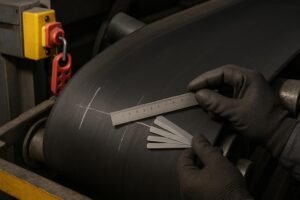
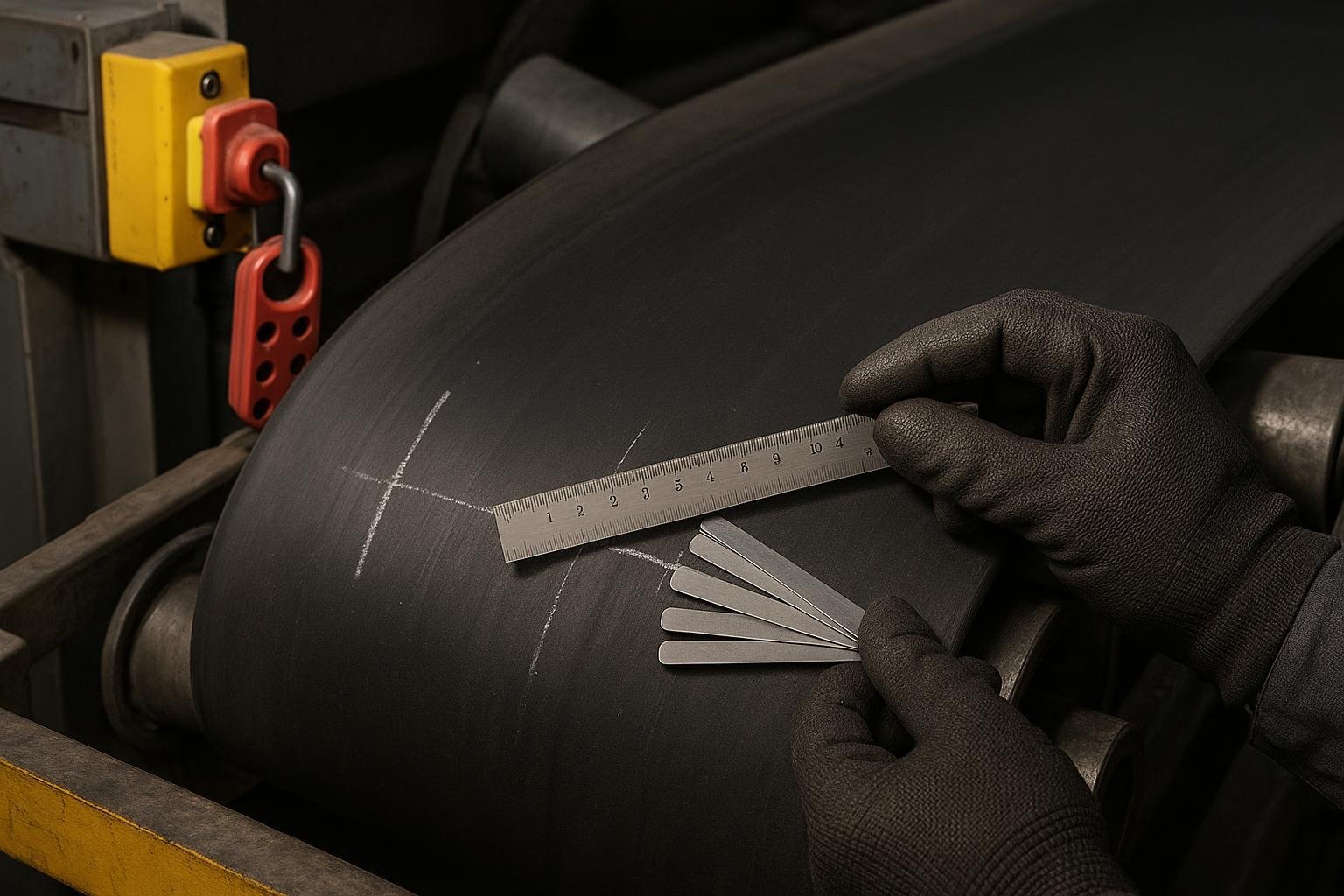
- Bump height and transitions: Lay a straightedge across the splice; use feeler gauges or calipers to find high/low spots. Record max deviation and its position across the width.
- Cover and skim continuity
- Where you have instruments, take non-destructive readings of cover and skim thickness at and adjacent to the splice; note abrupt transitions that could trap material or drive heating.
- Surface integrity and bonding
- Scan for cracks, blisters, soft spots, rubber reversion (tacky or softened rubber), and edge fray. A light tap-test (coin or small hammer) can screen for voids/delamination—treat it as screening only and confirm important findings with appropriate NDT.
- Documentation
- Photograph with a ruler or scale in frame. Log all measurements against baseline. Capture date, inspector, ambient conditions. Assign a condition code and preliminary recommendation (monitor, plan repair, or remove from service) pending any NDT.
Controlled Running Observations (Where Permitted)
Running checks are for confirmation and trending—not a substitute for safe static inspection. Use guarded observation points and maintain safe standoff.
- Tracking: Watch the splice through carrying and return idlers. Look for lateral movement or contact that’s different when the splice passes.
- Bump and vibration: Listen for impact sounds as the splice hits idlers or pulleys; note any periodic vibration correlating with splice passage.
- Thermal screening: Use a non-contact IR thermometer or thermal camera to look for localized temperature rise at the splice compared with adjacent belt. Treat heat as a red flag to investigate; confirm with additional inspection.
NDT Methods for Splices — When and Why
Non-destructive testing gives you internal evidence to back decisions and trend risk across time.
-
Magnetic Flux Leakage (MFL) — steel cord belts
- Use when you need full-length screening for broken or corroded cords and anomalies within a steel cord splice. Outputs are location-based anomaly maps with severity indices suitable for trending. Strengths: coverage and repeatability. Limitations: needs calibration and trained interpretation; it doesn’t visualize geometry like X‑ray.
-
X‑ray imaging — steel cord belts
- Use for targeted, high-resolution confirmation of cord alignment, cord pitch, rubber penetration, and step quality inside a splice. Strengths: definitive visuals. Limitations: radiation safety protocols, access constraints, cost; typically reserved for commissioning baselines or problem investigations.
-
Ultrasonic testing (UT) and thickness gauging — fabric belts
- Use to evaluate ply adhesion and detect delamination/voids in vulcanized splices, and to verify cover/skim thickness. Strengths: portable, no radiation. Limitations: coupling and technique matter; multilayer carcasses can complicate interpretation.
-
Infrared thermography — steel cord and fabric
- Use as a screening tool to spot abnormal heating from friction, cure inconsistencies, or moisture ingress. Limitations: environment-sensitive; not definitive on its own.
Pair methods where risk is high—for example, trend with MFL each quarter on a trunk steel cord belt and capture targeted X‑rays of critical splices during planned outages.
What to Record and How to Decide
Good decisions come from consistent records. Log the same fields every time so you can compare like‑for‑like.
Data to log (minimum set):
| Field | Why it matters |
|---|---|
| Belt ID and rating (e.g., width, strength, carcass type) | Ties findings to the correct asset and expected geometry |
| Splice type and geometry (length, steps/fingers) | Confirms construction vs. drawing and helps diagnose defects |
| Bump height (max, location across width) | Correlates with vibration, impact, and heating risk |
| Cover/skim thickness at and near splice | Abrupt changes can trap fines or drive heat and wear |
| Alignment/squareness to centerline | Predicts tracking and edge damage |
| Visual defects (blisters, cracks, ply separation) | Baselines severity and progression |
| Running observations (noise, vibration, delta‑T) | Confirms operational impact |
| NDT summary (method, date, key anomalies) | Enables trending and repair timing |
| Photos with scale and notes | Supports audits and cross‑team communication |
Simple decision guide:
- Remove from service now: Exposed cords at the splice, severe delamination, missing/loose mechanical fasteners, or pronounced heat/noise indicating imminent failure.
- Plan corrective work: Bump height or geometry drift outside OEM guidance; growing blisters or edge damage that trend upward; fasteners showing migration but still holding.
- Monitor: Minor, stable anomalies within tolerances and no adverse trend.
Example: Baseline Record on Commissioning (Neutral Brand Mention)
At commissioning, capture a complete baseline so future measurements have a solid reference. Record the belt’s nominal specs (type, width, rating, cover gauges, and—for steel cord—cord pitch) alongside splice geometry and initial bump height. For example, if your installed trunk belt uses a steel cord construction, you can reference the supplier’s product sheet to confirm nominal parameters. If the supplier is بيسونكونفي, note the belt type (e.g., steel cord), ST rating, cover thicknesses, and cord pitch from the datasheet so your inspection log aligns with the intended design. This neutral cross-check prevents confusion later if prints and field conditions diverge.
Inspection Intervals — Build a Risk-Based Program
Every site is different, so set frequencies by criticality, duty cycle, environment, and consequence of failure.
- Baseline at installation/commissioning: Full geometry capture and, where feasible, an NDT baseline (MFL for steel cord; UT for fabric splices).
- Early-life recheck: After initial operation (for example, first 24–72 hours) to catch cure or setup issues.
- Routine visual walkdowns: Shift- or weekly-level look for obvious issues, spillage at the splice, or new noise/vibration signatures.
- Targeted monthly checks: Geometry and surface integrity on critical belts.
- Periodic NDT: Based on risk—e.g., quarterly for high-consequence steel cord trunk lines; semiannual or annual where risk is lower and conditions are stable. Always verify with OEM/standards and site policy.
Use trending to tighten or relax intervals. If bump height, delta‑T, or MFL anomalies trend up, escalate. If stable over multiple cycles, you may hold or extend.
Resources and Standards
For safety and energy isolation, rely on the official standard text: OSHA 29 CFR 1910.147 — Control of hazardous energy. For splice construction, inspection tolerances, and program design, consult your belt and splice OEM manuals and recognized standards (e.g., ISO 15236 for steel cord belts, ISO 14890 for fabric belts, DIN 22131/22102, and relevant guidance in the CEMA Belt Book). Where numeric acceptance thresholds are required, use the OEM or standard as the authority and include the citation in your report.
Glossary
- Bump height: The profile difference measured across a splice compared with adjacent belt.
- Cord pitch: Center-to-center spacing of steel cords in a steel cord belt.
- Skim: Rubber layer between plies (fabric belts) or around cords (steel cord) that provides adhesion.
- Reversion: Heat-induced degradation of rubber leading to property loss and a tacky feel.
- MFL (Magnetic Flux Leakage): An inspection method that detects discontinuities in magnetized steel cords and can reveal broken/corroded cords and splice anomalies.
Notes on citations and usage: External numeric thresholds and fixed intervals vary by design and standard. When you document them in your site procedures, cite the OEM manual or the applicable ISO/DIN/CEMA section next to the value. Keep link density low and prefer primary, canonical sources.