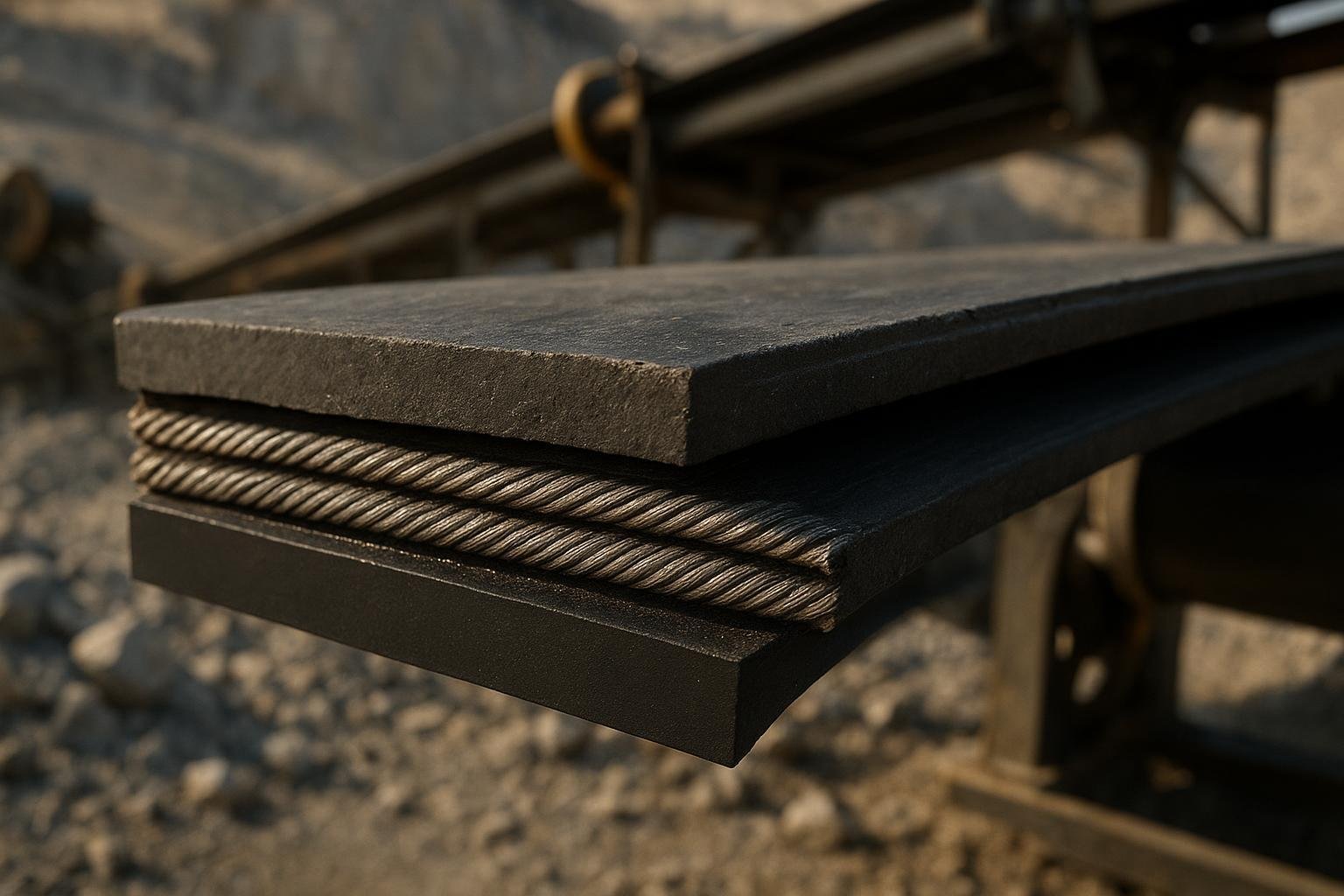
Getting conveyor belt thickness right is one of the simplest ways to improve wear life, uptime, and safety. Thickness is not just a single number—it’s the sum of the carcass (fabric plies or steel cords) plus the top and bottom rubber covers. The top cover takes the brunt of abrasion and impact; the bottom cover protects against idler contact and flex fatigue. In this guide, you’ll get a practical workflow to convert site conditions into defensible thickness choices, along with examples, standards context, and verification tips.
DIN/ISO cover grades and why they matter to conveyor belt thickness
Cover grade determines how your rubber resists abrasion, cuts, gouging, and impact. Two families are widely referenced: DIN 22102 (Y, W, X) and EN ISO 14890 (L, D, H). Lower abrasion loss (measured as mm³ volume loss) indicates a tougher, longer-wearing cover. For background on test methods, see the overview of abrasion measurement in Dunlop’s abrasion standards and test methods (technical note) and a practical aggregates-oriented primer in Rock Products’ 2024 selection article.
| DIN 22102 grade | EN ISO 14890 grade | Typical use and notes |
|---|---|---|
| Y | L | General service. Baseline abrasion resistance for moderate wear. |
| W | D | High abrasion resistance for demanding wear (sand, fines, sharp material). |
| X | H | Abrasion plus improved cut/gouge/impact protection; suited to lumps and higher drop heights. |
Tip: Cover grade is the compound’s capability; cover thickness is how much of that protection you carry. Both have to match the duty.
Preparatory checklist: information to collect on-site
Before you pick a carcass or covers, capture the following:
- Material: type, abrasiveness, particle shape, lump size distribution, moisture.
- Loading: drop height, transfer chute design, skirtboard setup/pressure, impact zone support.
- Conveyor: belt width, speed, trough angle, idler spacing, transition distances.
- Pulleys: diameters (head, tail, snub, bend), lagging condition.
- Environment: temperature range, oils/chemicals, UV/exposure, fire risk requirements.
- Operations: target service life, maintenance intervals, splicing method (mechanical or vulcanized).
A six-step workflow to select conveyor belt thickness
-
Assess material and duty Identify the wear and impact drivers. Fines and sharp sand demand abrasion-resistant grades; large, angular lumps and higher drop heights call for added cut/gouge resistance.
-
Size the carcass strength and base gauge Choose EP/NN ply count or a steel cord rating to meet tension and troughability requirements. Carcass thickness rises with ply count (think roughly 1–2 mm per ply, varying by fabric and gauge). Ensure the base belt can flex cleanly over your pulleys and through transitions.
-
Match cover grade and cover thickness to risk For general duty, top covers often sit around 2–3 mm with 0–1.5 mm bottom covers. For abrasive or impact duty, top covers move up to 4–6 mm or higher, with 1–2 mm bottom covers. Use tougher compounds (DIN W/X or ISO D/H) where wear and impact are significant.
-
Check pulley diameters and flex limits Thicker belts and stiffer constructions demand larger pulleys to control bending stress and flex fatigue. If your pulleys are small, avoid over-thick covers and confirm minimum diameters against manufacturer tables. For context on how pulley sizes affect belt stress, see this overview of common pulley diameters and design considerations.
-
Verify standards, splice details, and installation plan Confirm that chosen cover grades align with your duty. Ensure splice design and thickness control match the belt gauge—skive depths, step lengths, and adhesive systems must be compatible. Plan installation for proper transition distances and loading zone support.
-
Monitor wear and adjust Track top cover wear rate across the loading zone and drive return; log gouging events, entrapment marks under skirtboards, and splice health. Adjust cover thickness or loading-zone support (impact bars/beds, chute changes) if wear accelerates.
Worked examples: turning inputs into thickness decisions
These examples are indicative, drawn from public datasheets and trade references. Always verify with your belt supplier.
Example 1: Aggregates quarry feed (high impact)
- Inputs: 1200 mm belt width; 2 m drop height; angular granite up to 150 mm lumps; speed 2.5 m/s; skirtboards over a 2 m loading zone; head/tail pulleys ~610 mm; environment ambient, dry.
- Rationale: High impact/gouge risk with abrasive fines. Favor DIN X/ISO H compounds and a thicker top cover.
- Indicative selection: EP630/4 carcass with a top/bottom cover around 5/2 mm using a high abrasion grade. A published textile belt example with this cover set is shown in Tehnoguma’s EP630/4 5/2 DIN Y datasheet; switch the compound to DIN X or ISO H for added gouge resistance while maintaining similar thickness.
- Verification step: Confirm minimum pulley diameters are adequate for this gauge; check skirtboard pressure and impact bed alignment to avoid entrapment.
Example 2: Long-haul trunk belt (steel cord)
- Inputs: 1400 mm width; 6–8 km length; high capacity; pulleys ≥762 mm; speed 4 m/s; material: iron ore with occasional 80–100 mm lumps; ambient temperature.
- Rationale: Long-distance steel cord belt benefits from a thicker top cover to guard the cords and carry abrasion resistance; the bottom cover can be thinner.
- Indicative selection: A 6+3 mm cover configuration is common practice in severe service textiles and aligns well with steel cord expectations. A documented 6+3 configuration exists in a heavy-duty textile case reported by Dunlop; it helps illustrate the thickness split. For steel cord, confirm exact gauge and minimum pulley diameter with your supplier’s tables.
- Verification step: Validate splice design and curing cycle for total gauge; ensure transitions and take-up are tuned to minimize flex fatigue.
Example 3: Fine abrasive sand (moderate impact, high abrasion)
- Inputs: 1000 mm width; fines and small particles; low drop height (<0.5 m); speed 3 m/s; pulleys ~508–610 mm; humid environment.
- Rationale: Abrasion dominates; impact is limited. Favor a high abrasion grade with a moderate top cover.
- Indicative selection: EP400/3 with a 3:0 top/bottom cover pattern for certain light-duty applications is documented in Nolte Werk’s EP400/3 3:0 summary. For continuous sand service, step up to a 4–5 mm top cover in a DIN W/ISO D compound and keep the bottom cover slim (0–1.5 mm) to maintain flexibility.
- Verification step: Confirm troughability and pulley diameter constraints; watch for moisture-related hydroplaning and adjust compound accordingly.
Disclosure: بيسونكونفي is our product. In this workflow, a BisonConvey EP/NN belt can be specified with the indicated cover thickness ranges and an abrasion-resistant compound where fines dominate; for long-haul service, a steel cord belt can be paired with a thicker top cover. Selection should follow the same verification steps and supplier consultation.
Troubleshooting thickness-related symptoms (quick reference)
Gouging and deep cuts near the loading zone usually mean the top cover is too thin for the drop height and lump size, or the chute and impact support are misaligned. Increase top cover thickness and improve impact beds.
Premature top cover cracking across the carry side often points to small pulleys or short transitions relative to belt stiffness and total thickness. Reduce gauge or increase pulley diameters and transition lengths.
Rapid abrasion under skirtboards indicates excessive seal pressure or inadequate support causing entrapment. Reduce skirt pressure, tune sealing geometry, and stiffen the load zone.
Splice step delamination can arise from mismatched splice design to the belt gauge. Recalculate skive depths and step lengths for the selected thickness and verify adhesive systems.
For broader inspection priorities across loading zones and components, see Martin Engineering’s practical overview of critical conveyor inspection points.
Verification checklist before you order
- Confirm cover grade (DIN/ISO) matches duty conditions and material mix.
- Validate carcass strength, troughability, and minimum pulley diameters for total thickness.
- Specify top/bottom cover thickness, compound, and edge type in the quotation.
- Align splice design and curing parameters with the belt gauge.
- Plan loading-zone support (impact bars/beds), skirtboard geometry, and transition distances.
- Set up a wear log: measure top cover thickness at fixed stations monthly for the first quarter.
Simple measurement and inspection worksheet
Conveyor ID: __________________  Width: ______ mm  Speed: _____ m/s
Material: ______________________ Lump size (P80): ______ mm
Drop height: ______ m  Loading zone length: ______ m
Cover grade (target): DIN ___ / ISO ___  Top cover: ___ mm  Bottom cover: ___ mm
Carcass: EP ___/___ (plies) or Steel cord ST ___
Pulleys (diameters): Head ___ mm  Tail ___ mm  Snub/Bend ___ mm
Splice type: ____________  Skive depth: ___ mm  Step length: ___ mm
Support: Impact beds/bars? Yes/No   Skirt pressure: Low/Med/High
Initial top cover thickness readings (mm): Station A ___  B ___  C ___
Notes: _____________________________________________________________
Special notes: chevron and sidewall belts
Profiled belts use cleat geometry and height to carry material on inclines. Base belt thickness should still respect your pulleys and transitions. As a practical reference on profile heights and typical incline suitability, see Dunlop’s chevron profiled belts overview. Corrugated sidewall systems are engineered per application—verify base belt and sidewall specifications directly with the manufacturer.
Pulley diameter and energy tradeoffs
As total conveyor belt thickness increases, bending resistance rises. That’s good for impact protection, but it demands larger pulleys and can nudge power draw upward. Keep thickness within what your pulley set and drive design can comfortably handle; consult your belt supplier’s minimum diameter tables, and use this design overview of pulley sizing for context while you gather exact numbers.
Wrap-up
Choosing the right conveyor belt thickness is about balancing wear protection and flexibility. Start with the prep checklist, run the six-step workflow, and verify against your pulley diameters and splice plan. Log wear data in the first 90 days and be ready to adjust cover thickness or loading-zone support. When in doubt, share your worksheet with suppliers and ask for tables covering minimum pulley diameters and splice details for your chosen construction. That collaboration—and the right thickness—will pay back in uptime.